

- Market Size (2026)
- USD 5.7 Bn
- Forecast (2036)
- USD 7.3 Bn
- CAGR (2026 to 2036)
- 2.2%
How big is Bulk Material Handling System Market in 2026?
The market is estimated at USD 5.56 billion in 2025. FMI publishes USD 5.7 billion for 2026 and USD 7.3 billion for 2036, with a stated CAGR of 2.2% for 2026 to 2036.
The global bulk material handling system market covers equipment that moves materials across mining, manufacturing, construction and terminal operations. Estimated at USD 5.56 billion in 2025, the market has a published outlook of USD 5.7 billion in 2026 and USD 7.3 billion by 2036, with FMI stating a CAGR of 2.2% for 2026 to 2036. Mining accounts for 38.0% of the application breakdown in 2026, reflecting the movement of material between extraction, processing, storage and dispatch. Band conveyors hold 36.0% of the separate equipment breakdown that year.
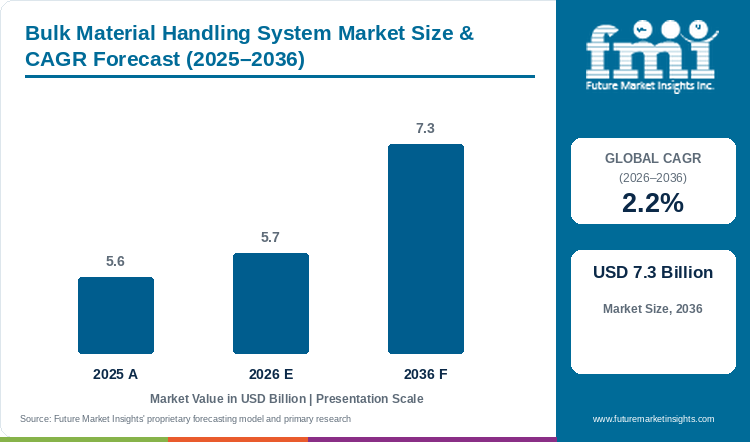
New processing capacity, changes to material routes and replacement of installed equipment create distinct sources of demand. The technical requirements vary with the material being moved: a June 2025 screw-conveyor study examines particle movement and geometry, while a pneumatic-screw experiment assesses moisture, feed and operating variables. [1][2] Research on dense-phase pneumatic conveying separately examines gas velocity and particle-slug behaviour in a defined arrangement. [3] Together, these studies show why conveying performance needs an application-specific assessment. USGS mineral-production statistics provide a wider demand setting for mining-related handling activity. [4]
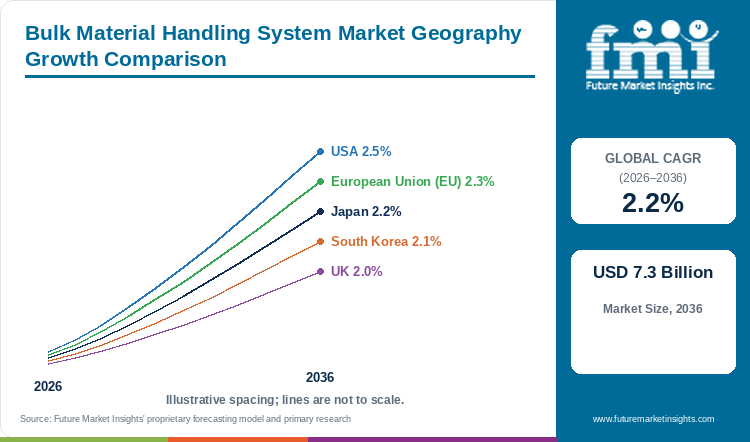
Across the profiled geographies, the USA leads with a published CAGR of 2.5% for 2026 to 2036, followed by the European Union regional aggregate at 2.3%. Japan is projected to grow at 2.2%, South Korea at 2.1% and the UK at 2.0% over the same period.
Metso, BEUMER Group, thyssenkrupp Industrial Solutions, FLSmidth and Sandvik are representative participants. Their coverage spans conveying, mineral processing and plant engineering, making the connection between individual machines and the wider material route central to competition. Differentiation rests on equipment suited to the feed conditions, well-designed transfers and controls, and installation and maintenance support. Packages that coordinate these functions give operators a clearer basis for assessing sustained throughput and planning later changes to the process.
Key Market Trends & Insights
- Conveyor selection increasingly depends on the material and operating conditions, rather than a nominal capacity figure alone. [1][2]
- Mechanical and pneumatic functions can be coupled within one handling arrangement, requiring a common operating specification. [2]
- Public mineral statistics provide a demand setting for mining equipment, while material throughput and equipment revenue remain different measures. [4]
Regional Highlights
- The USA has the highest selected published country rate, at 2.5% for 2026 to 2036; the EU regional aggregate follows at 2.3%.
- Japan, South Korea and the UK retain published rates of 2.2%, 2.1% and 2.0%, respectively, for the same period.
- The 2025 USGS Mineral Commodity Summaries provide commodity-specific US and world production context, rather than a count of bulk handling equipment orders. [4]
Market Size & Forecast
Table 1: Market Size and Forecast for Bulk Material Handling System Market (USD billion and percentage), 2025 to 2036
| Metric | Value |
|---|---|
| 2025 market estimate | USD 5.56 billion |
| Published 2026 market value | USD 5.7 billion |
| Published 2036 market forecast | USD 7.3 billion |
| CAGR 2026 to 2036 | 2.2% |
| Revenue increase between published endpoints | USD 1.6 billion |
The published revenue outlook adds USD 1.6 billion between 2026 and 2036. Equipment purchasing can involve a new process line, an additional transfer operation or the replacement of equipment in service. Those routes require different installation and support scopes. A supplier needs the intended material flow and operating constraints established before interpreting the revenue forecast as a product-specific opportunity.
The Material Handling Equipment Market provides wider related coverage of equipment used to move and position materials across customer processes.
Material behaviour can change the value of an otherwise capable conveyor
A conveyor with adequate nominal capacity can perform differently when the material moisture, particle behaviour or feed arrangement changes. The 2025 screw-conveyor study evaluates geometry through a particle-movement methodology, while the public-institute pneumatic-screw experiment relates productivity to several operating and material variables. [1][2] These are defined research settings, so the results need to be assessed against the proposed installation. For procurement, they establish useful questions about the test material, feed conditions and operating range behind a supplier's rating. The buyer also needs the transfer and discharge arrangements included in the comparison because a restriction elsewhere in the process can limit the value of added conveying capacity.
Table 2: Industry evidence relevant to the bulk material handling system market
| Indicator | Data point or observation | Market relevance | Source |
|---|---|---|---|
| Screw-conveyor geometry | A university study published on 20 June 2025 evaluates bulk transport using particle movement and conveying-power criteria. | Geometry and operating duty need to be assessed for the particular material. | [1] |
| Coupled pneumatic-screw operation | A 2025 public-institute study relates productivity to screw speed, hopper opening, material moisture and air pressure. | The feeder, screw and air arrangement belong within the same purchasing assessment. | [2] |
| Mining demand context | USGS published Mineral Commodity Summaries 2025 on 31 January 2025. | Commodity-specific production data provide context for material movement; they do not measure equipment demand directly. | [4] |
Analyst Perspective
“The most useful bulk handling proposal connects the material specification with the flow the complete site can sustain. Buyers need comparable feed conditions, transfer assumptions and maintenance access. A higher conveyor rating creates little value if the receiving operation, material condition or operating arrangement prevents the customer from using that capacity.”
- Nikhil Kaitwade, Future Market Insights
How is the Bulk Material Handling System Market segmented?
The market is segmented by Application, Equipment, and Region.
Application identifies the customer process, while equipment describes a particular material-moving function. The published benchmarks place mining at 38.0% of application demand and band conveyors at 36.0% of equipment demand in 2026. A plant can use several handling technologies within the same material route, so an equipment category also needs to be read within the wider process and installation boundary.
What supports mining in the published application benchmark?
Table 3: Application Share for Bulk Material Handling System Market (percentage share), 2026
| Application | Published share (2026) |
|---|---|
| Mining | 38.0% |
| Other applications | 62.0% |
| Total | 100.0% |
Table 4: Segment Position and Market Growth for Bulk Material Handling System Market, 2026 to 2036
| Metric | Value |
|---|---|
| Global CAGR (2026 to 2036) | 2.2% |
| Profiled application segment | Mining |
Mining represents 38.0% of the published 2026 application-chart benchmark. A mining customer needs material moved between extraction, processing, storage or dispatch operations, with equipment suited to its actual feed and operating schedule. The commercial assessment needs that material route established before individual conveyor or stockyard products are compared. USGS commodity statistics provide a wider demand setting, while equipment selection requires site-level information about the material and process. [4] Suppliers can improve the offer by explaining the assumed feed conditions, transfer responsibilities and maintenance access, together with how the proposed installation will be commissioned within the existing operation.
Mining represents 38.0% of the application benchmark in 2026.
- Mining accounts for 38.0% in the published 2026 chart; other applications together represent 62.0%.
- Material properties, transfer points and the operating schedule determine the appropriate handling scope.
Why do band conveyors lead the published equipment benchmark?
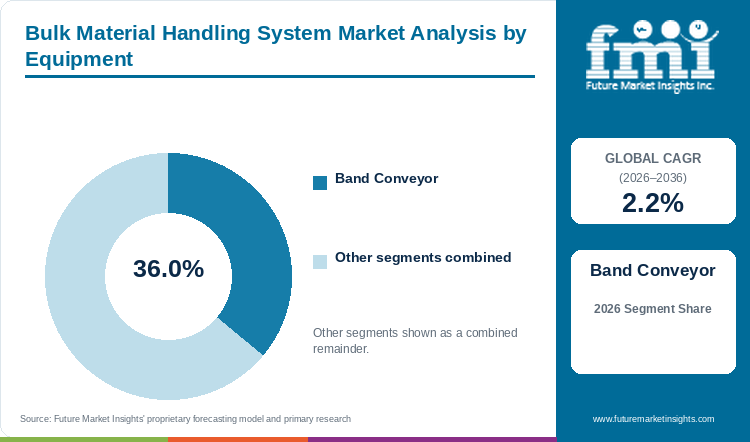
Table 5: Equipment Share for Bulk Material Handling System Market (percentage share), 2026
| Equipment | Published share (2026) |
|---|---|
| Band Conveyor | 36.0% |
| Other equipment types | 64.0% |
| Total | 100.0% |
Band conveyors represent 36.0% of the published 2026 equipment-chart benchmark. Their role needs to be assessed within the site's material flow rather than through belt capacity alone. The purchaser needs the intended material, loading arrangement, transfer points and discharge conditions defined before comparing equipment. Installation space and maintenance access can also change the preferred configuration. The material-specific design considerations illustrated by screw and pneumatic-conveying research reinforce the broader need to qualify each technology for its actual duty. [1][2] A supplier can make its band-conveyor offer more useful by defining the operating assumptions and the work required around the conveyor to deliver the customer's intended process flow.
Band conveyors represent 36.0% of the equipment benchmark in 2026.
- Band conveyors account for 36.0% in the published 2026 chart; other equipment types together represent 64.0%.
- The chart benchmark describes an equipment category; the actual product needs an application-specific installation assessment.
- The Bulk Terminals Market offers related coverage of the loading, storage and transfer setting in which bulk handling equipment operates.
What are the drivers, restraints, and opportunities in the Bulk Material Handling System Market?
Material movement and process changes support demand; feed behaviour and installation interfaces constrain performance; coordinated design and continuing operating support improve the purchasing case.
Driver
Mining, manufacturing and terminal operations need material moved between processes and storage or dispatch points. New capacity creates equipment requirements, while operating sites can generate demand for replacement, rerouting or additional handling capability. Commodity production provides one demand-side context, as shown in the USGS 2025 summaries. [4] The actual order still depends on a defined process need. Suppliers should establish whether the customer is increasing total site throughput or resolving a restriction at one operation. This changes the required equipment, controls and installation work. A useful proposal connects the product duty with the receiving and discharge conditions that determine whether the customer can use the additional capacity.
Restraint
Material behaviour and existing process interfaces can constrain an otherwise capable handling system. Moisture, feed conditions and the combined mechanical and pneumatic arrangement can affect productivity, as the 2025 public-institute experiment demonstrates within its laboratory scope. [2] The customer also needs maintenance, cleaning and access requirements included in the layout. A quotation that focuses only on a conveying unit may leave feeders, transfers or control work outside the contract. Those omissions can alter the installed cost and the operating result. Buyers need a common material and process specification across bids, together with clear responsibility for testing the complete arrangement under relevant conditions.
Opportunity
Suppliers can strengthen their position by making the operating boundary and material assumptions easier to assess. A complete offer identifies the test material, the expected feed range and the transfers or auxiliary systems included. Research on dense-phase conveying illustrates that changes to gas velocity can affect particle-slug behaviour in a defined arrangement. [3] Such evidence is useful when it informs an application-specific assessment, rather than a universal improvement claim. Continuing support offers another route where operating records help the customer diagnose a restriction or evaluate a change in material. The commercial value lies in keeping the required material flow available and making later modifications easier to plan.
The Conveyor System Market provides related coverage of conveying equipment, where the actual load and connected operations shape the installation.
Which country CAGRs are profiled in the Bulk Material Handling System Market?
Table 6: Country CAGR Comparison for Bulk Material Handling System Market (CAGR percentage), 2026 to 2036
| Country | CAGR |
|---|---|
| USA | 2.5% |
| European Union (EU) | 2.3% |
| Japan | 2.2% |
| South Korea | 2.1% |
| UK | 2.0% |
Country-wise Analysis
USA Bulk Material Handling System Market Outlook (2026 to 2036)
Commodity-specific production provides a useful demand setting for US bulk handling equipment. The USGS 2025 summaries cover US and world mineral activity, with measures that need to be kept distinct from equipment sales. [4] FMI's published USA equipment-market growth estimate is 2.5% for 2026 to 2036. A supplier assessing an opportunity needs the actual material route, process duty and procurement stage established. A new processing operation may need a coordinated package, while a retrofit can involve work around an existing feeder, conveyor or storage system. Buyers benefit from offers that identify the material assumptions, transfer responsibilities and installation window, allowing comparison of the complete operating improvement rather than the price of an isolated machine.
European Union (EU) Bulk Material Handling System Market Outlook (2026 to 2036)
A customer operating across several facilities still needs each handling system assessed against its material and process conditions. A common equipment description cannot settle differences in moisture, feed arrangement or the work performed around a transfer point. Suppliers can make the comparison more useful by explaining the operating range covered by their rating and identifying the equipment retained in a retrofit. The purchaser also needs the installation and maintenance responsibilities defined. This links the offer to a measurable site requirement rather than applying the regional revenue outlook to every existing product line.
Japan Bulk Material Handling System Market Outlook (2026 to 2036)
An industrial handling purchase in Japan needs the equipment duty connected to the site's process and available installation space. A machine with sufficient nominal capacity may still require changes to the feed or discharge arrangement before it can provide the intended improvement. FMI's published Japan growth estimate is 2.2% for 2026 to 2036. Buyers comparing a replacement with a wider system modification need the interfaces and retained equipment made explicit. Suppliers can support that assessment through a proposal that identifies the material assumptions, controls and service requirements. A clear commissioning plan then gives the customer a practical way to judge whether the complete installation can sustain the required flow.
South Korea Bulk Material Handling System Market Outlook (2026 to 2036)
Bulk handling equipment in South Korea needs to fit the operating sequence of the customer facility. A transfer restriction can arise from the material, the connected process or the available maintenance arrangement, so the required purchase is not always a larger conveying unit. FMI's published country growth estimate is 2.1% for 2026 to 2036. A purchaser needs the actual flow and load conditions established before comparing designs. Suppliers can make their offer easier to assess by identifying which feeders, transfers and controls are included and how the system will be verified with representative material. Continuing technical support also helps the owner evaluate later changes without losing the original operating assumptions behind the design.
UK Bulk Material Handling System Market Outlook (2026 to 2036)
A UK bulk handling retrofit begins with an operating site whose layout and work practices may already constrain the change. The customer needs to establish which component or process interface limits useful throughput before selecting replacement equipment. FMI's published UK growth estimate is 2.0% for 2026 to 2036. A supplier can improve the purchasing comparison by identifying retained equipment, required modifications and the installation work window. The offer should also explain the material and feed conditions covered by the rating. That allows the buyer to compare the complete handling arrangement and continuing support, including the work needed to keep the equipment accessible and maintainable after the project enters service.
Who are the notable companies in the Bulk Material Handling System Market?
Metso; BEUMER Group; thyssenkrupp Industrial Solutions; FLSmidth; Sandvik
The published market coverage identifies Metso, BEUMER Group, thyssenkrupp Industrial Solutions, FLSmidth and Sandvik among its representative participants. Buyers need the actual offered equipment and contracting entity established before comparing packages. A conveying unit, a stockyard system and a wider processing installation can involve different operating and delivery responsibilities. The table uses the coverage positions to frame those purchasing questions. Comparison focuses on the material duty, the equipment boundary and the work needed at the customer's site. A useful bid makes the performance assumptions and continuing support requirements visible alongside the initial price.
Competitive Benchmarking: Bulk Material Handling System Market
Table 7: Competitive positioning for the bulk material handling system market
| Company | Positioning | Buyer comparison focus |
|---|---|---|
| Metso | Mineral-processing and handling coverage | Match the offered handling package to the material and connected process. |
| BEUMER Group | Bulk handling and conveying coverage | Clarify conveying, transfer and control responsibilities within the bid. |
| thyssenkrupp Industrial Solutions | Bulk handling and plant-engineering coverage | Separate equipment, plant engineering and installation obligations. |
| FLSmidth | Mineral-processing and handling coverage | Define the proposed process boundary, operating duty and support scope. |
| Sandvik | Mining and material-processing coverage | Assess the actual offered equipment against the site material route. |
Key Developments in the Bulk Material Handling System Market
- University researchers published their screw-conveyor design methodology in June 2025. [1]
- A 2025 public-institute study examined productivity in a sectional pneumatic screw conveyor. [2]
- USGS published its 2025 Mineral Commodity Summaries in January 2025. [4]
Key Players in the Bulk Material Handling System Market
Mineral-processing and handling coverage
- Metso
- FLSmidth
Bulk handling and conveying coverage
- BEUMER Group
Bulk handling and plant-engineering coverage
- thyssenkrupp Industrial Solutions
Mining and material-processing coverage
- Sandvik
Bulk Material Handling System Market Report Scope
Table 8: Report Scope for Bulk Material Handling System Market, 2026 to 2036
| Coverage field | Report scope |
|---|---|
| Market definition | Bulk material handling systems and equipment used across mining, manufacturing, construction and terminal operations. |
| Units | USD billion; percentage |
| Published forecast endpoints | USD 5.7 billion in 2026 and USD 7.3 billion in 2036. |
| Growth representations | Publisher-stated CAGR of 2.2% for 2026 to 2036. |
| 2025 reference | Estimated market value for 2025. |
| Chart benchmarks | Mining 38.0%; band conveyors 36.0%; reference year 2026. |
| Geographic profiles | USA; EU regional aggregate; Japan; South Korea; UK, using published 2026 to 2036 rates. |
Bulk Material Handling System Market Research Methodology
Table 9: Research Methodology for Bulk Material Handling System Market, 2026 edition
| Method | Approach |
|---|---|
| Revenue outlook | Retain the two published 2026 and 2036 endpoints. |
| Growth comparison | Use the publisher-stated CAGR of 2.2% for 2026 to 2036. |
| Reference value | Use an estimated 2025 market value of USD 5.56 billion. |
| Share benchmarks | Use the published mining and band-conveyor shares in 2026. |
| Country profiles | Retain published 2026 to 2036 rates; EU is a regional aggregate. |
| Operating evidence | Research describes particular material and equipment configurations; USGS supplies commodity demand context. |
Bulk Material Handling System Market by Segments
Bulk Material Handling System Market segmented by Application:
- Mining
- Packaging
- Construction
- Manufacturing
- Sea Ports & Cargo Terminals
Bulk Material Handling System Market segmented by Equipment:
- Stacker
- Stacker cum Reclaimer
- Band Conveyor
- Bucket Wheel Excavator
- Stripping Shovel
- Rope Shovel
- Bucket Elevator
- Ship Loader and Unloader
Bulk Material Handling System Market by Region
- North America
- United States
- Canada
- Mexico
- Latin America
- Brazil
- Argentina
- Western Europe
- Germany
- Italy
- France
- United Kingdom
- Spain
- BENELUX
- Nordic countries
- Eastern Europe
- Poland
- Hungary
- Romania
- Czech Republic
- East Asia
- China
- Japan
- South Korea
- South Asia and Pacific
- India
- ASEAN
- Australia
- New Zealand
- Middle East and Africa
- Saudi Arabia
- United Arab Emirates
- Turkiye
- Israel
Research Sources and Bibliography
- [1] Don State Technical University researchers / Engineering Technologies and Systems. 20 June 2025. Simulation and Research Methodology for the Process of Conveying Bulk Materials by Screw Conveyors
- [2] National Institute of Research–Development for Machines and Installations Designed for Agriculture and Food Industry, with collaborating universities. 2025. Experimental Investigation of a Sectional Pneumatic Screw Conveyor for Bulk Material Transport in the Food Industry
- [3] American Chemical Society / university research authors. 2025; volume 64, issue 3. Insight into the Mesoscale Slug Characteristics in the Dense Horizontal Pneumatic Conveying Process
- [4] US Geological Survey. 31 January 2025. Mineral Commodity Summaries 2025
This Report Answers
- How big is the market in 2026?
- What is the 2036 market forecast?
- What growth rates are shown?
- Which application leads the published chart?
- Which equipment leads the published chart?
- Which selected country has the highest published rate?
Frequently Asked Questions
What is the estimated market size in 2026?
FMI publishes a 2026 market value of USD 5.7 billion.
What is the 2036 market forecast?
FMI publishes USD 7.3 billion for 2036.
What growth rates are shown?
FMI states a CAGR of 2.2% for 2026 to 2036.
Which application leads the published chart?
Mining represents 38.0% of the application benchmark in 2026.
Which equipment leads the published chart?
Band conveyors represent 36.0% of the equipment benchmark in 2026.
Which selected country has the highest published rate?
The USA has the highest selected country rate, at 2.5% for 2026 to 2036.
Preview the report firsthand - request a free sample
Get SampleGet the brochure for pricing and purchase details.
Get PDFTable of Content
- Key Takeaways
- Market Size and CAGR
- Top Growth Driver
- Fastest Growing Segment
- Leading Region
- Key Companies
- Emerging Opportunities
- Executive Summary
- Global Market Outlook
- Demand-side Trends
- Supply-side Trends
- Technology Roadmap Analysis
- Analysis and Recommendations
- Analyst Perspective (What is happening? Why now? What should investors know?)
- Key Questions Answered
- How large is the market?
- What is the CAGR?
- What are key trends?
- Which region dominates?
- Who are the leaders?
- Market Overview
- Market Coverage / Taxonomy
- Market Definition / Scope / Limitations
- Research Methodology
- Chapter Orientation
- Analytical Lens and Working Hypotheses
- Market Structure, Signals, and Trend Drivers
- Benchmarking and Cross-market Comparability
- Market Sizing, Forecasting, and Opportunity Mapping
- Research Design and Evidence Framework
- Desk Research Programme (Secondary Evidence)
- Expert Input and Fieldwork (Primary Evidence)
- Tooling, Models, and Reference Databases
- Data Engineering and Model Build
- Quality Assurance and Audit Trail
- Market Background
- Market Dynamics (Drivers, Restraints, Opportunity, Trends)
- Scenario Forecast (Optimistic, Likely, Conservative)
- Impact Analysis
- AI Impact
- Sustainability Impact
- Regulatory Impact
- Technology Impact
- Consumer / Buyer Analysis
- Purchase Drivers
- Adoption Barriers
- Buyer Journey
- Opportunity Map Analysis
- Product Life Cycle Analysis
- Supply Chain Analysis
- Investment Feasibility Matrix
- Value Chain Analysis
- PESTLE and Porter's Analysis
- Regulatory Landscape
- Regional Parent Market Outlook
- Production and Consumption Statistics
- Import and Export Statistics
- Global Market Analysis and Forecast, 2021 to 2036
- Historical Market Size Value (USD Billion) Analysis, 2021 to 2025
- Current and Future Market Size Value (USD Billion) Projections, 2026 to 2036
- Y-o-Y Growth Trend Analysis
- Absolute $ Opportunity Analysis
- Global Market Pricing Analysis, 2021 to 2036
- Global Market Analysis and Forecast, By Application, 2021 to 2036
- Introduction / Key Findings
- Historical Market Size Value (USD Billion) Analysis By Application, 2021 to 2025
- Current and Future Market Size Value (USD Billion) Analysis and Forecast By Application, 2026 to 2036
- Mining
- Packaging
- Construction
- Manufacturing
- Sea Ports & Cargo Terminals
- Y-o-Y Growth Trend Analysis By Application, 2021 to 2025
- Absolute $ Opportunity Analysis By Application, 2026 to 2036
- Global Market Analysis and Forecast, By Equipment, 2021 to 2036
- Introduction / Key Findings
- Historical Market Size Value (USD Billion) Analysis By Equipment, 2021 to 2025
- Current and Future Market Size Value (USD Billion) Analysis and Forecast By Equipment, 2026 to 2036
- Stacker
- Stacker cum Reclaimer
- Band Conveyor
- Bucket Wheel Excavator
- Stripping Shovel
- Rope Shovel
- Bucket Elevator
- Ship Loader and Unloader
- Y-o-Y Growth Trend Analysis By Equipment, 2021 to 2025
- Absolute $ Opportunity Analysis By Equipment, 2026 to 2036
- Global Market Analysis and Forecast, By Region, 2021 to 2036
- Introduction
- Historical Market Size Value (USD Billion) Analysis By Region, 2021 to 2025
- Current Market Size Value (USD Billion) Analysis and Forecast By Region, 2026 to 2036
- North America
- Latin America
- Western Europe
- Eastern Europe
- East Asia
- South Asia and Pacific
- Middle East and Africa
- Market Attractiveness Analysis By Region
- North America Market Analysis and Forecast, By Country, 2021 to 2036
- Historical Market Size Value (USD Billion) Trend Analysis By Market Taxonomy, 2021 to 2025
- Market Size Value (USD Billion) Forecast By Market Taxonomy, 2026 to 2036
- By Country
- United States
- Canada
- Mexico
- By Application
- By Equipment
- By Country
- Market Attractiveness Analysis
- By Country
- By Application
- By Equipment
- Key Takeaways
- Latin America Market Analysis and Forecast, By Country
- Historical Market Size Value (USD Billion) Trend Analysis By Market Taxonomy, 2021 to 2025
- Market Size Value (USD Billion) Forecast By Market Taxonomy, 2026 to 2036
- By Country
- Brazil
- Argentina
- By Application
- By Equipment
- By Country
- Market Attractiveness Analysis
- By Country
- By Application
- By Equipment
- Key Takeaways
- Western Europe Market Analysis and Forecast, By Country
- Historical Market Size Value (USD Billion) Trend Analysis By Market Taxonomy, 2021 to 2025
- Market Size Value (USD Billion) Forecast By Market Taxonomy, 2026 to 2036
- By Country
- Germany
- Italy
- France
- United Kingdom
- Spain
- BENELUX
- Nordic countries
- By Application
- By Equipment
- By Country
- Market Attractiveness Analysis
- By Country
- By Application
- By Equipment
- Key Takeaways
- Eastern Europe Market Analysis and Forecast, By Country
- Historical Market Size Value (USD Billion) Trend Analysis By Market Taxonomy, 2021 to 2025
- Market Size Value (USD Billion) Forecast By Market Taxonomy, 2026 to 2036
- By Country
- Poland
- Hungary
- Romania
- Czech Republic
- By Application
- By Equipment
- By Country
- Market Attractiveness Analysis
- By Country
- By Application
- By Equipment
- Key Takeaways
- East Asia Market Analysis and Forecast, By Country
- Historical Market Size Value (USD Billion) Trend Analysis By Market Taxonomy, 2021 to 2025
- Market Size Value (USD Billion) Forecast By Market Taxonomy, 2026 to 2036
- By Country
- China
- Japan
- South Korea
- By Application
- By Equipment
- By Country
- Market Attractiveness Analysis
- By Country
- By Application
- By Equipment
- Key Takeaways
- South Asia and Pacific Market Analysis and Forecast, By Country
- Historical Market Size Value (USD Billion) Trend Analysis By Market Taxonomy, 2021 to 2025
- Market Size Value (USD Billion) Forecast By Market Taxonomy, 2026 to 2036
- By Country
- India
- ASEAN
- Australia
- New Zealand
- By Application
- By Equipment
- By Country
- Market Attractiveness Analysis
- By Country
- By Application
- By Equipment
- Key Takeaways
- Middle East and Africa Market Analysis and Forecast, By Country
- Historical Market Size Value (USD Billion) Trend Analysis By Market Taxonomy, 2021 to 2025
- Market Size Value (USD Billion) Forecast By Market Taxonomy, 2026 to 2036
- By Country
- Saudi Arabia
- United Arab Emirates
- Turkiye
- Israel
- By Application
- By Equipment
- By Country
- Market Attractiveness Analysis
- By Country
- By Application
- By Equipment
- Key Takeaways
- Key Countries Market Analysis
- United States
- Pricing Analysis
- Market Share Analysis, 2025
- By Application
- By Equipment
- Canada
- Pricing Analysis
- Market Share Analysis, 2025
- By Application
- By Equipment
- Mexico
- Pricing Analysis
- Market Share Analysis, 2025
- By Application
- By Equipment
- Brazil
- Pricing Analysis
- Market Share Analysis, 2025
- By Application
- By Equipment
- Germany
- Pricing Analysis
- Market Share Analysis, 2025
- By Application
- By Equipment
- United Kingdom
- Pricing Analysis
- Market Share Analysis, 2025
- By Application
- By Equipment
- Italy
- Pricing Analysis
- Market Share Analysis, 2025
- By Application
- By Equipment
- Spain
- Pricing Analysis
- Market Share Analysis, 2025
- By Application
- By Equipment
- France
- Pricing Analysis
- Market Share Analysis, 2025
- By Application
- By Equipment
- India
- Pricing Analysis
- Market Share Analysis, 2025
- By Application
- By Equipment
- ASEAN
- Pricing Analysis
- Market Share Analysis, 2025
- By Application
- By Equipment
- China
- Pricing Analysis
- Market Share Analysis, 2025
- By Application
- By Equipment
- Japan
- Pricing Analysis
- Market Share Analysis, 2025
- By Application
- By Equipment
- South Korea
- Pricing Analysis
- Market Share Analysis, 2025
- By Application
- By Equipment
- Poland
- Pricing Analysis
- Market Share Analysis, 2025
- By Application
- By Equipment
- Hungary
- Pricing Analysis
- Market Share Analysis, 2025
- By Application
- By Equipment
- European Union (EU)
- Pricing Analysis
- Market Share Analysis, 2025
- By Application
- By Equipment
- United States
- Market Structure Analysis
- Competition Dashboard
- Competition Benchmarking
- Market Share Analysis of Top Players
- By Regional
- By Application
- By Equipment
- Emerging Startups
- Innovation Benchmarking
- Competition Analysis
- Competition Deep Dive
- Metso
- Overview
- Product Portfolio
- Profitability by Market Segments
- Sales Footprint
- Strategy Overview
- Marketing Strategy
- Product Strategy
- Channel Strategy
- BEUMER Group
- thyssenkrupp Industrial Solutions
- FLSmidth
- Sandvik
- Metso
- Case Studies
- Success Stories
- Recent Developments
- Competition Deep Dive
- Assumptions & Acronyms Used


