

- Industry Size (2026)
- USD 150.7 Mn
- Forecast (2036)
- USD 227.4 Mn
- CAGR (2026 to 2036)
- 4.2%
Acrylic Paint Market Size, Market Forecast and Outlook By FMI
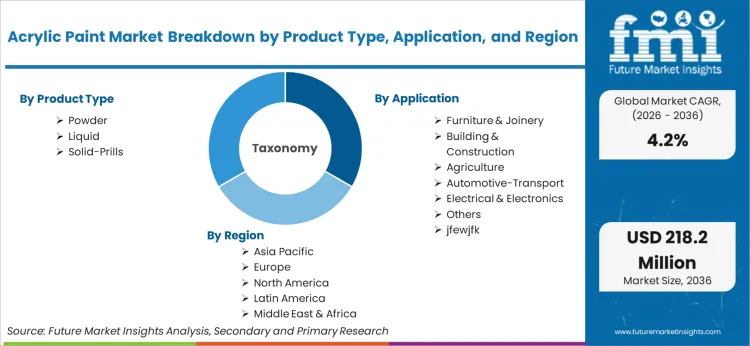
In 2025, the acrylic paint market was valued at USD 144.6 million. Based on Future Market Insights' analysis, demand for acrylic paints is estimated to reach USD 150.7 million in 2026 and USD 218.2 million by 2035, before rising further to approximately USD 227.4 million by 2036. This trajectory reflects a CAGR of 4.2% during the forecast period.
Absolute dollar growth of more than USD 76 million between 2026 and 2036 signals a market expanding at a steady pace, underpinned by sustained demand from the building and construction sector, which remains the largest consumer of acrylic paints. This value uplift also reflects a structural mix shift toward premium product categories, particularly heavy body acrylics favored by professional artists and high-end decorative applications, alongside specialized formulations for industrial and textile uses.
Summary of Acrylic Paint Market
- Demand Drivers in the Market
- Expansion of global construction and infrastructure spending, particularly in residential and commercial sectors, where acrylic paints are specified for both interior and exterior finishes due to their durability, ease of application, and aesthetic versatility.
- Growing consumer participation in DIY activities and home improvement projects, which drives retail sales of acrylic paints in user-friendly formats and smaller packaging.
- Increasing professional and amateur engagement in visual arts, spurring demand for high-quality acrylics with superior pigment load, texture, and color range.
- Key Segments Analyzed in the FMI Report
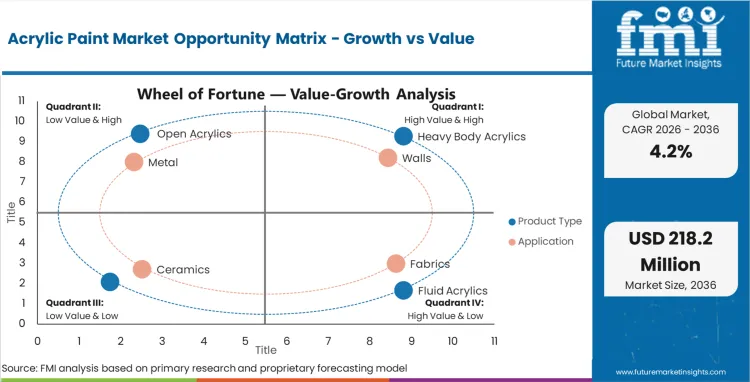
- Product Type: Heavy Body Acrylics, which account for 54.2% of market value in 2025 due to their dominance in professional art and high-end decorative applications, and Fluid Acrylics, Open Acrylics, and other specialty types that serve diverse techniques and use cases.
- Application: Walls, which hold 40.0% of global market value in 2025 and represent the largest end-use channel for acrylic paints, driven by construction and renovation activity.
- Industry Vertical: Building & Construction, which captures 47.4% of market value in 2025, making it the primary consumer of acrylic paints, followed by industrial, textile, and automotive sectors.
- Analyst Opinion at FMI
- Nikhil Kaitwade, principal consultant for Chemicals & Materials at Future Market Insights states, "In the updated Acrylic Paint Market Report, CXOs will see how product differentiation moves beyond basic color and coverage toward specialized performance attributes, texture, lightfastness, and formulation integrity for specific substrates. My assessment is that the most resilient growth will accrue to manufacturers that combine premium product portfolios with strong distribution networks in high-growth construction markets and authentic engagement with the professional arts community."
- Strategic Implications/Executive Takeaways
- Prioritize product development in the heavy body acrylics segment, where higher price points and brand loyalty among professional artists and serious hobbyists generate above-average margins and stable demand.
- Align go-to-market strategies with the building and construction vertical by developing formulations that meet regional regulatory standards (e.g., low-VOC) and offer proven durability for exterior applications, a key selling point in infrastructure and housing projects.
- Build and publicize project references in the commercial real estate and institutional building sectors, where specification by architects and interior designers can drive significant volume and reinforce brand prestige.
- Methodology
- The market view is grounded in primary input from construction end users, paint retailers, and coatings industry participants, and in technical and policy sources focused on construction materials and chemical formulations, avoiding reliance on secondary market research reports from competing providers.
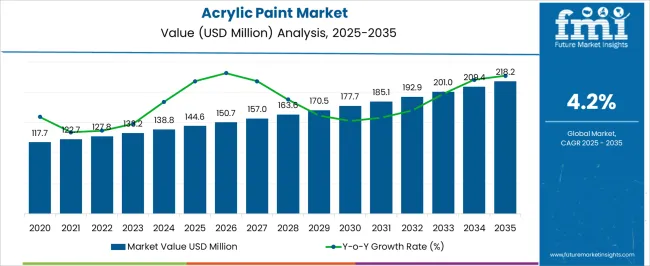
North America, Europe, and Asia-Pacific account for the bulk of incremental revenues through 2036, but the underlying demand logic is distinct in each region. In North America, a strong culture of DIY home improvement, a large base of professional artists, and robust demand from the commercial construction sector underpin a stable replacement and upgrade cycle.
In Europe, renovation activities and stringent regulations on VOCs drive demand for compliant, high-performance water-based acrylics. Across Asia-Pacific, rapid urbanization, expanding middle-class populations, and significant government investment in infrastructure projects position acrylic paints as a standard finish in new builds, creating a structurally higher growth profile than in mature markets.
Acrylic Paint Market Definition
Acrylic paints are water-based, fast-drying coatings made of pigment suspended in an acrylic polymer emulsion. For this report, the market covers liquid acrylic coatings sold for applications including interior and exterior walls, fabrics, metal surfaces, ceramics, and other substrates in residential, commercial, artistic, and industrial settings, where their properties, durability, such as color retention, resistance to cracking and moisture, and low odor, deliver quantifiable aesthetic and protective benefits.
Acrylic Paint Market Inclusions
The report provides a comprehensive analysis of the acrylic paint market, covering global and regional market sizes in value terms and a 10-year forecast from 2026 to 2036. It includes segmental breakdowns by product type, application, and industry vertical, across core regions including North America, Latin America, Western Europe, Eastern Europe, East Asia, South Asia & Pacific, and the Middle East & Africa.
Acrylic Paint Market Exclusions
The scope excludes oil-based and solvent-borne paints not classified as acrylic-based emulsions, as their chemical composition, performance profiles, and regulatory landscapes differ materially. It also omits raw materials such as acrylic polymers and pigments sold in isolation, as well as industrial coatings applied via non-liquid methods such as powder coatings. Very low-volume, custom-formulated paints for niche, experimental, or conservation-restoration projects that do not contribute meaningfully to global revenue pools are likewise outside the quantified scope.
Acrylic Paint Market Research Methodology
- Primary research: Structured interviews were conducted with specifiers, including architects and interior designers, procurement managers in construction firms, and retail buyers in hardware and art supply chains, alongside discussions with paint manufacturers and raw material suppliers on formulation trends, pricing dynamics, and distribution strategies across key regions.
- Desk research: Technical documentation and application guides from major acrylic paint manufacturers, together with industry publications on coatings technology and architectural finishes, were assessed to benchmark performance, formulation trends, and to align market modeling with the latest data on construction activity and consumer preferences.
- Market-sizing and forecasting: A hybrid top-down and bottom-up modeling framework was applied, reconstructing acrylic paint demand from construction spending data, residential and commercial renovation rates, and per-capita consumption patterns, then validating outputs against publicly available commentary from leading manufacturers on sales trends and regional market dynamics.
- Data validation and update cycle: Model outputs undergo consistency checks across regions, product types, and industry verticals, with iterative calibration using new regulatory guidance, manufacturer portfolio updates, and emerging data on construction and infrastructure spending to ensure that the forecast reflects the latest structural drivers.
Segmental Analysis
Acrylic Paint Market Analysis by Product Type
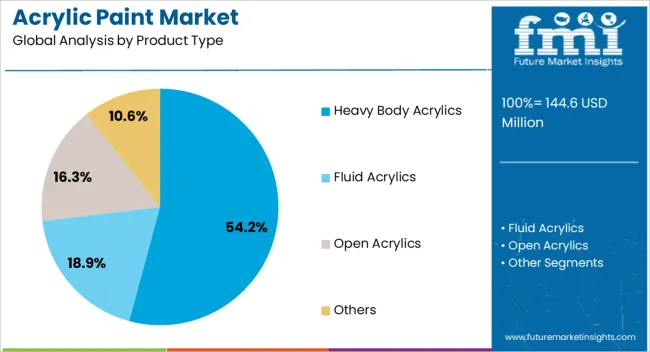
Based on FMI's acrylic paint market assessment, Heavy Body Acrylics constitute 54.2% of global market value in 2025, underscoring their position as the premium choice for professional artists and serious hobbyists. Their high viscosity and pigment concentration enable impasto techniques and textured finishes that are difficult to achieve with fluid formulations.
This leadership is expected to persist through 2036 as art education programs expand globally and consumer interest in original, handcrafted décor supports demand for materials that enable textural and layered effects. Leading manufacturers continue to innovate in this space, introducing new colors and improved lightfastness to retain professional users.
Acrylic Paint Market Analysis by Application
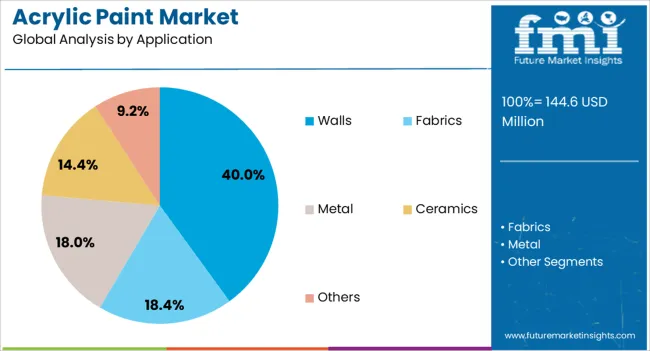
Within application, Walls capture 40.0% of global market value in 2025, establishing it as the dominant end-use channel for acrylic paints. This reflects the sheer volume of interior and exterior wall space in residential, commercial, and institutional buildings that requires coating, both in new construction and renovation projects.
The dominance of this application is linked to urbanization trends, rising real estate development, and consumer preference for acrylics' low odor, quick drying time, and resistance to fading and moisture compared to traditional alkyd paints. These performance attributes make acrylics the default specification for wall finishes in many markets.
Acrylic Paint Market Analysis by Industry Vertical
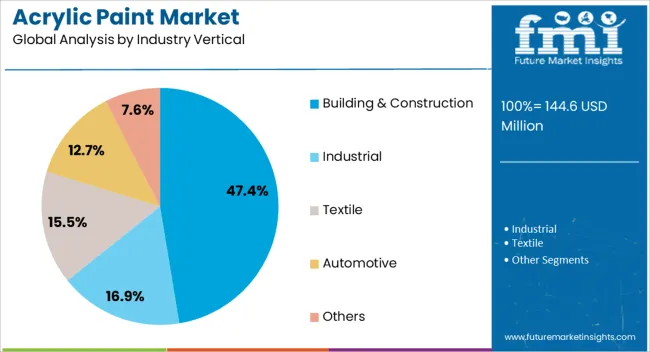
The Building & Construction industry vertical accounts for 47.4% of global market value in 2025. This dominant share is a direct consequence of acrylic paints being the coating of choice for a vast array of construction-related surfaces: interior drywall, exterior facades, ceilings, trim, and decorative elements.
This vertical's leadership reflects both new construction activity in rapidly urbanizing regions and a robust renovation market in mature economies. The segment's growth is further reinforced by the development of specialized acrylic formulations-such as elastomeric coatings for exterior masonry-that offer superior weather resistance and crack-bridging properties, making them essential for modern building envelopes.
Acrylic Paint Market Drivers, Restraints, Opportunities and Trends
Drivers
Global construction and infrastructure spending
Expansion of construction activity, particularly in residential housing and commercial real estate, is a primary structural driver for acrylic paint demand. Acrylics are specified extensively for walls and other architectural surfaces in new builds. Infrastructure projects, including schools, hospitals, and public transport hubs, also generate significant coating demand, with acrylics selected for their durability, ease of maintenance, and compliance with indoor air quality standards [1].
Growth of the professional and amateur art sectors
The visual arts sector represents a stable and growing consumer base for acrylic paints. Art education at school and university levels, the proliferation of recreational painting classes for adults, and the rise of online platforms where artists share techniques and sell works have all expanded the community of paint users. This segment preferentially consumes premium products like heavy body acrylics, supporting higher value growth [2].
DIY and home improvement culture
Increased consumer engagement in home decoration and improvement projects, amplified by social media platforms showcasing renovation ideas, drives retail sales of acrylic paints. DIY users favor acrylics for their ease of use, water cleanup, and low odor, which are particularly valued in interior spaces. Smaller packaging and user-friendly marketing by manufacturers have effectively targeted this growing consumer segment [3].
Restraints
Volatility in raw material prices
Acrylic paints are formulated using petrochemical-derived polymers and specialty pigments, making production costs sensitive to fluctuations in crude oil and mineral prices. Sustained increases or high volatility in raw material costs can compress manufacturer margins and lead to price increases that temper demand in price-sensitive segments, particularly in developing markets [4].
Regulatory compliance costs
Manufacturers face a complex and evolving landscape of environmental regulations, particularly in Europe and North America, concerning VOC content, chemical labeling, and waste disposal. Compliance requires ongoing investment in reformulation and testing, which can be disproportionately burdensome for smaller players and may limit product portfolios in some markets [5].
Opportunities
Premiumization and product differentiation
Opportunity exists to capture higher value through premium product lines that offer enhanced performance: improved lightfastness for artists' materials, superior weatherability for exterior paints, or specialized textures and finishes for decorative applications. Brands that successfully establish a reputation for quality in these niches can command price premiums and build customer loyalty.
Expansion in emerging construction markets
Rapid urbanization and government-led infrastructure development in countries across Asia and Africa present significant volume growth opportunities. Manufacturers that establish strong distribution networks, offer products suited to local climatic conditions, and navigate regulatory frameworks effectively can secure substantial market share as these regions' construction sectors expand [6].
Regional Analysis
.webp "Top Country Growth Comparison Acrylic Paint Market Cagr (2026 2036)")
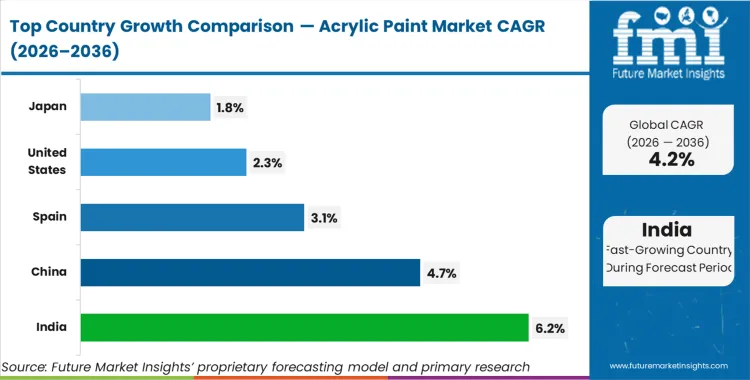
| Countries | Value CAGR (2026 to 2036) |
|---|---|
| India | 6.2% |
| China | 4.7% |
| Spain | 3.1% |
| United States | 2.3% |
| Japan | 1.8% |
Source: Future Market Insights analysis, supported by a proprietary forecasting model and primary research
India
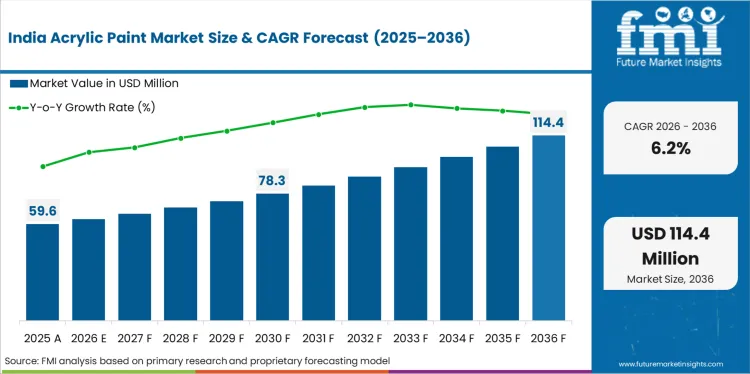
India's acrylic paint market is projected to expand at a 6.2% CAGR from 2026 to 2036, the highest among key countries, underpinned by rapid urbanization, a booming real estate sector, and a growing culture of DIY and home upcycling projects. The government's focus on affordable housing and infrastructure development generates sustained demand from the building and construction vertical, while rising disposable incomes enable consumers to invest in home aesthetics and personal creative pursuits [7].
China
China's acrylic paint market is expected to grow at a 4.7% CAGR over 2025-2035. The country's continued urbanization and massive investment in residential and commercial construction are the primary demand drivers. As living standards rise, consumer preference for higher-quality interior finishes supports the uptake of acrylic paints over traditional alternatives. The market also benefits from a large and active artistic community, particularly in major cities [8].
Spain
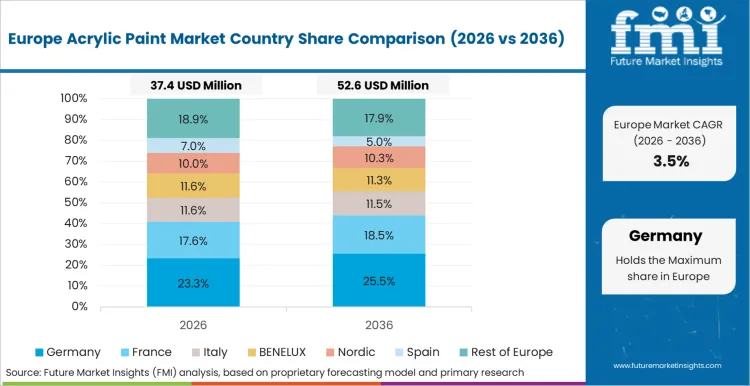
Spain's acrylic paint market is forecast to expand at a 3.1% CAGR from 2026 to 2036. The integration of art education into the school curriculum creates sustained demand from the educational and hobbyist segments. Furthermore, a strong cultural emphasis on arts and crafts among adults supports retail sales. Renovation activity in the housing stock, particularly in urban centers, also contributes to demand from the walls application segment [9].
United States
The United States acrylic paint market is projected to grow at a 2.3% CAGR between 2026 and 2036. A large and stable base of professional artists and a robust culture of recreational painting and DIY home improvement drive growth. The commercial construction and renovation sector provides consistent demand for architectural paints. The market's maturity results in a moderate growth rate compared to developing economies, but it remains the largest value market in North America [10].
Japan
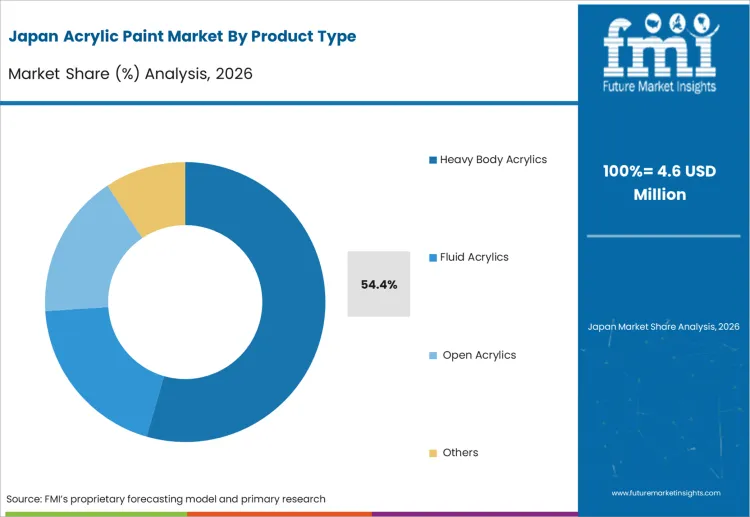
Japan's acrylic paint market is forecast to grow at a 1.8% CAGR from 2026 to 2036, the most moderate among key countries. Consumer preference for non-toxic, low-VOC products is well-established and drives demand for compliant acrylic formulations. The market is mature, with growth linked primarily to renovation activity rather than new construction, and to the stable but not rapidly expanding hobby and arts sector.
Competitive Aligners for Market Players
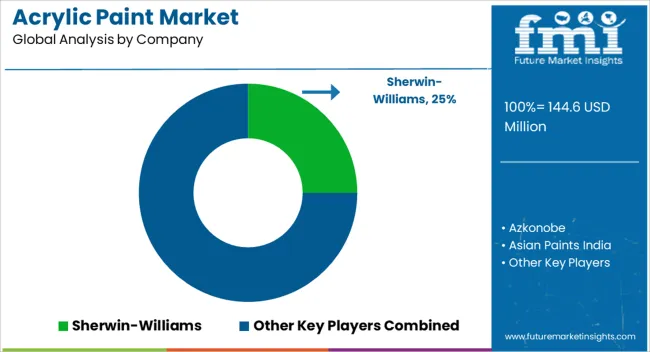
The acrylic paint market features a mix of global diversified chemical and coatings conglomerates and specialized regional players. Competitive positioning increasingly hinges on portfolio strength across both high-volume architectural segments and premium art materials. Manufacturers compete on product quality, color range, brand reputation, distribution reach, and formulation compliance with environmental standards.
Leading players such as Sherwin-Williams, AkzoNobel, Asian Paints, BASF, and PPG Industries leverage their extensive distribution networks and broad product portfolios to serve the building and construction vertical. Their scale allows them to invest in R&D for performance-enhanced formulations and to navigate complex regulatory requirements across multiple regions. In the art materials niche, brands under these conglomerates, alongside specialists, compete on pigment quality, consistency, and innovation in texture and finish.
From a strategic perspective, differentiation is moving beyond basic performance toward demonstrable capability in three areas. These include formulation expertise for specific substrates and environmental conditions (e.g., exterior durability, low-VOC compliance); strength in digital and retail channels to reach the growing DIY and hobbyist consumer base; and the ability to supply and support large-scale construction projects with consistent quality and technical service.
Key Developments
- Sherwin-Williams has continued to expand its presence in the architectural coatings market through its extensive network of company-operated stores and strategic acquisitions, strengthening its ability to serve both professional contractors and DIY consumers with a wide range of acrylic-based paints.
- Asian Paints has focused on innovation in the home décor space in India, launching new acrylic paint products with enhanced features such as anti-bacterial properties and specialized textures, targeting the premium interior decoration segment as part of its "Beautiful Homes" service.
- BASF has directed its coatings division's R&D toward sustainability, developing new binder technologies that allow for high-performance acrylic paints with reduced VOC content, aligning with tightening global regulations and corporate sustainability commitments from construction clients.
Key Players Profiled
- Sherwin-Williams
- Akzo Nobel
- Asian Paints India
- BASF SE
- Berger Paints India
- Berkshire Hathaway
- PPG Industries
- The Dow Chemical
- National Coatings
- Gellner Industrial
Scope of the Report
| Metric | Value |
|---|---|
| Quantitative Units | USD 150.7 million (2026) to approximately USD 227.4 million (2036), at a CAGR of 4.2%, with 2025 historic value of USD 144.6 million |
| Market Definition | The acrylic paint market comprises water-based coatings where pigment is suspended in an acrylic polymer emulsion, sold for application on walls, fabrics, metal, ceramics, and other surfaces in residential, commercial, artistic, and industrial settings. |
| Product Type Segmentation | Heavy Body Acrylics; Fluid Acrylics; Open Acrylics; Others, with Heavy Body Acrylics accounting for 54.2% of market value in 2025 and expected to remain the leading product type. |
| Application Coverage | Walls; Fabrics; Metal; Ceramics; Others |
| Industry Vertical Coverage | Building & Construction; Industrial; Textile; Automotive; Others, with Building & Construction holding 47.4% share in 2025. |
| Regions Covered | North America, Latin America, Western Europe, Eastern Europe, East Asia, South Asia & Pacific, Middle East & Africa |
| Countries Covered | United States, Japan, Spain, China, India |
| Key Companies Profiled | Sherwin-Williams; Akzonobel; Asian Paints India; BASF SE; Berger Paints India; Berkshire Hathaway; PPG Industries; The Dow Chemical; National Coatings; Gellner Industrial |
| Forecast Period | 2026 to 2036 |
| Approach | Hybrid top-down and bottom-up market modeling validated through primary interviews with construction specifiers, paint retailers, and coatings industry participants, supported by benchmarking against construction spending data, regulatory documents, and manufacturer technical publications on coating formulations. |
Acrylic Paint Market Analysis by Segments
Product Type:
- Heavy Body Acrylics
- Fluid Acrylics
- Open Acrylics
- Others
Application:
- Walls
- Fabrics
- Metal
- Ceramics
- Others
Industry Vertical:
- Building & Construction
- Industrial
- Textile
- Automotive
- Others
Region:
- North America
- Latin America
- Western Europe
- Eastern Europe
- East Asia
- South Asia & Pacific
- Middle East & Africa
Bibliography
- Organisation for Economic Co-operation and Development (OECD). (2024). Global Construction 2040: Outlook for construction and infrastructure spending. OECD Publishing.
- UNESCO Institute for Statistics. (2023). Participation in arts and cultural education: Global data on school curricula and enrollment. UNESCO.
- Home Improvement Research Institute (HIRI). (2025). DIY consumer trends and market forecast, 2025-2030. HIRI Industry Reports.
- USA Geological Survey (USGS). (2024). Mineral commodity summaries: Titanium dioxide and titanium pigments. USGS Publications Warehouse.
- European Chemicals Agency (ECHA). (2024). Understanding REACH: Restriction of hazardous substances in paints and coatings. ECHA Guidance Documents.
- United Nations Human Settlements Programme (UN-Habitat). (2025). World Cities Report 2025: Urbanization and infrastructure development. UN-Habitat.
- Government of India, Ministry of Statistics and Programme Implementation. (2025). Annual survey of industries: Chemicals and chemical products. MOSPI.
- National Bureau of Statistics of China. (2025). China statistical yearbook on construction and real estate. China Statistics Press.
- Ministerio de Educación y Formación Profesional, Spain. (2024). Estadísticas de la educación: Enseñanzas de régimen general y artes plásticas y diseño. Gobierno de España.
- USA Census Bureau. (2025). Characteristics of new housing: Interior finishes and materials. USA Department of Commerce.
This Report Addresses
- How fast the global acrylic paint market is growing between 2026 and 2036 in value terms, and which structural factors underpin the 4.2% CAGR?
- Why Heavy Body Acrylics, with a 54.2% share in 2025, lead the product type segmentation and how their role differs from Fluid and Open Acrylics.
- How Walls, as the dominant application with 40.0% share, and the Building & Construction vertical, with 47.4% share, anchor market demand and what this implies for product and channel strategies.
- Which regulatory instruments, such as REACH in Europe and national VOC limits, concretely influence product formulation and specification patterns in key regions.
- How leading countries such as India (6.2% CAGR), China (4.7%), Spain (3.1%), the United States (2.3%), and Japan (1.8%) contribute to global growth and what documented initiatives shape their demand outlook?
- How manufacturer strategies around premiumization, distribution, and formulation compliance are redefining competitive dynamics and value pools in the acrylic paint market.
- What risks and constraints, including raw material price volatility and regulatory compliance costs, may limit market growth and how stakeholders are addressing them?
Frequently Asked Questions
What is the size of the global acrylic paint market in 2025 and how fast is it expected to grow through 2036?
The global acrylic paint market is valued at USD 144.6 million in 2025 and is projected to grow at a 4.2% CAGR, reaching about USD 150.7 million in 2026 and approximately USD 227.4 million by 2036.
Why do Heavy Body Acrylics hold 54.2% of the acrylic paint market in 2026?
Heavy Body Acrylics account for 54.2% of market value because they are the preferred medium for professional artists and serious hobbyists, offering high viscosity and pigment concentration for textured techniques and superior color intensity.
What explains the dominance of Walls as an application with 40.0% share in 2026?
Walls hold 40.0% of global market value as they represent the largest surface area requiring coating in residential, commercial, and institutional buildings, driven by both new construction and renovation activity.
Why does the Building & Construction industry vertical represent 47.4% of the market?
Building & Construction captures 47.4% of market value because acrylic paints are the standard specification for interior and exterior architectural finishes, benefiting from the sheer volume of construction and renovation globally.
How do environmental regulations influence acrylic paint formulation?
Regulations such as REACH in Europe and VOC limits in North America require manufacturers to reformulate products to reduce solvent content and hazardous chemicals, driving innovation in compliant, water-based acrylic technologies.
What role does the DIY sector play in acrylic paint demand?
The DIY sector, encompassing home improvement and recreational painting, drives significant retail volume, with consumers preferring acrylics for their ease of use, low odor, and water cleanup, particularly for interior wall projects.
Why is India's acrylic paint market projected to grow at a 6.2% CAGR from 2026 to 2036?
The 6.2% CAGR reflects rapid urbanization, a booming real estate sector, government infrastructure investment, and a growing DIY/upcycling culture, all generating sustained demand from construction and consumer segments.
What drives China's 4.7% acrylic paint CAGR between 2026 and 2036?
China's 4.7% CAGR is driven by continued urbanization, massive residential and commercial construction, and rising consumer preference for higher-quality interior finishes as living standards improve.
How do Spain's cultural and educational policies support a 3.1% CAGR?
Spain's integration of art into school curricula and a strong cultural emphasis on arts and crafts create stable demand from educational and hobbyist segments, alongside renovation activity in housing.
What explains the more moderate growth in the United States (2.3%) and Japan (1.8%)?
Both markets are mature, with growth tied primarily to renovation activity, stable professional artist bases, and established DIY cultures, rather than rapid expansion in new construction.
How are leading manufacturers like Sherwin-Williams and Asian Paints positioning in the market?
Sherwin-Williams leverages its extensive retail network and acquisitions to serve contractors and DIYers, while Asian Paints innovates with premium, feature-enhanced products targeting India's growing interior decoration market.
What is BASF focusing on in its acrylic paint portfolio?
BASF's coatings R&D is focused on developing new binder technologies that enable high-performance acrylic paints with reduced VOC content, helping customers meet sustainability and regulatory goals.
How do raw material prices affect the acrylic paint market?
Volatility in prices of petrochemical-derived polymers and titanium dioxide pigment can compress manufacturer margins and lead to price increases, potentially tempering demand in price-sensitive market segments.
What are the main technical barriers to formulation innovation?
Key barriers include balancing enhanced performance (e.g., durability, color retention) with regulatory compliance (low-VOC), and achieving consistency and stability in new formulations across different application conditions and substrates.
What is the significance of premium product segments like heavy body acrylics?
Premium segments offer higher margins and foster brand loyalty among professional users. They represent an opportunity for differentiation through superior pigment quality, color range, and specialized textures not found in standard paints.
How does distribution channel strategy impact market competitiveness?
Strong distribution networks-spanning hardware stores, paint specialty retailers, art supply shops, and online platforms-are critical for reaching diverse customer segments, from construction firms to DIY consumers and artists.
What risks and opportunities does the current policy environment create for suppliers?
Stringent chemical regulations create R&D costs and compliance burdens but also present opportunities for suppliers who can innovate with compliant, high-performance formulations, gaining preference in regulated markets and among environmentally conscious buyers.
Preview the report firsthand - request a free sample
Get SampleGet the brochure for pricing and purchase details.
Get PDFTable of Content
- Executive Summary
- Global Market Outlook
- Demand-side Trends
- Supply-side Trends
- Technology Roadmap Analysis
- Analysis and Recommendations
- Market Overview
- Market Coverage / Taxonomy
- Market Definition / Scope / Limitations
- Research Methodology
- Chapter Orientation
- Analytical Lens and Working Hypotheses
- Market Structure, Signals, and Trend Drivers
- Benchmarking and Cross-market Comparability
- Market Sizing, Forecasting, and Opportunity Mapping
- Research Design and Evidence Framework
- Desk Research Programme (Secondary Evidence)
- Company Annual and Sustainability Reports
- Peer-reviewed Journals and Academic Literature
- Corporate Websites, Product Literature, and Technical Notes
- Earnings Decks and Investor Briefings
- Statutory Filings and Regulatory Disclosures
- Technical White Papers and Standards Notes
- Trade Journals, Industry Magazines, and Analyst Briefs
- Conference Proceedings, Webinars, and Seminar Materials
- Government Statistics Portals and Public Data Releases
- Press Releases and Reputable Media Coverage
- Specialist Newsletters and Curated Briefings
- Sector Databases and Reference Repositories
- FMI Internal Proprietary Databases and Historical Market Datasets
- Subscription Datasets and Paid Sources
- Social Channels, Communities, and Digital Listening Inputs
- Additional Desk Sources
- Expert Input and Fieldwork (Primary Evidence)
- Primary Modes
- Qualitative Interviews and Expert Elicitation
- Quantitative Surveys and Structured Data Capture
- Blended Approach
- Why Primary Evidence is Used
- Field Techniques
- Interviews
- Surveys
- Focus Groups
- Observational and In-context Research
- Social and Community Interactions
- Stakeholder Universe Engaged
- C-suite Leaders
- Board Members
- Presidents and Vice Presidents
- R&D and Innovation Heads
- Technical Specialists
- Domain Subject-matter Experts
- Scientists
- Physicians and Other Healthcare Professionals
- Governance, Ethics, and Data Stewardship
- Research Ethics
- Data Integrity and Handling
- Primary Modes
- Tooling, Models, and Reference Databases
- Desk Research Programme (Secondary Evidence)
- Data Engineering and Model Build
- Data Acquisition and Ingestion
- Cleaning, Normalisation, and Verification
- Synthesis, Triangulation, and Analysis
- Quality Assurance and Audit Trail
- Market Background
- Market Dynamics
- Drivers
- Restraints
- Opportunity
- Trends
- Scenario Forecast
- Demand in Optimistic Scenario
- Demand in Likely Scenario
- Demand in Conservative Scenario
- Opportunity Map Analysis
- Product Life Cycle Analysis
- Supply Chain Analysis
- Investment Feasibility Matrix
- Value Chain Analysis
- PESTLE and Porter’s Analysis
- Regulatory Landscape
- Regional Parent Market Outlook
- Production and Consumption Statistics
- Import and Export Statistics
- Market Dynamics
- Global Market Analysis 2021 to 2025 and Forecast, 2026 to 2036
- Historical Market Size Value (USD Million) Analysis, 2021 to 2025
- Current and Future Market Size Value (USD Million) Projections, 2026 to 2036
- Y-o-Y Growth Trend Analysis
- Absolute $ Opportunity Analysis
- Global Market Pricing Analysis 2021 to 2025 and Forecast 2026 to 2036
- Global Market Analysis 2021 to 2025 and Forecast 2026 to 2036, By Product Type
- Introduction / Key Findings
- Historical Market Size Value (USD Million) Analysis By Product Type , 2021 to 2025
- Current and Future Market Size Value (USD Million) Analysis and Forecast By Product Type , 2026 to 2036
- Heavy Body Acrylics
- Fluid Acrylics
- Open Acrylics
- Others
- Heavy Body Acrylics
- Y-o-Y Growth Trend Analysis By Product Type , 2021 to 2025
- Absolute $ Opportunity Analysis By Product Type , 2026 to 2036
- Global Market Analysis 2021 to 2025 and Forecast 2026 to 2036, By Application
- Introduction / Key Findings
- Historical Market Size Value (USD Million) Analysis By Application, 2021 to 2025
- Current and Future Market Size Value (USD Million) Analysis and Forecast By Application, 2026 to 2036
- Walls
- Fabrics
- Metal
- Ceramics
- Walls
- Y-o-Y Growth Trend Analysis By Application, 2021 to 2025
- Absolute $ Opportunity Analysis By Application, 2026 to 2036
- Global Market Analysis 2021 to 2025 and Forecast 2026 to 2036, By Industry Vertical
- Introduction / Key Findings
- Historical Market Size Value (USD Million) Analysis By Industry Vertical, 2021 to 2025
- Current and Future Market Size Value (USD Million) Analysis and Forecast By Industry Vertical, 2026 to 2036
- Building & Construction
- Industrial
- Textile
- Automotive
- Building & Construction
- Y-o-Y Growth Trend Analysis By Industry Vertical, 2021 to 2025
- Absolute $ Opportunity Analysis By Industry Vertical, 2026 to 2036
- Global Market Analysis 2021 to 2025 and Forecast 2026 to 2036, By Region
- Introduction
- Historical Market Size Value (USD Million) Analysis By Region, 2021 to 2025
- Current Market Size Value (USD Million) Analysis and Forecast By Region, 2026 to 2036
- North America
- Latin America
- Western Europe
- Eastern Europe
- East Asia
- South Asia and Pacific
- Middle East & Africa
- Market Attractiveness Analysis By Region
- North America Market Analysis 2021 to 2025 and Forecast 2026 to 2036, By Country
- Historical Market Size Value (USD Million) Trend Analysis By Market Taxonomy, 2021 to 2025
- Market Size Value (USD Million) Forecast By Market Taxonomy, 2026 to 2036
- By Country
- USA
- Canada
- Mexico
- By Product Type
- By Application
- By Industry Vertical
- By Country
- Market Attractiveness Analysis
- By Country
- By Product Type
- By Application
- By Industry Vertical
- Key Takeaways
- Latin America Market Analysis 2021 to 2025 and Forecast 2026 to 2036, By Country
- Historical Market Size Value (USD Million) Trend Analysis By Market Taxonomy, 2021 to 2025
- Market Size Value (USD Million) Forecast By Market Taxonomy, 2026 to 2036
- By Country
- Brazil
- Chile
- Rest of Latin America
- By Product Type
- By Application
- By Industry Vertical
- By Country
- Market Attractiveness Analysis
- By Country
- By Product Type
- By Application
- By Industry Vertical
- Key Takeaways
- Western Europe Market Analysis 2021 to 2025 and Forecast 2026 to 2036, By Country
- Historical Market Size Value (USD Million) Trend Analysis By Market Taxonomy, 2021 to 2025
- Market Size Value (USD Million) Forecast By Market Taxonomy, 2026 to 2036
- By Country
- Germany
- UK
- Italy
- Spain
- France
- Nordic
- BENELUX
- Rest of Western Europe
- By Product Type
- By Application
- By Industry Vertical
- By Country
- Market Attractiveness Analysis
- By Country
- By Product Type
- By Application
- By Industry Vertical
- Key Takeaways
- Eastern Europe Market Analysis 2021 to 2025 and Forecast 2026 to 2036, By Country
- Historical Market Size Value (USD Million) Trend Analysis By Market Taxonomy, 2021 to 2025
- Market Size Value (USD Million) Forecast By Market Taxonomy, 2026 to 2036
- By Country
- Russia
- Poland
- Hungary
- Balkan & Baltic
- Rest of Eastern Europe
- By Product Type
- By Application
- By Industry Vertical
- By Country
- Market Attractiveness Analysis
- By Country
- By Product Type
- By Application
- By Industry Vertical
- Key Takeaways
- East Asia Market Analysis 2021 to 2025 and Forecast 2026 to 2036, By Country
- Historical Market Size Value (USD Million) Trend Analysis By Market Taxonomy, 2021 to 2025
- Market Size Value (USD Million) Forecast By Market Taxonomy, 2026 to 2036
- By Country
- China
- Japan
- South Korea
- By Product Type
- By Application
- By Industry Vertical
- By Country
- Market Attractiveness Analysis
- By Country
- By Product Type
- By Application
- By Industry Vertical
- Key Takeaways
- South Asia and Pacific Market Analysis 2021 to 2025 and Forecast 2026 to 2036, By Country
- Historical Market Size Value (USD Million) Trend Analysis By Market Taxonomy, 2021 to 2025
- Market Size Value (USD Million) Forecast By Market Taxonomy, 2026 to 2036
- By Country
- India
- ASEAN
- Australia & New Zealand
- Rest of South Asia and Pacific
- By Product Type
- By Application
- By Industry Vertical
- By Country
- Market Attractiveness Analysis
- By Country
- By Product Type
- By Application
- By Industry Vertical
- Key Takeaways
- Middle East & Africa Market Analysis 2021 to 2025 and Forecast 2026 to 2036, By Country
- Historical Market Size Value (USD Million) Trend Analysis By Market Taxonomy, 2021 to 2025
- Market Size Value (USD Million) Forecast By Market Taxonomy, 2026 to 2036
- By Country
- Kingdom of Saudi Arabia
- Other GCC Countries
- Turkiye
- South Africa
- Other African Union
- Rest of Middle East & Africa
- By Product Type
- By Application
- By Industry Vertical
- By Country
- Market Attractiveness Analysis
- By Country
- By Product Type
- By Application
- By Industry Vertical
- Key Takeaways
- Key Countries Market Analysis
- USA
- Pricing Analysis
- Market Share Analysis, 2025
- By Product Type
- By Application
- By Industry Vertical
- Canada
- Pricing Analysis
- Market Share Analysis, 2025
- By Product Type
- By Application
- By Industry Vertical
- Mexico
- Pricing Analysis
- Market Share Analysis, 2025
- By Product Type
- By Application
- By Industry Vertical
- Brazil
- Pricing Analysis
- Market Share Analysis, 2025
- By Product Type
- By Application
- By Industry Vertical
- Chile
- Pricing Analysis
- Market Share Analysis, 2025
- By Product Type
- By Application
- By Industry Vertical
- Germany
- Pricing Analysis
- Market Share Analysis, 2025
- By Product Type
- By Application
- By Industry Vertical
- UK
- Pricing Analysis
- Market Share Analysis, 2025
- By Product Type
- By Application
- By Industry Vertical
- Italy
- Pricing Analysis
- Market Share Analysis, 2025
- By Product Type
- By Application
- By Industry Vertical
- Spain
- Pricing Analysis
- Market Share Analysis, 2025
- By Product Type
- By Application
- By Industry Vertical
- France
- Pricing Analysis
- Market Share Analysis, 2025
- By Product Type
- By Application
- By Industry Vertical
- India
- Pricing Analysis
- Market Share Analysis, 2025
- By Product Type
- By Application
- By Industry Vertical
- ASEAN
- Pricing Analysis
- Market Share Analysis, 2025
- By Product Type
- By Application
- By Industry Vertical
- Australia & New Zealand
- Pricing Analysis
- Market Share Analysis, 2025
- By Product Type
- By Application
- By Industry Vertical
- China
- Pricing Analysis
- Market Share Analysis, 2025
- By Product Type
- By Application
- By Industry Vertical
- Japan
- Pricing Analysis
- Market Share Analysis, 2025
- By Product Type
- By Application
- By Industry Vertical
- South Korea
- Pricing Analysis
- Market Share Analysis, 2025
- By Product Type
- By Application
- By Industry Vertical
- Russia
- Pricing Analysis
- Market Share Analysis, 2025
- By Product Type
- By Application
- By Industry Vertical
- Poland
- Pricing Analysis
- Market Share Analysis, 2025
- By Product Type
- By Application
- By Industry Vertical
- Hungary
- Pricing Analysis
- Market Share Analysis, 2025
- By Product Type
- By Application
- By Industry Vertical
- Kingdom of Saudi Arabia
- Pricing Analysis
- Market Share Analysis, 2025
- By Product Type
- By Application
- By Industry Vertical
- Turkiye
- Pricing Analysis
- Market Share Analysis, 2025
- By Product Type
- By Application
- By Industry Vertical
- South Africa
- Pricing Analysis
- Market Share Analysis, 2025
- By Product Type
- By Application
- By Industry Vertical
- USA
- Market Structure Analysis
- Competition Dashboard
- Competition Benchmarking
- Market Share Analysis of Top Players
- By Regional
- By Product Type
- By Application
- By Industry Vertical
- Competition Analysis
- Competition Deep Dive
- Sherwin-Williams
- Overview
- Product Portfolio
- Profitability by Market Segments (Product/Age /Sales Channel/Region)
- Sales Footprint
- Strategy Overview
- Marketing Strategy
- Product Strategy
- Channel Strategy
- Akzo Nobel
- Asian Paints India
- BASF SE
- Berger Paints India
- Berkshire Hathaway
- PPG Industries
- Sherwin-Williams
- Competition Deep Dive
- Assumptions & Acronyms Used


