

- Market Size (2026)
- USD 92.5 Bn
- Forecast (2036)
- USD 300.33 Bn
- CAGR (2026 to 2036)
- 12.5%
E-Waste Management Market Size, Market Forecast and Outlook By FMI
Summary of the E-Waste Management Market
- Demand and Growth Drivers
- Demand for e-waste management services is shaped by accelerating electronic device replacement cycles, tightening environmental regulations, and growing recognition of the economic value embedded in discarded electronic equipment.
- Regulatory frameworks including the EU WEEE Directive, Extended Producer Responsibility (EPR) mandates, and national e-waste collection targets are creating structured demand for formal recycling and disposal services.
- Increasing volumes of consumer electronics, IT equipment, and industrial electronic waste are expanding the addressable processing base as device penetration and replacement rates accelerate globally.
- Product and Segment View
- Recycling is expected to account for 68.4% of the application segment in 2026, reflecting the economic incentive to recover precious metals, rare earth elements, and base metals from electronic waste streams.
- IT and Telecommunication Equipment represents 45.7% of the Source segment, driven by high replacement rates and growing device penetration across global markets.
- Material recovery from printed circuit boards, batteries, and display panels is expanding as processing technology improves extraction rates and recovery economics.
- Geography and Competitive Outlook
- USA (12.6%) and South Korea (12.6%) lead growth, driven by regulatory mandates, consumer electronics volumes, and investment in formal recycling infrastructure.
- European markets reflect mature regulatory frameworks with established collection and processing infrastructure supporting high recycling rates.
- Sims Limited and other established participants are positioned through processing capacity, precious metals recovery capability, and compliance with environmental regulations across multiple jurisdictions.
- Analyst Opinion
- The e-waste management market is transitioning from an informal collection activity into a regulated, industrialized processing sector where material recovery economics and environmental compliance define commercial viability.
- Recycling dominates the application segment, reflecting the economic value of precious metals, copper, and rare earth elements recoverable from electronic waste, combined with regulatory mandates requiring formal processing.
- Growth reflects the structural acceleration of electronic device consumption and replacement cycles, with smartphones, laptops, data center equipment, and consumer appliances generating increasing waste volumes annually.
- Companies with large scale processing infrastructure, advanced material separation technology, and regulatory compliance capability across multiple geographies are positioned to capture share as formal e-waste processing volumes increase.
Key Takeaways, Market Size, and Forecast
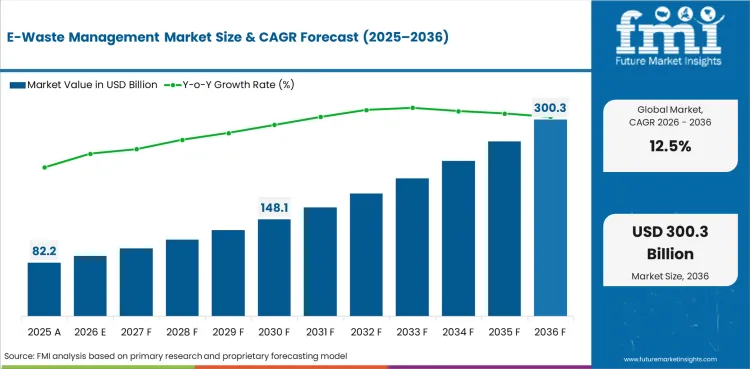
- The e-waste management market was valued at USD 82.21 billion in 2025.
- The market is projected to reach USD 92.5 billion in 2026 and USD 300.33 billion by 2036, growing at a CAGR of 12.5%.
- By 2036, the E-Waste Management Market is expected to be worth USD 300.33 billion.
- From 2026 to 2036, the market is projected to expand at a CAGR of 12.5%.
- The market is projected to create an incremental opportunity of USD 207.84 billion between 2026 and 2036.
- In 2026, recycle is expected to account for 68.4% of the application segment, driven by established recycling infrastructure, regulatory compliance mandates, and the economic value of recovered materials from electronic waste streams.
- USA (12.6%) and South Korea (12.6%) are two of the fastest growing markets in the world.
E-Waste Management Market Definition
The e-waste management market encompasses collection, transportation, processing, recycling, and disposal services for end of life electronic equipment. The scope covers consumer electronics, IT and telecom equipment, industrial electronics, medical devices, and other electronic waste categories processed through recycling and refurbishment operations.
E-Waste Management Market Inclusions
Market scope encompasses all commercially traded e-waste management services categorized by application, source, material type, technology. Revenue coverage spans from 2026 to 2036 across North America, Latin America, Europe, East Asia, South Asia and Pacific, and Middle East and Africa.
E-Waste Management Market Exclusions
The scope does not include general municipal solid waste management services, hazardous waste treatment for non electronic materials, or refurbished electronics sold through secondary retail channels without processing. Scrap metal trading without electronic waste specific processing is also excluded.
E-Waste Management Market Research Methodology
- Primary Research: FMI analysts conducted interviews with industry participants, product specialists, and distribution channel stakeholders across key geographies.
- Desk Research: Aggregated data from trade associations, regulatory filings, and manufacturer disclosures to build a comprehensive market baseline.
- Market Sizing and Forecasting: Applied a bottom up methodology across product segments, end use categories, and regional adoption curves to arrive at market valuations from 2026 to 2036.
- Data Validation: Cross verified quarterly against production data, trade statistics, and manufacturer reported figures to maintain forecast accuracy.
Why is the E-Waste Management Market Growing?
- Accelerating electronic device replacement cycles and increasing device penetration globally are expanding the volume of electronic waste requiring formal collection and processing.
- Regulatory mandates including EPR frameworks, collection rate targets, and hazardous substance disposal requirements are creating structured demand for certified e-waste management services.
- USA and South Korea lead growth at 12.6%, driven by consumer electronics volumes, regulatory enforcement, and investment in processing infrastructure.
The e-waste management market is expanding rapidly as electronic waste volumes grow and regulatory frameworks mandate formal collection and processing. Recycling accounts for 68.4% of the application segment, reflecting the economic value of precious metals, copper, and rare earth elements recoverable from printed circuit boards, batteries, and electronic components. Refurbishment and resale represent a secondary application, serving markets where device lifecycle extension offers economic and environmental benefits.
Source categories span consumer electronics, IT and telecom equipment, industrial electronics, medical devices, and household appliances. Consumer electronics generate the highest waste volumes due to short replacement cycles and high device penetration. IT and data center equipment is emerging as a growing source category as cloud infrastructure expansion accelerates server and networking hardware refresh rates.
Regional growth reflects regulatory maturity, enforcement effectiveness, and processing infrastructure investment. The USA and South Korea lead at 12.6%, driven by regulatory mandates, formal collection programs, and investment in advanced material recovery facilities. European markets maintain high recycling rates supported by established WEEE Directive compliance. Emerging markets in South Asia and Africa represent growth opportunities as formal e-waste processing replaces informal and environmentally harmful practices.
Market Segmentation Analysis
- Recycling holds 68.4% of the application segment, driven by material recovery economics and regulatory mandates requiring formal electronic waste processing.
- IT and Telecommunication Equipment leads the source segment, reflecting high replacement rates and growing device penetration across global markets.
- Material recovery technology is advancing across printed circuit boards, lithium ion batteries, and display panels, improving extraction rates and recovery economics.
The e-waste management market is segmented by application, source, material type, technology. Each segment reflects distinct processing requirements, regulatory frameworks, and commercial dynamics.
Insights into the Recycling Application Segment
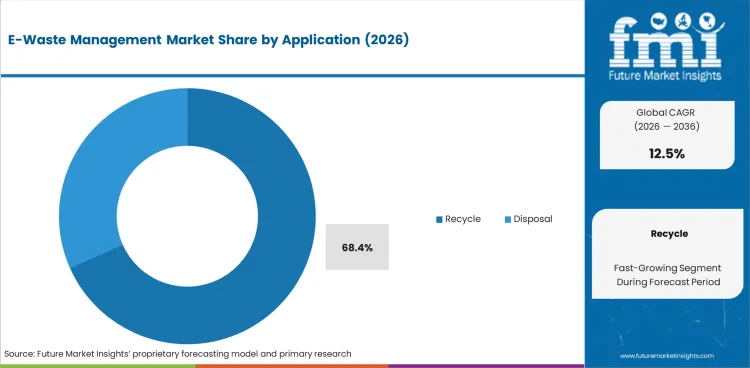
Recycling accounts for 68.4% of application demand in 2026, reflecting the economic incentive to recover precious metals (gold, silver, palladium), base metals (copper, aluminum), and rare earth elements from electronic waste. Processing operations include mechanical shredding, magnetic and eddy current separation, pyrometallurgical smelting, and hydrometallurgical extraction. Recovery economics are strongest for printed circuit boards and connectors where precious metal concentrations justify processing costs.
Insights into the IT and Telecommunication Equipment Source Segment
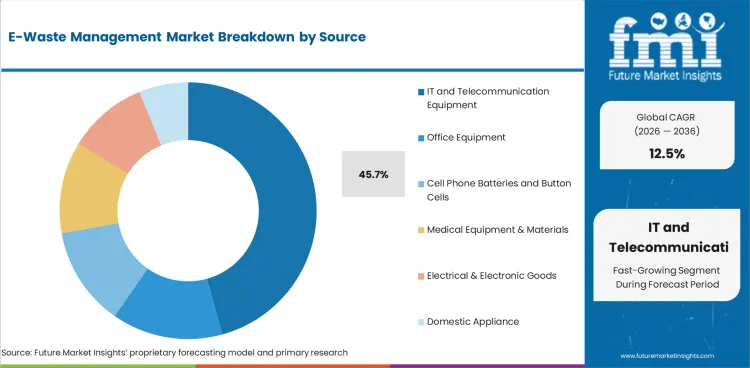
IT and Telecommunication Equipment generates the highest waste volumes due to short device replacement cycles, high consumer penetration, and the rapid pace of technology evolution. Smartphones, tablets, laptops, and televisions represent the largest waste streams by unit volume. IT and telecom equipment, including servers, networking hardware, and data center components, is growing as a source category as enterprise hardware refresh cycles accelerate alongside cloud infrastructure expansion.
E-Waste Management Market Drivers, Restraints, and Opportunities
- Regulatory mandates and EPR frameworks are creating structured demand for formal e-waste collection and processing across established and emerging markets.
- Processing cost variability, hazardous material handling complexity, and informal sector competition limit profitability in regions with weak regulatory enforcement.
- Battery recycling and rare earth recovery represent high growth opportunity segments as electric vehicle and energy storage waste volumes increase.
The e-waste management market evolves as regulatory frameworks tighten, waste volumes increase, and material recovery technology advances across multiple electronic waste categories.
Regulatory Mandates and Collection Targets
EPR frameworks and national collection rate targets require manufacturers and importers to fund or manage end of life processing for electronic products. These mandates create structured demand for certified collection and recycling services and shift processing from informal to formal channels.
Processing Cost and Informal Sector Competition
Formal e-waste processing requires investment in environmental controls, worker safety systems, and material separation technology. Informal sector operators in emerging markets process e-waste without these safeguards, creating cost competition that limits formal sector profitability and processing volumes.
Battery Recycling Opportunity
Growing volumes of lithium ion batteries from consumer electronics, electric vehicles, and energy storage systems are creating a distinct processing demand category. Battery recycling requires specialized technology and safety protocols, creating entry barriers that favor established processors with hazardous material handling capability.
Precious Metals Recovery Economics
The economic value of gold, silver, palladium, and platinum group metals in electronic waste drives investment in advanced separation and extraction technology. Recovery economics are strongest for high grade waste streams including printed circuit boards, connectors, and semiconductor packaging.
Analysis of E-Waste Management Market By Key Countries
.webp "Top Country Growth Comparison E Waste Management Market Cagr (2026 2036)")
| Country | CAGR |
|---|---|
| USA | 12.6% |
| South Korea | 12.6% |
| European Union | 12.5% |
| UK | 12.4% |
| Japan | 9.1% |
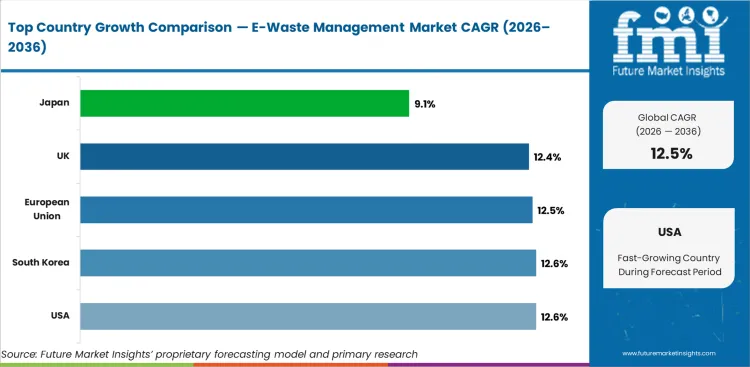
- USA and South Korea lead at 12.6%, driven by regulatory mandates, consumer electronics waste volumes, and formal recycling infrastructure investment.
- European markets sustain high recycling rates through established WEEE Directive compliance and mature collection infrastructure.
- Emerging markets in South Asia represent growth opportunities as formal processing replaces informal e-waste handling practices.
The global e-waste management market is expected to grow at a rate of 12.5% per year from 2026 to 2036. The study covers more than 30 countries, and the main markets are listed below.
Demand Outlook for E-Waste Management Market in USA
The USA is projected to grow at 12.6% through 2036, driven by federal and state e-waste regulations, growing consumer electronics disposal volumes, and investment in advanced material recovery facilities. EPA guidelines and state level EPR mandates are expanding formal collection and processing infrastructure.
- Federal and state regulations drive expansion of formal e-waste collection programs.
- Consumer electronics disposal volumes sustain processing facility throughput.
- Advanced material recovery technology investment improves extraction rates and profitability.
Future Outlook for E-Waste Management Market in South Korea
South Korea is expected to grow at 12.6% through 2036, supported by strong regulatory enforcement, high consumer electronics penetration, and government funded recycling infrastructure. Extended producer responsibility programs ensure manufacturer participation in collection and processing.
- Strong regulatory enforcement ensures high collection and recycling rates.
- High consumer electronics penetration generates consistent waste volumes.
- Government funded infrastructure supports efficient processing operations.
Opportunity Analysis of E-Waste Management Market in European Union
European Union is expected to grow at 12.5% through 2036, supported by expanding demand and infrastructure investment.
- Expanding demand supports market growth.
- Infrastructure investment creates opportunities.
- Regulatory compliance shapes procurement.
In-depth Analysis of E-Waste Management Market in UK
UK is expected to grow at 12.4% through 2036, supported by expanding demand and infrastructure investment.
- Expanding demand supports market growth.
- Infrastructure investment creates opportunities.
- Regulatory compliance shapes procurement.
Sales Analysis of E-Waste Management Market in Japan
Japan is expected to grow at 9.1% through 2036, supported by expanding demand and infrastructure investment.
- Expanding demand supports market growth.
- Infrastructure investment creates opportunities.
- Regulatory compliance shapes procurement.
Competitive Landscape and Strategic Positioning
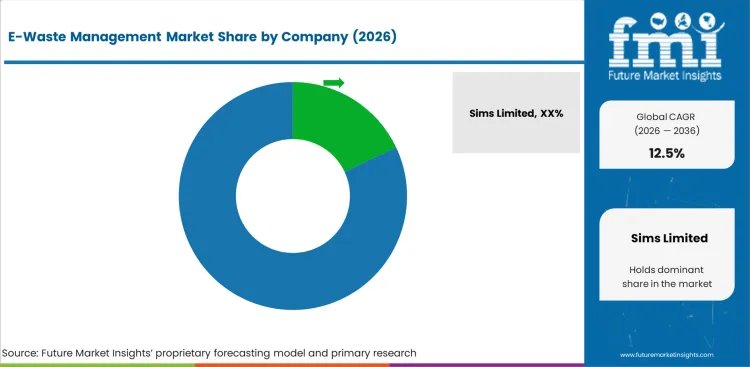
- Sims Limited maintains competitive leadership through processing scale, precious metals recovery capability, and environmental compliance across multiple jurisdictions.
- Aurubis AG and Umicore compete on metallurgical processing technology, with strong positions in precious metals and base metals recovery from electronic waste.
- Regional processors and emerging participants are building capacity in formal e-waste collection and processing, particularly in markets transitioning from informal to regulated processing frameworks.
Sims Limited holds competitive leadership through large scale processing infrastructure, integrated material recovery operations, and established compliance with environmental regulations across key markets. Aurubis AG specializes in copper and precious metals recovery from electronic waste.
Umicore competes on advanced metallurgical processing for precious metals, rare earth elements, and battery material recovery. Electronic Recyclers International and Enviro Hub Holdings serve regional markets with collection, processing, and certified data destruction services.
Market entry barriers include environmental permitting requirements, hazardous material handling certification, capital investment in processing technology, and the operational complexity of managing diverse electronic waste streams across varying regulatory jurisdictions.
Key Companies in the E-Waste Management Market
Key global companies leading the e-waste management market include:
- Sims Limited, Aurubis AG, Umicore, Electronic Recyclers International hold established positions through operational scale, distribution reach, and product breadth across multiple segments and geographies.
- TES have built competitive positioning through focused portfolios and regional market presence.
Competitive Benchmarking: E-Waste Management Market
| Company | Processing Capacity | Recovery Technology | Regulatory Compliance | Geographic Reach |
|---|---|---|---|---|
| Sims Limited | High | High | Strong | Global |
| Aurubis AG | High | High | Strong | Global |
| Umicore | Medium | High | Moderate | Regional |
| Electronic Recyclers International | Medium | Medium | Moderate | Regional |
| TES | Medium | Medium | Moderate | Regional |
Source: Future Market Insights competitive analysis, 2026.
Key Players in the E-Waste Management Market
Major Global Players
- Sims Limited
- Aurubis AG
- Umicore
- Electronic Recyclers International
- TES
Report Scope and Coverage
| Parameter | Details |
|---|---|
| Quantitative Units | USD 92.49 billion to USD 300.33 billion, at a CAGR of 12.5% |
| Market Definition | The e-waste management market covers collection, processing, recycling, and disposal services for end of life electronic equipment across consumer, commercial, and industrial categories. |
| Regions Covered | North America, Latin America, Europe, East Asia, South Asia and Pacific, Middle East and Africa |
| Countries Covered | USA, South Korea, European Union, UK, Japan, 30 plus countries |
| Key Companies Profiled | Sims Limited, Aurubis AG, Umicore, Electronic Recyclers International, TES |
| Forecast Period | 2026 to 2036 |
| Approach | Hybrid bottom up and top down methodology starting with verified transaction data, projecting adoption velocity across segments and regions. |
Segmentation
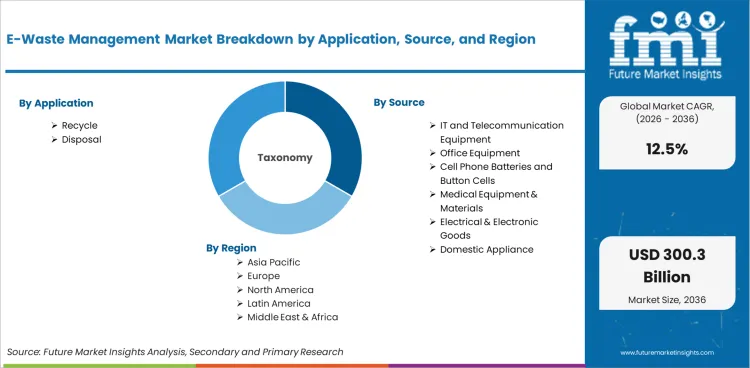
E-Waste Management Market Segmented by Application:
- Recycle
- Disposal
E-Waste Management Market Segmented by Source:
- IT and Telecommunication Equipment
- Office Equipment
- Cell Phone Batteries and Button Cells
- Medical Equipment & Materials
- Electrical & Electronic Goods
- Domestic Appliance
E-Waste Management Market Segmented by Material Type:
- Rhodium
- Selenium
- Germanium
- Tellurium
- Tantalum
- Palladium
- Gallium
- Platinum
- Silver
- Gold
E-Waste Management Market Segmented by Technology:
- Recycling Technology
- Hydrometallurgical Processing
- Pyrometallurgical Processing
- Material Recovery Technology
- Precious Metal Recovery
- Rare Earth Element Recovery
- Data Destruction Technology
- Software Based Data Erasure
- Physical Data Destruction
- Automation Technology
- Robotic Sorting Systems
- Artificial Intelligence Based Sorting
E-Waste Management Market by Region:
- North America
- USA
- Canada
- Mexico
- Latin America
- Brazil
- Chile
- Rest of Latin America
- Western Europe
- Germany
- UK
- Italy
- Spain
- France
- Nordic
- BENELUX
- Rest of Western Europe
- Eastern Europe
- Russia
- Poland
- Hungary
- Balkan & Baltic
- Rest of Eastern Europe
- East Asia
- China
- Japan
- South Korea
- South Asia and Pacific
- India
- ASEAN
- Australia & New Zealand
- Rest of South Asia and Pacific
- Middle East & Africa
- Kingdom of Saudi Arabia
- Other GCC Countries
- Turkiye
- South Africa
- Other African Union
- Rest of Middle East & Africa
Research Sources and Bibliography
- 1. United Nations Environment Programme. (2025). UNEP Global E-Waste Monitor. UNEP.
- 2. European Commission. (2024). EU Waste Electrical and Electronic Equipment (WEEE) Directive Implementation Report. EC.
- 3. USA Environmental Protection Agency. (2024). EPA Electronics Waste Management Guidelines. EPA.
- 4. International Telecommunication Union. (2025). ITU Global E-Waste Statistics Partnership Report. ITU.
- 5. World Health Organization. (2025). WHO Children and Digital Dumpsites: E-Waste Health Impact Report. WHO.
This bibliography is provided for reader reference. The full Future Market Insights report contains the complete reference list with publication dates, URLs, and supporting data for all cited works.
This Report Answers
- Estimating the size of the market and revenue projections from 2026 to 2036.
- Segmentation analysis across application, source, material type, technology.
- Regional and country level insights covering more than 30 markets.
- Competitive landscape assessment including company positioning, benchmarking, and key developments.
- Identification of growth drivers, restraints, and strategic opportunities across segments.
- Investment opportunity assessment across high growth segments and geographies.
- Supply chain and distribution channel analysis.
- Data delivery in PDF and Excel formats.
Frequently Asked Questions
What is the global market demand for E-Waste Management Market in 2026?
In 2026, the global e-waste management market is expected to be worth USD 92.49 billion.
How big will the E-Waste Management Market be in 2036?
By 2036, the e-waste management market is expected to be worth USD 300.33 billion.
How much is demand expected to grow between 2026 and 2036?
Between 2026 and 2036, demand is expected to grow at a CAGR of 12.5%.
Which application segment leads in 2026?
Recycling is expected to account for 68.4% of the application segment in 2026, driven by material recovery economics and regulatory mandates.
What is causing demand to rise in the USA?
USA is expected to grow at 12.6% through 2036, supported by regulatory mandates, electronics waste volumes, and recycling infrastructure investment.
What is causing demand to rise in South Korea?
South Korea is expected to grow at 12.6% through 2036, reflecting strong regulatory enforcement and high consumer electronics penetration.
What does this report mean by 'E-Waste Management Market definition'?
The e-waste management market covers collection, processing, recycling, and disposal services for end of life electronic equipment.
How does FMI validate the forecast?
Forecasting models use a hybrid bottom up and top down approach, starting with verified transaction data and validating against waste generation statistics and processor throughput data.
Preview the report firsthand - request a free sample
Get SampleGet the brochure for pricing and purchase details.
Get PDFTable of Content
- Executive Summary
- Global Market Outlook
- Demand-side Trends
- Supply-side Trends
- Technology Roadmap Analysis
- Analysis and Recommendations
- Market Overview
- Market Coverage / Taxonomy
- Market Definition / Scope / Limitations
- Research Methodology
- Chapter Orientation
- Analytical Lens and Working Hypotheses
- Market Structure, Signals, and Trend Drivers
- Benchmarking and Cross-market Comparability
- Market Sizing, Forecasting, and Opportunity Mapping
- Research Design and Evidence Framework
- Desk Research Programme (Secondary Evidence)
- Company Annual and Sustainability Reports
- Peer-reviewed Journals and Academic Literature
- Corporate Websites, Product Literature, and Technical Notes
- Earnings Decks and Investor Briefings
- Statutory Filings and Regulatory Disclosures
- Technical White Papers and Standards Notes
- Trade Journals, Industry Magazines, and Analyst Briefs
- Conference Proceedings, Webinars, and Seminar Materials
- Government Statistics Portals and Public Data Releases
- Press Releases and Reputable Media Coverage
- Specialist Newsletters and Curated Briefings
- Sector Databases and Reference Repositories
- FMI Internal Proprietary Databases and Historical Market Datasets
- Subscription Datasets and Paid Sources
- Social Channels, Communities, and Digital Listening Inputs
- Additional Desk Sources
- Expert Input and Fieldwork (Primary Evidence)
- Primary Modes
- Qualitative Interviews and Expert Elicitation
- Quantitative Surveys and Structured Data Capture
- Blended Approach
- Why Primary Evidence is Used
- Field Techniques
- Interviews
- Surveys
- Research Ethics
- Data Integrity and Handling
- Primary Modes
- Tooling, Models, and Reference Databases
- Desk Research Programme (Secondary Evidence)
- Data Engineering and Model Build
- Data Acquisition and Ingestion
- Cleaning, Normalisation, and Verification
- Synthesis, Triangulation, and Analysis
- Quality Assurance and Audit Trail
- Market Background
- Market Dynamics
- Drivers
- Restraints
- Opportunity
- Trends
- Scenario Forecast
- Demand in Optimistic Scenario
- Demand in Likely Scenario
- Demand in Conservative Scenario
- Opportunity Map Analysis
- Product Life Cycle Analysis
- Supply Chain Analysis
- Investment Feasibility Matrix
- Value Chain Analysis
- PESTLE and Porter’s Analysis
- Regulatory Landscape
- Regional Parent Market Outlook
- Production and Consumption Statistics
- Import and Export Statistics
- Market Dynamics
- Global Market Analysis 2021 to 2025 and Forecast, 2026 to 2036
- Historical Market Size Value (USD Million) Analysis, 2021 to 2025
- Current and Future Market Size Value (USD Million) Projections, 2026 to 2036
- Y-o-Y Growth Trend Analysis
- Absolute $ Opportunity Analysis
- Global Market Pricing Analysis 2021 to 2025 and Forecast 2026 to 2036
- Global Market Analysis 2021 to 2025 and Forecast 2026 to 2036, By Application
- Introduction / Key Findings
- Historical Market Size Value (USD Million) Analysis By Application, 2021 to 2025
- Current and Future Market Size Value (USD Million) Analysis and Forecast By Application, 2026 to 2036
- Recycle
- Disposal
- Recycle
- Y-o-Y Growth Trend Analysis By Application, 2021 to 2025
- Absolute $ Opportunity Analysis By Application, 2026 to 2036
- Global Market Analysis 2021 to 2025 and Forecast 2026 to 2036, By Source
- Introduction / Key Findings
- Historical Market Size Value (USD Million) Analysis By Source, 2021 to 2025
- Current and Future Market Size Value (USD Million) Analysis and Forecast By Source, 2026 to 2036
- IT and Telecommunication Equipment
- Office Equipment
- Cell Phone Batteries and Button Cells
- Medical Equipment & Materials
- Electrical & Electronic Goods
- Domestic Appliance
- IT and Telecommunication Equipment
- Y-o-Y Growth Trend Analysis By Source, 2021 to 2025
- Absolute $ Opportunity Analysis By Source, 2026 to 2036
- Global Market Analysis 2021 to 2025 and Forecast 2026 to 2036, By Material Type
- Introduction / Key Findings
- Historical Market Size Value (USD Million) Analysis By Material Type, 2021 to 2025
- Current and Future Market Size Value (USD Million) Analysis and Forecast By Material Type, 2026 to 2036
- Rhodium
- Selenium
- Germanium
- Tellurium
- Tantalum
- Palladium
- Gallium
- Platinum
- Silver
- Gold
- Rhodium
- Y-o-Y Growth Trend Analysis By Material Type, 2021 to 2025
- Absolute $ Opportunity Analysis By Material Type, 2026 to 2036
- Global Market Analysis 2021 to 2025 and Forecast 2026 to 2036, By Technology
- Introduction / Key Findings
- Historical Market Size Value (USD Million) Analysis By Technology, 2021 to 2025
- Current and Future Market Size Value (USD Million) Analysis and Forecast By Technology, 2026 to 2036
- Recycling Technology
- Hydrometallurgical Processing
- Pyrometallurgical Processing
- Material Recovery Technology
- Precious Metal Recovery
- Rare Earth Element Recovery
- Data Destruction Technology
- Software Based Data Erasure
- Physical Data Destruction
- Automation Technology
- Robotic Sorting Systems
- Artificial Intelligence Based Sorting
- Recycling Technology
- Y-o-Y Growth Trend Analysis By Technology, 2021 to 2025
- Absolute $ Opportunity Analysis By Technology, 2026 to 2036
- Global Market Analysis 2021 to 2025 and Forecast 2026 to 2036, By Region
- Introduction
- Historical Market Size Value (USD Million) Analysis By Region, 2021 to 2025
- Current Market Size Value (USD Million) Analysis and Forecast By Region, 2026 to 2036
- North America
- Latin America
- Western Europe
- Eastern Europe
- East Asia
- South Asia and Pacific
- Middle East & Africa
- Market Attractiveness Analysis By Region
- North America Market Analysis 2021 to 2025 and Forecast 2026 to 2036, By Country
- Historical Market Size Value (USD Million) Trend Analysis By Market Taxonomy, 2021 to 2025
- Market Size Value (USD Million) Forecast By Market Taxonomy, 2026 to 2036
- By Country
- USA
- Canada
- Mexico
- By Application
- By Source
- By Material Type
- By Technology
- By Country
- Market Attractiveness Analysis
- By Country
- By Application
- By Source
- By Material Type
- By Technology
- Key Takeaways
- Latin America Market Analysis 2021 to 2025 and Forecast 2026 to 2036, By Country
- Historical Market Size Value (USD Million) Trend Analysis By Market Taxonomy, 2021 to 2025
- Market Size Value (USD Million) Forecast By Market Taxonomy, 2026 to 2036
- By Country
- Brazil
- Chile
- Rest of Latin America
- By Application
- By Source
- By Material Type
- By Technology
- By Country
- Market Attractiveness Analysis
- By Country
- By Application
- By Source
- By Material Type
- By Technology
- Key Takeaways
- Western Europe Market Analysis 2021 to 2025 and Forecast 2026 to 2036, By Country
- Historical Market Size Value (USD Million) Trend Analysis By Market Taxonomy, 2021 to 2025
- Market Size Value (USD Million) Forecast By Market Taxonomy, 2026 to 2036
- By Country
- Germany
- UK
- Italy
- Spain
- France
- Nordic
- BENELUX
- Rest of Western Europe
- By Application
- By Source
- By Material Type
- By Technology
- By Country
- Market Attractiveness Analysis
- By Country
- By Application
- By Source
- By Material Type
- By Technology
- Key Takeaways
- Eastern Europe Market Analysis 2021 to 2025 and Forecast 2026 to 2036, By Country
- Historical Market Size Value (USD Million) Trend Analysis By Market Taxonomy, 2021 to 2025
- Market Size Value (USD Million) Forecast By Market Taxonomy, 2026 to 2036
- By Country
- Russia
- Poland
- Hungary
- Balkan & Baltic
- Rest of Eastern Europe
- By Application
- By Source
- By Material Type
- By Technology
- By Country
- Market Attractiveness Analysis
- By Country
- By Application
- By Source
- By Material Type
- By Technology
- Key Takeaways
- East Asia Market Analysis 2021 to 2025 and Forecast 2026 to 2036, By Country
- Historical Market Size Value (USD Million) Trend Analysis By Market Taxonomy, 2021 to 2025
- Market Size Value (USD Million) Forecast By Market Taxonomy, 2026 to 2036
- By Country
- China
- Japan
- South Korea
- By Application
- By Source
- By Material Type
- By Technology
- By Country
- Market Attractiveness Analysis
- By Country
- By Application
- By Source
- By Material Type
- By Technology
- Key Takeaways
- South Asia and Pacific Market Analysis 2021 to 2025 and Forecast 2026 to 2036, By Country
- Historical Market Size Value (USD Million) Trend Analysis By Market Taxonomy, 2021 to 2025
- Market Size Value (USD Million) Forecast By Market Taxonomy, 2026 to 2036
- By Country
- India
- ASEAN
- Australia & New Zealand
- Rest of South Asia and Pacific
- By Application
- By Source
- By Material Type
- By Technology
- By Country
- Market Attractiveness Analysis
- By Country
- By Application
- By Source
- By Material Type
- By Technology
- Key Takeaways
- Middle East & Africa Market Analysis 2021 to 2025 and Forecast 2026 to 2036, By Country
- Historical Market Size Value (USD Million) Trend Analysis By Market Taxonomy, 2021 to 2025
- Market Size Value (USD Million) Forecast By Market Taxonomy, 2026 to 2036
- By Country
- Kingdom of Saudi Arabia
- Other GCC Countries
- Turkiye
- South Africa
- Other African Union
- Rest of Middle East & Africa
- By Application
- By Source
- By Material Type
- By Technology
- By Country
- Market Attractiveness Analysis
- By Country
- By Application
- By Source
- By Material Type
- By Technology
- Key Takeaways
- Key Countries Market Analysis
- USA
- Pricing Analysis
- Market Share Analysis, 2025
- By Application
- By Source
- By Material Type
- By Technology
- Canada
- Pricing Analysis
- Market Share Analysis, 2025
- By Application
- By Source
- By Material Type
- By Technology
- Mexico
- Pricing Analysis
- Market Share Analysis, 2025
- By Application
- By Source
- By Material Type
- By Technology
- Brazil
- Pricing Analysis
- Market Share Analysis, 2025
- By Application
- By Source
- By Material Type
- By Technology
- Chile
- Pricing Analysis
- Market Share Analysis, 2025
- By Application
- By Source
- By Material Type
- By Technology
- Germany
- Pricing Analysis
- Market Share Analysis, 2025
- By Application
- By Source
- By Material Type
- By Technology
- UK
- Pricing Analysis
- Market Share Analysis, 2025
- By Application
- By Source
- By Material Type
- By Technology
- Italy
- Pricing Analysis
- Market Share Analysis, 2025
- By Application
- By Source
- By Material Type
- By Technology
- Spain
- Pricing Analysis
- Market Share Analysis, 2025
- By Application
- By Source
- By Material Type
- By Technology
- France
- Pricing Analysis
- Market Share Analysis, 2025
- By Application
- By Source
- By Material Type
- By Technology
- India
- Pricing Analysis
- Market Share Analysis, 2025
- By Application
- By Source
- By Material Type
- By Technology
- ASEAN
- Pricing Analysis
- Market Share Analysis, 2025
- By Application
- By Source
- By Material Type
- By Technology
- Australia & New Zealand
- Pricing Analysis
- Market Share Analysis, 2025
- By Application
- By Source
- By Material Type
- By Technology
- China
- Pricing Analysis
- Market Share Analysis, 2025
- By Application
- By Source
- By Material Type
- By Technology
- Japan
- Pricing Analysis
- Market Share Analysis, 2025
- By Application
- By Source
- By Material Type
- By Technology
- South Korea
- Pricing Analysis
- Market Share Analysis, 2025
- By Application
- By Source
- By Material Type
- By Technology
- Russia
- Pricing Analysis
- Market Share Analysis, 2025
- By Application
- By Source
- By Material Type
- By Technology
- Poland
- Pricing Analysis
- Market Share Analysis, 2025
- By Application
- By Source
- By Material Type
- By Technology
- Hungary
- Pricing Analysis
- Market Share Analysis, 2025
- By Application
- By Source
- By Material Type
- By Technology
- Kingdom of Saudi Arabia
- Pricing Analysis
- Market Share Analysis, 2025
- By Application
- By Source
- By Material Type
- By Technology
- Turkiye
- Pricing Analysis
- Market Share Analysis, 2025
- By Application
- By Source
- By Material Type
- By Technology
- South Africa
- Pricing Analysis
- Market Share Analysis, 2025
- By Application
- By Source
- By Material Type
- By Technology
- USA
- Market Structure Analysis
- Competition Dashboard
- Competition Benchmarking
- Market Share Analysis of Top Players
- By Regional
- By Application
- By Source
- By Material Type
- By Technology
- Competition Analysis
- Competition Deep Dive
- Sims Limited
- Overview
- Product Portfolio
- Profitability by Market Segments (Product/Age /Sales Channel/Region)
- Sales Footprint
- Strategy Overview
- Marketing Strategy
- Product Strategy
- Channel Strategy
- Aurubis AG
- Umicore
- Electronic Recyclers International
- TES
- Sims Limited
- Competition Deep Dive
- Assumptions & Acronyms Used


