

- Market Size (2026)
- USD 46.7 Bn
- Forecast (2036)
- USD 82.1 Bn
- CAGR (2026 to 2036)
- 5.8%
How big is Luxury Products for Kids Market in 2026?
Across 2026 to 2036, sales of luxury products for kids rise at a 5.8% CAGR. The 2025 base came to USD 44.1 billion. The 2026 estimate reads USD 46.7 billion, with USD 82.1 billion projected for 2036.
An FMI update on luxury products for kids puts 2026 sales at an estimated USD 46.7 billion, against USD 44.1 billion in 2025. The market will record a 5.8% CAGR from 2026 to 2036, reaching USD 82.1 billion in 2036.
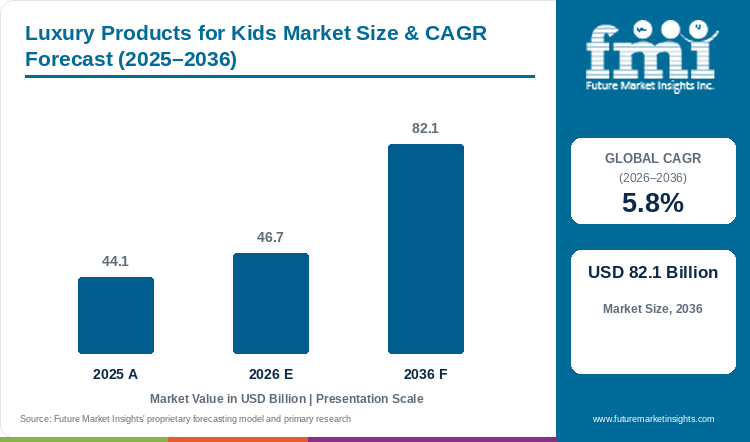
Luxury houses sell childrenswear in the flagships that carry handbags, and the luxury handbag market will record a 6.2% CAGR from 2026 to 2036. Kids luxury grows slower at 5.8%, so children's lines will ride on handbag store traffic. Luxury childrenswear is the top tier of the kids apparel market, on a 6.3% CAGR, so high-street brands will gain in children's clothing baskets.
Because apparel and footwear hold 37% of 2026 sales, children's lines follow the adult brand into each new store. For instance, Ralph Lauren reported Asia revenue up 25% in constant currency for Q1 FY27, in a 6 August 2026 release naming Polo Ralph Lauren Children among group brands.[1] Asian revenue growth at Ralph Lauren makes kids luxury an industry at a turning point toward the East.
However, eco ranges for children will face scarce premium organic fabrics. Brands will therefore keep eco capsules small and price them above core collections.
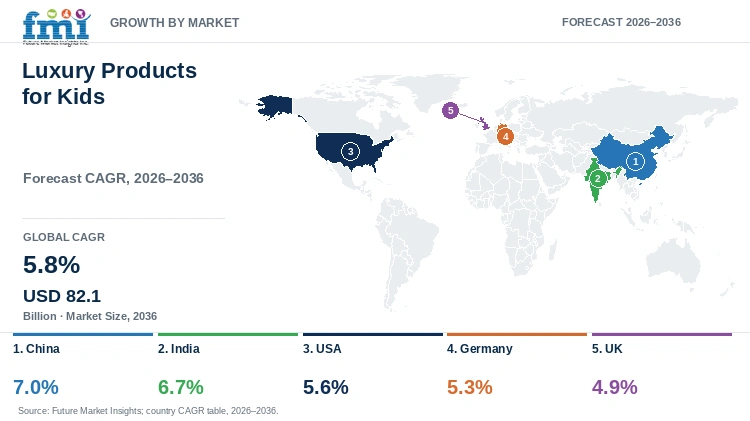
China (7.0%) and India (6.7%) post the quickest rates in the country table. Frequent size changes will bring Chinese and Indian families back two or three times a year, which hands online stores repeat orders.
Key Market Trends & Insights
- Product: apparel and footwear captured 37% of 2026 sales, with gear and strollers second and nursery and furniture third.
- Target group: infants and toddlers held 42% in 2026, and pre-schoolers made up an estimated 58%.
Regional Highlights
- China tops the profiled countries with a 7.0% CAGR through 2036, and India follows on 6.7%.
- Western markets run slower, with the UK lowest at 4.9% after the USA on 5.6% and Germany on 5.3%.
- China revenue at Ralph Lauren rose over 40% in Q1 FY27.[1]
Market Size & Forecast
Table 1: Market Size and Forecast for the Luxury Products for Kids Market (USD billion and percentage), 2025 to 2036
| Metric | Value |
|---|---|
| 2025 Market Size | USD 44.1 billion |
| Estimated Market Size in 2026 | USD 46.7 billion |
| Projected Market Size by 2036 | USD 82.1 billion |
| CAGR, 2026 to 2036 | 5.8% |
| Added Revenue, 2026 to 2036 | USD 35.4 billion |
| Market Expansion Multiple | 1.8x |
Kids luxury lines grow close to adult luxury handbags, which share the same stores. Handbags post a 6.2% CAGR from 2026 to 2036 in the luxury handbag market. Designer shoes from the luxury footwear market fill the same boutique floors. Luxury childrenswear forms the top price tier of the broader kids apparel market. FMI puts the luxury slice for children at a 5.8% CAGR, so premium labels will grow a little slower than the 6.3% kids apparel CAGR.
Luxury Group Results and the Boutique, Wholesale and Online Mix
Store sales outpaced online sales at Moncler in 2026. Moncler said the physical channel continued to outperform the online channel in the first half of 2026.[2] DTC made up 85.6% of Moncler brand revenue, up from 85.0% a year earlier.[2] Moncler DTC revenue rose 10% at constant exchange rates, and wholesale rose 3%.[2] Ralph Lauren reported mid-teens wholesale growth and 632 concessions at the end of June 2026, down from 665.[1] Le Bon Marché once again posted revenue growth in the first half, LVMH said.[3] Kering reported flat sales from directly operated stores on a comparable basis in H1 2026, and wholesale and other revenues rose 5%.[4] As per FMI, apparel and footwear hold 37% of kids luxury sales, and kids apparel and footwear will follow the adult brands into the same boutiques, concessions and web stores.
Table 2: Brand-Owner Results and Channel Mix Indicators for the Luxury Products for Kids Market (EUR, USD, counts and percentage), 2025 to 2026
| Indicator | Data Point | Relevance | Source |
|---|---|---|---|
| Moncler brand DTC share, H1 2026 | 85.6% (85.0% in H1 2025) | Direct sales carry most Moncler brand revenue. | [2] |
| Moncler DTC and wholesale growth, H1 2026 | +10% and +3% at constant exchange rates | Own stores grow faster than wholesale. | [2] |
| Moncler mono-brand wholesale stores, end of 2025 | 49, net decrease of 7 | Wholesale networks are being trimmed. | [5] |
| Ralph Lauren concessions, June 2026 | 632 (665 a year earlier) | Fewer concession counters in partner stores. | [1] |
| Ralph Lauren Asia digital comparable sales, Q1 FY27 | +32% | Online growth is strongest in Asia. | [1] |
| LVMH Fashion and Leather Goods revenue, H1 2026 | €18.1 billion, down 1% organic | Adult luxury demand sets the tone for kids lines. | [3] |
| LVMH retail network | Over 6,280 stores | Store reach for Dior and Fendi kids ranges. | [3] |
| Kering retail and wholesale growth, H1 2026 | Retail flat, wholesale and other +5% on a comparable basis | Partner stores grew faster than Kering boutiques. | [4] |
| Kering net store closures, H1 2026 | 84 of the 100 targeted for 2026 | Fewer Gucci and group boutiques carry kids lines. | [4] |
| Burberry divisions, Q1 FY27 | Growth across all four divisions, Childrenswear included, for the first time in three years | Direct evidence of recovery in designer kidswear. | [6] |
| Burberry comparable retail sales, Q1 FY27 | +5% (Greater China +9%, Americas +12%) | Store traffic recovered in two large regions. | [6] |
Analyst Perspective
“I see the strongest opportunity in luxury childrenswear sold through brand boutiques in China and India, home to the fastest growth in affluent families. Brands that tie kids collections to adult flagships and make size exchanges easy online will keep Chinese and Indian families for years.”
- Rahul Pandita, Principal Consultant, Future Market Insights.
How is the luxury products for kids market segmented?
Product and target group, plus region, define the luxury products for kids market. Apparel and footwear lead the product split at 37%, and infants and toddlers take 42% of the target group split in 2026.
By product: apparel and footwear, gear and strollers, and nursery and furniture.
By target group: infants and toddlers, and pre-schoolers.
By region: Oceania, the Middle East and Africa, Europe, Latin America, South Asia, East Asia, and North America.
Why do apparel and footwear lead product sales?
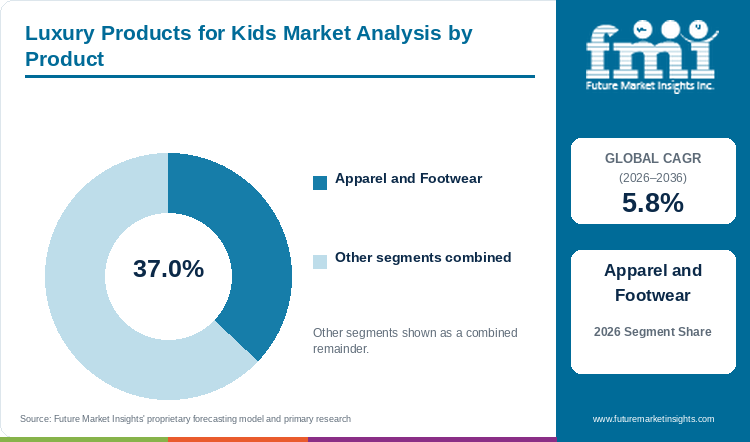
At 37% of 2026 product sales, apparel and footwear stay ahead of gear and strollers, estimated at 33.4%.
Table 3: Product Share for the Luxury Products for Kids Market (percentage share), 2026
| Product | Estimated Share (2026) |
|---|---|
| Apparel and Footwear | 37% |
| Gear and Strollers | 33.4% |
| Nursery and Furniture | 29.6% |
| Total | 100.0% |
Table 4: Product Leadership and Market Growth for the Luxury Products for Kids Market (segment and CAGR percentage), 2026 to 2036
| Metric | Value |
|---|---|
| Global CAGR (2026 to 2036) | 5.8% |
| Leading Segment | Apparel and Footwear |
Clothes and shoes are replaced with every growth spurt, and a stroller or cot is bought once. FMI data show apparel and footwear at 37% of product sales. Gear and strollers take an estimated 33.4%, and nursery and furniture about 29.6%. Moncler brand revenue rose 9% at constant exchange rates in the first half of 2026.[2] Burberry said in July 2026 that Womenswear, Menswear, Accessories and Childrenswear all grew for the first time in three years.[6] Outerwear and shoes from adult houses will keep the apparel lead, and co-branded strollers will grow the 33.4% gear and stroller share.
- Gear and strollers will gain from co-branded luxury models.
- Nursery and furniture will sell through design stores and brand web shops.
Why do pre-schoolers account for the larger target group share?
Pre-schoolers account for an estimated 58% of target group sales in 2026, and infants and toddlers for 42%.
Table 5: Target Group Share for the Luxury Products for Kids Market (percentage share), 2026
| Target Group | Estimated Share (2026) |
|---|---|
| Pre-schoolers | 58% |
| Infants and Toddlers | 42% |
| Total | 100.0% |
Pre-school children span a wider age band and need new sized clothing and shoes each season. Pre-schoolers hold an estimated 58% of target group sales. According to FMI, infants and toddlers take 42%. Gift purchases for newborns will keep the infant and toddler share near 42%. Sales of everyday baby products show the size of new-parent budgets. In 2026 the baby personal care products market reaches USD 84.6 billion, and the baby diaper market USD 66.9 billion.
- Infant gift sets will sell through flagship boutiques and online gift services.
- Pre-school ranges will follow adult seasonal collections.
What are the drivers, restraints, and opportunities in the luxury products for kids market?
Demand for luxury products for kids rises with affluent households in Asia, heritage brand loyalty and frequent size changes. Key challenges faced by manufacturers include limited capacity for premium organic textiles and long sourcing timelines.
- Driver: Wealthier families in China and India and new flagship stores.
- Restraint: Scarce premium organic textiles and soft European demand.
- Opportunity: Co-branded strollers and gear, plus online resale of outgrown items.
New Flagships Bring Kids Lines to Asian Families
Adoption of luxury childrenswear grows with flagship openings in Asia. Moncler brand revenue in Asia rose 19% at constant exchange rates in the first half of 2026.[2] Ralph Lauren reported Asia comparable store sales up 23% in Q1 FY27.[1] Kids collections will gain floor space in new Asian flagships.
Textile Scarcity and Soft European Demand Hold Back Sales
Moncler brand revenue in EMEA fell 4% at constant exchange rates in the first half of 2026.[2] Premium organic and sustainable textiles are in short global supply, and sourcing them needs high capital and long procurement timelines. The shifting balance between supply and demand for organic textiles will keep eco ranges for children at higher prices. Pitti Bimbo in Florence featured around 120 brands in June 2026, against more than 500 exhibitors in earlier years, FashionUnited reported.[7] The smaller Pitti Bimbo gives independent kidswear labels fewer chances to meet European buyers. European boutiques will lean on tourists and gifting to hold volumes.
Co-Branded Gear and Online Resale Open New Revenue
Ralph Lauren reported Asia digital comparable sales up 32% in Q1 FY27, the fastest regional digital pace.[1] Sales potential is expected to emerge from co-branded strollers, nursery pieces and resale of outgrown luxury items. Online channels will carry gear and resale offers to families outside flagship cities.
Which country CAGRs are profiled in the luxury products for kids market?
Table 6: Country CAGR Comparison for the Luxury Products for Kids Market (CAGR percentage), 2026 to 2036
| Country | CAGR |
|---|---|
| China | 7.0% |
| India | 6.7% |
| USA | 5.6% |
| Germany | 5.3% |
| UK | 4.9% |
How do country-level CAGRs compare in the luxury products for kids market?
China and India head the country table. China grows at a 7.0% CAGR from 2026 to 2036 and India at 6.7%, FMI reports. Below the 5.8% global CAGR come the USA on 5.6%, Germany on 5.3% and the UK on 4.9%.
- China adds affluent families and new brand flagships.
- India grows on occasion wear and online reach.
- The USA leans on gifting across stores, concessions and online.
- Germany favours durable gear and sustainable fabrics.
- The UK relies on London boutiques and online gifting.
Full report country CAGRs cover: 40-plus countries spread over the Middle East and Africa, Oceania, Latin America, East Asia, Europe, South Asia and North America.
Country-wise Analysis
China Luxury Products for Kids Market Outlook (2026 to 2036)
Ralph Lauren said China revenue grew over 40% in Q1 FY27.[1] Moncler named China and Korea as outperformers within Asia in the second quarter of 2026.[2] Burberry comparable retail sales in Greater China rose 9% in Q1 FY27, on local demand and outsized growth in Gen Z customers.[6] China tops the country table at a 7.0% CAGR through 2036. Affluent Chinese parents will buy kids lines in the same flagships as adult collections.
Key takeaway: China will reward brands that open kids corners inside new flagships in major cities.
India Luxury Products for Kids Market Outlook (2026 to 2036)
Second place goes to India on a 6.7% CAGR, FMI data show. Franchise India reported in June 2026 that French childrenswear label Jacadi Paris had opened a first high-street boutique in Bengaluru, on Vittal Mallya Road.[8] The 1,100 sq. ft. store covers clothing for newborns to 12-year-olds, with a mezzanine floor for newborn essentials and gifting.[8] Burgundy Brand Collective represents Jacadi Paris exclusively in India.[8] Wealthy families in Mumbai, Delhi and Bengaluru will buy designer kidswear for weddings and festivals. Online luxury platforms will reach buyers in smaller cities. Franchise partners like Burgundy Brand Collective will carry new brand launches in India.
Key takeaway: India will grow through occasion wear, franchise-run boutiques and online reach beyond the largest cities.
USA Luxury Products for Kids Market Outlook (2026 to 2036)
Ralph Lauren grew North America revenue 13% in Q1 FY27, with brick-and-mortar comparable sales up 10% and digital up 8%.[1] US department store counters and Ralph Lauren concessions will keep selling kids lines. For Gucci, Kering called North America the key growth driver in Q2 2026.[4] The USA posts a 5.6% CAGR through 2036. US gift buying for birthdays and holidays will drive repeat store visits.
Key takeaway: US kids luxury will lean on gifting across brand stores, concessions and web shops.
Germany Luxury Products for Kids Market Outlook (2026 to 2036)
Moncler EMEA revenue dropped 4% at constant exchange rates in H1 2026, and the company cited a weak online performance in the second quarter.[2] Burberry EMEIA comparable retail sales fell 3% in Q1 FY27, and the company cited the Middle East conflict and lower tourist spend.[6] German sales rise at a 5.3% CAGR to 2036. German parents will favour durable, sustainable materials for kids clothing and gear. Premium strollers and nursery furniture will sell through specialist stores.
Key takeaway: Germany will favour durable gear and sustainable fabrics.
UK Luxury Products for Kids Market Outlook (2026 to 2036)
London department stores and brand boutiques will keep the core of UK kids luxury sales. Ralph Lauren reported a slight increase in brick-and-mortar comparable sales in Europe and digital up 6% in Q1 FY27.[1] At a 4.9% CAGR through 2036, the UK has the lowest rate in the profiled group. Online gifting will take a larger part of UK sales.
Key takeaway: Online gifting and visitors shopping in London will carry UK growth.
Who are the notable companies in the luxury products for kids market?
Dior (LVMH), Gucci (Kering), Burberry, Fendi (LVMH), Stella McCartney, Balenciaga, Moncler, Dolce & Gabbana, Ralph Lauren and Thom Browne compete in luxury products for kids.
Dior and Fendi under LVMH and Gucci under Kering are among the key companies, FMI shows. LVMH reported first-half 2026 revenue of €38.6 billion, up 2% organic, and Fashion and Leather Goods returned to organic growth in the second quarter.[3] Maria Grazia Chiuri continued the creative renewal of Fendi collections.[3] Gucci sales fell 5% on a comparable basis to €2,757 million in the first six months of 2026, Kering reported.[4]
Other designer houses form the second group. Moncler group revenue reached €1,289.9 million in H1 2026, a 9% rise at constant exchange rates.[2] Ralph Lauren names Polo Ralph Lauren Children among the group brands.[1] Burberry retail revenue for Q1 FY27 reached £455 million, a 4% gain at constant exchange rates.[6] Stella McCartney, Balenciaga, Dolce & Gabbana and Thom Browne complete the designer field. Independent kidswear labels face a harder task breaking into established markets held by Moncler, Burberry, Ralph Lauren and the LVMH and Kering houses.
- Houses named with parent groups: Dior (LVMH), Fendi (LVMH) and Gucci (Kering).
- Other designer houses: Burberry, Stella McCartney, Balenciaga, Moncler, Dolce & Gabbana, Ralph Lauren and Thom Browne.
Competitive Benchmarking: Luxury Products for Kids Market
Table 7: Competitive Benchmarking for the Luxury Products for Kids Market (qualitative documentation ratings), 2026
| Company | Boutique Network | Wholesale and Concessions | Online Signals | Disclosure |
|---|---|---|---|---|
| LVMH (Dior, Fendi) | High | Low | Low | High |
| Moncler | High | Medium | Medium | High |
| Ralph Lauren | High | High | High | High |
| Kering (Gucci) | High | Medium | Low | High |
| Burberry | Medium | Low | Low | Medium |
Each item is rated High, Medium or Low on the volume of dated filing detail.
Key Developments in the Luxury Products for Kids Market
- In August 2026, Ralph Lauren reported first-quarter fiscal 2027 net revenue of $1,959.8 million, up 14%.[1]
- In July 2026, Kering posted €7,220 million of first-half revenue, a 1% comparable gain.[4]
- In July 2026, LVMH reported first-half revenue of €38.6 billion.[3]
- In July 2026, Moncler posted first-half group revenue of €1,289.9 million.[2]
- In July 2026, Burberry reported Q1 FY27 retail revenue of £455 million and growth across all four divisions, Childrenswear included.[6]
- In June 2026, Pitti Bimbo 103 ran in Florence with around 120 brands.[7]
- In June 2026, Franchise India reported that Jacadi Paris had opened a 1,100 sq. ft. high-street boutique in Bengaluru.[8]
- In February 2026, Moncler posted €3,132.1 million in 2025 group revenue, with DTC at 86.7% of Moncler brand revenue.[5]
Key Players in the Luxury Products for Kids Market
Houses Named with Parent Groups
- Dior (LVMH)
- Fendi (LVMH)
- Gucci (Kering)
Other Designer Houses
- Burberry
- Stella McCartney
- Balenciaga
- Moncler
- Dolce & Gabbana
- Ralph Lauren
- Thom Browne
Luxury Products for Kids Market - Report Scope
Table 8: Report Scope for the Luxury Products for Kids Market (coverage fields and definitions), 2026 to 2036
| Coverage field | Report scope |
|---|---|
| Market breakdown | Product; target group; region |
| Quantitative units | USD billion |
| Market definition | Luxury products for kids market covering designer apparel and footwear, gear and strollers, and nursery and furniture for infants, toddlers and pre-schoolers. |
| Regions covered | North America; Latin America; Europe; East Asia; South Asia; Oceania; Middle East and Africa |
| Countries covered | China; India; USA; Germany; UK |
| Key companies profiled | Dior (LVMH), Gucci (Kering), Burberry, Fendi (LVMH), Stella McCartney, Balenciaga, Moncler, Dolce & Gabbana, Ralph Lauren, Thom Browne |
| Forecast period | 2026 to 2036 |
Luxury Products for Kids Market - Research Methodology
Table 9: Research Methodology for the Luxury Products for Kids Market (research methods and approach), 2026 edition
| Method | Approach |
|---|---|
| Data Sources | Brand-owner results releases, annual reports and trade press issued in May 2025 or later inform the channel and regional analysis. |
| Desk Research | Desk research reviews luxury group results, boutique and concession counts, DTC and wholesale growth and online trends. |
| Market Sizing and Forecasting | Sizing starts from the 2025 base of USD 44.1 billion and the 5.8% CAGR. |
| Data Validation | Channel shares and growth rates were matched to the original company release for each period. |
Luxury Products for Kids Market by Segments
Luxury Products for Kids Market segmented by Product:
- Apparel and Footwear
- Gear and Strollers
- Nursery and Furniture
Luxury Products for Kids Market segmented by Target Group:
- Infants and Toddlers
- Pre-schoolers
Luxury Products for Kids Market by Region
- North America
- Latin America
- Europe
- East Asia
- South Asia
- Oceania
- Middle East and Africa
Research Sources and Bibliography
- [1] Ralph Lauren Corporation. (2026, August 6). Ralph Lauren Reports Better Than Expected First Quarter Fiscal 2027 Results and Updates Fiscal 2027 Outlook. https://investor.ralphlauren.com/static-files/5aefed21-3753-4099-9db7-7d24334251e9
- [2] Moncler S.p.A. (2026, July 22). H1 2026 Financial Results. https://www.monclergroup.com/v3/assets/blt61bda6b71f29a239/blt6651b04f18f67307/6a60e7584e8afd132530f0c6/Moncler-Group-Press-Release-H1-2026.pdf
- [3] LVMH. (2026, July 27). Accelerating growth in the second quarter, solid first half results. https://www.lvmh.com/en/publications/accelerating-growth-in-the-second-quarter---solid-first-half-results
- [4] Kering. (2026, July 28). 2026 First-half results: back to growth, performance improvement & strategy execution on track. https://mfn.se/all/a/kering/kering-2026-first-half-results-back-to-growth-performance-improvement-and-strategy-execution-on-track-be4c7c4c
- [5] Moncler S.p.A. (2026, February 19). FY 2025 Financial Results. https://www.monclergroup.com/v3/assets/blt61bda6b71f29a239/blte8ec579759db8819/69973e3d4a7ba3ed3622805f/Moncler-Group-Press-Release-FY-2025.pdf
- [6] Burberry Group plc. (2026, July 17). First Quarter Trading Update. https://www.burberryplc.com/news/financial/2026/first-quarter-trading-update
- [7] FashionUnited. (2026, June 26). Pitti Bimbo in Florence proves the merits of an intimate format. https://fashionunited.uk/news/fairs/pitti-bimbo-in-florence-proves-the-merits-of-an-intimate-format/2026062688889
- [8] Franchise India. (2026, June 16). Jacadi Paris Expands India Presence with Bengaluru High-Street Store Launch. https://www.franchiseindia.com/insights/en/news/jacadi-paris-expands-india-presence-with-bengaluru-high-street-store-launch.59092
This bibliography is provided for reader reference. The full report contains the complete reference list and detailed citations.
This Report Answers
- What will luxury products for kids sales total in 2026 and 2036?
- What CAGR will the market post from 2026 to 2036?
- Will apparel and footwear keep the lead over gear and nursery products?
- Which age group will carry more sales?
- Which countries will grow fastest through 2036?
- Which channels will gain as luxury houses expand kids lines?
Frequently Asked Questions
What is the size of the luxury products for kids market in 2026?
Kids luxury sales will come to USD 46.7 billion in 2026. FMI projects USD 82.1 billion of sales once the forecast reaches 2036. At what rate will the luxury products for kids market grow? A 5.8% CAGR will hold across the decade to 2036, led by Asian families and flagship openings.
Which product group will lead in 2026?
Clothing and shoes, at 37% of product sales, will stay first, and gear and strollers will rank second.
Which age group will buy more?
Pre-schoolers will take the larger part of target group sales, and infants and toddlers will hold 42%.
Which country will post the fastest growth?
China, per FMI, will expand fastest on a 7.0% CAGR, with India second on 6.7%.
Which companies will matter most in kids luxury?
Dior, Fendi and Gucci will anchor the group-owned field, and Moncler, Burberry and Ralph Lauren will compete as other designer houses.
Preview the report firsthand - request a free sample
Get SampleGet the brochure for pricing and purchase details.
Get PDFTable of Content
- Key Takeaways
- Market Size and CAGR
- Top Growth Driver
- Fastest Growing Segment
- Leading Region
- Key Companies
- Emerging Opportunities
- Executive Summary
- Global Market Outlook
- Demand-side Trends
- Supply-side Trends
- Technology Roadmap Analysis
- Analysis and Recommendations
- Analyst Perspective (What is happening? Why now? What should investors know?)
- Key Questions Answered
- How large is the market?
- What is the CAGR?
- What are key trends?
- Which region dominates?
- Who are the leaders?
- Market Overview
- Market Coverage / Taxonomy
- Market Definition / Scope / Limitations
- Research Methodology
- Chapter Orientation
- Analytical Lens and Working Hypotheses
- Market Structure, Signals, and Trend Drivers
- Benchmarking and Cross-market Comparability
- Market Sizing, Forecasting, and Opportunity Mapping
- Research Design and Evidence Framework
- Desk Research Programme (Secondary Evidence)
- Expert Input and Fieldwork (Primary Evidence)
- Tooling, Models, and Reference Databases
- Data Engineering and Model Build
- Quality Assurance and Audit Trail
- Market Background
- Market Dynamics (Drivers, Restraints, Opportunity, Trends)
- Scenario Forecast (Optimistic, Likely, Conservative)
- Impact Analysis
- AI Impact
- Sustainability Impact
- Regulatory Impact
- Technology Impact
- Consumer / Buyer Analysis
- Purchase Drivers
- Adoption Barriers
- Buyer Journey
- Opportunity Map Analysis
- Product Life Cycle Analysis
- Supply Chain Analysis
- Investment Feasibility Matrix
- Value Chain Analysis
- PESTLE and Porter's Analysis
- Regulatory Landscape
- Regional Parent Market Outlook
- Production and Consumption Statistics
- Import and Export Statistics
- Global Market Analysis and Forecast, 2021 to 2036
- Historical Market Size Value (USD Billion) Analysis, 2021 to 2025
- Current and Future Market Size Value (USD Billion) Projections, 2026 to 2036
- Y-o-Y Growth Trend Analysis
- Absolute $ Opportunity Analysis
- Global Market Pricing Analysis, 2021 to 2036
- Global Market Analysis and Forecast, By Product, 2021 to 2036
- Introduction / Key Findings
- Historical Market Size Value (USD Billion) Analysis By Product, 2021 to 2025
- Current and Future Market Size Value (USD Billion) Analysis and Forecast By Product, 2026 to 2036
- Apparel and Footwear
- Gear and Strollers
- Nursery and Furniture
- Y-o-Y Growth Trend Analysis By Product, 2021 to 2025
- Absolute $ Opportunity Analysis By Product, 2026 to 2036
- Global Market Analysis and Forecast, By Target Group, 2021 to 2036
- Introduction / Key Findings
- Historical Market Size Value (USD Billion) Analysis By Target Group, 2021 to 2025
- Current and Future Market Size Value (USD Billion) Analysis and Forecast By Target Group, 2026 to 2036
- Infants and Toddlers
- Pre-schoolers
- Y-o-Y Growth Trend Analysis By Target Group, 2021 to 2025
- Absolute $ Opportunity Analysis By Target Group, 2026 to 2036
- Global Market Analysis and Forecast, By Region, 2021 to 2036
- Introduction
- Historical Market Size Value (USD Billion) Analysis By Region, 2021 to 2025
- Current Market Size Value (USD Billion) Analysis and Forecast By Region, 2026 to 2036
- North America
- Latin America
- Europe
- East Asia
- South Asia
- Oceania
- Middle East and Africa
- Market Attractiveness Analysis By Region
- North America Market Analysis and Forecast, By Country, 2021 to 2036
- Historical Market Size Value (USD Billion) Trend Analysis By Market Taxonomy, 2021 to 2025
- Market Size Value (USD Billion) Forecast By Market Taxonomy, 2026 to 2036
- By Country
- By Product
- By Target Group
- Market Attractiveness Analysis
- By Country
- By Product
- By Target Group
- Key Takeaways
- Latin America Market Analysis and Forecast, By Country
- Historical Market Size Value (USD Billion) Trend Analysis By Market Taxonomy, 2021 to 2025
- Market Size Value (USD Billion) Forecast By Market Taxonomy, 2026 to 2036
- By Country
- By Product
- By Target Group
- Market Attractiveness Analysis
- By Country
- By Product
- By Target Group
- Key Takeaways
- Europe Market Analysis and Forecast, By Country
- Historical Market Size Value (USD Billion) Trend Analysis By Market Taxonomy, 2021 to 2025
- Market Size Value (USD Billion) Forecast By Market Taxonomy, 2026 to 2036
- By Country
- By Product
- By Target Group
- Market Attractiveness Analysis
- By Country
- By Product
- By Target Group
- Key Takeaways
- East Asia Market Analysis and Forecast, By Country
- Historical Market Size Value (USD Billion) Trend Analysis By Market Taxonomy, 2021 to 2025
- Market Size Value (USD Billion) Forecast By Market Taxonomy, 2026 to 2036
- By Country
- By Product
- By Target Group
- Market Attractiveness Analysis
- By Country
- By Product
- By Target Group
- Key Takeaways
- South Asia Market Analysis and Forecast, By Country
- Historical Market Size Value (USD Billion) Trend Analysis By Market Taxonomy, 2021 to 2025
- Market Size Value (USD Billion) Forecast By Market Taxonomy, 2026 to 2036
- By Country
- By Product
- By Target Group
- Market Attractiveness Analysis
- By Country
- By Product
- By Target Group
- Key Takeaways
- Oceania Market Analysis and Forecast, By Country
- Historical Market Size Value (USD Billion) Trend Analysis By Market Taxonomy, 2021 to 2025
- Market Size Value (USD Billion) Forecast By Market Taxonomy, 2026 to 2036
- By Country
- By Product
- By Target Group
- Market Attractiveness Analysis
- By Country
- By Product
- By Target Group
- Key Takeaways
- Middle East and Africa Market Analysis and Forecast, By Country
- Historical Market Size Value (USD Billion) Trend Analysis By Market Taxonomy, 2021 to 2025
- Market Size Value (USD Billion) Forecast By Market Taxonomy, 2026 to 2036
- By Country
- By Product
- By Target Group
- Market Attractiveness Analysis
- By Country
- By Product
- By Target Group
- Key Takeaways
- Key Countries Market Analysis
- China
- Pricing Analysis
- Market Share Analysis, 2025
- By Product
- By Target Group
- India
- Pricing Analysis
- Market Share Analysis, 2025
- By Product
- By Target Group
- USA
- Pricing Analysis
- Market Share Analysis, 2025
- By Product
- By Target Group
- Germany
- Pricing Analysis
- Market Share Analysis, 2025
- By Product
- By Target Group
- UK
- Pricing Analysis
- Market Share Analysis, 2025
- By Product
- By Target Group
- China
- Market Structure Analysis
- Competition Dashboard
- Competition Benchmarking
- Market Share Analysis of Top Players
- By Regional
- By Product
- By Target Group
- Emerging Startups
- Innovation Benchmarking
- Competition Analysis
- Competition Deep Dive
- LVMH (Dior, Fendi)
- Overview
- Product Portfolio
- Profitability by Market Segments
- Sales Footprint
- Strategy Overview
- Marketing Strategy
- Product Strategy
- Channel Strategy
- Moncler
- Ralph Lauren
- Kering (Gucci)
- Burberry
- Dior (LVMH)
- Fendi (LVMH)
- Gucci (Kering)
- Stella McCartney
- Balenciaga
- Dolce & Gabbana
- Thom Browne
- LVMH (Dior, Fendi)
- Case Studies
- Success Stories
- Recent Developments
- Competition Deep Dive
- Assumptions & Acronyms Used


