

- Market Size (2026)
- USD 18540.0 Mn
- Forecast (2036)
- USD 27970.0 Mn
- CAGR (2026 to 2036)
- 4.2%
How big is Waterproof Coatings Market in 2026?
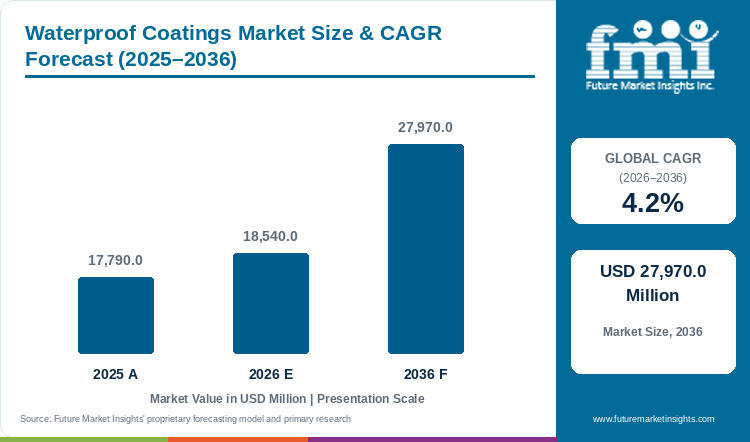
The waterproof coatings market is estimated at USD 17.8 billion in 2025 and is forecast to reach USD 18.5 billion in 2026. Demand is expected to grow at a 4.2% CAGR and will reach USD 28.0 billion by 2036.
Adoption of waterproof coatings is widest in homes, since roofs, terraces, bathrooms and exterior wood all need a sealed surface, and residential users are estimated at 32.4% of end-use sales in 2026. Sales estimated at USD 17.8 billion for 2025 are expected to reach USD 18.5 billion in 2026. FMI analysts expect a 4.2% CAGR across the forecast period, taking sales to a forecast USD 28.0 billion by 2036. A painter can open the can and apply the coat without mixing, so single-component products are likely to take 58.1% of product type sales.
Measured by coating use per square metre, demand intensity peaks in basements, tunnels and bridge decks. Those jobs need thick, multi-coat or two-component systems, and two-component products take an estimated 41.9% of product type sales in 2026. RPM International (Tremco CPG) agreed in September 2026 to buy Volteco, an Italian supplier of below-grade waterproofing with about €28 million of 2025 sales.[1] Below-grade and deck work lays down thicker layers per square metre than a roof repaint, so infrastructure, near 19.8% of end-use sales, carries a larger part of coating value than of coated area.
Key Market Trends & Insights
- Homeowners and small contractors buy one-pot products, giving single-component coatings 58.1% of product type sales in 2026 and two-component systems about 41.9%.
- Demand for waterproof coatings on wood, an estimated 34.6% of application material sales in 2026, comes from decks, fences, furniture and cladding sold through paint retail. Asian Paints grew Indian decorative volume 9% in the June 2026 quarter.[2]
- Homes are expected to take 32.4% of end-use sales in 2026, about 9 points more than commercial buildings. In April 2026, the Spanish Council of Ministers approved a EUR 7,000 million housing plan for 2026 to 2030, with 30% for rehabilitation.[3]
- Jointless films around drains and corners make liquid-applied technology likely to hold 54.3% of technology sales in 2026, more than twice the sheet-based share of 24.6%.
Regional Highlights
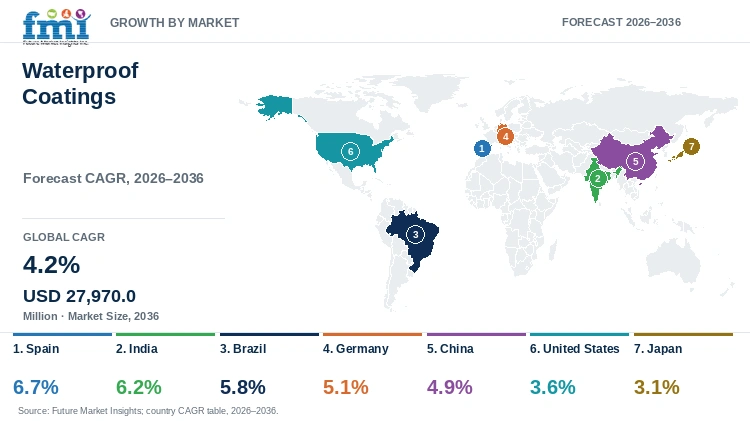
- Housing grants give Spain the quickest growth in FMI's country model, a 6.7% CAGR against 4.2% for the market.
- India and Brazil, on dealer growth and social housing, run close behind at 6.2% and 5.8%. Germany and China stay above the global figure on repair work, and the United States, at 3.6%, sits ahead of Japan, last in the country ranking at 3.1%.
- Brazil's government plans to finance 3 million Minha Casa, Minha Vida homes by the end of 2026, with R$125 billion of FGTS funds set for popular housing in 2026, Poder360 reported.[4]
Market Size & Forecast
Table 1: Market Size and Forecast for the Waterproof Coatings Market (USD million and percentage), 2025 to 2036
| Metric | Value |
|---|---|
| 2025 Market Size | USD 17,790.0 million |
| Estimated Market Size in 2026 | USD 18,540.0 million |
| Projected Market Size by 2036 | USD 27,970.0 million |
| CAGR, 2026 to 2036 | 4.2% |
| Added Revenue, 2026 to 2036 | USD 9,430.0 million |
| Market Expansion Multiple | 1.5x |
Waterproof coating orders follow the building season, with roof and terrace work done before the rains and renovation budgets setting the size of each season. With EMEA 7.7% higher and group sales up 4% in local currencies over January to June 2026, Sika moved the 2026 sales growth outlook up to a range of 3% to 6%.[5] Contractors buy waterproofing with admixtures, sealants and grouts in one package, and the construction chemicals market is forecast to rise at a 5.2% CAGR, so suppliers selling the full package will pick up waterproofing orders on new projects. Under FMI's numbers, waterproof coating sales are predicted to be USD 9.4 billion higher in 2036 than in 2026, about half again the 2026 level. Weak residential construction is the main risk, as Sika saw Chinese construction business fall by double digits over the half.[5]
Housing Programmes, Paint Dealers and Below-Grade Systems
Public housing programmes set the volume of new roofs and wet rooms. Spain's 2026 to 2030 housing plan carries EUR 7,000 million, three times the previous plan, with rehabilitation grants that can reach EUR 20,500 for each home.[3] Brazil aims at an average of 80,000 contracted homes per month through 2026 under Minha Casa, Minha Vida.[4] Each new or renovated home needs roof, bathroom and balcony waterproofing, so these programmes will add coating orders in Spain and Brazil through 2030.
Indian paint dealers stock waterproofing beside wall paint, so dealer growth at the large paint groups widens the shelf for waterproof coatings. Birla Opus sold ₹1,661 crore of paint in the quarter to June 2026, 64% more than a year earlier, through over 1,450 exclusive franchise outlets.[6] AkzoNobel completed the sale of AkzoNobel India, including the liquid paints and coatings business in India, to the parent group of JSW Paints in December 2025 at an enterprise value of about €1.4 billion.[7] Roof coatings reach buyers through the same contractors, and sales in the roofing materials market are expected to expand at a 5.3% CAGR. Roofers buying membranes and shingles will add liquid coatings for details, upstands and repairs.
Table 2: Housing, Dealer and Supplier Indicators for the Waterproof Coatings Market (values, shares and dates), 2025 to 2026
| Indicator | Data Point | Relevance | Source |
|---|---|---|---|
| Spain State Housing Plan 2026 to 2030 | EUR 7,000 million; 30% for rehabilitation | Renovated roofs and bathrooms need waterproofing. | [3] |
| Brazil Minha Casa, Minha Vida target | 3 million homes financed by end-2026 | Social housing adds roof and wet-room jobs. | [4] |
| Sika sales growth, H1 2026 | 4% in local currencies; EMEA up 7.7% | Construction chemical demand is recovering in Europe. | [5] |
| Asian Paints Indian decorative volume, April to June 2026 | Up 9% | Dealer sales of paints and waterproofing rise. | [2] |
| Birla Opus revenue, April to June 2026 | ₹1,661 crore; up 64% | A new dealer network widens the coatings shelf. | [6] |
| RPM International (Tremco CPG) and Volteco, September 2026 | About €28 million of 2025 sales | Below-grade waterproofing draws acquirers. | [1] |
Analyst Perspective
“Spain pays up to EUR 20,500 per home for rehabilitation, and every renovated roof and bathroom needs a waterproof layer. I expect single-component, liquid-applied products to gain the most from that work, because a small contractor can coat a terrace in a day without mixing equipment.”
- Nikhil Kaitwade, Principal Consultant, Future Market Insights.
How is the waterproof coatings market segmented?
The market is segmented into product type, application material, end use, technology, and region. Single-component products are expected to lead product type sales with 58.1% share in 2026, and liquid-applied technology is likely to hold 54.3% of technology sales.
By product type: single component, and two component.
By application material: wood, metal, concrete, and composite.
By end use: residential, commercial, industrial, infrastructure, electrical and electronics, and other industries.
By technology: liquid applied coating technology, sheet based coating technology, nano coating technology, and green coating technology.
By region: building owners and contractors in North America, Latin America, Western Europe, Eastern Europe, East Asia, South Asia and Pacific, and Middle East and Africa.
Why do single-component products lead waterproof coatings sales by product type?
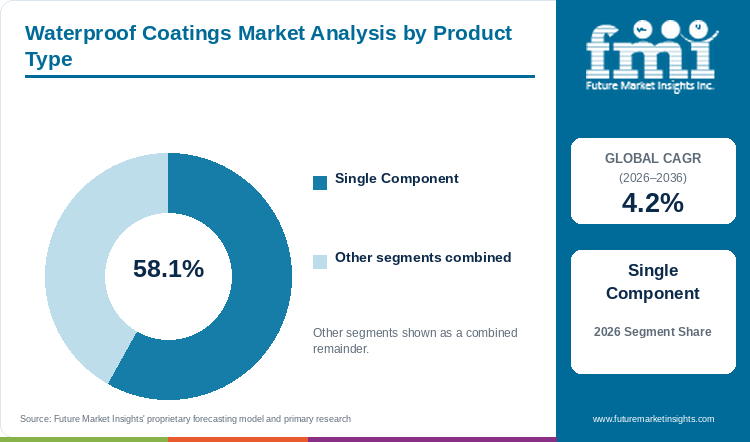
Single-component products are projected to lead product type sales with 58.1% share in 2026, ahead of two-component systems at an estimated 41.9%.
Table 3: Product Type Share for the Waterproof Coatings Market (percentage share), 2026
| Product Type | Estimated Share (2026) |
|---|---|
| Single Component | 58.1% |
| Two Component | 41.9% |
| Total | 100.0% |
Table 4: Product Type Leadership and Market Growth for the Waterproof Coatings Market (segment and CAGR percentage), 2026 to 2036
| Metric | Value |
|---|---|
| Global CAGR (2026 to 2036) | 4.2% |
| Leading Segment | Single Component |
Acrylic, polyurethane and cementitious one-pot products cure on contact with air or moisture and need no mixing on site, so single-component coatings are expected to lead product type sales with 58.1% share in 2026. Two-component systems, estimated at 41.9%, give thicker and harder films for car parks, tanks and bridge decks but need trained crews, mixing gear and exact ratios. Polyurea is a fast-setting two-component chemistry used on heavy decks, and the polyurea coatings market is likely to grow at a 6.3% CAGR across the forecast period, so two-component share will hold up on infrastructure jobs. Homeowners and small contractors buying from a paint dealer pick the one-pot product.
- Acrylic roof coatings, moisture-curing polyurethanes and flexible cementitious slurries form the single-component range.
- Volteco, which RPM International (Tremco CPG) agreed to buy in September 2026, sells flexible liquids, mortars, resins and damp-proofing materials for patch and repair work.[1]
What gives wood the lead in waterproof coatings by application material?
Wood is expected to lead application material sales with an estimated 34.6% share in 2026, ahead of concrete at 31.2%.
Table 5: Application Material Share for the Waterproof Coatings Market (percentage share), 2026
| Application Material | Estimated Share (2026) |
|---|---|
| Wood | 34.6% |
| Concrete | 31.2% |
| Metal | 22.8% |
| Composite | 11.4% |
| Total | 100.0% |
Decks, fences, garden furniture, window frames and cladding need water repellents and sealers renewed every few seasons, so wood is expected to lead application material sales in 2026 at about 34.6%. Concrete, at an estimated 31.2%, covers roofs, basements and wet rooms, and a concrete coat lasts longer between jobs, so repeat buying is lower. Metal, about 22.8%, receives waterproof and anti-corrosion layers on roofs, tanks and steel structures, mostly for industrial buyers. Composite surfaces, near 11.4%, include fibre-cement boards and GRP panels, a small base of coated area. Wood sealers sell through paint shops and DIY stores, so the owner of a timber deck buys again after each weathering cycle.
- Deck oils, wood sealers and clear water repellents for cladding and fences form the wood range.
- Value growth in the Indian decorative business of Asian Paints was 16.6% for the quarter to June 2026.[2]
Why do residential users lead waterproof coatings sales by end use?
Residential users are likely to lead end-use sales with an estimated 32.4% share in 2026, ahead of commercial buildings at 23.6%.
Table 6: End Use Share for the Waterproof Coatings Market (percentage share), 2026
| End Use | Estimated Share (2026) |
|---|---|
| Residential | 32.4% |
| Commercial | 23.6% |
| Infrastructure | 19.8% |
| Industrial | 13.1% |
| Electrical and Electronics | 6.3% |
| Other Industries | 4.8% |
| Total | 100.0% |
Every house needs roof, terrace, bathroom and basement protection, and owners repeat the job after each leak, so residential users will lead end-use sales in 2026 at an estimated 32.4%. Commercial buildings, at an estimated 23.6%, buy on project tenders for offices, malls and data centres, and data centre sales at Sika grew by double digits in the Americas over the half.[5] Infrastructure, about 19.8%, includes bridges, tunnels and water tanks with heavy coating use per job but fewer jobs. Industrial plants, near 13.1%, coat floors and tanks during shutdowns. Electrical and electronics, about 6.3%, uses water-repellent coatings on boards and enclosures, and other industries hold 4.8%. Tile and panel fixing follows the same building cycle, and the construction adhesives market is predicted to increase at a CAGR of 4.6%, so home renovation crews will keep ordering adhesives and waterproof coats together.
- Roofs, terraces, bathrooms, kitchens and basements form the residential job list.
- The Spanish housing plan approved in April 2026 funds rehabilitation at up to EUR 20,500 for a single home.[3]
Why does liquid-applied technology lead waterproof coatings sales by technology?
Liquid-applied coating technology is projected to lead technology sales with an estimated 54.3% share in 2026, ahead of sheet-based systems at 24.6%.
Table 7: Technology Share for the Waterproof Coatings Market (percentage share), 2026
| Technology | Estimated Share (2026) |
|---|---|
| Liquid Applied Coating Technology | 54.3% |
| Sheet Based Coating Technology | 24.6% |
| Green Coating Technology | 13.4% |
| Nano Coating Technology | 7.7% |
| Total | 100.0% |
A jointless film follows pipes, drains and corners on a roof without laps, so liquid-applied technology is estimated to lead technology sales with 54.3% in 2026. Sheet-based systems, an estimated 24.6%, give a factory-controlled thickness and suit large flat roofs and below-grade walls, though each lap needs welding or taping. Green coating technology, about 13.4%, covers water-based and low-VOC products asked for by public buyers. Nano coatings, near 7.7%, go on glass, textiles and electronics in thin layers, so coated value per job is small. Two-pack liquids are applied with the same rollers and sprayers, and the 2K coatings market is forecast to expand at a 4.7% CAGR, so crews trained on liquid systems will move between one-pot and two-pot products on the same job.
- Acrylic, polyurethane, bitumen-modified and cementitious liquids form the liquid-applied group.
- Closing of the Volteco purchase by RPM International (Tremco CPG) is expected in the second quarter of fiscal 2027, adding the Amphibia sheet membrane to the range.[1]
What are the drivers, restraints, and opportunities in the waterproof coatings market?
Housing and repair programmes keep roofs, terraces and wet rooms in need of fresh waterproof layers. Raw material swings and contractor skill gaps hold back premium systems, and basements, tunnels and decks open room for heavier two-component products.
- Driver: Public housing and renovation grants put new roofs and bathrooms on contractor schedules, and each one needs a waterproof layer before tiling or finishing.
- Restraint: Volatile resin and solvent prices squeeze coating makers, and untrained applicators often choose cheaper cement slurries over premium membranes.
- Opportunity: Below-grade, tunnel and deck projects need thick, chemical-resistant systems, so suppliers with two-component and sheet ranges sell more value per job.
Housing Programmes Add Roof and Wet-Room Jobs
Increasing public housing finance is supporting the demand for roof and wet-room waterproofing. Brazil's Ministry of Cities aims to finance 3 million Minha Casa, Minha Vida homes by the end of 2026, with about 2 million contracted by the end of 2025.[4] Thirty percent of the EUR 7,000 million Spanish plan goes to rehabilitation.[3] Builders on these programmes specify low-cost liquid coatings for roofs and bathrooms, so single-component volume rises with each housing tranche.
Raw Material Swings and Applicator Skills Limit Premium Systems
Producers of waterproof coatings face volatile raw material costs and a shortage of trained applicators. Asian Paints pointed to volatility in raw material prices in July 2026 and used calibrated pricing actions.[2] Price revisions at Birla Opus added up to an 8.8% overall impact over the June quarter.[6] Higher shelf prices push small contractors toward cheaper cement slurries, and premium polyurethane and polyurea systems need crews trained in mixing and film thickness.
Below-Grade and Data Centre Projects Need Heavier Systems
Basements, tunnels and data centre slabs need thick waterproofing that resists water pressure. In September 2026, RPM International (Tremco CPG) agreed to buy Volteco, maker of the Amphibia below-grade membrane.[1] Data centre activity for Sika in the United States grew at a double-digit rate over January to March 2026 despite winter storms.[8] Suppliers with two-component and sheet systems will gain larger orders per project from these builders.
Which country CAGRs are profiled in the waterproof coatings market?
Table 8: Country CAGR Comparison for the Waterproof Coatings Market (CAGR percentage), 2026 to 2036
| Country | CAGR (2026 to 2036) |
|---|---|
| Spain | 6.7% |
| India | 6.2% |
| Brazil | 5.8% |
| Germany | 5.1% |
| China | 4.9% |
| United States | 3.6% |
| Japan | 3.1% |
How do country-level CAGRs compare in the waterproof coatings market?
The Spanish housing plan for 2026 to 2030 triples the budget of the previous plan to EUR 7,000 million, Legal Today reported.[3] Five of the seven profiled markets beat the 4.2% global CAGR in FMI's ranking. Housing grants put Spain first at 6.7%, dealer growth carries India to 6.2%, and social housing gives Brazil 5.8%. Renovation keeps Germany at 5.1%, and repair work holds China at 4.9% after the new-build slump. Mature re-roofing cycles leave the United States at 3.6% and Japan at 3.1%.
- Spanish rehabilitation grants put roof and facade repairs on contractor schedules.
- Paint dealers in India sell waterproofing before each monsoon.
- Social housing builders in Brazil coat roofs and bathrooms in every new block.
- German apartment owners pair flat-roof repairs with insulation upgrades.
- Orders in China are moving from new towers to repair of existing buildings.
- Data centre slabs add new orders in the United States.
- Japanese condominium owners renew roof and balcony waterproofing during large-scale repairs.
Full report country CAGRs cover: two Western European countries (Spain, Germany), two East Asian countries (China, Japan), India, Brazil and the United States, with Eastern Europe and Middle East and Africa handled through regional totals.
Country-wise Analysis
Spain Waterproof Coatings Market Outlook (2026 to 2036)
The 2026 to 2030 State Housing Plan, approved by the Council of Ministers in April 2026, sets aside EUR 7,000 million.[3] FMI places Spain at a 6.7% CAGR, 2.5 points over the global figure. Rehabilitation grants will put roof and facade repairs on contractor schedules in Spanish cities, and each repair needs a waterproof coat.
Key takeaway: Grant-funded roof and facade repairs will keep Spanish coating orders rising fastest.
India Waterproof Coatings Market Outlook (2026 to 2036)
Demand for waterproof coatings in India is projected, per FMI's country model, to rise at a 6.2% CAGR, second only to Spain. Asian Paints sold 9% more decorative paint by volume in India over the June quarter.[2] Birla Opus grew sales 64% in the same three months.[6] AkzoNobel completed the sale of AkzoNobel India to the parent group of JSW Paints in December 2025.[7] Sika named India a standout performer in Asia Pacific over the six months to June 2026.[5] Paint dealers sell waterproofing beside wall paint before each monsoon, so dealer growth at these groups widens the shelf for waterproof coatings.
Key takeaway: Paint-dealer reach and monsoon repairs carry Indian growth.
Brazil Waterproof Coatings Market Outlook (2026 to 2036)
About 2 million Minha Casa, Minha Vida homes had financing contracted by the end of 2025, and the Ministry of Cities wants 3 million by the end of 2026, backed by R$144.5 billion of FGTS funds for 2026, Poder360 reported.[4] In the FMI outlook, Brazil will expand at a 5.8% CAGR, 1.6 points faster than the market average. Social housing builders will specify low-cost acrylic and cementitious coatings for roofs and bathrooms in each new block.
Key takeaway: Social housing keeps Brazilian coating orders growing.
Germany Waterproof Coatings Market Outlook (2026 to 2036)
Sika said German performance improved in Q2 2026.[5] Roof renovation points to a likely 5.1% CAGR for Germany. Owners of apartment blocks are pairing flat-roof repairs with insulation upgrades, and each repair uses liquid-applied or sheet waterproofing.
Key takeaway: Roof renovation keeps Germany above the global rate.
China Waterproof Coatings Market Outlook (2026 to 2036)
A double-digit fall in Chinese construction business led Sika to make structural adjustments there in 2026.[5] FMI expects China to grow at a 4.9% CAGR, 0.7 points over the global figure, as repair of existing housing and infrastructure replaces new residential towers as the main source of orders. Waterproofing contractors will shift crews from new towers to leak repair on older estates.
Key takeaway: Repair work supports China after the new-build slump.
United States Waterproof Coatings Market Outlook (2026 to 2036)
Winter storms and economic uncertainty weighed on U.S. construction early in 2026, though data centre work kept growing, Sika said.[8] Sika opened a concrete admixtures plant in Florida and expanded mortar production in New Jersey during the half.[5] The United States is expected to grow at a 3.6% CAGR, 0.6 points under the global figure, because re-roofing of a large existing stock grows slowly. Data centre and warehouse slabs will bring the strongest new orders.
Key takeaway: Data centres add growth on top of a slow re-roofing base in the United States.
Japan Waterproof Coatings Market Outlook (2026 to 2036)
Japanese condominium owners renew roof and balcony waterproofing during scheduled large-scale repairs. Japan, last in the country ranking, is projected at a 3.1% CAGR. Repair contractors working on an ageing building stock keep orders steady, and few new housing starts limit growth.
Key takeaway: Repair cycles hold Japan steady at the low end of the group.
Who are the notable companies in the waterproof coatings market?
Sika, AkzoNobel, Asian Paints, Birla Opus, Berger Paints, Kansai Nerolac, JSW Paints, Dow, GAF and RPM International (Tremco CPG) are the profiled companies.
Coating makers compete for waterproofing work through specification sales to contractors and dealer sales to homeowners. Half-year net sales at Sika came to CHF 5,589.8 million, 4% higher in local currencies.[5] Consolidated net sales at Asian Paints grew 17.9% to ₹10,521.4 crore in the quarter to June 2026.[2] Below-grade waterproofing is coming into RPM International (Tremco CPG) through the Volteco deal.[1] AkzoNobel, Birla Opus, Berger Paints, Kansai Nerolac, JSW Paints, Dow and GAF complete the profiled group.
- Construction chemical specialists: Sika and RPM International (Tremco CPG).
- Global paint and materials groups: AkzoNobel and Dow.
- Indian paint makers: Asian Paints, Birla Opus, Berger Paints, Kansai Nerolac and JSW Paints.
- Roofing manufacturer: GAF.
Competitive Benchmarking: Waterproof Coatings Market
Table 9: Competitive Benchmarking for the Waterproof Coatings Market (qualitative documentation ratings), 2026
| Company | Liquid-Applied Range | Sheet Systems | Dealer Reach | Recency |
|---|---|---|---|---|
| Sika | High | High | Medium | High |
| RPM International (Tremco CPG) | Medium | High | Low | High |
| Asian Paints | Medium | Low | High | High |
| Birla Opus | Low | Low | High | High |
| AkzoNobel | Medium | Low | Medium | Medium |
Scoring follows the amount of recent release detail on an attribute, and the grades carry no share reading.
Key Developments in the Waterproof Coatings Market
- On 23 September 2026, RPM International (Tremco CPG) agreed to acquire Italian waterproofing supplier Volteco.[1]
- On 12 August 2026, Grasim announced ₹1,661 crore of Birla Opus sales for the quarter, 64% higher.[6]
- On 29 July 2026, Asian Paints announced 9% Indian decorative volume growth for the quarter.[2]
- On 28 July 2026, Sika moved the 2026 local-currency growth outlook up to a range of 3% to 6%.[5]
- On 21 April 2026, Spain's Council of Ministers approved the EUR 7,000 million State Housing Plan for 2026 to 2030.[3]
- On 14 April 2026, Sika reported first-quarter sales of CHF 2,490.2 million.[8]
- On 13 December 2025, Poder360 reported Brazil's goal of 3 million financed homes by the end of 2026.[4]
- On 10 December 2025, AkzoNobel completed the sale of AkzoNobel India.[7]
Key Players in the Waterproof Coatings Market
Construction Chemical Specialists
- Sika
- RPM International (Tremco CPG)
Global Paint and Materials Groups
- AkzoNobel
- Dow
Indian Paint Makers
- Asian Paints
- Birla Opus
- Berger Paints
- Kansai Nerolac
- JSW Paints
Roofing Manufacturer
- GAF
Waterproof Coatings Market - Report Scope
Table 10: Report Scope for the Waterproof Coatings Market (coverage fields and definitions), 2026 to 2036
| Coverage field | Report scope |
|---|---|
| Market breakdown | Product type; application material; end use; technology; region |
| Quantitative units | USD million |
| Market definition | Single- and two-component coatings that form a water barrier on wood, metal, concrete and composite surfaces, applied as liquids, sheets, nano layers or low-VOC green formulations. |
| Regions covered | North America; Latin America; Western Europe; Eastern Europe; East Asia; South Asia and Pacific; Middle East and Africa |
| Countries covered | United States; Canada; Brazil; Mexico; Argentina; Chile; Germany; France; United Kingdom; Italy; Spain; Benelux; Nordics; Poland; Czech Republic; Romania; Hungary; China; Japan; South Korea; India; ASEAN; Australia and New Zealand; GCC Countries; South Africa; Türkiye; Israel |
| Key companies profiled | Sika, AkzoNobel, Asian Paints, Birla Opus, Berger Paints, Kansai Nerolac, JSW Paints, Dow, GAF, RPM International (Tremco CPG) |
| Forecast period | 2026 to 2036 |
Waterproof Coatings Market - Research Methodology
Table 11: Research Methodology for the Waterproof Coatings Market (research methods and approach), 2026 edition
| Method | Approach |
|---|---|
| Data Sources | Coating and construction chemical company results, housing programme notices and trade press from May 2025 onward. |
| Desk Research | Housing budgets, dealer networks, acquisitions, plant openings and raw material pricing. |
| Market Sizing and Forecasting | Sizing starts from the 2025 base of USD 17,790.0 million and the 4.2% CAGR for 2026 to 2036. |
| Data Validation | Sales, budgets and dates were matched to the company, ministry or publication that released them. |
Waterproof Coatings Market by Segments
Waterproof Coatings Market segmented by Product Type:
- Single Component
- Two Component
Waterproof Coatings Market segmented by Application Material:
- Wood
- Metal
- Concrete
- Composite
Waterproof Coatings Market segmented by End Use:
- Residential
- Commercial
- Industrial
- Infrastructure
- Electrical and Electronics
- Other Industries
Waterproof Coatings Market segmented by Technology:
- Liquid Applied Coating Technology
- Sheet Based Coating Technology
- Nano Coating Technology
- Green Coating Technology
Waterproof Coatings Market by Region
- North America
- United States
- Canada
- Latin America
- Brazil
- Mexico
- Argentina
- Chile
- Western Europe
- Germany
- France
- United Kingdom
- Italy
- Spain
- Benelux
- Nordics
- Eastern Europe
- Poland
- Czech Republic
- Romania
- Hungary
- East Asia
- China
- Japan
- South Korea
- South Asia and Pacific
- India
- ASEAN
- Australia and New Zealand
- Middle East and Africa
- GCC Countries
- South Africa
- Türkiye
- Israel
Research Sources and Bibliography
- [1] Painting & Coatings Industry. (2026, September 23). RPM to Acquire Italian Waterproofing Supplier Volteco. https://www.pcimag.com/articles/115267-rpm-to-acquire-italian-waterproofing-supplier-volteco
- [2] Asian Paints Limited. (2026, July 29). Asian Paints Press Release Q1 FY27. https://www.asianpaints.com/content/dam/asianpaints/website/secondary-navigation/press-releases/2026-2027/Asian-Paints-Press-Release-Q1FY27.pdf
- [3] Legal Today. (2026, April 21). El Consejo de Ministros aprueba el nuevo Plan Estatal de Vivienda. https://www.legaltoday.com/actualidad-juridica/noticias-de-derecho/el-consejo-de-ministros-apruebael-nuevo-plan-estatal-de-vivienda-2026-04-21/
- [4] Poder360. (2025, December 13). Governo quer financiar 3 milhões de moradias até 2026. https://www.poder360.com.br/poder-economia/governo-quer-financiar-3-milhoes-de-moradias-ate-2026/
- [5] Sika AG. (2026, July 28). Half-Year Report 2026. https://www.sika.com/en/media/media-releases/2026/half-year-report-2026.html
- [6] Grasim Industries Limited. (2026, August 12). Grasim Results Q1FY27. https://www.grasim.com/media/press-releases/grasim-results-q1fy-2026-27
- [7] AkzoNobel. (2025, December 10). AkzoNobel completes sale of AkzoNobel India to JSW Group. https://akzonobel.com/en/media/media-releases/akzonobel-completes-sale-of-akzonobel-india-to-jsw-group
- [8] Sika AG. (2026, April 14). Sika Reports Q1 2026 Sales of CHF 2.49 Billion. https://www.sika.com/dms/getdocument.get/df266823-ccd9-4a5d-8270-d83a6077d4e6/glo-en-media-release-Q1-14042026.pdf
This bibliography is provided for reader reference. The full report contains the complete reference list and detailed citations.
This Report Answers
- How big is the waterproof coatings market during 2026?
- What market size is projected by 2036?
- Which product type holds notable share?
- Which application material holds notable share?
- Which countries have notable growth?
- Which companies are notable in the market?
Frequently Asked Questions
How large is the waterproof coatings market expected in 2026?
Waterproof coatings are expected to reach USD 18.5 billion of sales in 2026, from an estimated USD 17.8 billion in 2025. FMI projects USD 28.0 billion by 2036.
What CAGR is projected for the waterproof coatings market through 2036?
A 4.2% CAGR is forecast for 2026 to 2036. Housing programmes, renovation grants and infrastructure decks support that rate.
Which product type holds a notable market share in 2026?
One-pot single-component coatings are likely to hold 58.1% of product type sales in 2026. Two-component systems account for an estimated 41.9%.
Which application material holds a notable market share in 2026?
Decks, fences and cladding give wood the lead, at an estimated 34.6% share in 2026. Concrete is close behind at 31.2%.
Which country has a notable expansion outlook through 2036?
Spain has the fastest profiled rate in the FMI outlook, a 6.7% CAGR. Japan grows slowest at 3.1%.
Who are the key companies in the waterproof coatings market?
Sika, AkzoNobel, Asian Paints, Birla Opus and RPM International (Tremco CPG) are among the key companies. Berger Paints, Kansai Nerolac, JSW Paints, Dow and GAF complete the profiled group.
Preview the report firsthand - request a free sample
Get SampleGet the brochure for pricing and purchase details.
Get PDFTable of Content
- Key Takeaways
- Market Size and CAGR
- Top Growth Driver
- Fastest Growing Segment
- Leading Region
- Key Companies
- Emerging Opportunities
- Executive Summary
- Global Market Outlook
- Demand-side Trends
- Supply-side Trends
- Technology Roadmap Analysis
- Analysis and Recommendations
- Analyst Perspective (What is happening? Why now? What should investors know?)
- Key Questions Answered
- How large is the market?
- What is the CAGR?
- What are key trends?
- Which region dominates?
- Who are the leaders?
- Market Overview
- Market Coverage / Taxonomy
- Market Definition / Scope / Limitations
- Research Methodology
- Chapter Orientation
- Analytical Lens and Working Hypotheses
- Market Structure, Signals, and Trend Drivers
- Benchmarking and Cross-market Comparability
- Market Sizing, Forecasting, and Opportunity Mapping
- Research Design and Evidence Framework
- Desk Research Programme (Secondary Evidence)
- Expert Input and Fieldwork (Primary Evidence)
- Tooling, Models, and Reference Databases
- Data Engineering and Model Build
- Quality Assurance and Audit Trail
- Market Background
- Market Dynamics (Drivers, Restraints, Opportunity, Trends)
- Scenario Forecast (Optimistic, Likely, Conservative)
- Impact Analysis
- AI Impact
- Sustainability Impact
- Regulatory Impact
- Technology Impact
- Consumer / Buyer Analysis
- Purchase Drivers
- Adoption Barriers
- Buyer Journey
- Opportunity Map Analysis
- Product Life Cycle Analysis
- Supply Chain Analysis
- Investment Feasibility Matrix
- Value Chain Analysis
- PESTLE and Porter's Analysis
- Regulatory Landscape
- Regional Parent Market Outlook
- Production and Consumption Statistics
- Import and Export Statistics
- Global Market Analysis and Forecast, 2021 to 2036
- Historical Market Size Value (USD Million) Analysis, 2021 to 2025
- Current and Future Market Size Value (USD Million) Projections, 2026 to 2036
- Y-o-Y Growth Trend Analysis
- Absolute $ Opportunity Analysis
- Global Market Pricing Analysis, 2021 to 2036
- Global Market Analysis and Forecast, By Product Type, 2021 to 2036
- Introduction / Key Findings
- Historical Market Size Value (USD Million) Analysis By Product Type, 2021 to 2025
- Current and Future Market Size Value (USD Million) Analysis and Forecast By Product Type, 2026 to 2036
- Single Component
- Two Component
- Y-o-Y Growth Trend Analysis By Product Type, 2021 to 2025
- Absolute $ Opportunity Analysis By Product Type, 2026 to 2036
- Global Market Analysis and Forecast, By Application Material, 2021 to 2036
- Introduction / Key Findings
- Historical Market Size Value (USD Million) Analysis By Application Material, 2021 to 2025
- Current and Future Market Size Value (USD Million) Analysis and Forecast By Application Material, 2026 to 2036
- Wood
- Metal
- Concrete
- Composite
- Y-o-Y Growth Trend Analysis By Application Material, 2021 to 2025
- Absolute $ Opportunity Analysis By Application Material, 2026 to 2036
- Global Market Analysis and Forecast, By End Use, 2021 to 2036
- Introduction / Key Findings
- Historical Market Size Value (USD Million) Analysis By End Use, 2021 to 2025
- Current and Future Market Size Value (USD Million) Analysis and Forecast By End Use, 2026 to 2036
- Residential
- Commercial
- Industrial
- Infrastructure
- Electrical and Electronics
- Other Industries
- Y-o-Y Growth Trend Analysis By End Use, 2021 to 2025
- Absolute $ Opportunity Analysis By End Use, 2026 to 2036
- Global Market Analysis and Forecast, By Technology, 2021 to 2036
- Introduction / Key Findings
- Historical Market Size Value (USD Million) Analysis By Technology, 2021 to 2025
- Current and Future Market Size Value (USD Million) Analysis and Forecast By Technology, 2026 to 2036
- Liquid Applied Coating Technology
- Sheet Based Coating Technology
- Nano Coating Technology
- Green Coating Technology
- Y-o-Y Growth Trend Analysis By Technology, 2021 to 2025
- Absolute $ Opportunity Analysis By Technology, 2026 to 2036
- Global Market Analysis and Forecast, By Region, 2021 to 2036
- Introduction
- Historical Market Size Value (USD Million) Analysis By Region, 2021 to 2025
- Current Market Size Value (USD Million) Analysis and Forecast By Region, 2026 to 2036
- North America
- Latin America
- Western Europe
- Eastern Europe
- East Asia
- South Asia and Pacific
- Middle East and Africa
- Market Attractiveness Analysis By Region
- North America Market Analysis and Forecast, By Country, 2021 to 2036
- Historical Market Size Value (USD Million) Trend Analysis By Market Taxonomy, 2021 to 2025
- Market Size Value (USD Million) Forecast By Market Taxonomy, 2026 to 2036
- By Country
- United States
- Canada
- By Product Type
- By Application Material
- By End Use
- By Technology
- By Country
- Market Attractiveness Analysis
- By Country
- By Product Type
- By Application Material
- By End Use
- By Technology
- Key Takeaways
- Latin America Market Analysis and Forecast, By Country
- Historical Market Size Value (USD Million) Trend Analysis By Market Taxonomy, 2021 to 2025
- Market Size Value (USD Million) Forecast By Market Taxonomy, 2026 to 2036
- By Country
- Brazil
- Mexico
- Argentina
- Chile
- By Product Type
- By Application Material
- By End Use
- By Technology
- By Country
- Market Attractiveness Analysis
- By Country
- By Product Type
- By Application Material
- By End Use
- By Technology
- Key Takeaways
- Western Europe Market Analysis and Forecast, By Country
- Historical Market Size Value (USD Million) Trend Analysis By Market Taxonomy, 2021 to 2025
- Market Size Value (USD Million) Forecast By Market Taxonomy, 2026 to 2036
- By Country
- Germany
- France
- United Kingdom
- Italy
- Spain
- Benelux
- Nordics
- By Product Type
- By Application Material
- By End Use
- By Technology
- By Country
- Market Attractiveness Analysis
- By Country
- By Product Type
- By Application Material
- By End Use
- By Technology
- Key Takeaways
- Eastern Europe Market Analysis and Forecast, By Country
- Historical Market Size Value (USD Million) Trend Analysis By Market Taxonomy, 2021 to 2025
- Market Size Value (USD Million) Forecast By Market Taxonomy, 2026 to 2036
- By Country
- Poland
- Czech Republic
- Romania
- Hungary
- By Product Type
- By Application Material
- By End Use
- By Technology
- By Country
- Market Attractiveness Analysis
- By Country
- By Product Type
- By Application Material
- By End Use
- By Technology
- Key Takeaways
- East Asia Market Analysis and Forecast, By Country
- Historical Market Size Value (USD Million) Trend Analysis By Market Taxonomy, 2021 to 2025
- Market Size Value (USD Million) Forecast By Market Taxonomy, 2026 to 2036
- By Country
- China
- Japan
- South Korea
- By Product Type
- By Application Material
- By End Use
- By Technology
- By Country
- Market Attractiveness Analysis
- By Country
- By Product Type
- By Application Material
- By End Use
- By Technology
- Key Takeaways
- South Asia and Pacific Market Analysis and Forecast, By Country
- Historical Market Size Value (USD Million) Trend Analysis By Market Taxonomy, 2021 to 2025
- Market Size Value (USD Million) Forecast By Market Taxonomy, 2026 to 2036
- By Country
- India
- ASEAN
- Australia and New Zealand
- By Product Type
- By Application Material
- By End Use
- By Technology
- By Country
- Market Attractiveness Analysis
- By Country
- By Product Type
- By Application Material
- By End Use
- By Technology
- Key Takeaways
- Middle East and Africa Market Analysis and Forecast, By Country
- Historical Market Size Value (USD Million) Trend Analysis By Market Taxonomy, 2021 to 2025
- Market Size Value (USD Million) Forecast By Market Taxonomy, 2026 to 2036
- By Country
- GCC Countries
- South Africa
- Türkiye
- Israel
- By Product Type
- By Application Material
- By End Use
- By Technology
- By Country
- Market Attractiveness Analysis
- By Country
- By Product Type
- By Application Material
- By End Use
- By Technology
- Key Takeaways
- Key Countries Market Analysis
- United States
- Pricing Analysis
- Market Share Analysis, 2025
- By Product Type
- By Application Material
- By End Use
- By Technology
- Canada
- Pricing Analysis
- Market Share Analysis, 2025
- By Product Type
- By Application Material
- By End Use
- By Technology
- Mexico
- Pricing Analysis
- Market Share Analysis, 2025
- By Product Type
- By Application Material
- By End Use
- By Technology
- Brazil
- Pricing Analysis
- Market Share Analysis, 2025
- By Product Type
- By Application Material
- By End Use
- By Technology
- Chile
- Pricing Analysis
- Market Share Analysis, 2025
- By Product Type
- By Application Material
- By End Use
- By Technology
- Germany
- Pricing Analysis
- Market Share Analysis, 2025
- By Product Type
- By Application Material
- By End Use
- By Technology
- United Kingdom
- Pricing Analysis
- Market Share Analysis, 2025
- By Product Type
- By Application Material
- By End Use
- By Technology
- Italy
- Pricing Analysis
- Market Share Analysis, 2025
- By Product Type
- By Application Material
- By End Use
- By Technology
- Spain
- Pricing Analysis
- Market Share Analysis, 2025
- By Product Type
- By Application Material
- By End Use
- By Technology
- France
- Pricing Analysis
- Market Share Analysis, 2025
- By Product Type
- By Application Material
- By End Use
- By Technology
- India
- Pricing Analysis
- Market Share Analysis, 2025
- By Product Type
- By Application Material
- By End Use
- By Technology
- ASEAN
- Pricing Analysis
- Market Share Analysis, 2025
- By Product Type
- By Application Material
- By End Use
- By Technology
- Australia and New Zealand
- Pricing Analysis
- Market Share Analysis, 2025
- By Product Type
- By Application Material
- By End Use
- By Technology
- China
- Pricing Analysis
- Market Share Analysis, 2025
- By Product Type
- By Application Material
- By End Use
- By Technology
- Japan
- Pricing Analysis
- Market Share Analysis, 2025
- By Product Type
- By Application Material
- By End Use
- By Technology
- South Korea
- Pricing Analysis
- Market Share Analysis, 2025
- By Product Type
- By Application Material
- By End Use
- By Technology
- Poland
- Pricing Analysis
- Market Share Analysis, 2025
- By Product Type
- By Application Material
- By End Use
- By Technology
- Hungary
- Pricing Analysis
- Market Share Analysis, 2025
- By Product Type
- By Application Material
- By End Use
- By Technology
- Türkiye
- Pricing Analysis
- Market Share Analysis, 2025
- By Product Type
- By Application Material
- By End Use
- By Technology
- South Africa
- Pricing Analysis
- Market Share Analysis, 2025
- By Product Type
- By Application Material
- By End Use
- By Technology
- United States
- Market Structure Analysis
- Competition Dashboard
- Competition Benchmarking
- Market Share Analysis of Top Players
- By Regional
- By Product Type
- By Application Material
- By End Use
- By Technology
- Emerging Startups
- Innovation Benchmarking
- Competition Analysis
- Competition Deep Dive
- Sika
- Overview
- Product Portfolio
- Profitability by Market Segments
- Sales Footprint
- Strategy Overview
- Marketing Strategy
- Product Strategy
- Channel Strategy
- RPM International (Tremco CPG)
- Asian Paints
- Birla Opus
- AkzoNobel
- Dow
- Berger Paints
- Kansai Nerolac
- JSW Paints
- GAF
- Sika
- Case Studies
- Success Stories
- Recent Developments
- Competition Deep Dive
- Assumptions & Acronyms Used


