


Executive Summary: From Label Compliance to Proof-of-Control Manufacturing
Packaged food manufacturers are moving from basic allergen label compliance to proof-of-control manufacturing. The risk is not limited to a wrong label. It can start with supplier changes, shared equipment or weak cleaning verification inside the plant.
The business pressure is sharper because allergens affect both consumer safety and brand trust. FDA requires companies to list ingredients on packaged food and beverage labels. FDA also applies specific labeling rules for major food allergens. This makes allergen control a factory process issue and a label governance issue at the same time. [5]
This report examines the needs of CTOs, Marketing/Sales leaders, CIOs and CEOs in packaged food manufacturing. It connects Future Market Insights market data with public evidence from FDA, CDC and USDA FSIS. The SaaS opportunity is to turn allergen tests, cleaning checks and label records into one proof layer for process control and customer trust.
CDC reported in January 2026 that 6.7% of USA adults had a diagnosed food allergy in 2024. The same source reported that 5.3% of USA children had a diagnosed food allergy in 2024. This consumer-risk base makes allergen proof more than a compliance file. It becomes part of how packaged food brands protect repeat purchase and retailer confidence. [6]
Market Overview: The Proof Burden in Food Allergen Testing
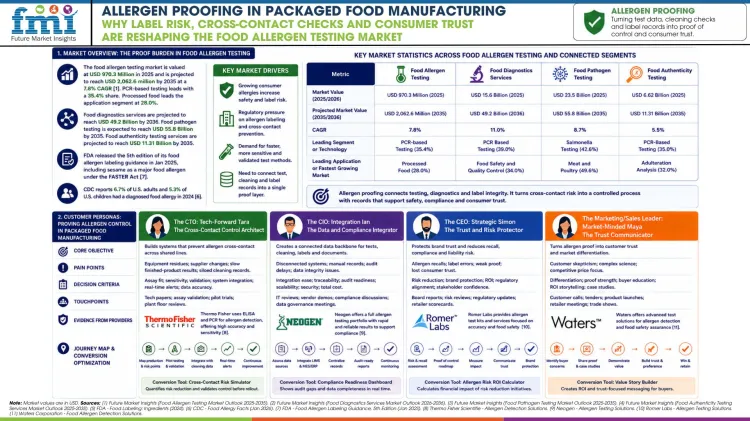
The food allergen testing market is valued at USD 970.3 Million in 2025. Future Market Insights projects it to reach USD 2,062.6 million by 2035. The market is forecast to expand at a 7.8% CAGR from 2025 to 2035. PCR-based testing is expected to lead the technology segment with a 35.4% share. Processed food is expected to lead the application segment with a 28.0% share. [1]
The adjacent testing markets show why allergen proofing belongs inside a broader food safety data system. Food diagnostics services are projected to reach USD 49.2 Billion by 2036. Food pathogen testing is expected to reach USD 55.8 Billion by 2035. Food authenticity testing services are projected to reach USD 11.31 Billion by 2035. These markets connect product safety, label accuracy and traceable test evidence. [2] [3] [4]
FDA published the fifth edition of its food allergen labeling guidance in January 2025. The guidance covers allergen labeling requirements under the Federal Food, Drug and Cosmetic Act. It also reflects sesame’s inclusion as a major food allergen under the FASTER Act. This keeps label accuracy and cross-contact prevention high on the packaged food manufacturing agenda. [7]
Key Market Statistics Across Food Allergen Testing and Connected Segments:
| Metric | Food Allergen Testing | Food Diagnostics Services | Food Pathogen Testing | Food Authenticity Testing |
|---|---|---|---|---|
| Market Value (2025/2026) | USD 970.3 Million (2025) | USD 15.6 Billion (2025) | USD 23.5 Billion (2025) | USD 6.62 Billion (2025) |
| Projected Market Value (2035/2036) | USD 2,062.6 Million (2035) | USD 49.2 Billion (2036) | USD 55.8 Billion (2035) | USD 11.31 Billion (2035) |
| CAGR | 7.8% | 11.0% | 8.7% | 5.5% |
| Leading Segment or Technology | PCR-based Testing (35.4%) | PCR Based Testing (39.0%) | Salmonella Testing (42.6%) | PCR-Based Testing (35.0%) |
| Leading Application or Fastest Growing Market | Processed Food (28.0%) | Food Safety and Quality Control (34.0%) | Meat and Poultry (49.6%) | Adulteration Analysis (32.0%) |
These figures show that allergen proofing sits between testing, diagnostics and label integrity. Food allergen testing provides the specific cross-contact and ingredient-risk evidence. Food diagnostics services add the broader quality-control system. Food pathogen testing shares the same plant-level testing infrastructure. Food authenticity testing reinforces the label-accuracy burden. This makes allergen proofing software useful for CTOs and marketing teams that need process control and customer proof.
Customer Personas: Proving Allergen Control in Packaged Food Manufacturing
The CTO: Tech-Forward Tara - The Cross-Contact Control Architect
Tech-Forward Tara is the CTO in a packaged food company. She owns the technical problem behind allergen proofing. Her plant may run products with milk, peanut, wheat or sesame on shared lines. She needs to know whether cleaning, swabbing and finished-product testing prove control before a product reaches packaging.
- Core Objective: Tara must turn allergen control into a repeatable production system. She needs test data and process records that show cross-contact risk is under control.
- Pain Points: Shared equipment can create allergen residue risk after a product changeover. Supplier substitutions can change allergen exposure when ingredient documentation arrives late. Finished-product testing alone may be too slow if the issue began during staging or mixing. Cleaning verification can lose value when results are stored outside the production record.
- Decision Criteria: Tara reviews assay fit and matrix performance. She checks whether the platform can connect line clearance, sanitation checks and product testing. She needs alert rules that separate routine checks from a true cross-contact risk. Validation matters because false confidence can create label risk.
- Touchpoints: Tara reviews technical whitepapers, assay validation notes and plant-floor proof-of-concept trials.
Evidence from Providers:
Thermo Fisher Scientific states that allergen testing is commonly carried out using ELISA and PCR techniques in food manufacturing labs. The company also notes that some processed proteins such as egg and milk can be difficult to detect in certain processed foods. This supports Tara’s need to match test method, product matrix and process step before relying on one result. [9]
Journey Map & Conversion Optimization:
Tara’s journey starts with a line-level risk map. She identifies shared equipment, allergen changeovers and cleaning-verification gaps. A SaaS provider should offer a Cross-Contact Control Pilot. The pilot should connect sanitation results, product matrix rules and line-clearance data. Conversion improves when Tara sees which process step creates the highest allergen proof gap.
Marketing & Sales: Growth-Focused Grace - The Label Trust Builder
Growth-Focused Grace leads Marketing and Sales. She must protect consumer trust in the packaged food label. A product can lose buyer confidence if allergen information is unclear or if a recall shows weak internal control. Her challenge is to turn allergen proof into a credible trust story without overstating safety claims.
- Core Objective: Grace must use allergen-control evidence to support retailer confidence and consumer trust. She needs proof that label claims are backed by controlled production records.
- Pain Points: Sales teams may lack evidence behind allergen-free or allergen-aware positioning. Retail buyers may ask for control records after a category issue. Consumer trust can fall quickly when undeclared allergens trigger public alerts. Marketing claims can create risk if proof records cannot support them.
- Decision Criteria: Grace needs clear label-risk dashboards and retailer-ready proof summaries. She values testing evidence that can support account reviews. She also needs guardrails that stop sales teams from using unsupported allergen claims.
- Touchpoints: Grace uses retailer meetings, customer service reports and sales enablement workshops.
Evidence from Providers:
Hygiena states that its rapid PCR, ELISA and lateral flow solutions help detect and control allergens in ingredients, surfaces and finished products before they reach consumers. The company also connects allergen detection with documentation needs for food and beverage brands. This evidence fits Grace’s need for proof that can support label trust. [10]
Journey Map & Conversion Optimization:
Grace’s journey begins when a retailer asks how the brand manages allergen risk. She needs a clean answer that links label claims with production evidence. A SaaS provider should offer a Label Trust Proof Pack. The pack should show allergen-control checkpoints, verified test records and claim-review status. Conversion improves when Grace can use the same proof in retailer reviews and internal brand-risk meetings.
The CIO: Data-Driven David - The Allergen Record Governor
Data-Driven David owns the records behind allergen proof. He must connect supplier documents, batch records and test results. His problem is not only storage. He needs a reliable chain of evidence when a customer, auditor or regulator asks how a label decision was made.
- Core Objective: David must maintain trusted allergen records across ingredients, production and finished products. He needs data integrity from supplier intake to label release.
- Pain Points: Supplier allergen declarations may sit in procurement files. Cleaning checks may sit in plant spreadsheets. Laboratory results may be stored in separate systems. Label approval records can become disconnected from the batch data that supports them.
- Decision Criteria: David reviews ERP fit and API access. He needs audit trails, role-based access and automated record retention. He also checks whether the platform can connect supplier changes with label impact before production begins.
- Touchpoints: David reviews vendor risk assessments, IT architecture workshops and compliance documentation.
Evidence from Providers:
USDA FSIS issued Directive 7230.1 in September 2025 on managing establishment profiles in the Public Health Information System. The directive includes attention to allergen and labeling controls inside inspected establishments. This reinforces David’s need for structured records that can support inspection and label-control workflows. [8]
Journey Map & Conversion Optimization:
David’s journey starts with an allergen data map. He identifies where supplier files, cleaning logs and finished-product results are stored. A SaaS provider should offer an Allergen Record Readiness Checklist. The checklist should map each record to a compliance or customer-proof need. Conversion improves when David sees one batch-level evidence chain from supplier intake to label approval.
The CEO: Strategic Simon - The Recall Exposure Sponsor
Strategic Simon is the CEO of a packaged food manufacturer. He sees allergen control as a brand-risk and account-risk issue. A wrong label can trigger recall cost and customer trust loss. He wants assurance that the company can prove control before an incident becomes public.
- Core Objective: Simon must reduce recall exposure and protect retailer relationships. He needs allergen proofing to support growth without adding avoidable brand risk.
- Pain Points: Allergen recalls can damage category trust and retailer confidence. Manual controls can break when the company adds new SKUs or new suppliers. Growth can increase risk when shared lines run more frequent product changeovers.
- Decision Criteria: Simon evaluates software by recall-risk reduction and retailer confidence. He values dashboards that show risk by plant, product family and supplier. He needs the business case to connect proofing cost with avoided disruption and stronger account retention.
- Touchpoints: Simon reviews board packs, recall-risk briefings and customer quality scorecards.
Evidence from Providers:
Romer Labs states that its allergen test kits are designed for routine analyses as part of an allergen management plan. The company also links its testing approach with HACCP principles. This supports Simon’s need for a repeatable control system that can scale across plants and product lines. [11]
Journey Map & Conversion Optimization:
Simon’s journey begins with a risk review after a label change or customer audit. He asks whether the company can prove allergen control across high-risk product families. A SaaS provider should offer a Recall Exposure Dashboard. The dashboard should rank risk by product line, supplier and production route. Conversion improves when Simon can compare current manual control cost with the cost of a recall event.
Key Market Research Pointers: Future Outlook for B2B SaaS in Food Allergen Testing
To provide a specific perspective beyond standard syndicated research, consider these five evidence-based pointers for the future of the food allergen testing market, specifically for B2B SaaS providers:
- Cross-Contact Risk Maps for Shared Production Lines: Allergen testing software will move beyond storing final test results. The stronger platform will map risk by ingredient, line and changeover sequence. CTOs can use this view to adjust cleaning checks before a high-risk product runs. This turns allergen control into a live process map rather than an end-of-line record.
- Label Claim Governance for Packaged Food Brands: Label risk often begins before packaging artwork is approved. SaaS platforms can connect supplier declarations, recipes and allergen rules to label review. Marketing teams can then see whether an allergen claim is supported by current production evidence. This reduces the gap between brand language and plant reality.
- Cleaning Verification Workflows with Test Escalation: Cleaning records and allergen test results often sit apart. A SaaS workflow can connect sanitation sign-off with swab testing and product release. If a line fails a threshold or misses a check, the system can escalate before packaging begins. This gives the CTO a stronger control point during changeovers.
- Supplier Allergen Change Alerts for Recipe Owners: Ingredient changes can create label risk even when the plant process does not change. SaaS platforms can alert R&D, quality and label teams when supplier allergen declarations shift. This helps manufacturers stop production errors before a batch uses an outdated label. The value comes from catching risk before it enters the production schedule.
- Retailer-Ready Allergen Proof Packs: Retailers need evidence that allergen controls are more than policy statements. SaaS platforms can create proof packs with supplier declarations, test results and label approvals. Sales teams can use these packs in customer reviews. CIOs can use the same record set for audits and dispute handling.
Uniqueness Explanation: These pointers move beyond market size and test-method commentary. The article focuses on how allergen risk moves through ingredients, lines and labels. The operating shift is from test completion to proof-of-control manufacturing. The technology shift is from lab records to connected allergen governance. The buyer shift is from compliance interest to evidence-backed trust.
Conclusion: The Strategic Imperative of Allergen Proofing
Allergen proofing is becoming a core requirement in packaged food manufacturing. Label risk and cross-contact checks now affect more than quality teams. They shape production release, retailer confidence and consumer trust. The strongest packaged food manufacturers will not only test for allergens. They will show how each allergen-control decision is backed by process evidence.
B2B SaaS providers must connect supplier records, line checks and label approvals in one system. CTOs need control over cross-contact points. Marketing teams need proof that supports customer trust. CIOs need audit-ready records. CEOs need lower recall exposure. The practical opportunity is clear. Allergen testing data must become a proof system before products reach the shelf.
Ready to strengthen allergen proofing in packaged food manufacturing? Request a Demo of our Allergen Control Intelligence Platform to manage cross-contact checks, govern label claims and build retailer-ready proof.
References
- [1] Future Market Insights. "Food Allergen Testing Market: Global Industry Analysis 2015 - 2024 and Opportunity Assessment 2025 - 2035." July 8, 2025. https://www.futuremarketinsights.com/reports/food-allergen-testing-market
- [2] Future Market Insights. "Food Diagnostics Services Market | Global Market Analysis Report - 2036." https://www.futuremarketinsights.com/reports/food-diagnostics-market
- [3] Future Market Insights. "Food Pathogen Testing Market Size 2025-2035." April 5, 2025. https://www.futuremarketinsights.com/reports/food-pathogen-testing-market
- [4] Future Market Insights. "Food Authenticity Testing Services Market Size & Trends 2025 to 2035." June 30, 2025. https://www.futuremarketinsights.com/reports/food-authenticity-market
- [5] USA Food and Drug Administration. "Food Allergies." March 11, 2026. https://www.fda.gov/food/nutrition-food-labeling-and-critical-foods/food-allergies
- [6] Centers for Disease Control and Prevention. "Almost a Third of USA Adults and Children Have at Least One Diagnosed Allergic Condition." January 8, 2026. https://www.cdc.gov/nchs/pressroom/releases/20260108.html
- [7] USA Food and Drug Administration. "Guidance for Industry: Questions and Answers Regarding Food Allergens, Including the Food Allergen Labeling Requirements of the Federal Food, Drug, and Cosmetic Act." January 6, 2025. https://www.fda.gov/regulatory-information/search-fda-guidance-documents/guidance-industry-questions-and-answers-regarding-food-allergen-labeling-edition-5
- [8] USA Department of Agriculture Food Safety and Inspection Service. "FSIS Directive 7230.1: Establishment Profile in the Public Health Information System." September 11, 2025. https://www.fsis.usda.gov/policy/fsis-directives/7230.1
- [9] Thermo Fisher Scientific. "Food Allergens Testing Information." https://www.thermofisher.com/in/en/home/industrial/food-beverage/food-beverage-learning-center/food-analytical-testing-information/food-allergens-testing-information.html
- [10] Hygiena. "Food Allergen Detection for Safer, Compliant Production". https://www.hygiena.com/food-safety/allergen-detection
- [11] Romer Labs. "Food Allergen Testing Solutions." https://www.romerlabs.com/en/food-allergen-test-kits

