


- In-line leak testing becomes financially justified when a failed part creates costly rework, warranty exposure, safety risk, scrap, or line disruption.
- The strongest business case is usually found in high-volume sealed assemblies where manual testing cannot keep pace with production.
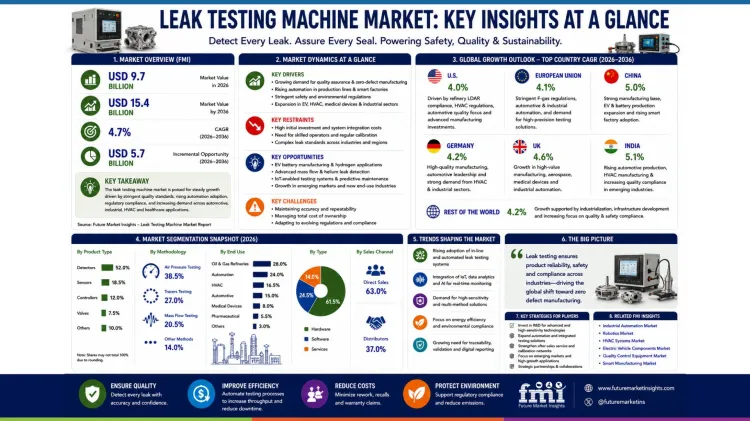
- FMI expects automation end use to account for 24.0% of leak testing machine demand in 2026, reflecting growing use of controlled line-level validation.
- Air-pressure testing leads methodology demand with a 38.5% share because dry testing supports faster inspection in automotive and HVAC production.
- Integrated cells can command a higher value than standalone testers when they combine fixtures, robotic loading, guarding, serial-level records, and validation support.
- The investment should be assessed against the cost of escaped defects and production interruption, not only against labour saved per shift.
The decision to install an in-line leak testing machine often begins with a quality problem rather than an automation strategy. A manufacturer may be handling a growing volume of warranty claims. It may be finding leaks only after final assembly. It may be using manual water-bath checks that slow production and create inconsistent records. In other cases, it may be producing sealed parts whose failure cannot be tolerated once the product reaches a vehicle, refrigeration system, refinery, medical device, or industrial installation.
This is where in-line testing changes from a quality-control expense into a production asset.
FMI estimates that the leak testing machine market will rise from USD 9.7 billion in 2026 to USD 15.4 billion by 2036 at a 4.7% CAGR. Hardware is projected to contribute 61.5% of market demand, detectors account for 52.0% of hardware revenue, and air-pressure testing represents 38.5% of methodology demand. These shares suggest that the market is still rooted in physical test instruments, fixtures, and production-line deployment rather than software alone.
The ROI case becomes strongest when a manufacturer can identify the precise operational cost of a leak. That cost may include rejected production, disassembly, replacement parts, technician time, transport, warranty claims, damaged customer confidence, safety incidents, refrigerant loss, field repair, or plant downtime. In battery assembly, an unverified cooling plate or housing can create thermal-management and safety concerns. In HVAC production, a refrigerant leak can lead to failed final inspection, costly repair, or non-compliance risk. In medical products, a weak seal can affect sterility or fluid integrity. In refinery equipment, a leak may create a far larger operational and environmental consequence.
Manual testing becomes difficult when cycle time is short. A production line moving several hundred parts per hour cannot rely on an inspection method that requires prolonged immersion, visual interpretation, operator judgment, or repeated handling. Water-bath testing can be useful for some applications, but it introduces slower handling and does not naturally create the digital records that large manufacturers increasingly require.
FMI directly identifies the shift away from manual inspection as a long-term driver for replacement demand. The report notes that automated factories prefer in-line testers because manual water-bath checks slow cycle time and reduce traceability. This is an important distinction. The payback is not limited to labour reduction. It comes from protecting throughput while improving evidence that every part passed the required test.
Air-pressure testing holds a practical advantage in many high-volume environments. It is dry, relatively fast, and suitable for automotive parts, HVAC assemblies, enclosures, valves, and sealed housings. A pressure-decay system can identify whether a part loses pressure beyond an approved threshold during a defined interval. Its suitability depends on part volume, allowable leak rate, test time, fixture quality, temperature stability, and the need for traceable records.
A pressure-decay tester can justify itself quickly in a standardized production environment. Consider a manufacturer of HVAC coils, refrigerant lines, battery enclosures, fuel systems, or fluid-control assemblies. If each component follows a repeatable geometry and can be loaded into a fixture rapidly, the test station can be integrated into the production sequence without creating a bottleneck. The financial benefit grows when the line would otherwise require dedicated inspectors or when a failed component would travel further downstream before discovery.
The next layer of ROI comes from fixtures. In many leak testing projects, the instrument is only one part of the cost. The fixture needs to seal the component repeatedly without damaging it, accommodate tolerances, survive thousands of cycles, and allow rapid loading and unloading. The FMI market analysis highlights fixture engineering as an area of supplier differentiation, particularly for Cincinnati Test Systems and CETA Testsysteme. This reflects a practical reality, since poor fixture repeatability can turn a technically capable tester into an unreliable production station.
The return case improves when the machine is attached to a defined production bottleneck. A battery manufacturer may need to inspect cooling plates before assembly. An automotive supplier may need to confirm fuel rail, transmission housing, braking component, or thermal module integrity before further assembly. A refrigerator manufacturer may need to validate sealed refrigerant circuits before shipment. In each case, the test station can prevent the value added by later production steps from being applied to a defective part.
EV battery manufacturing is becoming one of the clearer high-value uses for advanced in-line systems. FMI states that battery cell makers need systems capable of finding very small leaks without slowing production. It cites the INFICON 2025 ELT Vmax data sheet, which lists a smallest detectable leak rate of 5x10^-8 mbar l/s and a multi-chamber output of 640 cells per minute. Such equipment is not necessary for every sealed component. It becomes relevant where micro-leaks could affect cell performance, battery safety, coolant control, or warranty exposure.
This creates an important ROI divide. Standard pressure-decay testing can be appropriate for many automotive, appliance, HVAC, and industrial components. High-sensitivity tracer-gas or vacuum systems are more appropriate for products with lower allowable leak limits or higher failure consequences. The return is stronger where the buyer can quantify the cost of the defect. A premium leak detection system may not pay back quickly in a low-volume, low-risk application. The same system can be essential in battery cells, vacuum hardware, semiconductor equipment, advanced medical packaging, or critical industrial seals.
Automation also changes the average selling price of leak testing systems. FMI observes that automotive automation is moving buyers beyond standalone testers into integrated cells with robotic loading, safety guarding, traceability software, and validation support. These cells cost more, and they can remove multiple sources of variation at once. A robot can place the part consistently. The fixture can seal it in the same position each cycle. The tester can record leak-rate data. The line control system can reject failed parts automatically. Quality teams can retrieve records by serial number.
The additional return comes from fewer unplanned decisions on the shop floor. Operators do not need to interpret a questionable test visually. Supervisors do not need to locate an unrecorded defect source. Quality engineers can compare results by lot, fixture, shift, component version, or supplier batch. In regulated or safety-critical production, that traceability can carry more value than the test result itself.
The ROI calculation should also account for calibration and maintenance. Leak testing machines are not install-and-forget equipment. Sensors drift, fixtures wear, and seals deteriorate. Temperature changes can affect pressure measurements. Gas-based systems may require consumables and leak-standard verification. A buyer that ignores these requirements can overestimate payback.
FMI notes that calibration requirements and the move toward controlled production assets strengthen long-term equipment replacement demand. This suggests that suppliers can create recurring service revenue through calibration, fixture refurbishment, preventive maintenance, validation support, and software upgrades. Buyers should include these costs in total ownership calculations rather than treating machine purchase price as the full investment.
The right timing for in-line automation is usually visible through a few operating signals. Growing rework or scrap linked to sealed components is one. A line whose speed exceeds manual inspection capability is another. A product launch where leakage failures would be expensive in the field is a third indicator. A customer requirement for traceability points the same way, as does a labour-constrained facility where trained inspection operators are difficult to retain.
The weaker use case is a low-volume operation with varied part geometries, infrequent testing, and limited cost of failure. Such facilities may be better served by benchtop systems, flexible fixtures, service providers, or shared test stations. In-line automation requires stable volumes and enough repeatability to justify the engineering.
The practical conclusion is that in-line leak testing pays back when it protects value already being created on the line. The system is most compelling when defects are expensive, production is fast, parts are repeatable, and records matter. The equipment is less about replacing an inspector and more about preventing a defective sealed component from becoming a larger operational, safety, or warranty event.

