


The plant-based food industry is at a pricing pressure point. Consumer interest remains stable and the “Green Premium” remains high, often ranging from 40% to 80%. This pricing analysis examines Biological Arbitrage. The concept refers to the strategic use of plant-derived inputs to replicate animal-based sensory experiences at lower biological conversion cost. The commercial outcome is more complex. Plant-based products can still carry higher economic prices after ingredient processing and retail margin pressure.
This report analyzes the core business objectives of CEOs, CTOs, CIOs and Marketing/Sales leaders. It integrates data from multiple Future Market Insights reports and vendor-verified evidence from leaders like Unilever, Danone and Beyond Meat. The report provides a unique perspective on why the Green Premium persists. It explains how B2B SaaS providers can offer technical infrastructure to close this gap through supply chain cost tracking and predictive formulation. Pricing strategy tools form the third layer.
Market Overview: The Persistence of the Green Premium
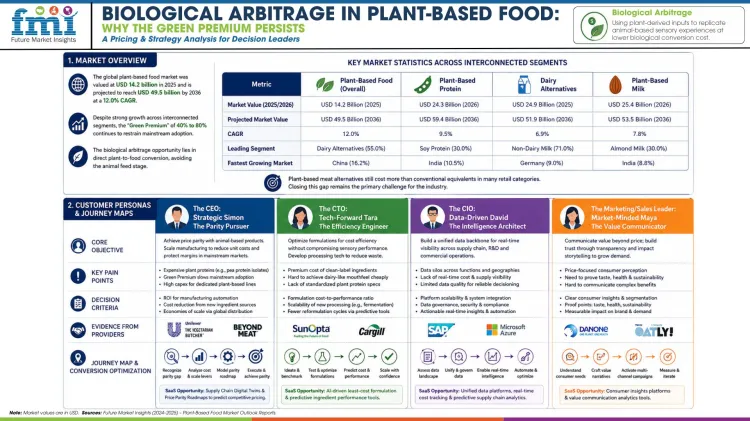
The global plant-based food market was valued at USD 14.2 billion in 2025. It is projected to reach USD 49.5 billion by 2036 at a 12.0% CAGR. Pricing dynamics continue to restrain broader adoption. The plant-based protein market is a key segment and is expected to reach USD 24.3 billion by 2026. The dairy alternatives market is projected to reach USD 51.9 billion by 2036. Despite these large connected markets, price parity remains difficult.
Key Market Statistics Across Interconnected Segments:
| Metric | Plant-Based Food (Overall) | Plant-Based Protein | Dairy Alternatives | Plant-Based Milk |
|---|---|---|---|---|
| Market Value (2025/2026) | USD 14.2 Billion (2025) | USD 24.3 Billion (2026) | USD 24.9 Billion (2025) | USD 25.4 Billion (2026) |
| Projected Market Value | USD 49.5 Billion (2036) | USD 59.4 Billion (2036) | USD 51.9 Billion (2036) | USD 53.5 Billion (2036) |
| CAGR | 12.0% | 9.5% | 6.9% | 7.8% |
| Leading Segment | Dairy Alternatives (55.0%) | Soy Protein (30.0%) | Non-Dairy Milk (71.0%) | Almond Milk (30.0%) |
| Fastest Growing Market | China (16.2%) | India (10.5%) | Germany (9.0%) | India (8.8%) |
The biological arbitrage opportunity lies in direct plant-to-food conversion. This route avoids the animal feed stage. The current economic reality is less simple. Plant-based meat alternatives still cost more than conventional equivalents in many retail categories. Closing this gap remains the primary challenge for the industry.
Customer Personas: Navigating the Economics of Plant-Based Food
The CEO: Strategic Simon - The Parity Pursuer
Strategic Simon is the CEO of a plant-based food brand. He is focused on price parity. He knows early adopters are willing to pay a premium. The mainstream consumer is more price-sensitive. His primary goal is to scale manufacturing and reduce ingredient costs. He needs a price point that competes directly with conventional meat and dairy.
- Core Objective: To achieve price parity with animal-based products. He must scale manufacturing to reduce unit costs and protect margins during expansion into price-sensitive mainstream markets.
- Pain Points: Specialized plant proteins such as pea protein isolates remain expensive. The Green Premium slows mainstream adoption. Dedicated plant-based production lines can require high capital expenditure.
- Decision Criteria: Return on Investment for manufacturing automation. Cost reduction potential from new ingredient sources. Ability to use economies of scale through global distribution.
Evidence from Providers:
Unilever has built a visible position through its brand The Vegetarian Butcher. The brand benefits from Unilever’s global distribution network and established foodservice relationships. Beyond Meat continues to focus on price parity through manufacturing scale and supply chain cost control.
Journey Map & Conversion Optimization:
Simon’s journey involves SaaS platforms that offer Supply Chain Digital Twins. These tools identify cost-saving opportunities in logistics and manufacturing. Conversion opportunities lie in Price Parity Roadmaps. These roadmaps use market data to predict when specific product lines can reach competitive pricing.
The CTO: Tech-Forward Tara - The Efficiency Engineer
Tech-Forward Tara is the CTO. She is tasked with the technical challenge of Biological Arbitrage. She needs to engineer plant-based matrices that mimic animal fat and protein structures with less expensive inputs. Clean-label ingredients often carry a premium price. Less expensive synthetic alternatives can face consumer resistance.
- Core Objective: To optimize formulations for cost efficiency without weakening sensory performance. She must develop processing technologies that reduce ingredient waste.
- Pain Points: Clean-label functional ingredients can raise cost. Dairy-like mouthfeel is difficult to achieve with inexpensive plant bases. Plant proteins often lack standardized performance specifications.
- Decision Criteria: Formulation cost-to-performance ratio. Scalability of new processing techniques such as precision fermentation. Ability to reduce reformulation cycles through predictive modeling.
- Touchpoints: Technical whitepapers from ingredient suppliers like SunOpta. R&D symposiums and sensory benchmarking reports also influence her evaluation.
Evidence from Providers:
Plant protein selection is moving from basic protein content toward formulation performance. Tara needs suppliers that provide application support and reduce trial work. Soy protein represents a 30.0% share of the market. It remains preferred because of cost control and processing familiarity.
Journey Map & Conversion Optimization:
Tara’s journey is focused on technical optimization. She needs SaaS platforms that offer AI-driven least-cost formulation tools. These tools can suggest ingredient substitutions that maintain sensory parity and reduce costs. Conversion opportunities include Sensory Benchmarking Dashboards. These dashboards compare the cost and performance of different plant-protein sources.
The CIO: Data-Driven David - The Value Chain Orchestrator
Data-Driven David is the CIO. He manages data flow across a complex supply chain. He needs to track the cost of every input from farm gate to retail shelf. He must identify where the Green Premium is being added. Plant-protein price volatility makes real-time cost visibility important.
- Core Objective: To implement supply chain visibility platforms that track costs in real time. He must improve inventory management and support cleaner procurement decisions.
- Pain Points: Supplier data is fragmented across many systems. Ingredient price changes are not always visible in real time. Sustainability initiatives can be difficult to measure through a true-cost lens.
- Decision Criteria: Real-time data integration capabilities. Predictive analytics for ingredient pricing. Procurement management modules with strong controls.
- Touchpoints: ERP system audits, supply chain visibility workshops and data security reviews.
Evidence from Providers:
Route-to-market complexity remains high. Retail represents a 26.0% share and requires disciplined replenishment. Offline retail accounts for 65.0% of plant-based food movement. This makes inventory planning important for chilled and shelf-stable distribution.
Journey Map & Conversion Optimization:
David’s journey is about data orchestration. He evaluates SaaS platforms based on integration with ERP and procurement systems. Conversion opportunities include Ingredient Price Volatility Alerts. Supply Chain Transparency Modules can help justify the Green Premium through verified cost data.
Marketing & Sales: Growth-Focused Grace - The Value Storyteller
Growth-focused Grace leads Marketing and Sales. She must justify the Green Premium to retail buyers and consumers. She must also support lower prices to drive volume. Her value story must go beyond environmental claims. It must show why the product offers better value in taste and lifestyle fit.
- Core Objective: To craft narratives that justify the current premium through consumer value. She must prepare for a high-volume and lower-margin mainstream future.
- Pain Points: Consumers can react negatively to shelf price gaps. Biological Arbitrage is difficult to explain to a general audience. Retailers often pressure brands to reduce prices.
- Decision Criteria: Consumer willingness-to-pay data. Competitor pricing benchmarks. Ability to use private-label strategies for more affordable options.
- Touchpoints: Retail category management meetings, consumer insight surveys and brand positioning workshops.
Evidence from Providers:
Almond Milk holds a 30.0% share of the plant-based milk market. Its position reflects use across premium and mass assortment ladders. Grace can apply this pattern through tiered pricing strategies. Premium barista versions can sit alongside more affordable everyday formats.
Journey Map & Conversion Optimization:
Grace’s journey involves translating market data into sales strategy. She needs SaaS platforms that offer Retail Category Analytics. These tools show buyers how plant-based products support category value. Consumer Value-Perception Dashboards help identify suitable price points for different shopper groups.
Key Market Research Pointers: Future Outlook for B2B SaaS in Plant-Based Pricing
To provide a specific perspective beyond standard syndicated research, consider these five evidence-based pointers for B2B SaaS in the Plant-Based Food Market:
- 1. AI-Driven Price Parity Prediction Engines: Future SaaS platforms are expected to use datasets on crop yields, energy costs and manufacturing efficiency. These tools can predict when specific plant-based categories may reach price parity with animal products. CEOs can use this view to time market entry and scaling investments with more confidence.
- 2. Biological Arbitrage Optimization Software: Software are anticipated to move beyond least-cost formulation. Biological Arbitrage tools will identify plant-protein structures that can replicate animal sensory experiences with lower processing demand. This can lower the cost base before the product reaches manufacturing scale.
- 3. Real-Time Green Premium Transparency Dashboards: SaaS tools can help brands show a clear breakdown of the Green Premium at the shelf. QR-code-linked dashboards could show how much of the extra cost comes from sourcing or processing. This can turn the premium into a clearer value claim where evidence supports it.
- 4. Decentralized Micro-Manufacturing Management Platforms: The industry may use smaller local production hubs to reduce logistics costs. SaaS platforms would manage production schedules, ingredient availability and local demand signals. This model can reduce freight costs if quality control stays consistent across sites.
- 5. Dynamic Pricing Models for Flexitarian Segments: Future pricing will not always be static. SaaS tools can support targeted discounts for flexitarian consumers based on purchase history. These tools can encourage shoppers to substitute plant-based options more often. Higher volume can support the lower unit cost needed for parity.
- Uniqueness Explanation: These pointers analyze the economic and biological drivers of the market. They offer practical strategies for B2B SaaS development that go beyond simple cost-plus pricing models.
Conclusion: Closing the Gap through Technological Infrastructure
The Green Premium in the plant-based food market is not just a pricing problem. It is a technology and data orchestration challenge. B2B SaaS providers that offer tools for Biological Arbitrage can help optimize each step of the value chain from seed to shelf. These systems can support the industry’s move from a premium niche to a mainstream global standard. Closing the price gap remains the central commercial test for plant-based food.
Call to Action (CTA)
Are you ready to work toward price parity in plant-based food? Request a Demo of our Value Chain Optimization Platform to identify cost-saving opportunities, improve formulations and close the Green Premium gap.
References
- [1] Future Market Insights. "Plant-Based Food Market | Global Market Analysis Report - 2036."
- [2] Future Market Insights. "Plant-Based Protein Market Analysis 2026 to 2036."
- [3] Future Market Insights. "Dairy Alternative Market Demand & Growth - 2036."
- [4] Future Market Insights. "Plant-based Milk Market | Global Dairy Alternatives Industry Forecast & Outlook 2036."

