


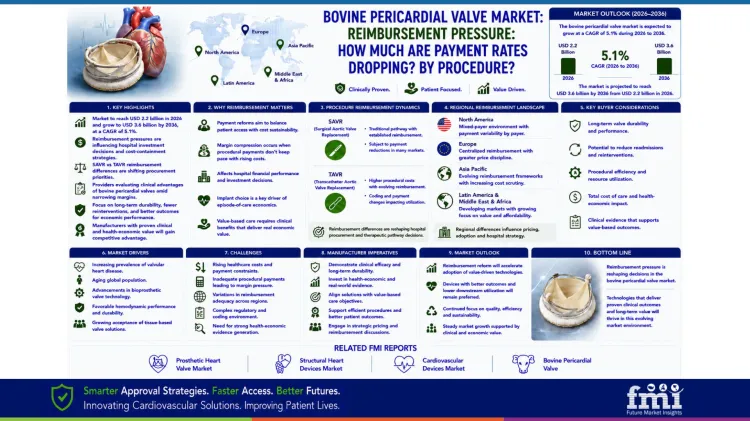
- The bovine pericardial valve market is expected to reach USD 2.2 billion in 2026 and grow to USD 3.6 billion by 2036, reflecting a 5.1% CAGR over the forecast period.
- Reimbursement pressures for cardiac procedures are increasingly influencing hospital investment decisions, particularly in markets where payment reforms focus on cost containment and care based on outcomes.
- The difference in procedure-level reimbursement of surgical aortic valve replacement (SAVR) versus trans catheter interventions is shifting procurement priorities across cardiovascular centers.
- Healthcare providers are evaluating the clinical advantages of bovine pericardial valves relative to the narrowing procedural margins, resulting in more stringent value evaluations during purchase decisions.
- Hospitals are concerned with long-term valve durability, lower intervention rates, and better post-procedure outcomes to ensure positive economic performance in the context of changing reimbursement structures.
- With increasing scrutiny of reimbursement, manufacturers who can demonstrate both clinical efficacy and health-economic value will improve their competitive position.
The bovine pericardial valve market continues to evolve in an increasingly complex reimbursement environment. The development of bio prosthetic valve technologies has expanded treatment options for patients with valvular heart disease, but healthcare systems worldwide are facing growing pressure to optimise cardiovascular spending.
In this context, reimbursement dynamics are emerging as an important driver of device use patterns and procurement strategies.
The market is expected to reach USD 3.6 billion by 2036, growing at a CAGR of 5.1% during the forecast period, generating USD 2.2 billion in 2026. This growth is driven by the increasing prevalence of valvular diseases, aging populations and increasing acceptance of tissue-based valve replacement options.
Rising costs of healthcare have forced a re-evaluation of procedural reimbursement models by public and private payers alike.
The costs of diagnostics, surgery, hospitalization, physician services and post-operative care are high when cardiac interventions are performed with bovine pericardial valves. As such, reimbursement policies are increasingly trying to balance patient access and financial sustainability.
Hospitals operating under fixed payment models are particularly sensitive to reimbursement changes.
Procedural payments do not adequately compensate for rising treatment costs, which leads to margin compression. That environment encourages more scrutiny of all pieces that drive episode-of-care economics, including implant choice.
Bovine pericardial valves have many features that are aligned with value-based health care objectives.
Their use in appropriately selected patient populations is supported by reduced requirements for life-long anticoagulation therapy, favorable hemodynamic performance and improving durability profiles. But hospitals are increasingly demanding evidence that these clinical benefits translate into real economic benefits as well.
The decision between surgical vs catheter-based pathways of treatment further complicates reimbursement considerations.
Changes in procedural coding, inpatient reimbursement patterns, and resource allocation may affect institutional attitudes toward therapeutic approaches. Therefore, clinicians assess bovine pericardial valve technologies not only in terms of clinical aspects, but also in terms of the financial impact on the overall performance.
And then you get the regional differences, which make things even more complicated.
Markets with government-financed health care systems often have centralized reimbursement schedules that impose more price discipline. Mixed-payer environments may offer more flexibility, but may also lead to variations in the adequacy of payments for patient populations.
But the trend is the same, wherever you are. Providers are increasingly interested in technologies that can help them to drive high-quality outcomes within defined economic parameters.
Procurement strategies are changing accordingly.
Traditional buying decisions were heavily price driven. Today, hospitals are expanding their evaluation criteria to include long-term durability, procedural efficiency, potential for reducing readmissions, and implications for total cost of care. Manufacturers are therefore stepping up efforts to produce health-economic evidence.
In commercial discussions, traditional safety and efficacy data are being increasingly supplemented by clinical studies demonstrating improvements in durability, lower complication rates and positive patient outcomes.
We must dispel the myth that reimbursement pressure always dampens demand for advanced cardiovascular technologies.
In reality, reimbursement reform can speed up adoption of interventions that offer better value propositions. But devices that deliver better results with less downstream health care utilization tend to remain well positioned even when broader cost containment initiatives are in play.
The dynamic of bovine pericardial valves presents challenges and opportunities.
Manufacturers need to meet increasingly sophisticated buyer expectations while showing how their technologies contribute to evolving healthcare goals of quality, efficiency and sustainability.
Bottom Line
The way decisions are made about using bovine pericardial valves is changing because of pressure from reimbursement. Economic scrutiny is partly a function of payment constraints, but technologies capable of supporting positive clinical outcomes and long-term health care value should remain well positioned for growth over the forecast period.

