


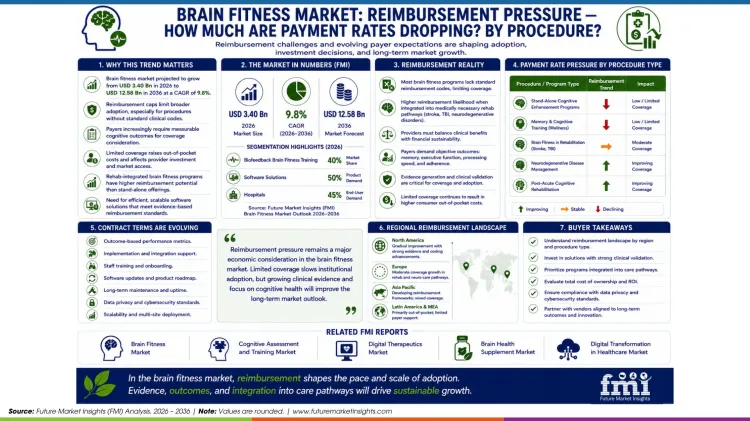
- The brain fitness market is projected to grow from $3.40 billion in 2026 to $12.58 billion in 2036 at a CAGR of 9.8%, as cognitive wellness gains traction in healthcare and preventive care.
- Reimbursement caps remain barriers to greater use of brain fitness interventions especially for procedures and programs that lack standard clinical coding structures.
- And today hospitals and wellness providers are increasingly requiring measurable cognitive outcomes from brain fitness therapies before they will provide reimbursement support.
- Limited payer coverage results in greater out-of-pocket costs for consumers, which influences provider investment decisions and market access.
- Brain fitness programs integrated into rehabilitation pathways are more likely to achieve positive reimbursement than stand-alone cognitive enhancement offerings.
- Growing need for efficient, scalable software solutions for brain health that satisfy evolving evidence-based reimbursement standards.
The brain fitness market is changing in a healthcare system that is increasingly focused on value, better patient outcomes and cost management. There is increasing awareness around cognitive health, but reimbursement for brain fitness interventions is fragmented and inconsistent across global healthcare systems.
This economic reality has implications for provider adoption and investment decisions.
The market is projected to reach USD 12.58 billion by 2036, growing at a CAGR of 9.8% from USD 3.40 billion in 2026. This growth is driven by increasing consumer awareness regarding cognitive wellness, technological advancements in digital therapeutics, and rising prevalence of neurological and age-related cognitive disorders.
Good fundamentals for growth, but undeveloped reimbursement pathways.
They are usually not covered by standard reimbursement systems for cognition-enhancing brain fitness programs. As a result, patients are often left to fork over most of the costs themselves. This dynamic can reduce participation rates and limit access for price-sensitive populations.
On the other hand, the likelihood of reimbursement is higher for cognitive interventions embedded in medically indicated rehabilitation programs.
The procedures aimed at the support of the recovery of stroke, traumatic brain injury rehabilitation or neurodegenerative diseases management are slowly shifting the focus on the restoration of cognition as a part of larger treatment strategies. Brain fitness solutions could be integrated into existing reimbursement frameworks in these settings.
Thus, important economic factors confront healthcare providers.
When evaluating investments in brain health, hospitals and rehabilitation centres need to balance clinical effectiveness with financial sustainability. Even if there is proven therapeutic benefit, institutional adoption of solutions without a clear path for reimbursement may be slower.
Hence, evidence generation has become a critical market requirement.
Payers want objective outcome measures before they extend coverage for reimbursement. The discussion around eligibility for coverage is increasingly focusing on memory retention, executive function, processing speed and patient adherence.
The trend is toward providers who can generate robust clinical validation.
Software-based brain fitness platforms appear particularly well positioned against this changing context. This allows for wider deployment with less resource intensity. They are scalable and remotely accessible and relatively less costly to implement.
In terms of segmentation, biofeedback brain fitness training is a market demand of 40% in 2026 with high usage in the existing applications. Likewise, software held a 50% share of the product segment, indicating the growing significance of digital delivery models.
These dynamics are reinforced by end-user patterns.
The rise of integrated neurological care pathways and cognitive rehab will drive hospitals to account for 45% of market demand by 2026. But uncertainty about reimbursement still determines both the timelines for purchase and the scale of implementation.
Regional reimbursement environments differ significantly.
As the evidence base for cognitive interventions grows, comprehensive healthcare systems may slowly open up more reimbursement opportunities. At the same time, common patterns of demand driven by consumers are likely to continue in areas that are heavily dependent on private spending.
The misconception to avoid is that reimbursement equals market viability.
"Consumer awareness, aging populations and technological innovation continue to fuel demand. However, reimbursement influences the rate and breadth of institutional adoption by providing healthcare providers with return-on-investment expectations.
Those organizations that can demonstrate measurable outcomes, support evidence-based practice and fit well into existing models of care are likely to strengthen their competitive position.
The bottom line: reimbursement pressure remains a major economic consideration in the brain fitness market. "Limited coverage is a barrier to institutional adoption, but increasing clinical evidence and greater focus on cognitive health are likely to improve long-term market outlook.

