


- The brain fitness market is projected to be valued at USD 12.58 billion by 2036 from USD 3.40 billion in 2026, at a CAGR of 9.8% during the forecast period 2026-2036 owing to increasing focus on preventive cognitive health management.
- The growing acceptance of value-based healthcare models is also raising the stakes for brain fitness solutions, driving investment in interventions that boost cognitive outcomes and lower long-term healthcare costs.
- There is an increasing demand for evidence-based brain fitness platforms as healthcare providers are increasingly incorporating cognitive training programs into broader wellness programs.
- The market is expected to be 50% software solutions by 2026 due to the growing popularity of scalable digital-first cognitive enhancement tools.
- Institutional interest in non-pharmacological methods for cognitive support continues to grow, and hospitals are projected to account for 45% of end-user demand in 2026.
- The buying decision is shifting towards outcome-based solutions with measurable gains in patient engagement and cognitive performance influencing the buying decision.
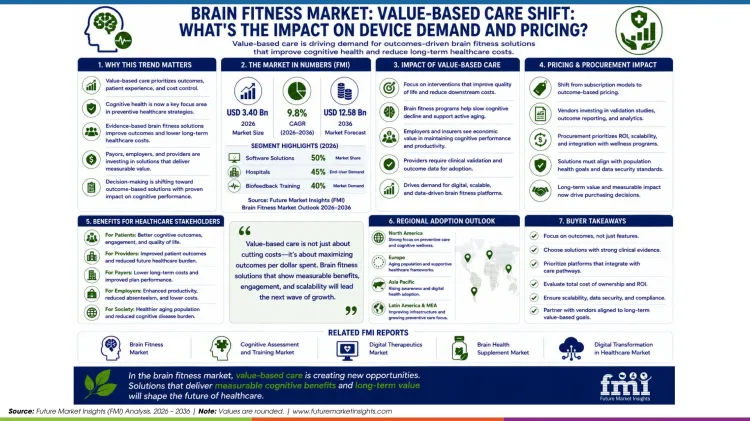
Healthcare is shifting from a volume-based care delivery system to value-based models aimed at improving outcomes, patient experience, and long-term cost control. It is increasingly spilling over into adjacent sectors like the brain fitness market.
Brain fitness solutions, once seen as consumer wellness apps, are now coming into their own as complementary tools for preventive health strategies. The protection of cognitive function in an aging population is becoming a key area of focus and an opportunity for technologies that can show real benefits.
Brain Fitness Market is expected to grow from USD 3.40 billion in 2026 to USD 12.58 Billion by 2036 at a CAGR of 9.8% during the forecast period 2026 to 2036. The growth is attributed to increasing awareness of cognitive health, increasing acceptance of digital therapeutics, and increasing demand for preventive wellness interventions.
Value based care frameworks target interventions that improve quality of life and reduce downstream healthcare costs. In this context, cognitive wellness is becoming increasingly important as healthcare systems look to slow or prevent the progression of age-related cognitive decline.
Brain fitness programs help to support this goal by promoting active participation in cognitive training activities that are specifically developed to improve memory, attention, processing speed and executive functioning.
Value-based care isn't just clinical.
Employers, wellness organizations and insurers are increasingly aware of the economic impact of cognitive health. Reduced productivity due to stress and burnout and cognitive burdens of aging create incentive to seek preventive solutions to maintain mental performance over the long term.
Changes in the brain fitness market are creating shifts in demand patterns in this evolving landscape.
The share of software solutions is expected to grow to 50% of the market by 2026, which indicates a strong need for flexible and scalable delivery models. Digital platforms provide benefits like remote access, individualized training pathways and the capacity to produce performance data for the measurement of outcomes.
From the end-user perspective, hospitals are expected to account for 45% of the market in 2026. The sustained adoption of the technology in healthcare settings is fuelled by a growing institutional interest in cognitive wellness programs, rehabilitation support services and preventive care initiatives.
The shift to value-based care is also affecting pricing strategies.
The history of brain fitness solutions has been based on subscription-based consumer models that focus on engagement rather than measurable outcomes. However, healthcare stakeholders are increasingly requesting evidence of effectiveness prior to such programs being incorporated into wider care pathways.
Hence vendors are focusing on validation studies, outcome reporting capabilities and data analytics functionalities that can support value demonstration.
So the procurement considerations are changing accordingly.
As healthcare institutions become more selective in their decisions, solutions that enable the preventive care goals of healthcare organizations and clearly prove their value are becoming more popular. It is increasingly important to be able to plug into existing wellness ecosystems and support population health initiatives.
The effects of value-based trends can also be seen in regional adoption patterns.
Implementation efforts are expected to be led by developed healthcare markets with aging populations and an increasing focus on preventive interventions. At the same time, digital health technologies are reaching more and more developing countries as their healthcare infrastructure matures.
The myth to dispel is that value-based care is about cutting costs no matter what.
In practice, the value-based approach is to maximize the benefits per dollar spent. While it may require initial financial outlays, investments that can help maintain cognition, foster patient autonomy and improve quality of life can provide substantial long-term rewards.
This lens is increasingly being used to test brain fitness solutions.
Platforms capable of demonstrating user engagement, quantifiable cognitive benefits and scalability across different populations are likely to enhance their competitive position as healthcare systems turn increasingly to prevention and whole person wellness.
In conclusion, the move to value-based healthcare is creating a fertile ground for brain fitness solutions that offer accessibility, measurable results and preventive health benefits. Those organizations that can match their offerings to emerging care priorities should be positioned to access growing opportunities in this fast-growing market.

