


Key Takeaways
- Most bulk bags in Europe and North America are polypropylene FIBCs made in a narrow group of countries, especially India, Bangladesh, Turkey and China, so risk is concentrated in a few resin streams and shipping lanes.
- Polypropylene resin prices in the United States rose by around 180 percent between early 2020 and mid-2021, while global container freight rates in 2021 peaked at roughly four times pre-pandemic levels, which translated into sharp increases in bulk bag prices and much longer lead times.
- Freight and trade volatility have not gone back to a 2018 normal; UNCTAD and other observers now describe a structurally more fragile shipping system shaped by the war in Ukraine, Red Sea disruptions and new tariff waves, with longer routes and more unstable rates.
- EU packaging law and global plastic pollution initiatives are pushing bulk bag specifications toward mono-material, recyclable designs and higher recycled polypropylene content, favouring suppliers that can prove recyclability and run closed-loop collection schemes.
- In response, large users are shifting from spot buys to multi-year contracts, dual sourcing between Asian hubs and nearer-shore producers, and experimenting with pooling and reuse models for big bags, especially in Europe.
What does the bulk bag supply chain actually look like today?
Bulk bags, or flexible intermediate bulk containers, are large woven polypropylene sacks that usually hold between 500 and 2,000 kilograms of dry, flowable material such as grain, fertilizer, plastics, minerals or construction aggregates. They sit in the middle of many supply chains as the unit that bridges silos, silage pits, silos, railcars and containers with forklifts and pallet trucks.
Upstream, the key input is polypropylene resin produced by petrochemical complexes that crack oil and gas liquids into propylene and then polymerise it. Packaging uses a large share of global polypropylene, so any squeeze in resin availability shows up quickly in the cost base of woven fabric and bag makers.
Midstream, weaving, cutting and sewing are highly concentrated in a handful of export hubs. Industry data for the European Union shows that about 55 percent of large bulk bags for the EU are produced in India, with other important volumes coming from Bangladesh, Turkey, China and Eastern European plants, and that roughly 90 percent of these bags are imported rather than made locally. For the United States, China, India, Vietnam and Latin America dominate supply, and about 80 percent of large bulk bags are imported. This means that for most Western buyers, bulk bags are a classic offshore, low-margin, containerised product.
Downstream, demand is diversified but tightly coupled to trade in commodities and chemicals. Agriculture, food and feed, fertilizers, construction, mining and chemicals all rely on bulk bags for flows where paper sacks or rigid containers are either too fragile or too expensive. Food-grade and hazardous-goods applications add another layer of complexity, because they require cleanroom-style manufacturing, electrostatic control and certification to standards such as UN dangerous goods and HACCP, which only some plants can offer.
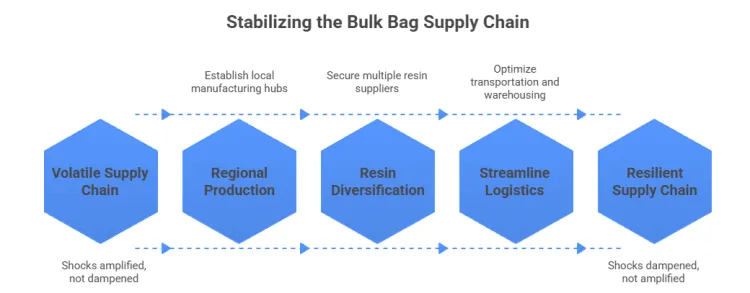
The basic picture is a long, globalised chain: petrochemical feedstock in a few regions, fabric and bag conversion in a few export clusters, then long ocean legs into high-consumption markets. That structure amplifies shocks in resin, freight and policy rather than damping them.
What new pressures are shaping sourcing, design and recycling strategies?
The next layer of pressure is regulatory and environmental rather than purely economic. The European Union’s new Packaging and Packaging Waste Regulation requires that by 2030 all packaging placed on the EU market be recyclable, and sets rising targets for recycling rates and recycled content in plastic packaging through 2040. These rules apply to business-to-business transport packaging as well as consumer packs, so bulk bags are included in the scope.
In parallel, UNEP and a growing body of life cycle research argue for reuse and return systems as a major lever to cut plastic pollution, and highlight that packaging already accounts for about 40 percent of plastic use in Europe. For big bags, that is now materialising in pilots and programmes that try to collect, wash and refill bags several times before recycling them, instead of treating each bag as single use. The Dutch big bag pooling project, for example, works on harmonising specifications, washing, tracking and design guidelines so that big bags can circulate within and across sectors without compromising safety or contamination standards.
Suppliers are adjusting their designs to fit this world. Technical guidelines from large FIBC players in Europe show a push toward mono-material polypropylene bags, including loops, accessories and even liners, to make them easier to recycle into high quality recycled polypropylene. Some programmes aim for a high share of big bags to be "designed for recycling" by 2030, with explicit targets for how many are actually collected and recycled. Equipment makers such as Starlinger now showcase big bag production lines that can handle high shares of recycled polypropylene, and case studies from Turkey indicate that big bags with substantial recycled content can still meet the safety factors needed for heavy loads.
For buyers, these trends mean that price is now entangled with documentation and design choices. A lower-priced bag that mixes polymers or uses hard-to-recycle liners may look attractive on a per-unit basis but can be a liability once extended producer responsibility fees, recycling obligations or internal sustainability targets are included. Suppliers that can provide life cycle assessments, recyclability assessments and evidence of circular programmes are effectively offering a bundled service that includes regulatory risk management. That service component partly explains why prices diverge between manufacturers that may look similar if you only compare fabric weight and safe working load.
How FMI Can Help
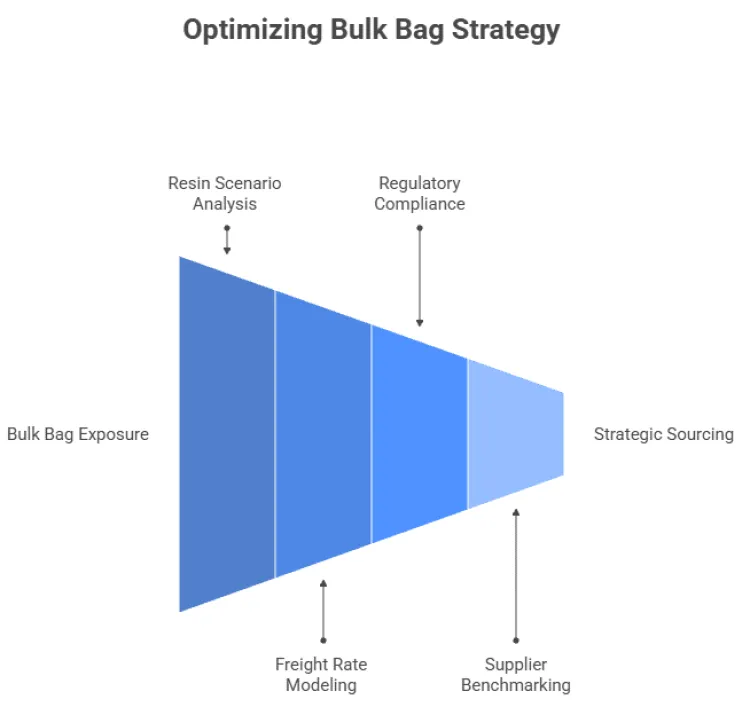
Future Market Insights can map bulk bag exposure as part of a wider packaging and logistics strategy rather than treating it as a commodity line item. That includes linking polypropylene resin scenarios to packaging cost curves, modelling how freight rate changes flow through landed cost in different sourcing configurations, and translating evolving regulations such as the EU Packaging and Packaging Waste Regulation into concrete specification choices. We can also benchmark supplier groups on their ability to provide certified food-grade or hazardous-goods bags, support closed-loop or pooling systems, and document recyclability and recycled content. The result is a sourcing and specification strategy that treats bulk bags as a small but critical node in your wider supply chain, with clear trade-offs between cost, risk and compliance.
Sources
- UNCTAD, Review of Maritime Transport 2022 and related freight rate analyses, including summary material on 2021-2022 container rate spikes and port delays.
- Bain & Company, "What companies can learn from the recent surge in plastic resin prices," using industry benchmarks for polypropylene price movements in 2020-2021.
- European Commission and EUROPEN, official pages and guidance on the Packaging and Packaging Waste Regulation and recycling targets for plastic packaging.
- LC Packaging, Starlinger and Dutch big bag pooling project documentation on design-for-recycling guidelines, circular FIBC initiatives and reuse pilots for big bags.
- UNEP and peer-reviewed work on reusable packaging and plastic pollution, including life cycle assessments of reusable systems and global plastic trends.

