

- Industry Size (2025)
- USD 1.5 Bn
- Forecast (2035)
- USD 2.5 Bn
- CAGR (2025 to 2035)
- 5.3%
Demand for Ventilated Bulk Bags in Japan Forecast and Outlook 2025 to 2035
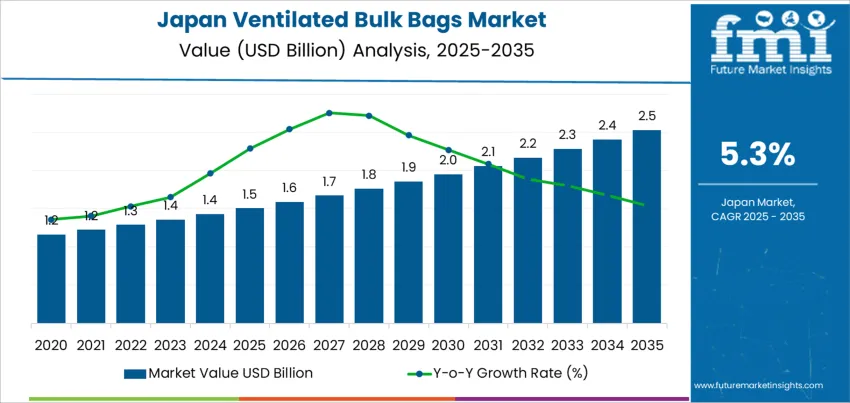
Ventilated bulk bag demand in Japan is valued at USD 1.5 billion in 2025 and is projected to reach USD 2.5 billion by 2035 at a CAGR of 5.3%. Early growth is anchored in agricultural produce handling, where controlled airflow is critical for transporting onions, potatoes, and other vegetables that require moisture dissipation to prevent spoilage. Domestic agricultural cooperatives and food distribution companies form the core buyer base, with demand tied closely to regional harvesting and storage cycles. Construction aggregates and firewood packaging add secondary volume where breathability improves material stability during outdoor storage. Polypropylene remains the dominant material due to load-bearing strength and reuse potential across multi-trip logistics.
After 2030, demand expansion reflects rising logistical sophistication rather than sharp changes in agricultural output. Market value rises from about USD 2.0 billion in 2030 toward USD 2.5 billion by 2035 as exporters of fresh produce and specialty crops adopt higher-spec ventilated bags to support longer transit times and moisture-sensitive shipments. Retail-ready bulk packaging formats gain traction in wholesale markets and regional distribution hubs. Design emphasis shifts toward optimized vent spacing, UV resistance, and higher tear strength for mechanical handling. Growth is further supported by increased palletized bulk movement through automated warehouses serving food processing, cold storage, and regional trading centers across Japan.
Quick Stats of the Demand for Ventilated Bulk Bags in Japan
- Demand for Ventilated Bulk Bags in Japan Value (2025): USD 1.5 billion
- Demand for Ventilated Bulk Bags in Japan Forecast Value (2035): USD 2.5 billion
- Demand for Ventilated Bulk Bags in Japan Forecast CAGR (2025 to 2035): 5.3%
- Demand for Ventilated Bulk Bags in Japan Leading Material: Polypropylene (55%)
- Demand for Ventilated Bulk Bags in Japan Key Growth Regions: Kyushu & Okinawa, Kanto, Kansai, Chubu, Tohoku, Rest of Japan
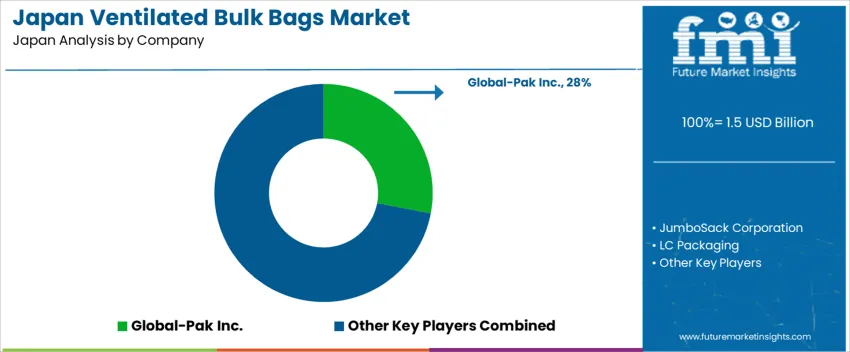
- Demand for Ventilated Bulk Bags in Japan Top Players: Global-Pak Inc., JumboSack Corporation, LC Packaging, Star Industries, Carpo Industries
What is the Demand Forecast for Ventilated Bulk Bags in Japan through 2035?
Ventilated bulk bags in Japan derive demand from moisture-sensitive commodity logistics rather than from general-purpose packaging usage, giving the category a highly application-specific growth profile. Demand increases from USD 1.5 billion in 2025 to USD 1.6 billion by 2026 and USD 1.7 billion by 2027, reaching USD 1.9 billion by 2030 and adding USD 0.4 billion from the 2025 base. This phase reflects steady movement across agricultural produce, forestry products, and mineral handling where airflow control is required to prevent mold, condensation, and spoilage. Growth is supported by domestic produce distribution, fertilizer handling, and biomass fuel transport rather than export-led acceleration.
From 2030 to 2035, the market expands from USD 1.9 billion to USD 2.5 billion, adding USD 0.6 billion in the second half of the decade. This back weighted acceleration reflects rising use in high-volume root vegetables, wood pellets, industrial salts, and feedstock aggregation where ventilation performance directly affects storage yield and quality retention. Higher fabric strength ratings, optimized mesh geometry, and demand for reusable industrial-grade formats raise value per unit. As Japan strengthens food security logistics and bioresource circulation systems, ventilated bulk bags transition from niche handling solutions into standardized bulk transport infrastructure, sustaining long-term demand growth through 2035.
Ventilated Bulk Bags Industry in Japan Key Takeaways
| Metric | Value |
|---|---|
| Industry Value (2025) | USD 1.5 billion |
| Forecast Value (2035) | USD 2.5 billion |
| Forecast CAGR (2025 to 2035) | 5.3% |
What Is Driving the Demand for Ventilated Bulk Bags in Japan?
The demand for ventilated bulk bags in Japan developed from long standing requirements in agriculture, food storage, and bulk material logistics where moisture control directly affects product quality. Early adoption was concentrated in onion, potato, and root vegetable supply chains where trapped humidity caused rot, mold, and cargo loss during storage and transport. As domestic distribution centers modernized and cold chain logistics expanded, ventilated bulk bags became a preferred alternative to rigid crates and sealed sacks. Feed producers, biomass handlers, and grain distributors also adopted ventilated formats to manage condensation and gas release during transit. Replacement demand grew as reusable woven bag systems became embedded in farm to processor handling cycles across regional agricultural hubs.
Future demand for ventilated bulk bags in Japan will be shaped by post-harvest loss reduction targets, logistics efficiency, and sustainability pressure. As food security and waste reduction become central policy and commercial priorities, airflow controlled bulk packaging will gain wider relevance beyond vegetables into animal feed, compostable materials, and moisture sensitive industrial solids. Design focus will shift toward higher load tolerance, UV resistance, and compatibility with automated filling and palletizing systems. Barriers remain in polypropylene material regulation, rising resin costs, and competition from reusable rigid containers. Growth will depend on how effectively ventilated bulk bags balance moisture control performance, reuse cycles, regulatory compliance, and total handling cost across agricultural and industrial supply chains.
How Are Material Type and Capacity Range Structuring the Demand for Ventilated Bulk Bags in Japan?
The demand for ventilated bulk bags in Japan is structured by material composition and load capacity range. Polypropylene accounts for 55% of total demand, followed by polyethylene, cotton, jute, and other material types used for specialized agricultural and industrial handling. By capacity range, bags below 200 kg represent 30.0% of total consumption, followed by 200 kg to 750 kg, 750 kg to 1500 kg, and above 1500 kg categories. Demand behavior is shaped by moisture control needs, airflow requirements, load stability, and compatibility with mechanized handling. These segments reflect how product protection requirements and logistics handling preferences influence bulk packaging selection across food, agriculture, and industrial distribution in Japan.
Why Does Polypropylene Lead the Ventilated Bulk Bag Material Demand in Japan?
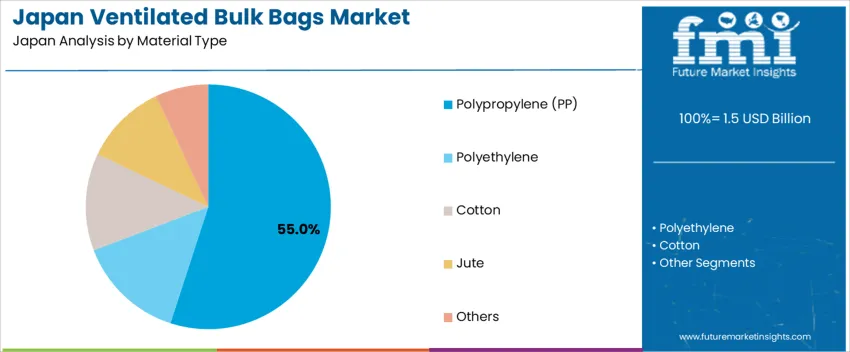
Polypropylene accounts for 55% of total ventilated bulk bag demand in Japan due to its high tensile strength, low moisture absorption, and resistance to abrasion under repeated handling. PP woven structures provide stable load bearing performance while allowing controlled airflow through ventilated panels, which is critical for transporting agricultural produce such as onions, potatoes, and root vegetables. The material maintains structural integrity under variable humidity and temperature conditions commonly encountered in agricultural logistics and coastal storage environments across Japan.
Polypropylene also supports consistent quality through standardized extrusion and weaving processes available across domestic packaging supply chains. Reusability under moderate duty cycles improves cost efficiency for growers and distributors. Lightweight construction reduces transport weight without compromising load stability. Compatibility with liner insertion, labeling, and automated filling further expands functional use. These strength performance, environmental tolerance, and processing efficiency factors jointly sustain polypropylene as the leading material segment in the Japan ventilated bulk bag demand structure.
Why Does the Below 200 kg Capacity Range Dominate Ventilated Bulk Bag Demand in Japan?
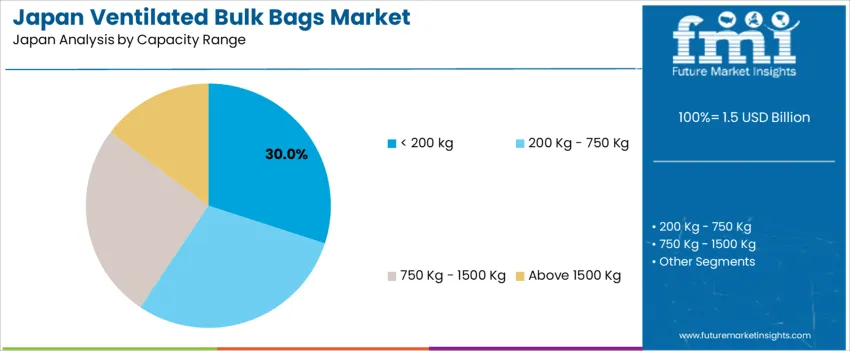
The below 200 kg capacity range accounts for 30.0% of total ventilated bulk bag demand in Japan due to its alignment with small batch agricultural handling and decentralized distribution patterns. Many fresh produce operations rely on frequent short haul transport between farms, regional aggregation centers, and wholesale markets. Smaller bag sizes support easier manual handling, rapid loading and unloading, and reduced dependence on heavy lifting equipment. These advantages are particularly relevant for smallholder farms and regional cooperatives that operate under space and labor constraints.
Lower capacity bags also improve lot traceability and inventory rotation in produce storage environments. Retail oriented supply chains favor smaller loads to limit product exposure during partial shipment releases. Reduced weight per unit improves operator safety and lowers drop damage risk during stacking. These handling practicality, traceability control, and safety performance factors position the below 200 kg capacity range as the leading segment within the Japan ventilated bulk bag demand landscape.
Why Are Ventilated Bulk Bags in Japan Treated as Moisture Risk Management Tools Rather Than Transport Containers?
Demand for ventilated bulk bags in Japan is driven by the need to control internal humidity during storage and transit rather than by simple load handling. Japans climate exposes agricultural and industrial goods to persistent moisture risk, especially during rainy seasons and coastal transport. Ventilation allows trapped heat and condensation to escape, reducing mold formation and material degradation. This is critical for wood pellets, agricultural produce, and mineral-based materials. Buyers evaluate these bags for airflow performance first and structural strength second, reversing the traditional procurement priority seen in standard bulk packaging.
How Do Agriculture, Forestry Products, and Biomass Logistics Shape Real-World Demand?
Bulk agricultural products such as potatoes, onions, ginger, and root crops rely on ventilated bags to prevent rot during regional distribution. Forestry and biomass industries use these bags for wood chips and pellets that generate internal heat and moisture after processing. Japans expanding biomass power sector increases movement of organic bulk materials that cannot be sealed airtight. Export handling of these materials also requires airflow during port storage. These applications depend on continuous moisture release, which anchors real demand in product respiration behavior rather than only in transport efficiency.
What Handling Discipline and Infrastructure Constraints Limit Wider Adoption?
Ventilated bulk bag usage in Japan is restrained by forklift handling precision, warehouse stacking limits, and exposure control requirements. Open-vent structures increase sensitivity to rain during outdoor staging unless covered circulation systems are used. Not all logistics terminals are equipped with weather-protected airflow zones. Limited stacking height compared with sealed FIBCs also reduces cubic efficiency in space-constrained facilities. Manual handling error can compromise airflow function. These infrastructure and operational constraints restrict use to applications where moisture control value outweighs space and handling penalties.
How Are Smart Vent Patterns, Material Engineering, and Energy Logistics Redefining Demand?
Future demand in Japan is shifting toward engineered vent patterns that regulate airflow without sacrificing load stability. High-tensile woven fabrics improve vertical strength while maintaining side ventilation. Antifungal yarn treatments extend usability for repeated crop cycles. Biomass and renewable energy logistics increasingly specify ventilated bags optimized for thermal dissipation during storage. Sensor tagging for internal humidity monitoring is also emerging in controlled supply chains. These developments show ventilated bulk bags evolving into moisture-managed logistics systems rather than static storage sacks.
What is the Demand for Ventilated Bulk Bags in Japan by Region?
| Region | CAGR (%) |
|---|---|
| Kyushu & Okinawa | 6.7% |
| Kanto | 6.1% |
| Kansai | 5.4% |
| Chubu | 4.7% |
| Tohoku | 4.2% |
| Rest of Japan | 3.9% |
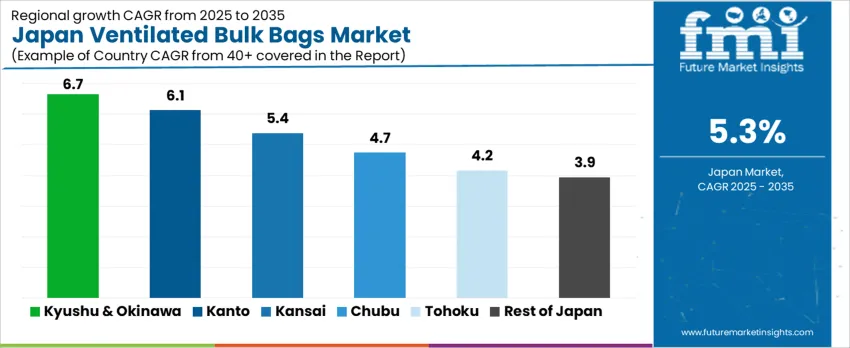
The demand for ventilated bulk bags in Japan is expanding steadily across all regions, with Kyushu & Okinawa leading at a 6.7% CAGR. Growth in this region is supported by strong agricultural output, fresh produce handling, and rising exports that require breathable packaging for crops such as onions, potatoes, and seafood. Kanto follows at 6.1%, driven by high volumes of food distribution, wholesale trade activity, and logistics operations serving dense urban markets. Kansai records 5.4% growth, supported by regional food processing and agricultural packaging demand. Chubu at 4.7% reflects moderate uptake tied to manufacturing and produce transport. Tohoku and Rest of Japan, at 4.2% and 3.9%, show slower growth shaped by smaller logistics networks and lower commercial packaging intensity.
How Is Agricultural and Industrial Handling Driving Demand in Kyushu And Okinawa?
Logistics activity in Kyushu and Okinawa is advancing at a CAGR of 6.7% through 2035 for ventilated bulk bag demand, supported by fresh produce exports, seafood byproduct transport, and fertilizer distribution. Root crops, onions, and agricultural inputs rely on ventilated packaging for airflow and moisture control. Regional ports support steady bulk movement across domestic and export trade lanes. Construction material handling also adds secondary demand. Demand remains handling and storage driven, with procurement closely aligned to crop harvest cycles, port throughput, and regional agro industrial distribution activity.
- Root crop exports anchor core bag usage
- Fertilizer transport supports recurring bulk handling demand
- Port logistics sustain steady container movement
- Construction materials add secondary industrial volume
What Is Sustaining Strong Ventilated Bulk Bag Adoption Across Kanto?
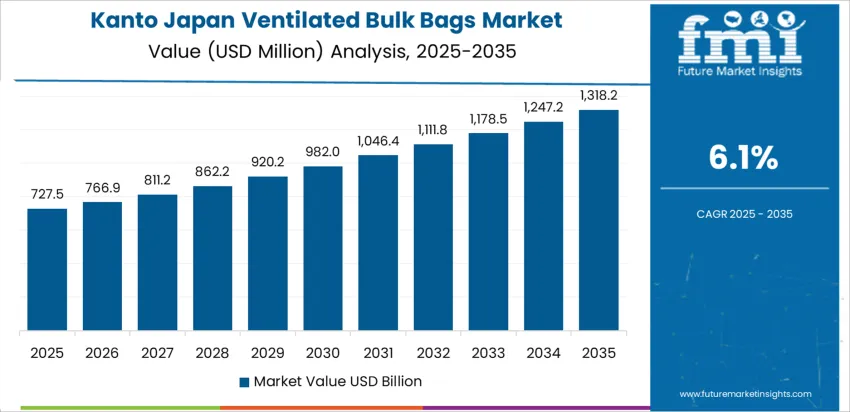
Urban supply chain intensity in Kanto supports a CAGR of 6.1% through 2035 for ventilated bulk bag demand, driven by wholesale produce markets, recycling material movement, and industrial raw material distribution. Central produce exchanges rely on ventilated bags for temperature control during high turnover transactions. Plastic scrap, grains, and mineral aggregates also use this format. High logistics efficiency requires consistent bag quality and stacking performance. Demand remains throughput driven and replacement led, shaped by continuous inbound and outbound material flow across dense metropolitan logistics and industrial distribution hubs.
- Central produce markets drive high frequency usage
- Recycling material transport supports steady volume
- Industrial raw materials add diversified demand
- High turnover logistics accelerate replacement cycles
Why Is Kansai Showing Balanced Growth in Ventilated Bulk Bag Usage?
Regional manufacturing and agriculture balance in Kansai supports a CAGR of 5.4% through 2035 for ventilated bulk bag demand, shaped by processed food raw material transport, seed distribution, and industrial intermediate handling. Grain suppliers and agricultural cooperatives use ventilated bags for aeration control and contamination prevention. Machinery parts and polymer additives also move in this format at moderate scale. Demand remains diversified and stability driven, with procurement tied to predictable production cycles and steady movement of farm and factory inputs across urban and semi urban logistics corridors.
- Agricultural cooperatives drive seed and grain transport
- Processed food inputs rely on ventilated handling
- Polymer and additive transport adds industrial usage
- Stable production cycles guide procurement timing
How Is Heavy Industry and Export Cargo Supporting Growth in Chubu?
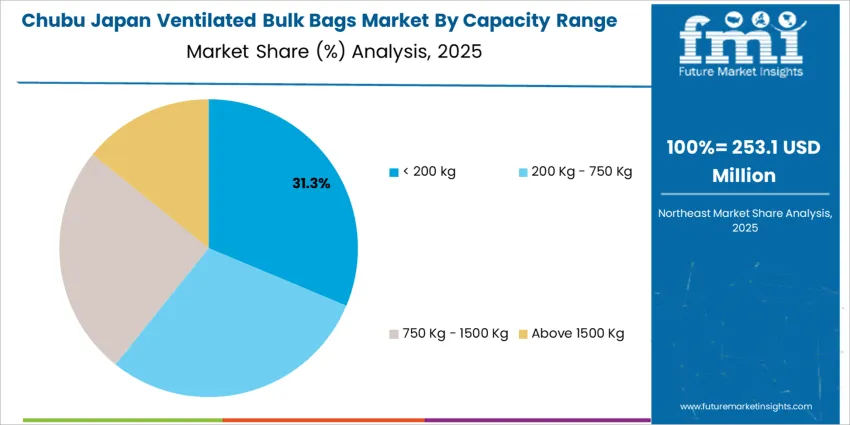
Industrial throughput in Chubu supports a CAGR of 4.7% through 2035 for ventilated bulk bag demand, driven by automotive supply chains, metal scrap handling, and industrial powder transport. Foundries and machining operations use ventilated bags for waste material movement and input storage. Export oriented component plants require airflow controlled bulk packaging for corrosion sensitive goods. Demand remains manufacturing led and contract driven, with purchasing behavior tied to plant output schedules, export shipping volumes, and standardized industrial logistics practices across automotive and precision engineering hubs.
- Metal scrap handling anchors industrial bag usage
- Automotive supply chains support steady logistics demand
- Export packing requires controlled airflow materials
- Plant output schedules govern procurement stability
What Is Guiding Moderate Ventilated Bulk Bag Growth in Tohoku?
Regional agriculture and recovery oriented manufacturing in Tohoku supports a CAGR of 4.2% through 2035 for ventilated bulk bag demand, shaped by potato farming, grain handling, and cooperative based distribution systems. Ventilated bags are used for storage and intra regional movement of farm produce. Light industrial materials such as wood chips and recycled aggregates also add modest volume. Limited port and heavy industrial activity moderates large scale growth. Demand remains necessity driven and locally anchored, with usage aligned to seasonal harvesting and cooperative logistics cycles.
- Potato and grain farming supports seasonal bag utilization
- Cooperative logistics sustain community level demand
- Recycled aggregates add light industrial volume
- Limited heavy industry restrains high scale expansion
Why Does the Rest of Japan Show Slower but Stable Demand Patterns?
Community scale agriculture and municipal logistics across the rest of Japan sustain a CAGR of 3.9% through 2035 for ventilated bulk bag demand, supported by local crop movement, landscaping material distribution, and small industrial handling needs. Municipal composting and soil supply also rely on ventilated packaging. Short transport distances reduce high performance packaging demand. Manual handling remains common. Demand stays stable and function driven, guided by routine agricultural circulation, landscaping activities, and essential small scale industrial material movement rather than high volume export or heavy manufacturing logistics.
- Municipal compost and soil transport supports base volume
- Local crop movement sustains steady seasonal demand
- Short logistics routes limit premium packaging needs
- Manual handling practices stabilize replacement cycles
What Is Driving the Demand for Ventilated Bulk Bags in Japan and Who Are the Key Suppliers Shaping the Market?
Demand for ventilated bulk bags in Japan is rising as agricultural producers, food processing firms, and logistics operators increasingly prioritise preservation of perishable goods during storage and transport. These bags use breathable woven polypropylene that permits airflow, reducing moisture accumulation, mold risk and spoilage of vegetables, tubers, and other produce. The demand grows further as supply chain standards tighten for freshness and hygiene, especially in produce, seafood, and horticulture. The shift toward mechanized packaging and efficient warehouse handling also favours bulk containers that combine strength with ventilation. Broader adoption of flexible intermediate bulk containers (FIBCs) supports higher volumes of produce handling, aligning with Japan’s advanced food distribution infrastructure.
Key providers influencing supply of ventilated bulk bags to the Japanese market include global and regional packaging firms such as Global Pak Inc., JumboSack Corporation, LC Packaging, Star Industries, and Carpo Industries. These suppliers offer a variety of ventilated FIBC products tailored for agricultural, food processing, and bulk commodity sectors. Their product ranges include ventilated polypropylene bags, customizable loop and discharge options, and compliance with industrial packaging standards. Through global production networks and export supply chains, they help meet demand from Japanese growers, food distributors, and wholesalers seeking high airflow bulk containers for fresh produce and moisture sensitive materials.
Key Players in Ventilated Bulk Bags Industry in Japan
- Global-Pak Inc.
- JumboSack Corporation
- LC Packaging
- Star Industries
- Carpo Industries
Scope of the Report
| Items | Values |
|---|---|
| Quantitative Units (2025) | USD billion |
| Material | Polypropylene (PP), Polyethylene, Cotton, Jute, Others |
| Capacity Range | < 200 kg, 200 kg - 750 kg, 750 kg - 1500 kg, Above 1500 kg |
| Region | Kyushu & Okinawa, Kanto, Kansai, Chubu, Tohoku, Rest of Japan |
| Key Companies Profiled | Global-Pak Inc., JumboSack Corporation, LC Packaging, Star Industries, Carpo Industries |
| Additional Attributes | Dollar by sales by material, capacity range, and region. Includes airflow performance, ventilation panel design, UV resistance, tear and tensile strength, moisture control, load-bearing capacity, reusability, pallet handling compatibility, cold storage suitability, automated filling compatibility, export-grade packaging, stackability, contamination risk management, biomass and agricultural application alignment, and optimized logistics efficiency for long-term storage and multi-trip transport in Japan. |
Ventilated Bulk Bags Industry in Japan Segmentation
Material Type:
- Polypropylene (PP)
- Polyethylene
- Cotton
- Jute
- Others
Capacity Range:
- < 200 kg
- 200 Kg - 750 Kg
- 750 Kg - 1500 Kg
- Above 1500 Kg
Region
- Kyushu & Okinawa
- Kanto
- Kansai
- Chubu
- Tohoku
- Rest of Japan
Frequently Asked Questions
How big is the demand for ventilated bulk bags in Japan in 2025?
The demand for ventilated bulk bags in Japan is estimated to be valued at USD 1.5 billion in 2025.
What will be the size of ventilated bulk bags in Japan in 2035?
The market size for the ventilated bulk bags in Japan is projected to reach USD 2.5 billion by 2035.
How much will be the demand for ventilated bulk bags in Japan growth between 2025 and 2035?
The demand for ventilated bulk bags in Japan is expected to grow at a 5.3% CAGR between 2025 and 2035.
What are the key product types in the ventilated bulk bags in Japan?
The key product types in ventilated bulk bags in Japan are polypropylene (pp), polyethylene, cotton, jute and others.
Which capacity range segment is expected to contribute significant share in the ventilated bulk bags in Japan in 2025?
In terms of capacity range, < 200 kg segment is expected to command 30.0% share in the ventilated bulk bags in Japan in 2025.
Preview the report firsthand - request a free sample
Get SampleGet the brochure for pricing and purchase details.
Get PDFTable of Content
- Executive Summary
- Japan Market Outlook
- Demand-side Trends
- Supply-side Trends
- Technology Roadmap Analysis
- Analysis and Recommendations
- Market Overview
- Market Coverage / Taxonomy
- Market Definition / Scope / Limitations
- Market Background
- Market Dynamics
- Drivers
- Restraints
- Opportunity
- Trends
- Scenario Forecast
- Demand in Optimistic Scenario
- Demand in Likely Scenario
- Demand in Conservative Scenario
- Opportunity Map Analysis
- Product Life Cycle Analysis
- Supply Chain Analysis
- Investment Feasibility Matrix
- Value Chain Analysis
- PESTLE and Porter’s Analysis
- Regulatory Landscape
- Regional Parent Market Outlook
- Production and Consumption Statistics
- Import and Export Statistics
- Market Dynamics
- Japan Market Analysis 2020 to 2024 and Forecast, 2025 to 2035
- Historical Market Size Value (USD Million) Analysis, 2020 to 2024
- Current and Future Market Size Value (USD Million) Projections, 2025 to 2035
- Y-o-Y Growth Trend Analysis
- Absolute $ Opportunity Analysis
- Japan Market Pricing Analysis 2020 to 2024 and Forecast 2025 to 2035
- Japan Market Analysis 2020 to 2024 and Forecast 2025 to 2035, By Material Type
- Introduction / Key Findings
- Historical Market Size Value (USD Million) Analysis By Material Type , 2020 to 2024
- Current and Future Market Size Value (USD Million) Analysis and Forecast By Material Type , 2025 to 2035
- Polypropylene (PP)
- Polyethylene
- Cotton
- Jute
- Others
- Y-o-Y Growth Trend Analysis By Material Type , 2020 to 2024
- Absolute $ Opportunity Analysis By Material Type , 2025 to 2035
- Japan Market Analysis 2020 to 2024 and Forecast 2025 to 2035, By Capacity Range
- Introduction / Key Findings
- Historical Market Size Value (USD Million) Analysis By Capacity Range, 2020 to 2024
- Current and Future Market Size Value (USD Million) Analysis and Forecast By Capacity Range, 2025 to 2035
- < 200 kg
- 200 Kg - 750 Kg
- 750 Kg - 1500 Kg
- Above 1500 Kg
- Y-o-Y Growth Trend Analysis By Capacity Range, 2020 to 2024
- Absolute $ Opportunity Analysis By Capacity Range, 2025 to 2035
- Market Structure Analysis
- Competition Dashboard
- Competition Benchmarking
- Market Share Analysis of Top Players
- By Regional
- By Material Type
- By Capacity Range
- Competition Analysis
- Competition Deep Dive
- Global‑Pak Inc.
- Overview
- Product Portfolio
- Profitability by Market Segments (Product/Age /Sales Channel/Region)
- Sales Footprint
- Strategy Overview
- Marketing Strategy
- Product Strategy
- Channel Strategy
- JumboSack Corporation
- LC Packaging
- Star Industries
- Carpo Industries
- Global‑Pak Inc.
- Competition Deep Dive
- Assumptions & Acronyms Used
- Research Methodology


