

- Industry Size (2026)
- USD 4.24 Bn
- Forecast (2036)
- USD 7.75 Bn
- CAGR (2026 to 2036)
- 6.1%
Bulk Molding Compounds Market Size, Market Forecast and Outlook By FMI
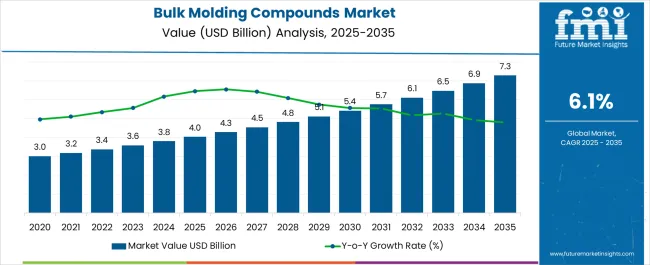
In 2025, the bulk molding compounds market was valued at USD 4.0 billion. Based on Future Market Insights’ analysis, demand for bulk molding compounds is estimated to grow to USD 4.24 billion in 2026 and USD 7.75 billion by 2036. FMI projects a CAGR of 6.1% during the forecast period.
An absolute dollar growth of USD 3.51 billion between 2026 and 2036 reflects structural conversion from stamped metal and die‑cast aluminum to compression‑molded glass‑reinforced polyester in vehicle structures and electrical housings. Growth depends on the continued displacement of steel in semi‑structural automotive applications and the penetration of bulk molding compounds into battery enclosure systems for electric vehicles. As per FMI, compounders are capturing value not from resin tonnage alone but from formulation tailoring for specific flow length, shrinkage control, and dielectric strength requirements.
In January 2025, Continental Structural Plastics (Teijin) announced the commercial launch of a new low‑density bulk molding compound formulation achieving 20% weight reduction versus standard glass‑fiber polyester for Class 8 truck hoods and fenders, developed in collaboration with a major North American heavy‑duty truck OEM. [1] This performance reflects accelerating specification of BMC in commercial vehicle programs where per‑part weight savings translate directly into payload capacity and fuel tax compliance.
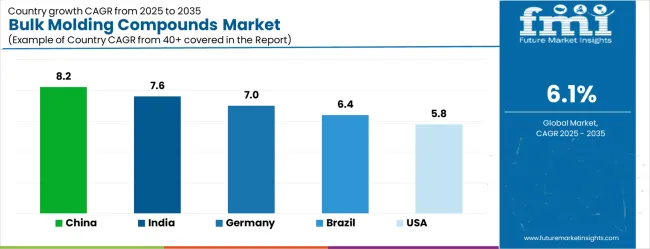
China (8.2% CAGR) leads global expansion, supported by domestic production of electrical switchgear, smart meter housings, and the localization of EV battery component manufacturing. The Ministry of Industry and Information Technology’s 2024 guidelines for new energy vehicle lightweighting explicitly recommend fiber‑reinforced composites for battery pack enclosures and bus structural parts. [2]
Summary of the Bulk Molding Compounds Market
- Market Definition
- The market comprises thermoset polyester and vinyl ester compounds reinforced with discontinuous glass or carbon fiber, formulated for compression and injection molding of rigid, heat‑resistant, and dimensionally stable components.
- Demand Drivers
- Irreversible conversion of die‑cast aluminum and stamped steel to glass‑reinforced polyester in headlamp housings, fuse boxes, and intake manifolds.
- Regulatory pressure on vehicle CO₂ emissions driving lightweighting programs in internal combustion and electric vehicle architectures.
- Replacement of ceramic and metal in electrical switchgear and insulator applications due to BMC’s tracking resistance and design freedom.
- Key Segments Analyzed
- Resin Type: Polyester resin leads, accounting for 56.4% share in 2025 due to cost‑to‑performance ratio and compatibility with high filler loadings.
- Fiber Type: Glass fiber dominates at 61.7% share, driven by tensile strength requirements at price points accessible to high‑volume automotive and appliance production.
- End‑Use: Transportation leads at 48.9% share, reflecting deep penetration of BMC in under‑hood components and lighting systems.
- Geography: North America leads revenue concentration through heavy‑duty truck and off‑highway vehicle programs; Asia‑Pacific leads volume growth through electrical infrastructure expansion and consumer appliance production.
- Analyst Opinion at FMI
- Nikhil Kaitwade, Associate Director for Chemicals & Materials at Future Market Insights, assesses: ‘The bulk molding compound sector, as re‑examined in this revised forecast, operates under different physics than a decade ago. Customers no longer inquire whether BMC can meet a heat deflection temperature, they demand rheology profiles that fill complex EV battery tray geometries in under 60 seconds. The material has migrated from “metal substitute” to “design material” with its own property library. Suppliers that cannot provide simulated flow front data alongside their price book will find themselves specified out of EV and 5G infrastructure programs before the request for quotation is issued.’
- Strategic Implications / Executive Takeaways
- Develop low‑profile additive systems that achieve Class A surface finish without secondary sanding or priming to recapture exterior body panel applications lost to sheet molding compound.
- Qualify carbon‑fiber BMC formulations for electromagnetic interference shielding in electric drive train components to capture margin uplift.
- Regionalize production in Eastern Europe and Mexico to insulate just‑in‑time automotive supply contracts from intercontinental freight disruption.
- Methodology
- Built on primary interviews with compound manufacturers and automotive lightweighting engineers.
- Benchmarked against thermoset resin consumption data and compression molding press utilisation rates.
- Validated using trade data and internal peer review as per FMI modelling standards.
India (7.6% CAGR) follows, driven by the expansion of consumer appliance manufacturing and the replacement of thermoset hand‑layup with compression‑molded BMC in lighting and power distribution components. Germany (7.0% CAGR) grows on the back of premium vehicle platform architectures that specify BMC for headlamp reflectors, ignition systems, and electric motor insulation components. Brazil (6.4% CAGR) benefits from recovering industrial equipment production and the modernization of electricity distribution infrastructure.
Mature markets such as the United States (5.8%), the United Kingdom (5.2%), and Japan (4.6%) generate comparatively slower expansion, where demand is shaped primarily by replacement cycles in existing vehicle and appliance platforms rather than net new application conquest, with aluminum substitution acting as a structural constraint on unit growth in closure panels.
Bulk Molding Compounds Market Definition
The bulk molding compounds market covers the global production and supply of thermoset polyester or vinyl ester resins reinforced with discontinuous glass or carbon fibers, formulated with mineral fillers and additives to produce a dough‑like molding compound. These compounds are processed via compression or injection molding to produce rigid, dimensionally stable components with high heat deflection temperatures, creep resistance, and electrical tracking resistance. They are widely used in transportation, electrical distribution, consumer appliances, and industrial equipment where metal replacement, flame retardancy, and long‑term durability under load are required.
Market Inclusions
The report includes global and regional market size estimates in value terms, with a forecast period from 2026 to 2036. It provides segmentation by Resin Type, Fiber Type, End‑Use, and Region. The analysis incorporates manufacturing technology trends, sheet molding compound substitution dynamics, formulation cost optimization, and regulatory compliance with volatile organic compound emission standards. Regional demand dynamics, country‑level growth rates, and competitive positioning are also evaluated as per FMI methodology.
Market Exclusions
The scope excludes continuous fiber‑reinforced sheet molding compound processed in roll form, neat resins sold without fiber reinforcement, pultruded profiles, and hand lay‑up or spray‑up fabricated parts. It also excludes revenues from finished assembled components and focuses strictly on the bulk molding compound manufacturing layer. Custom military‑specification compounds produced in sub‑commercial volumes are not considered due to negligible market contribution.
Research Methodology
- Primary Research: Interviews were conducted with bulk molding compound formulators, compression molding processors, automotive Tier 1 procurement executives, electrical enclosure manufacturers, and industrial design engineers.
- Desk Research: Public company filings, plastics industry association statistics, trade data under HS Code 3923 (conveyor or transmission belts), automotive lightweighting roadmaps, and electrical safety standard updates were reviewed.
- Market‑Sizing and Forecasting: A hybrid top‑down and bottom‑up model was constructed, reconstructing demand from vehicle production volumes, electrical meter installation rates, and compound‑per‑unit consumption ratios across end‑use industries.
- Data Validation and Update Cycle: Outputs were subjected to variance testing against production capacity announcements, thermoset resin consumption trends, and structured internal review prior to publication.
Segmental Analysis
Bulk Molding Compounds Market Analysis by Resin Type
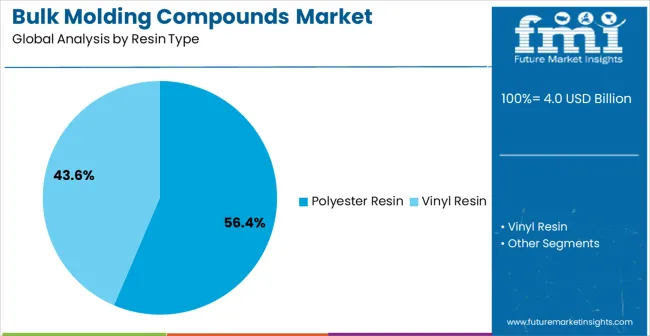
Based on FMI’s bulk molding compounds market report, demand for polyester resin remains the leading stream, capturing 56.4% of the market share. Its dominance is sustained by the material’s ability to accept high filler loadings (calcium carbonate, alumina trihydrate) that suppress raw material cost while maintaining mechanical properties. Polyester BMC also exhibits superior dielectric strength compared to vinyl ester, making it the default specification for electrical switchgear and meter housings where arc tracking resistance is critical.
- Capacity expansion: IDI Composites International announced in March 2025 a USD 25 million expansion of its Noblesville, Indiana facility, adding 15,000 tonnes of annual polyester BMC capacity to serve North American electrical infrastructure and heavy truck programs. [5]
- Formulation engineering: Menzolit introduced a new low‑styrene emission polyester BMC platform in April 2024, achieving a 40% reduction in volatile organic compound release during molding while maintaining identical flow and cure characteristics. The formulation enables compliance with California’s South Coast Air Quality Management District Rule 1168 without capital investment in thermal oxidiser retrofits. [6]
- Regulatory alignment: The U.S. Environmental Protection Agency’s 2024 final rule on hazardous organic national emission standards for reinforced plastic composites production established numeric emission limits for styrene from BMC compounding and molding operations. This has accelerated the transition to styrene‑suppressed resin systems and closed‑loop material handling investments among domestic compounders. [7]
Bulk Molding Compounds Market Analysis by Fiber Type
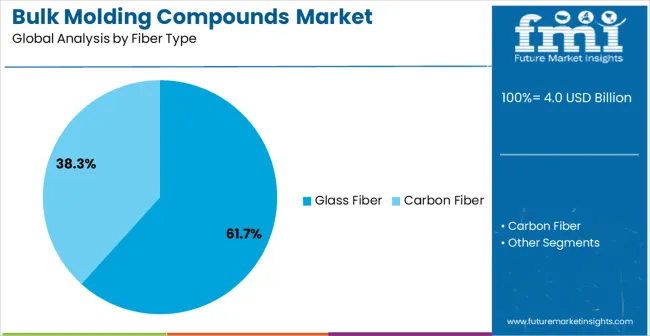
Glass fiber generates maximum demand at 61.7% for BMC reinforcement because it delivers the tensile modulus required for structural applications at a cost point compatible with high‑volume automotive and appliance production. Glass fiber BMC also exhibits predictable flow behaviour in long‑flow‑length molds, enabling the production of complex electrical enclosures without knit lines or weld zones that concentrate stress.
Faster value growth in BMC is increasingly concentrated in carbon fiber formulations, where electrical conductivity for electromagnetic interference shielding and weight reduction for aerospace ground support equipment command price premiums of 300-400% over glass‑reinforced grades.
- Application expansion: In September 2024, Core Molding Technologies announced a multi‑year supply agreement with a major data centre infrastructure provider for carbon‑fiber BMC panels used in raised floor systems. The specification shift from glass fiber was driven by carbon’s static dissipative properties and reduced deflection under concentrated equipment loads. [8]
- Manufacturing technology: DIC Corporation commenced commercial production of carbon‑fiber BMC utilizing recovered carbon fiber from aerospace pre‑preg scrap in February 2025, achieving a 30% cost reduction versus virgin fiber grades while maintaining mechanical property parity. The development opens carbon‑reinforced BMC to price‑sensitive automotive applications previously locked to glass fiber. [9]
Bulk Molding Compounds Market Drivers, Restraints, and Opportunities
Future Market Insights analysis indicates the market has historically existed as a high‑volume, low‑unit‑value engineering material tied to concealed components where surface appearance is secondary to dimensional stability and heat resistance. Its baseline scale is anchored in the persistent demand for electrical insulation and under‑hood automotive parts that must survive continuous operation at 150°C without creep or embrittlement.
FMI analysts observe a clear tension between standard electrical‑grade polyester BMC optimised for low cost and advanced formulations incorporating low‑shrink additives, carbon fiber, or halogen‑free flame retardants that raise unit value through engineering complexity. Standard compounds face pressure where brands rationalise SKU counts and consolidate part numbers across vehicle platforms, while growth is concentrated in applications that justify higher pricing through validated simulation data, lot‑to‑lot rheology consistency, and traceability mandates.
- EU End‑of‑Life Vehicle Regulation recast: The European Commission’s proposed ELV Regulation, expected to enter force in 2027, introduces mandatory recycled content quotas for plastic components in new vehicles. While BMC’s thermoset nature complicates mechanical recycling, compounders are developing pyrolysis oil‑derived resin replacement strategies and post‑industrial regrind incorporation methods to qualify for automotive procurement scorecards. [3]
- UL 94 V‑0 and 5VA compliance pressure: Updated flammability testing protocols from Underwriters Laboratories have increased the documentation burden for BMC used in data centre power distribution and electric vehicle battery components. Compounders that can certify halogen‑free flame retardant systems without sacrificing flow length gain specification advantage in high‑value electrical and electronics applications. [4]
- Aluminum substitution ceiling: While BMC continues to displace die‑cast aluminum in non‑visible structural components, it has failed to penetrate closure panels (hoods, liftgates) where sheet molding compound maintains surface quality advantages. This acts as a structural constraint on revenue growth in the transportation segment, confining BMC predominantly to black‑box components rather than body‑in‑white applications.
Regional Analysis
The bulk molding compounds market is segmented geographically across North America, Europe, Asia‑Pacific, Latin America, and Middle East & Africa. Growth dynamics differ based on vehicle production mix (passenger car versus commercial vehicle), electrical infrastructure investment cycles, and the local availability of thermoset compounding capacity. The full report also provides market attractiveness analysis across regions.
| Country | CAGR (2026-2036) |
|---|---|
| China | 8.2% |
| India | 7.6% |
| Germany | 7.0% |
| Brazil | 6.4% |
| USA | 5.8% |
| UK | 5.2% |
Source: Future Market Insights (FMI) analysis, based on proprietary forecasting model and primary research
North America Market Analysis
North America functions as a high‑specification procurement region for BMC, driven by Class 8 truck production, off‑highway equipment manufacturing, and the upgrading of aging electrical distribution infrastructure. Major players include IDI Composites International, Core Molding Technologies, and Continental Structural Plastics (Teijin), all maintaining technical centres co‑located with OEM engineering departments to support concurrent material and tooling development.
- United States: Demand for bulk molding compounds in the United States is forecasted to advance at 5.8% CAGR through 2036. Unlike Asia, where growth is volume‑led. Specifications gravitate towards higher‑performance grades and the conversion of medium‑duty truck components from sheet molding compound to BMC for finer detail reproduction and tighter dimensional tolerances in USA. The Bipartisan Infrastructure Law’s continued funding for smart grid deployment and transmission upgrades sustains demand for BMC electrical enclosures and meter bases through 2030. [10]
FMI’s analysis of bulk molding compounds market in North America consists of country‑wise assessment that includes the United States and Canada. Readers can find infrastructure spending linkage, heavy‑duty truck production forecasting, and UL certification tracking.
Europe Market Analysis
Europe acts as the regulatory‑push region for BMC sustainability and emission reduction. Regional players such as Menzolit and Astar S.A. maintain strong technical service relationships with German automotive powertrain and lighting engineering groups, aligning formulation development with OEM‐specific lightweighting targets.
- Germany: Demand for bulk molding compounds in Germany is projected to rise at 7.0% CAGR through 2036. Growth is influenced by the strength of the domestic premium vehicle segment and the concentration of global headlamp engineering competence. German Tier 1 suppliers specify BMC for headlamp reflectors and bezels due to its heat deflection temperature under continuous load and its coefficient of thermal expansion match with polycarbonate lenses. Germany’s export strength in industrial automation and power distribution equipment further supports BMC adoption in motor control centres and switchgear enclosures.
FMI’s analysis of bulk molding compounds market in Europe consists of country‑wise assessment that includes Germany, United Kingdom, France, Italy, and Spain. Readers can find ELV regulation impact modelling, recycled content integration case studies, and automotive platform mapping.
Asia-Pacific Market Analysis
Asia‑Pacific remains the volume expansion engine of the global BMC market. The region benefits from concentrated electrical equipment manufacturing clusters, rapid consumer appliance production growth, and the localization of EV battery component supply chains.
- China: Bulk molding compounds sales in China are projected to rise at 8.2% CAGR through 2036. Growth is supported by the State Grid Corporation’s continued investment in smart meter deployment and distribution automation. China’s strength lies in its vertically integrated supply chain—from glass fiber and unsaturated polyester resin production to compound formulation and part molding, which compresses delivered cost and lead time.
The Ministry of Industry and Information Technology’s 2024 Green Manufacturing industry catalogue explicitly lists fiber‑reinforced thermoset composites as a recommended lightweight material for new energy vehicles, influencing specification decisions at state‑owned automotive groups. [2]
FMI’s analysis of bulk molding compounds market in Asia‑Pacific consists of country‑wise assessment that includes China, India, Japan, and South Korea. Readers can find State Grid procurement trend analysis, EV platform adoption tracking, and regional capacity mapping.
- India: Demand for bulk molding compounds in India is projected to rise at 7.6% CAGR through 2036. Growth is supported by the expansion of domestic LED lighting manufacturing under the Production Linked Incentive scheme and the replacement of imported sheet molding compound with locally compounded BMC in automotive headlamp production.
India’s Bureau of Indian Standards published revised specifications for thermoset composite enclosures for electrical meters in 2024, aligning test methods with IEC 60695 for glow wire flammability and removing a technical barrier that previously favoured imported SMC over domestic BMC. [11]
FMI’s analysis of bulk molding compounds market in Asia‑Pacific consists of country‑wise assessment that includes China, India, Japan, and South Korea. Readers can find PLI scheme impact assessment, BIS standard mapping, and end‑use sector demand evolution insights.
Competitive Aligners for Market Players
The bulk molding compounds market is fragmented at the global level but consolidated at the regional level, with the top five players collectively controlling approximately 45% of North American and European value revenue, particularly in automotive‑qualified and UL‑recognized grades. The primary competitive variable is no longer resin pricing but application development engineering the ability to provide mold filling simulation, coefficient of thermal expansion prediction, and cycle time optimisation services alongside material supply.
Large integrated players such as IDI Composites International, Menzolit, and Continental Structural Plastics benefit from scale advantages in raw material procurement, multiple UL‑recognized formulation families, and direct‑to‑OEM technical sales coverage. Companies with diversified portfolios spanning both bulk and sheet molding compounds can recommend the optimal forming technology for a given application without self‑cannibalization concerns.
Buyer behavior in this market reflects increasing consolidation among automotive Tier 1 molders, who demand regionally harmonised pricing and multi‑plant supply consistency. Electrical equipment manufacturers, by contrast, maintain multi‑source qualification lists but exhibit high retention rates once a compounder is validated through the UL certification process, which typically requires 12-18 months.
Recent Developments
- Continental Structural Plastics - Product Launch (January 2025): CSP launched a low‑density BMC formulation achieving 1.4 specific gravity versus standard 1.9-2.1 for heavy‑duty truck exterior components, enabling 20% part weight reduction without tooling modification. [1]
- IDI Composites International - Capacity Expansion (March 2025): IDI announced a USD 25 million, 15,000‑tonne capacity expansion at its Noblesville, Indiana headquarters to serve electrical infrastructure and commercial vehicle demand. [5]
- Menzolit - Technology Introduction (April 2024): Menzolit introduced a low‑styrene emission polyester BMC platform achieving 40% VOC reduction, enabling SCAQMD compliance without capital expenditure. [6]
- DIC Corporation - Sustainable Sourcing (February 2025): DIC commenced commercial carbon‑fiber BMC production using recovered aerospace prepreg scrap, reducing virgin fiber content by 30%. [9]
- Core Molding Technologies - Supply Agreement (September 2024): Core Molding secured a multi‑year contract to supply carbon‑fiber BMC panels for data centre raised floor systems. [8]
Key Players in the Bulk Molding Compounds Market
- AOC
- Ashland Container Corporation
- Astar S.A.
- Continental Structural Plastics (Teijin)
- Core Molding Technologies
- CSP
- DIC Corporation
- IDI Composites International
- Kingfa Sci. &Tech. Co.,Ltd.
- LyondellBasell Industries Holdings B.V.
- Menzolit
- National Manufacturing Group
Scope of Report
| Metric | Value |
|---|---|
| Quantitative Units | USD 4.24 billion (2026) to USD 7.75 billion (2036), at a CAGR of 6.1% |
| Market Definition | The bulk molding compounds market comprises the global production and supply of thermoset polyester or vinyl ester resins reinforced with discontinuous glass or carbon fibers, formulated with mineral fillers and additives, processed via compression or injection molding for transportation, electrical, and industrial applications. |
| Resin Type Segmentation | Polyester Resin, Vinyl Resin |
| Fiber Type Segmentation | Glass Fiber, Carbon Fiber |
| End‑Use Segmentation | Transportation, Electrical & Electronics, Consumer Goods, Others |
| Region Segmentation | North America, Europe, Asia‑Pacific, Latin America, Middle East & Africa |
| Countries Covered | United States, Canada, Germany, United Kingdom, France, Italy, Spain, China, India, Japan, South Korea, Brazil and 40+ countries |
| Key Companies Profiled | AOC, Ashland Container Corporation, Astar S.A., Continental Structural Plastics (Teijin), Core Molding Technologies, CSP, DIC Corporation, IDI Composites International, Kingfa Sci.&Tech. Co.,Ltd., LyondellBasell Industries Holdings B.V., Menzolit, National Manufacturing Group |
| Forecast Period | 2026 to 2036 |
Bulk Molding Compounds Market Analysis by Segments
Resin Type
- Polyester Resin
- Vinyl Resin
Fiber Type
- Glass Fiber
- Carbon Fiber
End-Use
- Transportation
- Electrical & Electronics
- Consumer Goods
- Others
Region
- North America (USA, Canada, Mexico)
- Latin America (Brazil, Chile, Rest of Latin America)
- Western Europe (Germany, UK, Italy, Spain, France, Nordic, BENELUX, Rest of Western Europe)
- Eastern Europe (Russia, Poland, Hungary, Balkan & Baltic, Rest of Eastern Europe)
- East Asia (China, Japan, South Korea)
- South Asia and Pacific (India, ASEAN, Australia & New Zealand, Rest of South Asia and Pacific)
- Middle East & Africa (Kingdom of Saudi Arabia, Other GCC Countries, Turkiye, South Africa, Other African Union, Rest of Middle East & Africa
Bibliography
- [1] Continental Structural Plastics (Teijin). (2025, January 28). CSP launches low‑density bulk molding compound for heavy‑duty truck exterior applications. CSP Press Release.
- [2] Ministry of Industry and Information Technology, People's Republic of China. (2024). Guidelines for Lightweighting Technology Development in New Energy Vehicles (2024 Edition). Beijing: MIIT.
- [3] European Commission. (2024). Proposal for a Regulation of the European Parliament and of the Council on circularity requirements for vehicle design and on management of end‑of‑life vehicles. COM(2024) 123 final. Brussels: EC.
- [4] Underwriters Laboratories. (2024). UL 94: Standard for Tests for Flammability of Plastic Materials for Parts in Devices and Appliances (Edition 7). Northbrook, IL: UL.
- [5] IDI Composites International. (2025, March 12). IDI Composites announces capacity expansion at Noblesville global headquarters. IDI Corporate News.
- [6] Menzolit. (2024, April 17). Menzolit introduces new low‑styrene emission polyester BMC platform. Menzolit Group Press Release.
- [7] U.S. Environmental Protection Agency. (2024). National Emission Standards for Hazardous Air Pollutants: Reinforced Plastic Composites Production Residual Risk and Technology Review. 40 CFR Part 63. Washington, D.C.: EPA.
- [8] Core Molding Technologies. (2024, September 9). Core Molding Technologies announces multi‑year supply agreement for carbon‑fiber BMC data centre infrastructure panels. Core Molding Press Release.
- [9] DIC Corporation. (2025, February 20). DIC commences commercial production of carbon‑fiber BMC utilizing recovered aerospace scrap. DIC Global News.
- [10] USA Congress. (2021). Infrastructure Investment and Jobs Act, Public Law 117‑58, 117th Congress. Washington, D.C.: U.S. Government Publishing Office.
- [11] Bureau of Indian Standards. (2024). IS 13031:2024 – Specification for Thermoset Composite Enclosures for Electrical Energy Meters. New Delhi: BIS.
- [12] European Chemicals Agency. (2024). Committee for Risk Assessment Opinion on proposed restriction of styrene in consumer articles. Helsinki: ECHA.
This Report Addresses
- Market intelligence to enable structured strategic decision‑making across bulk molding compound formulators, compression molding processors, and automotive Tier 1 procurement organisations.
- Market size estimation and 10‑year revenue forecasts from 2026 to 2036, including validated CAGR and absolute dollar opportunity sizing.
- Growth opportunity mapping across Resin Type, Fiber Type, End‑Use, and regional demand pockets, with emphasis on conversion of die‑cast aluminum to glass‑reinforced polyester and carbon‑fiber penetration in EMI shielding applications.
- Segment and regional forecasting covering polyester and vinyl resin systems, glass and carbon fiber reinforcements, alongside end‑use demand trajectories across transportation, electrical infrastructure, and consumer appliances.
- Competition strategy assessment, including formulation differentiation, UL recognition portfolios, and application engineering support capabilities shaping supplier retention in automotive and electrical supply contracts.
- Product and compliance tracking focused on low‑styrene emission systems, halogen‑free flame retardancy, recycled content integration, and sustainable sourcing of carbon fiber reinforcements.
- Regulatory impact analysis covering EU ELV recycled content mandates, EPA hazardous air pollutant standards, and Chinese EV lightweighting guidelines influencing BMC specification and procurement.
- Report delivery in PDF, Excel, and presentation‑ready formats to support executive planning, R&D portfolio alignment, and manufacturing capacity benchmarking.
Frequently Asked Questions
How large is the demand for bulk molding compounds in the global market in 2026?
Demand for bulk molding compounds is estimated to be valued at USD 4.24 billion in 2026.
What will be the market size of bulk molding compounds in the global market by 2036?
Market size for bulk molding compounds is projected to reach USD 7.75 billion by 2036.
What is the expected demand growth for bulk molding compounds between 2026 and 2036?
Demand for bulk molding compounds is expected to grow at a 6.1% CAGR between 2026 and 2036.
Which resin type is poised to lead global sales?
Polyester resin is expected to remain the leading resin type, anchored by cost to performance balance and high filler loading compatibility, holding 56.4% share in 2025.
Which fiber type dominates the bulk molding compounds market?
Glass fiber is the dominant reinforcement, accounting for 61.7% of market revenue in 2025, driven by tensile strength requirements at price points accessible to high volume production.
Which end use segment leads adoption of bulk molding compounds?
Transportation is the leading end use sector at 48.9% share in 2025, reflecting deep penetration in under hood components, lighting systems, and structural parts.
What is driving demand in the United States?
Class 8 truck production, off highway equipment manufacturing, and smart grid infrastructure investment under the Bipartisan Infrastructure Law are supporting demand growth in the United States.
What is the United States growth outlook in this report?
The United States is projected to expand at a 5.8% CAGR during 2026 to 2036.
Why is Germany described as a strategic engineering location in this report?
German demand is shaped by the concentration of global headlamp engineering competence and premium vehicle powertrain development, where BMC’s heat deflection temperature and CTE match with polycarbonate lenses are critical specification criteria.
What is Germany's growth outlook in this report?
Germany is projected to expand at a 7.0% CAGR during 2026 to 2036.
Does the report cover the United Kingdom in its regional analysis?
Yes, the United Kingdom is included within Europe under the regional coverage framework.
What is the United Kingdom's growth outlook in this report?
The United Kingdom is projected to expand at a 5.2% CAGR during 2026 to 2036.
Does the report cover China in its regional analysis?
Yes, China is included within Asia Pacific and is the highest growth country market covered in the report.
What is China's growth outlook in this report?
China is projected to expand at an 8.2% CAGR during 2026 to 2036.
Does the report cover India in its regional analysis?
Yes, India is included within Asia Pacific and is covered in the country wise assessment.
What is India's growth outlook in this report?
India is projected to expand at a 7.6% CAGR during 2026 to 2036.
Does the report cover Japan in its regional analysis?
Yes, Japan is included within Asia Pacific under the regional scope of analysis.
What is Japan's growth outlook in this report?
Japan is projected to expand at a 4.6% CAGR during 2026 to 2036.
Does the report cover Brazil in its regional analysis?
Yes, Brazil is included within Latin America and is covered in the country wise assessment.
What is Brazil's growth outlook in this report?
Brazil is projected to expand at a 6.4% CAGR during 2026 to 2036.
What are bulk molding compounds and what are they mainly used for?
21Bulk molding compounds are thermoset polyester or vinyl ester resins reinforced with discontinuous glass or carbon fibers, formulated as a dough like compound and processed via compression or injection molding. They are mainly used for dimensional stable, heat resistant components in automotive under hood systems, electrical switchgear, meter enclosures, and consumer appliance parts.
What does the bulk molding compounds market mean in this report?
Bulk molding compounds refer to the global manufacturing and supply of bulk molding compounds by resin type, fiber type, end use, and region, measured in value terms at the compound manufacturing layer.
What is included in the scope of this bulk molding compounds market report?
Scope includes market sizing and forecasting for 2026 to 2036, segmentation by resin type, fiber type, end use, and region, along with competitive assessment, regulatory impact analysis, and country wise outlook.
What is excluded from the scope of this report?
The scope excludes continuous fiber reinforced sheet molding compound, neat resins sold without fiber reinforcement, pultruded profiles, hand lay up or spray up parts, and downstream revenues from assembled components.
How are regulatory developments shaping the bulk molding compounds market?
Regulatory developments including EU ELV recycled content mandates, EPA styrene emission standards, and Chinese EV lightweighting guidelines are shifting competitive advantage from raw material cost optimisation to formulation engineering, emissions compliance, and sustainability credentialing.
Preview the report firsthand - request a free sample
Get SampleGet the brochure for pricing and purchase details.
Get PDFTable of Content
- Executive Summary
- Global Market Outlook
- Demand-side Trends
- Supply-side Trends
- Technology Roadmap Analysis
- Analysis and Recommendations
- Market Overview
- Market Coverage / Taxonomy
- Market Definition / Scope / Limitations
- Research Methodology
- Chapter Orientation
- Analytical Lens and Working Hypotheses
- Market Structure, Signals, and Trend Drivers
- Benchmarking and Cross-market Comparability
- Market Sizing, Forecasting, and Opportunity Mapping
- Research Design and Evidence Framework
- Desk Research Programme (Secondary Evidence)
- Company Annual and Sustainability Reports
- Peer-reviewed Journals and Academic Literature
- Corporate Websites, Product Literature, and Technical Notes
- Earnings Decks and Investor Briefings
- Statutory Filings and Regulatory Disclosures
- Technical White Papers and Standards Notes
- Trade Journals, Industry Magazines, and Analyst Briefs
- Conference Proceedings, Webinars, and Seminar Materials
- Government Statistics Portals and Public Data Releases
- Press Releases and Reputable Media Coverage
- Specialist Newsletters and Curated Briefings
- Sector Databases and Reference Repositories
- FMI Internal Proprietary Databases and Historical Market Datasets
- Subscription Datasets and Paid Sources
- Social Channels, Communities, and Digital Listening Inputs
- Additional Desk Sources
- Expert Input and Fieldwork (Primary Evidence)
- Primary Modes
- Qualitative Interviews and Expert Elicitation
- Quantitative Surveys and Structured Data Capture
- Blended Approach
- Why Primary Evidence is Used
- Field Techniques
- Interviews
- Surveys
- Focus Groups
- Observational and In-context Research
- Social and Community Interactions
- Stakeholder Universe Engaged
- C-suite Leaders
- Board Members
- Presidents and Vice Presidents
- R&D and Innovation Heads
- Technical Specialists
- Domain Subject-matter Experts
- Scientists
- Physicians and Other Healthcare Professionals
- Governance, Ethics, and Data Stewardship
- Research Ethics
- Data Integrity and Handling
- Primary Modes
- Tooling, Models, and Reference Databases
- Desk Research Programme (Secondary Evidence)
- Data Engineering and Model Build
- Data Acquisition and Ingestion
- Cleaning, Normalisation, and Verification
- Synthesis, Triangulation, and Analysis
- Quality Assurance and Audit Trail
- Market Background
- Market Dynamics
- Drivers
- Restraints
- Opportunity
- Trends
- Scenario Forecast
- Demand in Optimistic Scenario
- Demand in Likely Scenario
- Demand in Conservative Scenario
- Opportunity Map Analysis
- Product Life Cycle Analysis
- Supply Chain Analysis
- Investment Feasibility Matrix
- Value Chain Analysis
- PESTLE and Porter’s Analysis
- Regulatory Landscape
- Regional Parent Market Outlook
- Production and Consumption Statistics
- Import and Export Statistics
- Market Dynamics
- Global Market Analysis 2021 to 2025 and Forecast, 2026 to 2036
- Historical Market Size Value (USD Million) Analysis, 2021 to 2025
- Current and Future Market Size Value (USD Million) Projections, 2026 to 2036
- Y-o-Y Growth Trend Analysis
- Absolute $ Opportunity Analysis
- Global Market Pricing Analysis 2021 to 2025 and Forecast 2026 to 2036
- Global Market Analysis 2021 to 2025 and Forecast 2026 to 2036, By Resin Type
- Introduction / Key Findings
- Historical Market Size Value (USD Million) Analysis By Resin Type , 2021 to 2025
- Current and Future Market Size Value (USD Million) Analysis and Forecast By Resin Type , 2026 to 2036
- Polyester
- Vinyl
- Polyester
- Y-o-Y Growth Trend Analysis By Resin Type , 2021 to 2025
- Absolute $ Opportunity Analysis By Resin Type , 2026 to 2036
- Global Market Analysis 2021 to 2025 and Forecast 2026 to 2036, By Fiber Type
- Introduction / Key Findings
- Historical Market Size Value (USD Million) Analysis By Fiber Type, 2021 to 2025
- Current and Future Market Size Value (USD Million) Analysis and Forecast By Fiber Type, 2026 to 2036
- Glass Fiber
- Carbon Fiber
- Glass Fiber
- Y-o-Y Growth Trend Analysis By Fiber Type, 2021 to 2025
- Absolute $ Opportunity Analysis By Fiber Type, 2026 to 2036
- Global Market Analysis 2021 to 2025 and Forecast 2026 to 2036, By Region
- Introduction
- Historical Market Size Value (USD Million) Analysis By Region, 2021 to 2025
- Current Market Size Value (USD Million) Analysis and Forecast By Region, 2026 to 2036
- North America
- Latin America
- Western Europe
- Eastern Europe
- East Asia
- South Asia and Pacific
- Middle East & Africa
- Market Attractiveness Analysis By Region
- North America Market Analysis 2021 to 2025 and Forecast 2026 to 2036, By Country
- Historical Market Size Value (USD Million) Trend Analysis By Market Taxonomy, 2021 to 2025
- Market Size Value (USD Million) Forecast By Market Taxonomy, 2026 to 2036
- By Country
- USA
- Canada
- Mexico
- By Resin Type
- By Fiber Type
- By Country
- Market Attractiveness Analysis
- By Country
- By Resin Type
- By Fiber Type
- Key Takeaways
- Latin America Market Analysis 2021 to 2025 and Forecast 2026 to 2036, By Country
- Historical Market Size Value (USD Million) Trend Analysis By Market Taxonomy, 2021 to 2025
- Market Size Value (USD Million) Forecast By Market Taxonomy, 2026 to 2036
- By Country
- Brazil
- Chile
- Rest of Latin America
- By Resin Type
- By Fiber Type
- By Country
- Market Attractiveness Analysis
- By Country
- By Resin Type
- By Fiber Type
- Key Takeaways
- Western Europe Market Analysis 2021 to 2025 and Forecast 2026 to 2036, By Country
- Historical Market Size Value (USD Million) Trend Analysis By Market Taxonomy, 2021 to 2025
- Market Size Value (USD Million) Forecast By Market Taxonomy, 2026 to 2036
- By Country
- Germany
- UK
- Italy
- Spain
- France
- Nordic
- BENELUX
- Rest of Western Europe
- By Resin Type
- By Fiber Type
- By Country
- Market Attractiveness Analysis
- By Country
- By Resin Type
- By Fiber Type
- Key Takeaways
- Eastern Europe Market Analysis 2021 to 2025 and Forecast 2026 to 2036, By Country
- Historical Market Size Value (USD Million) Trend Analysis By Market Taxonomy, 2021 to 2025
- Market Size Value (USD Million) Forecast By Market Taxonomy, 2026 to 2036
- By Country
- Russia
- Poland
- Hungary
- Balkan & Baltic
- Rest of Eastern Europe
- By Resin Type
- By Fiber Type
- By Country
- Market Attractiveness Analysis
- By Country
- By Resin Type
- By Fiber Type
- Key Takeaways
- East Asia Market Analysis 2021 to 2025 and Forecast 2026 to 2036, By Country
- Historical Market Size Value (USD Million) Trend Analysis By Market Taxonomy, 2021 to 2025
- Market Size Value (USD Million) Forecast By Market Taxonomy, 2026 to 2036
- By Country
- China
- Japan
- South Korea
- By Resin Type
- By Fiber Type
- By Country
- Market Attractiveness Analysis
- By Country
- By Resin Type
- By Fiber Type
- Key Takeaways
- South Asia and Pacific Market Analysis 2021 to 2025 and Forecast 2026 to 2036, By Country
- Historical Market Size Value (USD Million) Trend Analysis By Market Taxonomy, 2021 to 2025
- Market Size Value (USD Million) Forecast By Market Taxonomy, 2026 to 2036
- By Country
- India
- ASEAN
- Australia & New Zealand
- Rest of South Asia and Pacific
- By Resin Type
- By Fiber Type
- By Country
- Market Attractiveness Analysis
- By Country
- By Resin Type
- By Fiber Type
- Key Takeaways
- Middle East & Africa Market Analysis 2021 to 2025 and Forecast 2026 to 2036, By Country
- Historical Market Size Value (USD Million) Trend Analysis By Market Taxonomy, 2021 to 2025
- Market Size Value (USD Million) Forecast By Market Taxonomy, 2026 to 2036
- By Country
- Kingdom of Saudi Arabia
- Other GCC Countries
- Turkiye
- South Africa
- Other African Union
- Rest of Middle East & Africa
- By Resin Type
- By Fiber Type
- By Country
- Market Attractiveness Analysis
- By Country
- By Resin Type
- By Fiber Type
- Key Takeaways
- Key Countries Market Analysis
- USA
- Pricing Analysis
- Market Share Analysis, 2025
- By Resin Type
- By Fiber Type
- Canada
- Pricing Analysis
- Market Share Analysis, 2025
- By Resin Type
- By Fiber Type
- Mexico
- Pricing Analysis
- Market Share Analysis, 2025
- By Resin Type
- By Fiber Type
- Brazil
- Pricing Analysis
- Market Share Analysis, 2025
- By Resin Type
- By Fiber Type
- Chile
- Pricing Analysis
- Market Share Analysis, 2025
- By Resin Type
- By Fiber Type
- Germany
- Pricing Analysis
- Market Share Analysis, 2025
- By Resin Type
- By Fiber Type
- UK
- Pricing Analysis
- Market Share Analysis, 2025
- By Resin Type
- By Fiber Type
- Italy
- Pricing Analysis
- Market Share Analysis, 2025
- By Resin Type
- By Fiber Type
- Spain
- Pricing Analysis
- Market Share Analysis, 2025
- By Resin Type
- By Fiber Type
- France
- Pricing Analysis
- Market Share Analysis, 2025
- By Resin Type
- By Fiber Type
- India
- Pricing Analysis
- Market Share Analysis, 2025
- By Resin Type
- By Fiber Type
- ASEAN
- Pricing Analysis
- Market Share Analysis, 2025
- By Resin Type
- By Fiber Type
- Australia & New Zealand
- Pricing Analysis
- Market Share Analysis, 2025
- By Resin Type
- By Fiber Type
- China
- Pricing Analysis
- Market Share Analysis, 2025
- By Resin Type
- By Fiber Type
- Japan
- Pricing Analysis
- Market Share Analysis, 2025
- By Resin Type
- By Fiber Type
- South Korea
- Pricing Analysis
- Market Share Analysis, 2025
- By Resin Type
- By Fiber Type
- Russia
- Pricing Analysis
- Market Share Analysis, 2025
- By Resin Type
- By Fiber Type
- Poland
- Pricing Analysis
- Market Share Analysis, 2025
- By Resin Type
- By Fiber Type
- Hungary
- Pricing Analysis
- Market Share Analysis, 2025
- By Resin Type
- By Fiber Type
- Kingdom of Saudi Arabia
- Pricing Analysis
- Market Share Analysis, 2025
- By Resin Type
- By Fiber Type
- Turkiye
- Pricing Analysis
- Market Share Analysis, 2025
- By Resin Type
- By Fiber Type
- South Africa
- Pricing Analysis
- Market Share Analysis, 2025
- By Resin Type
- By Fiber Type
- USA
- Market Structure Analysis
- Competition Dashboard
- Competition Benchmarking
- Market Share Analysis of Top Players
- By Regional
- By Resin Type
- By Fiber Type
- Competition Analysis
- Competition Deep Dive
- AOC
- Overview
- Product Portfolio
- Profitability by Market Segments (Product/Age /Sales Channel/Region)
- Sales Footprint
- Strategy Overview
- Marketing Strategy
- Product Strategy
- Channel Strategy
- Ashland Container Corporation
- Astar S.A.
- Continental Structural Plastics (Teijin)
- Core Molding Technologies
- CSP
- DIC Corporation
- AOC
- Competition Deep Dive
- Assumptions & Acronyms Used


