

- Industry Size (2025)
- USD 39.7 Bn
- Forecast (2035)
- USD 51.4 Bn
- CAGR (2025 to 2035)
- 2.6%
Demand for Bulk Food Ingredients in Japan Forecast and Outlook 2025 to 2035
Demand for bulk food ingredients in Japan is valued at USD 39.7 billion in 2025 and is projected to reach USD 51.4 billion by 2035 at a CAGR of 2.6%. Under a rolling CAGR analysis, the early phase from 2025 to 2029 shows slightly stronger growth, with demand rising from USD 39.7 billion to about USD 42.9 billion. This period reflects steady procurement by processed-food manufacturers, bakeries, beverage producers, and institutional-catering operators. Key volume contributors include starches, sugars, edible oils, dairy solids, and protein concentrates used in standardized formulations. Growth during this window is supported by stable domestic food output, private-label expansion, and ongoing demand from convenience-food producers that rely on a predictable bulk-input supply.
From 2030 onward, the rolling CAGR tapers slightly as the market moves into a more mature phase of expansion. Demand advances from around USD 44.0 billion in 2030 to USD 51.4 billion by 2035, showing a flatter year-on-year contribution compared with the earlier window. Value growth in this stage is shaped more by ingredient specification upgrades than volume scaling. High-function ingredients such as specialty starches, fermentation-derived proteins, and tailored fat systems gain share within total procurement. Foodservice recovery in urban centers and export-oriented processed food production add incremental lift. Pricing trends in this later phase reflect raw material volatility, energy costs, and long-term supply contracts with milling, crushing, and fermentation operators across Japan.
Quick Stats of the Demand for Bulk Food Ingredients in Japan
- Demand for Bulk Food Ingredients in Japan Value (2025): USD 39.7 billion
- Demand for Bulk Food Ingredients in Japan Forecast Value (2035): USD 51.4 billion
- Demand for Bulk Food Ingredients in Japan Forecast CAGR (2025–2035): 2.6%
- Demand for Bulk Food Ingredients in Japan Leading Product Type: Processed Grains, Pulses & Cereals (30%)
- Demand for Bulk Food Ingredients in Japan Key Growth Regions: Kyushu & Okinawa, Kanto, Kansai, Chubu, Tohoku, Rest of Japan
- Demand for Bulk Food Ingredients in Japan Top Players: Cargill, Inc., Archer Daniels Midland Company (ADM), Ingredion Incorporated, Tate & Lyle PLC, Olam International

What is the Demand Forecast for Bulk Food Ingredients in Japan through 2035?
From 2020 to 2025, the demand for bulk food ingredients in Japan is expected to increase from USD 34.8 billion to USD 39.7 billion, reflecting a moderate rolling CAGR profile driven by steady expansion in processed foods, bakery, dairy formulation, beverage bases, and seasoning production. During this phase, yearly growth remains tightly ranged as manufacturers focus on cost control, formulation stability, and long-term supplier contracts. The rolling growth rate remains stable due to predictable consumption of core inputs such as starches, sugars, proteins, oils, and emulsifiers. Demand acceleration is limited by mature domestic consumption patterns and population plateauing, which keeps early-cycle growth structurally disciplined rather than volatile.
From 2025 to 2035, the market expands from USD 39.7 billion to USD 51.4 billion, with the rolling CAGR gradually strengthening as higher-value ingredient mixes gain share. Growth becomes increasingly weighted toward functional proteins, specialty carbohydrates, fermentation-derived inputs, and health-positioned additives used in nutritional foods, convenience meals, and fortified beverages. The rolling growth trend rises more noticeably between 2030 and 2035 as export-oriented food manufacturing, private-label scaling, and automated processing lines increase ingredient throughput. Value growth shifts from volume-driven expansion toward formulation complexity, higher purity specifications, and multi-ingredient blending systems, reinforcing a steadily improving long-term growth curve.
Bulk Food Ingredients Industry in Japan Key Takeaways
| Metric | Value |
|---|---|
| Industry Value (2025) | USD 39.7 billion |
| Forecast Value (2035) | USD 51.4 billion |
| Forecast CAGR (2025–2035) | 2.6% |
What Is Driving the Demand for Bulk Food Ingredients in Japan?
The demand for bulk food ingredients in Japan has expanded alongside changes in consumption patterns, retail distribution, and industrial food processing. As domestic manufacturers and convenience-food producers increased output of ready meals, packaged snacks, sauces, and processed foods, they sought stable, high-volume supplies of base ingredients such as starches, sugars, flours, oils, and dried vegetable or protein powders. Bulk procurement allowed them to manage cost, ensure consistency, and simplify supply chains for mass production and volume packaging. Foodservice operators, institutional kitchens, and retail private-label manufacturers also relied heavily on bulk ingredients to meet high throughput demands. This created a stable base demand for raw materials as part of industrial food processing and mass-market food supply.
Future demand for bulk food ingredients in Japan will be shaped by evolving food-production models, changing consumer preferences, and supply-chain optimization. Growth in ready-to-eat meals, meal kits, frozen foods, and convenience snacks will increase demand for processed or semi-processed ingredients that deliver consistency and shelf stability. Producers may favor ingredient blends, pre-formulated mixes, and functional ingredient combinations (e.g. protein-fortified flours) to cater to evolving dietary trends such as health-consciousness, low-carb or high-protein diets. However, barriers remain such as price sensitivity under raw-material cost volatility, regulatory scrutiny on food additives and labeling, and pressure from consumers for natural or clean-label products. The balance between cost-effective bulk sourcing and flexible, transparent ingredient profiles will determine how broadly bulk ingredients continue to dominate Japan’s food manufacturing supply chain.
How Are Product Type and Application Structuring the Demand for Bulk Food Ingredients in Japan?
The demand for bulk food ingredients in Japan is structured by product type and application. Processed grains, pulses, and cereals account for 30% of total demand, followed by vegetable oil, sea salt, sugar and sweeteners, tea coffee and cocoa, flours, and other ingredients. By application, bakery and confectionery represents 35.0% of total consumption, followed by beverages, meat and poultry, seafood, ready meals, and other food segments. Demand behavior is shaped by scale of food manufacturing, shelf life stability, ingredient standardization, and cost control in high volume production. These segments reflect how ingredient versatility and downstream processing intensity determine procurement patterns across Japan packaged food, foodservice, and industrial food processing sectors.
Why Do Processed Grains, Pulses, and Cereals Lead Bulk Food Ingredient Demand in Japan?
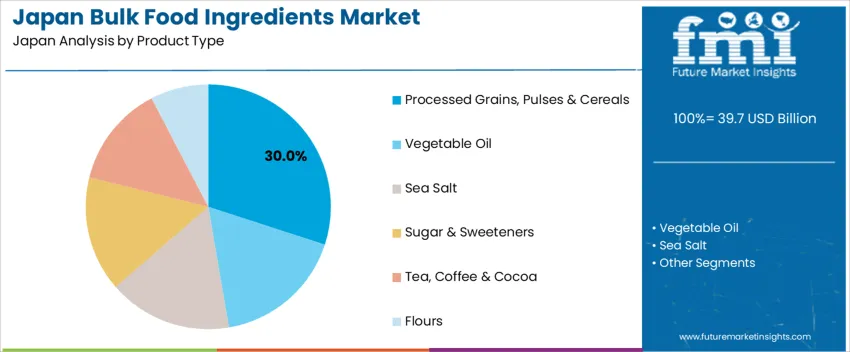
Processed grains, pulses, and cereals account for 30% of total bulk food ingredient demand in Japan due to their central role in staple food production and processed food manufacturing. These ingredients are used extensively across rice based meals, noodles, baked goods, snack products, and breakfast cereals. Their high carbohydrate content, controlled particle sizing, and predictable cooking performance support standardized processing in large scale food plants. Stable demand from school meal programs, institutional catering, and convenience food production further reinforces volume consumption across both public and private food supply chains.
These raw materials also support extended storage under controlled humidity conditions, which improves inventory planning and reduces spoilage risk. Domestic milling and grain handling infrastructure supports steady throughput across regions. Processed pulses add plant protein content to ready meals and bakery fillings, which expands functional usage. These nutritional function, processing stability, and high consumption frequency factors position processed grains, pulses, and cereals as the leading product type in the Japan bulk food ingredient demand structure.
Why Does Bakery and Confectionery Dominate Bulk Food Ingredient Application Demand in Japan?
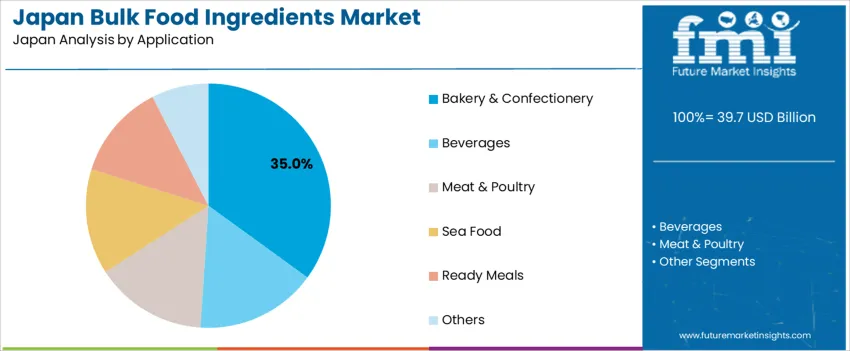
Bakery and confectionery accounts for 35.0% of total bulk food ingredient demand in Japan due to the high production volume of bread, cakes, biscuits, pastries, and sugar based confectionery products. These categories require large and continuous input of flours, sugars, sweeteners, vegetable oils, cocoa derivatives, and flavoring ingredients. Consumer demand for fresh bakery items and packaged snacks sustains steady production cycles across both artisanal bakeries and industrial baking facilities. Seasonal product launches further increase ingredient throughput during peak consumption periods.
Japan’s dense retail network and high product rotation rates in supermarkets and convenience stores reinforce daily replenishment needs. Bakery and confectionery production also serves institutional demand from schools, corporate cafeterias, and transport hubs. Precision in taste, texture, and shelf life requires consistent ingredient specifications, which favors bulk procurement under long term supply contracts. These volume intensity, retail turnover, and formulation consistency requirements position bakery and confectionery as the dominant application segment for bulk food ingredients in Japan.
Why Are Bulk Food Ingredients in Japan Treated as Production Stabilizers Rather Than Cost-Saving Inputs?
Demand for bulk food ingredients in Japan is driven by the need for production stability rather than simple cost reduction. Food manufacturers operate under tight product consistency expectations, where even minor flavor, texture, or color variation can disrupt brand trust. Bulk ingredients such as starches, sweeteners, proteins, and seasonings are used to lock in standardized performance across continuous production runs. Japan food sector prioritizes repeatability over formulation flexibility. This makes bulk ingredients a control mechanism for output reliability, not merely a way to reduce per-unit raw material cost.
How Do Convenience Foods, Central Kitchens, and Private Brands Shape Volume Demand?
Centralized kitchens supplying convenience stores and ready-meal producers are major demand anchors for bulk food ingredients in Japan. These operations prepare massive volumes of sauces, broths, batters, and fillings that require uniform ingredient behavior at scale. Private-label food programs also depend heavily on bulk inputs to maintain margin control while matching branded taste profiles. Seasonal menu turnover increases formulation change frequency, which sustains steady reordering of core bulk bases. These centralized production models convert bulk ingredient demand into a continuous industrial flow rather than a fragmented procurement pattern.
What Import Dependence, Storage Constraints, and Freshness Standards Limit Expansion?
Bulk food ingredient demand in Japan is constrained by heavy import reliance for grains, oils, and protein concentrates. Port congestion, currency fluctuation, and freight cost volatility directly affect procurement timing. Urban production facilities face limited on-site storage capacity, forcing frequent smaller deliveries instead of large stockpiling. High freshness and odor control standards also limit long-term warehousing of sensitive ingredients like fats, spices, and hydrocolloids. These logistics and quality pressures restrict aggressive bulk scaling even in high-volume processing environments.
How Are Functionalization, Health Reformulation, and Menu Localization Reshaping Demand?
Future demand in Japan is shifting toward bulk ingredients engineered for specific health and functional roles. Reduced-sodium seasonings, high-solubility proteins, resistant starches, and texture-modifying fibers are increasingly specified at scale. Aging-population nutrition programs influence the use of digestibility-enhanced bulk ingredients. At the same time, regional menu localization requires adjustments in sweetness, umami intensity, and mouthfeel, even within mass production. These trends show bulk food ingredients moving from neutral building blocks into precision-controlled functional systems within Japanese food manufacturing.
What is the Demand for Bulk Food Ingredients in Japan by Region?
| Region | CAGR (%) |
|---|---|
| Kyushu & Okinawa | 3.3% |
| Kanto | 3.0% |
| Kansai | 2.7% |
| Chubu | 2.3% |
| Tohoku | 2.0% |
| Rest of Japan | 1.9% |
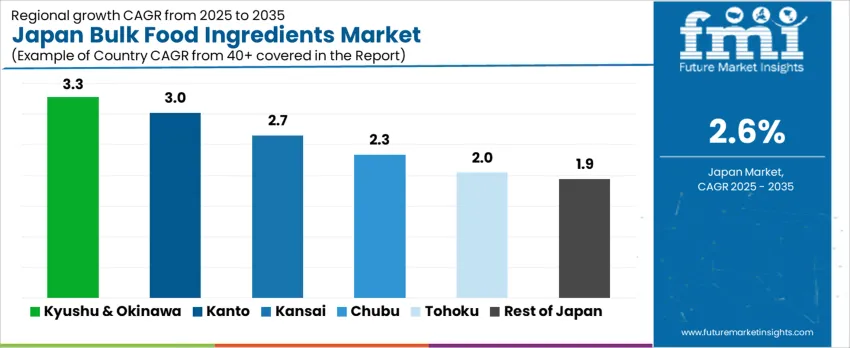
The demand for bulk food ingredients in Japan is growing at a moderate and steady pace across all regions, with Kyushu & Okinawa leading at a 3.3% CAGR. Growth in this region is supported by food processing activity linked to regional agriculture, seafood processing, and ingredient supply for packaged food manufacturers. Kanto follows at 3.0%, driven by dense concentration of large food manufacturers, beverage producers, and institutional food suppliers serving urban markets. Kansai records 2.7% growth, supported by steady demand from bakery, dairy, and confectionery processors. Chubu at 2.3% reflects moderate uptake tied to regional manufacturing and distribution. Tohoku and Rest of Japan, at 2.0% and 1.9%, show slower growth shaped by smaller population bases and lower concentration of large-scale food processing facilities.
How Is Regional Food Processing Activity Supporting Growth in Kyushu And Okinawa?
Food manufacturing activity in Kyushu and Okinawa is advancing at a CAGR of 3.3% through 2035 for bulk food ingredient demand, supported by seafood processing, condiment production, and frozen meal manufacturing. Salt, starches, sweeteners, and functional additives remain core volume drivers. Export oriented processed food also contributes to incremental ingredient intake. Regional cooperatives strengthen ingredient aggregation and distribution. Demand remains production led and formulation focused, with procurement tied closely to stable plant throughput, seasonal seafood output, and steady growth in ready to cook food categories across coastal processing hubs.
- Seafood processing supports high volume ingredient intake
- Condiment and sauce production anchors base demand
- Export food manufacturing adds steady secondary volume
- Cooperative sourcing stabilizes regional procurement
What Is Sustaining Bulk Food Ingredient Demand Across Kanto?
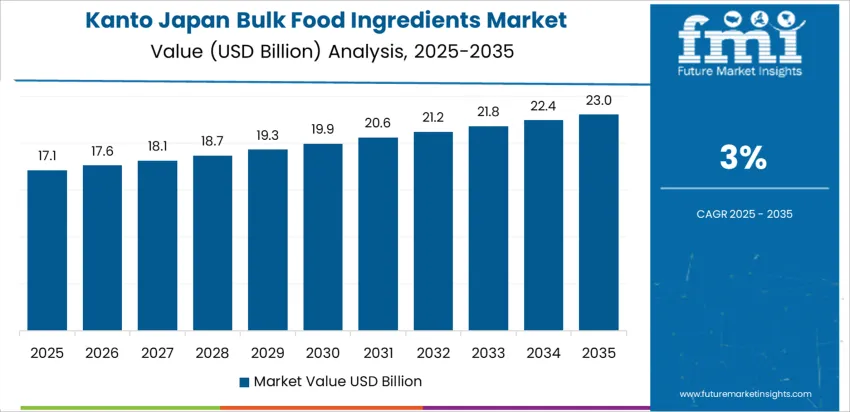
Urban consumption scale in Kanto supports a CAGR of 3.0% through 2035 for bulk food ingredient demand, driven by large beverage plants, bakery production, and national ready meal manufacturing centers. Sugar, flour, dairy powders, and emulsifiers dominate volume movement. Central kitchens and private label processors require consistent ingredient delivery to support continuous batch production. High retail turnover sustains frequent reorder cycles. Demand remains scale driven and throughput focused, shaped by dense food factory networks, supermarket supply chains, and daily volume driven consumer food consumption across metropolitan areas.
- Central kitchens drive continuous ingredient replenishment
- Bakery and beverage plants anchor core volume usage
- Retail turnover sustains frequent procurement cycles
- Private label manufacturing expands bulk sourcing needs
Why Is Kansai Showing Balanced Growth in Bulk Ingredient Usage?
Regional food brand diversity in Kansai supports a CAGR of 2.7% through 2035 for bulk food ingredient demand, shaped by confectionery production, noodle manufacturing, and processed snack output. Flour blends, flavor systems, and stabilizers form key ingredient categories. Small and mid sized manufacturers favor flexible bulk sourcing contracts. Department store food brands support artisanal scale production demand. Demand remains replacement driven rather than capacity driven, with procurement aligned to stable consumer food habits, seasonal gifting cycles, and consistent specialty food manufacturing activity.
- Confectionery and noodle production drive core demand
- Flavor systems support snack manufacturing volume
- Flexible contracts suit mid sized processors
- Seasonal gifting supports specialty ingredient usage
How Is Industrial Food Manufacturing Output Shaping Demand in Chubu?
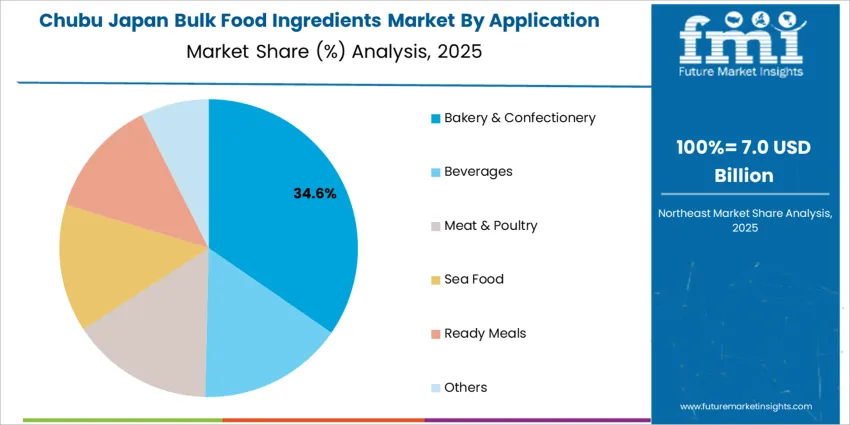
Manufacturing concentration in Chubu supports a CAGR of 2.3% through 2035 for bulk food ingredient demand, driven by centralized dairy processing, industrial seasoning production, and contract food manufacturing. Milk powders, protein concentrates, and texturizing agents dominate usage. Export oriented packaged food adds controlled secondary demand. Long production runs favor predictable ingredient supply agreements. Demand remains contract driven and output aligned, with procurement guided by dairy plant throughput, industrial seasoning batch schedules, and stable operation of food factories serving both domestic and regional export markets.
- Dairy powders anchor consistent volume consumption
- Industrial seasonings support steady formulation demand
- Export packaging adds controlled ingredient movement
- Long contracts stabilize supply planning
What Is Guiding Moderate Bulk Food Ingredient Growth in Tohoku?
Agricultural processing and cooperative production in Tohoku support a CAGR of 2.0% through 2035 for bulk food ingredient demand, shaped by grain milling, soybean processing, and regional frozen food manufacturing. Starches, vegetable powders, and fermentation inputs represent core usage. Local consumption dominates finished product sales. Limited large scale automation restrains rapid volume scaling. Demand remains necessity driven and locally anchored, with steady procurement linked to cooperative factory output, crop dependent processing cycles, and stable household food consumption across regional markets.
- Grain and soybean processing sustains base demand
- Frozen food production drives starch and binder usage
- Cooperative plants guide procurement stability
- Local consumption moderate’s expansion pace
Why Does the Rest f Japan Show Slower Yet Stable Ingredient Demand?
Community scale food production across the rest of Japan reflects a CAGR of 1.9% through 2035 for bulk food ingredient demand, supported by municipal food processors, institutional catering, and small packaged food workshops. Ingredients focus on staples such as sugar, flour, oils, and fermentation agents. Short distribution routes reduce large scale bulk handling requirements. Manual production remains common. Demand stays stable and function driven, guided by routine school meal supply, hospital kitchens, and small local brand manufacturing rather than expansion of industrial food processing capacity.
- Institutional catering anchors staple ingredient usage
- Sugar and flour dominate routine procurement
- Small producers rely on short supply chains
- Manual processing limits rapid volume growth
What Is Driving the Demand for Bulk Food Ingredients in Japan and Who Are the Key Suppliers Meeting That Demand?
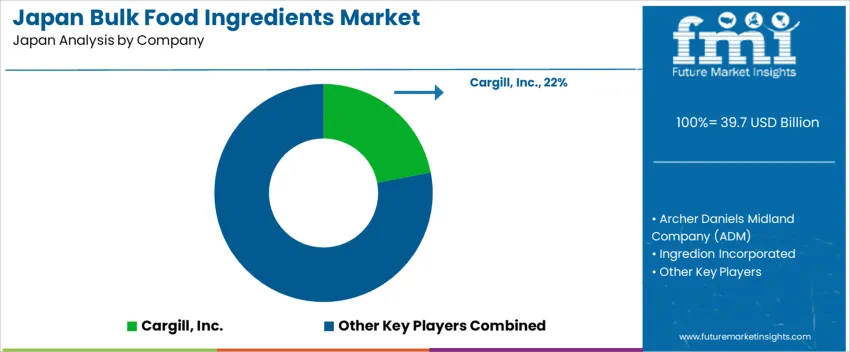
Demand for bulk food ingredients in Japan is expanding because food processors, packaged food makers, and food service firms increasingly rely on systematized ingredients to meet consumer needs for convenience, consistency, and variety. As demand grows for ready to eat meals, processed foods, frozen foods, bakery products, and beverages, manufacturers require standardized starches, sweeteners, proteins, flours, and other inputs in large volumes. Japan’s food processing industry depends significantly on imported raw materials and ingredients due to limited domestic arable land and rising input costs. This reliance supports stable import demand for bulk ingredients from global suppliers, especially when local production cannot meet volume or quality requirements.
Major global suppliers serving Japan’s bulk ingredient demand include Cargill, Inc., Archer Daniels Midland Company (ADM), Ingredion Incorporated, Tate & Lyle PLC, and Olam International. These firms supply commodities like grains, starches, sweeteners, oils, pulses, and functional ingredient solutions in large volume lots and with quality consistency. Their global sourcing networks and logistics infrastructure make them well positioned to export to Japan-supplying food processors, convenience food manufacturers, and beverage producers who value reliable, large scale ingredient access. Their presence stabilizes ingredient supply, supports production continuity, and enables scaling of processed food output in Japan’s food industry.
Key Players in Bulk Food Ingredients in Japan
- Cargill, Inc.
- Archer Daniels Midland Company (ADM)
- Ingredion Incorporated
- Tate & Lyle PLC
- Olam International
Scope of the Report
| Items | Values |
|---|---|
| Quantitative Units (2025) | USD billion |
| Product Type | Processed Grains, Pulses & Cereals, Vegetable Oil, Sea Salt, Sugar & Sweeteners, Tea, Coffee & Cocoa, Flours |
| Application | Bakery & Confectionery, Beverages, Meat & Poultry, Sea Food, Ready Meals, Others |
| Region | Kyushu & Okinawa, Kanto, Kinki, Chubu, Tohoku, Rest of Japan |
| Key Companies Profiled | Cargill, Inc., Archer Daniels Midland Company (ADM), Ingredion Incorporated, Tate & Lyle PLC, Olam International |
| Additional Attributes | Dollar by sales by product type, application, and region. Includes processed grain and cereal throughput, protein concentrate usage, vegetable oil volumes, sugar and sweetener handling, functional additive integration, beverage ingredient scaling, bakery and confectionery ingredient intensity, institutional catering inputs, export-oriented ingredient supply, private-label and convenience food formulation needs, seasonal production impact, quality consistency, storage management, import dependency, milling, crushing, and fermentation operations, multi-ingredient blending, formulation standardization, food safety compliance, and regional manufacturing network contribution across Japan. |
Bulk Food Ingredients in Japan Segmentation
Product Type:
- Processed Grains, Pulses & Cereals
- Vegetable Oil
- Sea Salt
- Sugar & Sweeteners
- Tea, Coffee & Cocoa
- Flours
Application:
- Bakery & Confectionery
- Beverages
- Meat & Poultry
- Sea Food
- Ready Meals
- Others
Region:
- Kyushu & Okinawa
- Kanto
- Kansai
- Chubu
- Tohoku
- Rest of Japan
Frequently Asked Questions
How big is the demand for bulk food ingredients in Japan in 2025?
The demand for bulk food ingredients in Japan is estimated to be valued at USD 39.7 billion in 2025.
What will be the size of bulk food ingredients in Japan in 2035?
The market size for the bulk food ingredients in Japan is projected to reach USD 51.4 billion by 2035.
How much will be the demand for bulk food ingredients in Japan growth between 2025 and 2035?
The demand for bulk food ingredients in Japan is expected to grow at a 2.6% CAGR between 2025 and 2035.
What are the key product types in the bulk food ingredients in Japan?
The key product types in bulk food ingredients in Japan are processed grains, pulses & cereals, vegetable oil, sea salt, sugar & sweeteners, tea, coffee & cocoa and flours.
Which application segment is expected to contribute significant share in the bulk food ingredients in Japan in 2025?
In terms of application, bakery & confectionery segment is expected to command 35.0% share in the bulk food ingredients in Japan in 2025.
Preview the report firsthand - request a free sample
Get SampleGet the brochure for pricing and purchase details.
Get PDFTable of Content
- Executive Summary
- Japan Market Outlook
- Demand-side Trends
- Supply-side Trends
- Technology Roadmap Analysis
- Analysis and Recommendations
- Market Overview
- Market Coverage / Taxonomy
- Market Definition / Scope / Limitations
- Market Background
- Market Dynamics
- Drivers
- Restraints
- Opportunity
- Trends
- Scenario Forecast
- Demand in Optimistic Scenario
- Demand in Likely Scenario
- Demand in Conservative Scenario
- Opportunity Map Analysis
- Product Life Cycle Analysis
- Supply Chain Analysis
- Investment Feasibility Matrix
- Value Chain Analysis
- PESTLE and Porter’s Analysis
- Regulatory Landscape
- Regional Parent Market Outlook
- Production and Consumption Statistics
- Import and Export Statistics
- Market Dynamics
- Japan Market Analysis 2020 to 2024 and Forecast, 2025 to 2035
- Historical Market Size Value (USD Million) Analysis, 2020 to 2024
- Current and Future Market Size Value (USD Million) Projections, 2025 to 2035
- Y-o-Y Growth Trend Analysis
- Absolute $ Opportunity Analysis
- Japan Market Pricing Analysis 2020 to 2024 and Forecast 2025 to 2035
- Japan Market Analysis 2020 to 2024 and Forecast 2025 to 2035, By Product Type
- Introduction / Key Findings
- Historical Market Size Value (USD Million) Analysis By Product Type , 2020 to 2024
- Current and Future Market Size Value (USD Million) Analysis and Forecast By Product Type , 2025 to 2035
- Processed Grains, Pulses & Cereals
- Vegetable Oil
- Sea Salt
- Sugar & Sweeteners
- Tea, Coffee & Cocoa
- Flours
- Y-o-Y Growth Trend Analysis By Product Type , 2020 to 2024
- Absolute $ Opportunity Analysis By Product Type , 2025 to 2035
- Japan Market Analysis 2020 to 2024 and Forecast 2025 to 2035, By Application
- Introduction / Key Findings
- Historical Market Size Value (USD Million) Analysis By Application, 2020 to 2024
- Current and Future Market Size Value (USD Million) Analysis and Forecast By Application, 2025 to 2035
- Bakery & Confectionery
- Beverages
- Meat & Poultry
- Sea Food
- Ready Meals
- Others
- Y-o-Y Growth Trend Analysis By Application, 2020 to 2024
- Absolute $ Opportunity Analysis By Application, 2025 to 2035
- Market Structure Analysis
- Competition Dashboard
- Competition Benchmarking
- Market Share Analysis of Top Players
- By Regional
- By Product Type
- By Application
- Competition Analysis
- Competition Deep Dive
- Cargill, Inc.
- Overview
- Product Portfolio
- Profitability by Market Segments (Product/Age /Sales Channel/Region)
- Sales Footprint
- Strategy Overview
- Marketing Strategy
- Product Strategy
- Channel Strategy
- Archer Daniels Midland Company (ADM)
- Ingredion Incorporated
- Tate & Lyle PLC
- Olam International
- Cargill, Inc.
- Competition Deep Dive
- Assumptions & Acronyms Used
- Research Methodology


