

- Industry Size (2026)
- USD 2.42 Bn
- Forecast (2036)
- USD 3.98 Bn
- CAGR (2026 to 2036)
- 5.1%
Kosher Foods Market Size, Market Forecast and Outlook By FMI
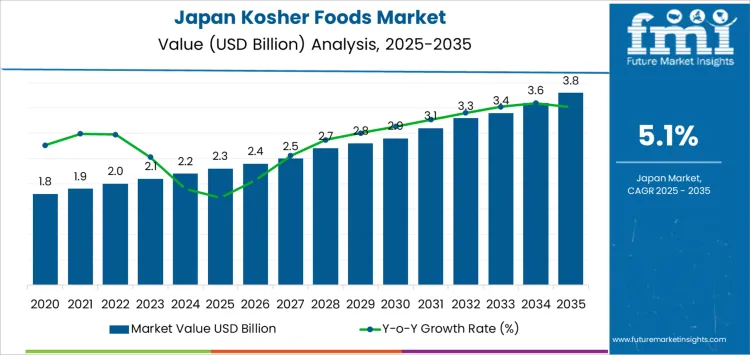
Demand for kosher foods in Japan was valued at USD 2.30 Billion in 2025. Based on Future Market Insights' analysis, demand for kosher foods is estimated to grow to USD 2.42 Billion in 2026 and USD 3.98 Billion by 2036. FMI projects a CAGR of 5.1% during the forecast period from 2026 to 2036. This translates to an incremental opportunity worth USD Billion 1.56 over the ten-year assessment window.
Summary of Kosher Foods Market in Japan
- Market Snapshot
- Demand for kosher foods in Japan is valued at USD Billion 2.30 in 2025 and is projected to reach USD Billion 3.98 by 2036.
- The market is expected to grow at a 5.1% CAGR from 2026 to 2036, creating an incremental opportunity of USD Billion 1.56.
- The market is a certification-driven, multi-channel food category where religious dietary compliance, quality-assurance signaling, and tourism-facing hospitality procurement define demand patterns.
- Demand and Growth Drivers
- Inbound tourism recovery and government targets for international visitor volumes are compelling hospitality operators to stock kosher-certified food products as part of multi-dietary compliance.
- Health-conscious domestic consumers are treating kosher certification as a quality-assurance proxy for ingredient traceability and processing standards.
- International kosher certification bodies are expanding their presence in Japan, certifying domestic manufacturers for both local distribution and export requirements.
- Among key regions, Kyushu & Okinawa leads at 6.4% CAGR, followed by Kanto at 5.9%, Kansai at 5.2%, Chubu at 4.5%, Tohoku at 4%, and Rest of Japan at 3.8%.
- Product and Segment View
- Kosher foods in Japan encompass kosher meat, kosher pareve (neither meat nor dairy), and kosher dairy products, all certified by recognized rabbinical authorities.
- Distribution spans supermarkets, convenience stores, online platforms, and specialty retailers serving religious, health-conscious, and tourism-facing customers.
- Kosher Meat leads by Product with 46% share in 2026, driven by hospitality procurement for international visitor dining and expatriate community demand.
- Supermarkets/Hypermarkets leads by Distribution Channel with 33% share in 2026, reflecting established shelf allocation and footfall-driven purchasing behavior.
- Scope includes certified kosher food products. Excluded are non-certified products and kosher-certified non-food items.
- Geography and Competitive Outlook
- Kyushu & Okinawa and Kanto are the fastest-growing regional clusters, driven by concentrated processing, distribution, and consumption infrastructure.
- Demand in Tohoku and Rest of Japan follows steadier, replacement-driven procurement cycles in established networks.
- Competition is shaped by certification breadth, supply chain traceability, multi-channel distribution capability, and the ability to serve both religious compliance and quality-assurance-driven procurement requirements.
- Key players include Archer Daniels Midland Company, Blommer Chocolate Company, BASF SE, Brooklyn Cookie Company LLC, Ice Chips Candy, LLC.
- Analyst Opinion at FMI
- Nandini Roy Choudhury, Principal Consultant for Food & Beverages, opines: 'In my analysis, I have observed that kosher food demand in Japan is decoupling from its traditional religious consumer base and evolving into a quality-assurance proxy for health-conscious buyers and inbound tourism-facing hospitality operators. Hotels and restaurants preparing for international visitor volumes are procuring kosher-certified ingredients as part of multi-dietary compliance strategies. Suppliers who position kosher certification purely as a niche religious requirement are missing the broader procurement shift, where certification acts as a trust signal for ingredient traceability and processing standards.'
- Strategic Implications / Executive Takeaways
- Domestic food manufacturers should pursue international kosher certification to access the growing hospitality procurement channel serving inbound tourism and expatriate demand.
- Retail buyers should expand kosher product shelf allocation as a multi-dietary compliance strategy aligned with Japan's tourism growth targets.
- Supply chain managers should invest in ingredient traceability systems that meet kosher certification audit requirements while supporting broader food safety compliance objectives.
Japan's kosher food market is shaped by the intersection of inbound tourism growth, expatriate community procurement, and expanding consumer interest in certified food products as quality indicators. The Orthodox Union and other international kosher certification bodies have increased their presence in Japan, certifying domestic food manufacturers to serve both export and local distribution requirements. FMI analysts observe that the supermarket and convenience store channels are expanding kosher product shelf allocation, driven by retailer strategies to serve international visitors and health-conscious domestic consumers. The structural challenge remains supply chain certification complexity, as ingredient traceability requirements under kosher standards exceed those of Japan's domestic food labeling framework.
Across Japanese prefectural clusters, growth trajectories vary based on industrial concentration and end-use demand density. Kyushu & Okinawa is projected to expand at 6.4% CAGR. Kanto is projected to expand at 5.9% CAGR. Kansai is projected to expand at 5.2% CAGR. Chubu is projected to expand at 4.5% CAGR. Tohoku is projected to expand at 4% CAGR. Rest of Japan is projected to expand at 3.8% CAGR. Kyushu & Okinawa leads the growth ranking, supported by concentrated processing and distribution infrastructure. Kanto, anchoring the Tokyo metropolitan consumption base, follows closely. Mature clusters such as Tohoku and Rest of Japan register steadier, replacement-driven demand patterns.
Kosher Foods Market Key Takeaways
| Metric | Details |
|---|---|
| Industry Size (2026) | USD 2.42 Billion |
| Industry Value (2036) | USD 3.98 Billion |
| CAGR (2026 to 2036) | 5.1% |
Source: Future Market Insights, 2026
Kosher Foods Market Definition
Kosher foods are food products manufactured, processed, and packaged in compliance with Jewish dietary laws (kashrut), as certified by recognized rabbinical authorities. In the Japanese market, this category encompasses kosher meat, kosher pareve (neither meat nor dairy), and kosher dairy products distributed through supermarkets, convenience stores, online platforms, and specialty retailers. Certification serves both religious dietary compliance and broader quality assurance signaling.
Kosher Foods Market Inclusions
Market scope includes kosher meat, kosher pareve, and kosher dairy products certified by recognized rabbinical authorities and sold through supermarkets, convenience stores, online platforms, and other retail channels in Japan. The assessment covers market sizes by product category, distribution channel, and Japanese prefectural region for 2026 to 2036.
Kosher Foods Market Exclusions
The scope excludes non-certified food products marketed as natural or clean-label without kosher certification. It also omits kosher-certified non-food items such as cleaning products and cosmetics.
Kosher Foods Market Research Methodology
- Primary Research: Analysts engaged with procurement managers, brand directors, and distribution leads at kosher foods manufacturing and distribution operations across Japan to map decision triggers and specification requirements.
- Desk Research: Data collection aggregated regulatory filings from the Ministry of Health, Labour and Welfare, trade statistics from Japan Customs, and published industry standards relevant to kosher foods production and distribution in Japan.
- Market-Sizing and Forecasting: Baseline values derive from a bottom-up aggregation of manufacturer shipments and import volumes, applying region-specific consumption curves to project demand velocity through 2036.
- Data Validation and Update Cycle: Projections are cross-checked against publicly reported production volumes, trade data, and downstream procurement disclosures from major producers and distributors operating in Japan.
Why is the Demand for Kosher Foods in Japan Growing?
The demand for kosher foods in Japan is growing as consumer interest in specialty diets and diverse food options increases. Kosher foods, which comply with the dietary laws of Judaism, have gained popularity not only among Jewish consumers but also among individuals seeking high-quality, ethically produced food. As Japan’s food culture becomes more globalized, consumers are increasingly open to trying new food types, and kosher foods are perceived as offering a higher standard of quality and purity. This shift toward specialty foods, driven by health-conscious consumers, is contributing to the growing demand for kosher products.
A significant driver of this growth is the rising awareness of food safety and quality. Kosher certification involves strict requirements for ingredients, food preparation, and handling, which often result in higher hygiene and production standards. As Japanese consumers become more focused on the origins and quality of their food, kosher products are seen as more trustworthy and reliable. The growing presence of international brands and restaurants offering kosher options has made these products more accessible to a wider range of consumers.
The expanding expatriate Jewish community in Japan and an increasing number of tourists from Jewish-populated countries are contributing to the demand for kosher foods. As ethical and specialty diets gain popularity, consumers are looking for products that align with their values, driving the growth of the kosher food sector. With greater availability and consumer awareness, the demand for kosher foods in Japan is expected to continue growing steadily through 2035.
What is the Segment-Wise Analysis of Demand for Kosher Foods in Japan?
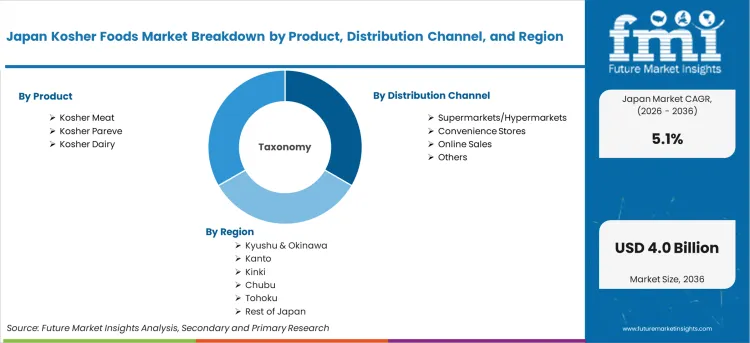
Demand for kosher foods in Japan is segmented by product type and distribution channel. By product type, demand is divided into kosher meat, kosher pareve, and kosher dairy, with kosher meat leading at 46%. The demand is also segmented by distribution channel, including supermarkets/hypermarkets, convenience stores, online sales, and others, with supermarkets/hypermarkets accounting for 33%. Regionally, demand is divided into Kanto, Kinki, Chubu, Kyushu & Okinawa, Tohoku, and the Rest of Japan.
How Does Kosher Meat Lead the Demand for Kosher Foods in Japan?
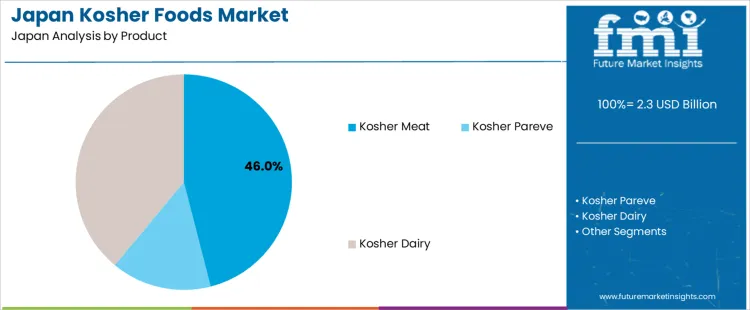
Kosher meat accounts for 46% of the demand for kosher foods in Japan, driven by its importance within Jewish dietary laws and the growing preference for ethically sourced meat. Kosher meat is prepared according to specific religious guidelines, making it essential for those who observe kosher dietary practices. The rising demand for high-quality, hormone-free, and antibiotic-free meat has led more Japanese consumers to choose kosher meat, even if they do not strictly follow kosher dietary laws. The emphasis on food safety, sustainability, and ethical sourcing aligns with the increasing interest in responsibly produced foods. As health-conscious eating and ethical consumption continue to gain traction in Japan, kosher meat remains the dominant product type, offering both religious and ethical benefits while meeting the growing desire for premium, sustainable food options.
Why Do Supermarkets/Hypermarkets Lead the Demand for Kosher Foods in Japan?
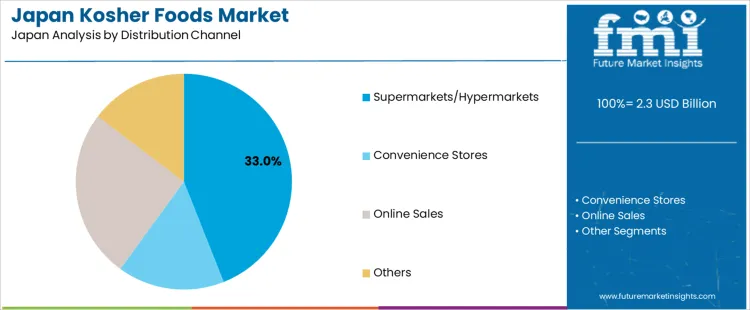
Supermarkets and hypermarkets account for 33% of the demand for kosher foods in Japan, primarily due to their accessibility, variety, and convenience. These retail outlets are the primary point of purchase for kosher products, offering a broad selection of kosher meat, dairy, and other specialty foods in one location. The ability to physically browse and compare different brands and types of kosher foods enhances the shopping experience for consumers. Supermarkets and hypermarkets often feature dedicated kosher sections, making it easier for consumers to find certified kosher products. The popularity of impulse buys and the availability of kosher items in these high-traffic stores further drive demand. As more consumers seek convenient, high-quality food options, supermarkets and hypermarkets will continue to be key players in the distribution of kosher foods in Japan.
What are the Key Trends, Drivers, and Restraints in Demand for Kosher Foods in Japan?
Demand for kosher foods in Japan has been gradually increasing as the industry becomes more established. Beyond the relatively small Jewish population, an important trend is rising interest among non Jewish consumers who view kosher certification as a mark of quality, safety, and ethical production. There is growing interest in ingredients with perceived “natural” benefits (e.g. botanical extracts, plant derived vitamins/minerals, probiotics, fiber supplements) that align with a holistic approach to health and lifestyle. At the same time, the relatively niche status of kosher foods, limited public awareness, and higher costs associated with certification and imports restrain faster expansion.
Why is Demand for Kosher Foods Growing in Japan?
Some consumers are motivated by faith or dietary laws (e.g. Jewish or expatriate populations). Others increasingly non Jewish choose kosher foods because they associate the certification with strict hygiene, high quality standards, and transparent supply chains. Kosher certification also appeals to people with dietary sensitivities or specific lifestyle choices such as veganism, clean label eating, or ethical sourcing preferences because many kosher certified offerings overlap with allergen free or plant based standards. As international tourism and global food culture expand, exposure to and availability of kosher foods increase in supermarkets, online stores, and hospitality businesses making them more accessible to curious or quality seeking consumers.
How are Industry & Industry Dynamics Supporting Kosher Food Demand in Japan?
Improved supply chain infrastructure, global trade, and certification processes have made it easier for kosher certified products to reach Japan. Importers and retailers are increasingly offering a wider variety of kosher certified items from meats and seafood to snacks, bakery goods, dietary supplements and plant based products expanding the choice for consumers. The growing global trend toward plant based diets and ethical, transparent production aligns well with kosher standards, so manufacturers and distributors see kosher certification as a differentiator for quality and safety. As supermarkets, hypermarkets and online grocery stores expand their kosher offerings, access becomes easier for a broader customer base, which helps normalize kosher foods beyond niche circles.
What are the Key Challenges and Risks That Could Limit Kosher Food Demand in Japan?
Kosher certification and import logistics often raise costs making kosher foods more expensive than mainstream alternatives, which may dissuade price sensitive consumers. Consumer awareness remains relatively low in Japan many people may not fully understand what kosher means, reducing perceived value and demand. For domestic producers, the complexity, time, and expense of obtaining and maintaining kosher certification (especially for meats, dairy, mixed products) can be a barrier. Finally, because kosher foods are still a niche segment (religious requirement covers a small portion of population), overall demand may not reach mainstream levels unless awareness and value perception grow substantially.
What is the Regional Demand Outlook for Kosher Foods in Japan?
.webp "Top Country Growth Comparison Japan Kosher Foods Market Cagr (2026 2036)")
| Region | CAGR (%) |
|---|---|
| Kyushu & Okinawa | 6.4% |
| Kanto | 5.9% |
| Kansai | 5.2% |
| Chubu | 4.5% |
| Tohoku | 4.0% |
| Rest of Japan | 3.8% |
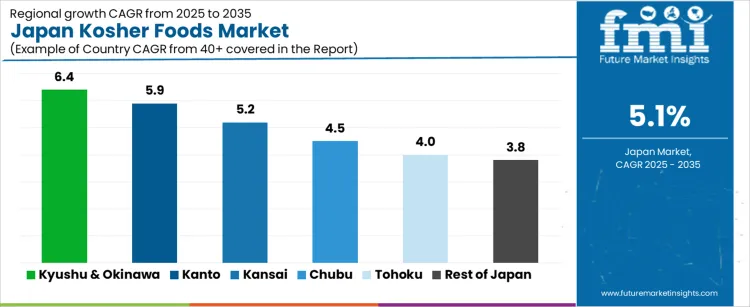
Demand for kosher foods in Japan is growing across all regions, with Kyushu & Okinawa leading at a 6.4% CAGR, driven by increasing awareness of dietary needs and the region’s growing international population. Kanto follows with a 5.9% CAGR, supported by the region’s large urban population and the rising demand for specialty foods. Kansai shows a 5.2% CAGR, driven by a growing interest in international cuisines and diverse food offerings. Chubu experiences a 4.5% CAGR, with demand rising as consumers become more health-conscious and seek specialized food options. Tohoku and the Rest of Japan see moderate growth at 4% and 3.8%, respectively, reflecting a gradual increase in interest for kosher foods in both urban and rural areas.
How is Demand for Kosher Foods Growing in Kyushu & Okinawa?
Kyushu & Okinawa leads the demand for kosher foods, growing at a 6.4% CAGR. The region's increasing international population, particularly in Okinawa due to tourism and military presence, is contributing to this growth. As global awareness of dietary restrictions and preferences rises, the demand for kosher foods is increasing, especially among those with religious or health-based dietary needs. Local food retailers, restaurants, and supermarkets in Okinawa and other parts of Kyushu are expanding their offerings to include kosher-certified products. Okinawa’s tourism sector drives demand as international visitors look for familiar food options that meet dietary requirements. With the growing number of health-conscious consumers and the increasing diversity of the population, the demand for kosher foods in Kyushu & Okinawa is expected to continue rising steadily.
Why is Demand for Kosher Foods Rising in Kanto?
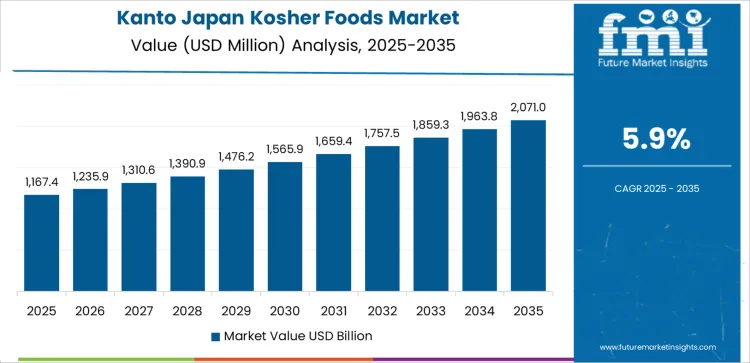
In Kanto, demand for kosher foods is rising at a 5.9% CAGR. The large urban population, particularly in Tokyo, has seen a growing interest in specialized diets, including kosher foods. As Japan becomes more international, with increased expatriate populations and international travelers, the demand for kosher-certified foods is growing. The Kanto region’s diverse food culture, combined with the rising awareness of religious and dietary preferences, has led to more grocery stores, supermarkets, and restaurants offering kosher products. Health-conscious consumers also seek kosher foods due to the perception of high standards in food production. With the growth of online retail and convenience stores offering kosher products, accessibility has become easier. As demand for ethical and specialized foods increases in Kanto, the industry for kosher foods is expected to grow steadily.
How is Demand for Kosher Foods Expanding in Kansai?
Kansai shows steady growth in kosher food demand, growing at a 5.2% CAGR. Known for its rich food culture, particularly in Osaka and Kyoto, Kansai has seen an increasing interest in international cuisines, including kosher foods. With the rise of international tourism and the growing diversity of residents, more restaurants and retailers are stocking kosher-certified food to cater to consumer demand. The region’s health-conscious consumers are turning to kosher foods for perceived higher quality and ethical standards. As more foodservice providers in Kansai incorporate kosher options into their menus and offerings, demand is expected to grow steadily. The region’s openness to global culinary trends, combined with the rise in specialized dietary requirements, supports the continued adoption of kosher foods in Kansai.
Why is Demand for Kosher Foods Growing in Chubu?
Chubu is experiencing steady growth in kosher food demand, growing at a 4.5% CAGR. As urban areas like Nagoya expand, consumers are increasingly seeking specialized food products, including kosher foods. The growth in international trade, travel, and multiculturalism in Chubu is contributing to the increased demand for kosher-certified products. Local supermarkets, health food stores, and restaurants are recognizing this trend and are expanding their kosher food offerings to cater to both residents and international visitors. Health-conscious consumers in Chubu are also drawn to kosher foods, as they are often perceived as being produced with higher quality and ethical standards. With increasing exposure to global dietary trends, demand for kosher foods is expected to rise steadily in the region, supported by the growth in multicultural and health-focused living.
How is Demand for Kosher Foods Expanding in Tohoku?
Tohoku is seeing moderate growth in kosher food demand, with a 4.0% CAGR. While demand in Tohoku is smaller compared to urban centers, the increasing awareness of dietary needs and preferences is contributing to the growth of the kosher food industry. Consumers in larger cities like Sendai are becoming more aware of the benefits of kosher foods, particularly for those with specific dietary requirements. As Tohoku’s food culture becomes more diverse, with an increasing interest in international foods, the demand for kosher-certified products is rising. With growing access to kosher foods through online platforms and specialty stores, awareness and availability are improving. As the region's residents increasingly embrace global food trends, demand for kosher foods in Tohoku is expected to continue growing, albeit at a moderate pace.
Why is Demand for Kosher Foods Steady in the Rest of Japan?
The Rest of Japan is experiencing steady demand for kosher foods, with a 3.8% CAGR. Although adoption is slower compared to urban regions, there is a gradual increase in interest in kosher foods as awareness grows about dietary needs and preferences. As multicultural influences increase in rural and smaller urban areas, kosher foods are becoming more available through local retailers and online shopping platforms. In addition, consumers who follow religious or ethical dietary guidelines are contributing to the steady rise in demand. The increased focus on healthy and ethically sourced foods also supports the growth of kosher food demand in these regions. As more consumers recognize the benefits of kosher certification, demand for these foods in the Rest of Japan is expected to grow gradually, reflecting the broader national trends toward health-conscious and ethically produced food choices.
What is Driving the Demand for Kosher Foods in Japan and Who Are the Key Players Shaping the Industry?
The demand for kosher foods in Japan is rising as the country becomes more globalized and diverse in terms of food preferences. While kosher foods were traditionally associated with Jewish dietary laws, increasing awareness and interest in specialized diets are driving the industry. Kosher foods are often perceived as higher quality due to the stringent standards they must meet, which appeal to health-conscious consumers looking for products that are free from certain additives, preservatives, or artificial ingredients. Japan’s growing international population, including expatriates and tourists, has increased the need for kosher-certified products in foodservice, retail, and hospitality sectors. The rising popularity of clean-label foods and ethical sourcing practices also contributes to the growing demand for kosher products.
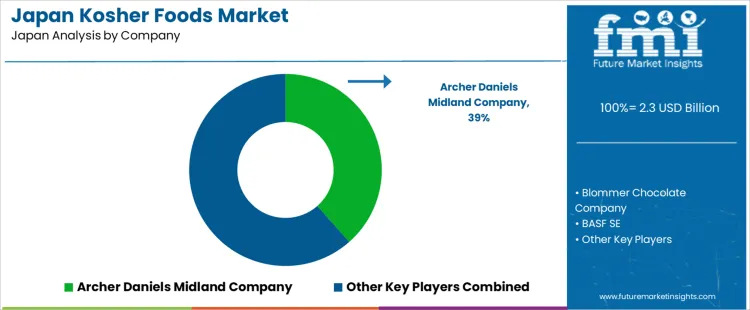
Key players shaping the kosher food industry in Japan include Archer Daniels Midland Company, Blommer Chocolate Company, BASF SE, Brooklyn Cookie Company LLC, and Ice Chips Candy, LLC. Archer Daniels Midland Company leads the industry with a significant share of 38.5%, offering a variety of kosher-certified food ingredients that cater to both commercial and consumer needs. These companies provide a wide range of kosher food products, including ingredients, snacks, and sweets, to meet the needs of Japan’s growing demand for specialty foods. They focus on ensuring their products comply with kosher standards while maintaining high quality and safety standards.
The growth of the kosher food industry in Japan is supported by the increasing awareness of dietary restrictions, ethical sourcing, and health benefits. As Japan’s food industry becomes more diverse and receptive to global food trends, kosher foods are expected to continue to play an important role. With the rise in demand for high-quality, ethical food choices, the kosher food sector is poised for further expansion in Japan’s evolving food landscape.
Key Players in Japan Kosher Foods Demand
- Archer Daniels Midland Company
- Blommer Chocolate Company
- BASF SE
- Brooklyn Cookie Company LLC
- Ice Chips Candy, LLC
Scope of the Report
| Metric | Value |
|---|---|
| Quantitative Units | USD Billion 2.42 to USD Billion 3.98, at a CAGR of 5.1% |
| Market Definition | Kosher foods are food products manufactured, processed, and packaged in compliance with Jewish dietary laws (kashrut), as certified by recognized rabbinical authorities. In the Japanese market, this category encompasses kosher meat, kosher pareve (neither meat nor dairy), and kosher dairy products distributed through supermarkets, convenience stores, online platforms, and specialty retailers. |
| Segmentation | Product: Kosher Meat, Kosher Pareve, Kosher Dairy; Distribution Channel: Supermarkets/Hypermarkets, Convenience Stores, Online Sales, Others |
| Regions Covered | Kyushu & Okinawa, Kanto, Kansai, Chubu, Tohoku, Rest of Japan |
| Key Companies Profiled | Archer Daniels Midland Company, Blommer Chocolate Company, BASF SE, Brooklyn Cookie Company LLC, Ice Chips Candy, LLC |
| Forecast Period | 2026 to 2036 |
| Approach | Forecasting models apply a bottom-up methodology starting with manufacturer shipment metrics and import volume data, cross-validated against downstream consumption patterns and regulatory compliance filings. |
Japan Kosher Foods Demand by Key Segments
Product
- Kosher Meat
- Kosher Pareve
- Kosher Dairy
Distribution Channel
- Supermarkets/Hypermarkets
- Convenience Stores
- Online Sales
- Others
Region
- Kyushu & Okinawa
- Kanto
- Kansai
- Chubu
- Tohoku
- Rest of Japan
Bibliography
- 1. Orthodox Union Kosher. (2025). International Kosher Certification Directory: Japan. OU Kosher.
- 2. Japan National Tourism Organization. (2025). Inbound Tourism Statistics and Dining Accessibility Report. JNTO.
- 3. Consumer Affairs Agency, Government of Japan. (2024). Food Labeling Standards and Certification Framework. CAA.
- 4. Ministry of Health, Labour and Welfare. (2024). Food Sanitation Act: Imported Food Inspection Statistics. MHLW.
- 5. World Health Organization. (2024). Food Safety Country Profile: Japan. WHO.
This bibliography is provided for reader reference. The full Future Market Insights report contains the complete reference list with primary research documentation.
Frequently Asked Questions
How large is the demand for Kosher Foods in Japan in 2026?
Demand for kosher foods in Japan is estimated to be valued at USD Billion 2.42 in 2026.
What will be the market size of Kosher Foods in Japan by 2036?
Market size for kosher foods in Japan is projected to reach USD Billion 3.98 by 2036.
What is the expected demand growth for Kosher Foods in Japan between 2026 and 2036?
Demand for kosher foods in Japan is expected to grow at a CAGR of 5.1% between 2026 and 2036.
Which Product is poised to lead sales in 2026?
Kosher Meat accounts for 46% share in 2026, driven by established procurement preferences and compatibility across primary end-use applications.
Which region is growing fastest for Kosher Foods in Japan?
Kyushu & Okinawa is projected to grow at a CAGR of 6.4% during 2026 to 2036, leading all regional clusters in Japan.
What is included in the scope of this Kosher Foods report?
Market scope includes kosher meat, kosher pareve, and kosher dairy products certified by recognized rabbinical authorities and sold through supermarkets, convenience stores, online platforms, and other retail channels in Japan. The assessment covers market sizes by product category, distribution channel, and Japanese prefectural region for 2026 to 2036.
What is excluded from the scope of this report?
The scope excludes non-certified food products marketed as natural or clean-label without kosher certification. It also omits kosher-certified non-food items such as cleaning products and cosmetics.
How does FMI build and validate the Kosher Foods forecast?
Forecasting models apply a bottom-up methodology starting with manufacturer shipment data and import volumes, cross-validated against downstream consumption patterns and regulatory compliance filings.
Preview the report firsthand - request a free sample
Get SampleGet the brochure for pricing and purchase details.
Get PDFTable of Content
- Executive Summary
- Japan Market Outlook
- Demand-side Trends
- Supply-side Trends
- Technology Roadmap Analysis
- Analysis and Recommendations
- Market Overview
- Market Coverage / Taxonomy
- Market Definition / Scope / Limitations
- Research Methodology
- Chapter Orientation
- Analytical Lens and Working Hypotheses
- Market Structure, Signals, and Trend Drivers
- Benchmarking and Cross-market Comparability
- Market Sizing, Forecasting, and Opportunity Mapping
- Research Design and Evidence Framework
- Desk Research Programme (Secondary Evidence)
- Company Annual and Sustainability Reports
- Peer-reviewed Journals and Academic Literature
- Corporate Websites, Product Literature, and Technical Notes
- Earnings Decks and Investor Briefings
- Statutory Filings and Regulatory Disclosures
- Technical White Papers and Standards Notes
- Trade Journals, Industry Magazines, and Analyst Briefs
- Conference Proceedings, Webinars, and Seminar Materials
- Government Statistics Portals and Public Data Releases
- Press Releases and Reputable Media Coverage
- Specialist Newsletters and Curated Briefings
- Sector Databases and Reference Repositories
- FMI Internal Proprietary Databases and Historical Market Datasets
- Subscription Datasets and Paid Sources
- Social Channels, Communities, and Digital Listening Inputs
- Additional Desk Sources
- Expert Input and Fieldwork (Primary Evidence)
- Primary Modes
- Qualitative Interviews and Expert Elicitation
- Quantitative Surveys and Structured Data Capture
- Blended Approach
- Why Primary Evidence is Used
- Field Techniques
- Interviews
- Surveys
- Focus Groups
- Observational and In-context Research
- Social and Community Interactions
- Stakeholder Universe Engaged
- C-suite Leaders
- Board Members
- Presidents and Vice Presidents
- R&D and Innovation Heads
- Technical Specialists
- Domain Subject-matter Experts
- Scientists
- Physicians and Other Healthcare Professionals
- Governance, Ethics, and Data Stewardship
- Research Ethics
- Data Integrity and Handling
- Primary Modes
- Tooling, Models, and Reference Databases
- Desk Research Programme (Secondary Evidence)
- Data Engineering and Model Build
- Data Acquisition and Ingestion
- Cleaning, Normalisation, and Verification
- Synthesis, Triangulation, and Analysis
- Quality Assurance and Audit Trail
- Market Background
- Market Dynamics
- Drivers
- Restraints
- Opportunity
- Trends
- Scenario Forecast
- Demand in Optimistic Scenario
- Demand in Likely Scenario
- Demand in Conservative Scenario
- Opportunity Map Analysis
- Product Life Cycle Analysis
- Supply Chain Analysis
- Investment Feasibility Matrix
- Value Chain Analysis
- PESTLE and Porter’s Analysis
- Regulatory Landscape
- Regional Parent Market Outlook
- Production and Consumption Statistics
- Import and Export Statistics
- Market Dynamics
- Japan Market Analysis 2021 to 2025 and Forecast, 2026 to 2036
- Historical Market Size Value (USD Million) Analysis, 2021 to 2025
- Current and Future Market Size Value (USD Million) Projections, 2026 to 2036
- Y-o-Y Growth Trend Analysis
- Absolute $ Opportunity Analysis
- Japan Market Pricing Analysis 2021 to 2025 and Forecast 2026 to 2036
- Japan Market Analysis 2021 to 2025 and Forecast 2026 to 2036, By Product
- Introduction / Key Findings
- Historical Market Size Value (USD Million) Analysis By Product , 2021 to 2025
- Current and Future Market Size Value (USD Million) Analysis and Forecast By Product , 2026 to 2036
- Kosher Meat
- Kosher Pareve
- Kosher Dairy
- Kosher Meat
- Y-o-Y Growth Trend Analysis By Product , 2021 to 2025
- Absolute $ Opportunity Analysis By Product , 2026 to 2036
- Japan Market Analysis 2021 to 2025 and Forecast 2026 to 2036, By Distribution Channel
- Introduction / Key Findings
- Historical Market Size Value (USD Million) Analysis By Distribution Channel, 2021 to 2025
- Current and Future Market Size Value (USD Million) Analysis and Forecast By Distribution Channel, 2026 to 2036
- Supermarkets/Hypermarkets
- Convenience Stores
- Online Sales
- Others
- Supermarkets/Hypermarkets
- Y-o-Y Growth Trend Analysis By Distribution Channel, 2021 to 2025
- Absolute $ Opportunity Analysis By Distribution Channel, 2026 to 2036
- Japan Market Analysis 2021 to 2025 and Forecast 2026 to 2036, By Region
- Introduction
- Historical Market Size Value (USD Million) Analysis By Region, 2021 to 2025
- Current Market Size Value (USD Million) Analysis and Forecast By Region, 2026 to 2036
- Kyushu & Okinawa
- Kanto
- Kinki
- Chubu
- Tohoku
- Rest of Japan
- Market Attractiveness Analysis By Region
- Kyushu & Okinawa Market Analysis 2021 to 2025 and Forecast 2026 to 2036, By Country
- Historical Market Size Value (USD Million) Trend Analysis By Market Taxonomy, 2021 to 2025
- Market Size Value (USD Million) Forecast By Market Taxonomy, 2026 to 2036
- By Country
- By Product
- By Distribution Channel
- By Country
- Market Attractiveness Analysis
- By Country
- By Product
- By Distribution Channel
- Key Takeaways
- Kanto Market Analysis 2021 to 2025 and Forecast 2026 to 2036, By Country
- Historical Market Size Value (USD Million) Trend Analysis By Market Taxonomy, 2021 to 2025
- Market Size Value (USD Million) Forecast By Market Taxonomy, 2026 to 2036
- By Country
- By Product
- By Distribution Channel
- By Country
- Market Attractiveness Analysis
- By Country
- By Product
- By Distribution Channel
- Key Takeaways
- Kinki Market Analysis 2021 to 2025 and Forecast 2026 to 2036, By Country
- Historical Market Size Value (USD Million) Trend Analysis By Market Taxonomy, 2021 to 2025
- Market Size Value (USD Million) Forecast By Market Taxonomy, 2026 to 2036
- By Country
- By Product
- By Distribution Channel
- By Country
- Market Attractiveness Analysis
- By Country
- By Product
- By Distribution Channel
- Key Takeaways
- Chubu Market Analysis 2021 to 2025 and Forecast 2026 to 2036, By Country
- Historical Market Size Value (USD Million) Trend Analysis By Market Taxonomy, 2021 to 2025
- Market Size Value (USD Million) Forecast By Market Taxonomy, 2026 to 2036
- By Country
- By Product
- By Distribution Channel
- By Country
- Market Attractiveness Analysis
- By Country
- By Product
- By Distribution Channel
- Key Takeaways
- Tohoku Market Analysis 2021 to 2025 and Forecast 2026 to 2036, By Country
- Historical Market Size Value (USD Million) Trend Analysis By Market Taxonomy, 2021 to 2025
- Market Size Value (USD Million) Forecast By Market Taxonomy, 2026 to 2036
- By Country
- By Product
- By Distribution Channel
- By Country
- Market Attractiveness Analysis
- By Country
- By Product
- By Distribution Channel
- Key Takeaways
- Rest of Japan Market Analysis 2021 to 2025 and Forecast 2026 to 2036, By Country
- Historical Market Size Value (USD Million) Trend Analysis By Market Taxonomy, 2021 to 2025
- Market Size Value (USD Million) Forecast By Market Taxonomy, 2026 to 2036
- By Country
- By Product
- By Distribution Channel
- By Country
- Market Attractiveness Analysis
- By Country
- By Product
- By Distribution Channel
- Key Takeaways
- Key Countries Market Analysis
- Kyushu & Okinawa
- Pricing Analysis
- Market Share Analysis, 2025
- By Product
- By Distribution Channel
- Kanto
- Pricing Analysis
- Market Share Analysis, 2025
- By Product
- By Distribution Channel
- Kinki
- Pricing Analysis
- Market Share Analysis, 2025
- By Product
- By Distribution Channel
- Chubu
- Pricing Analysis
- Market Share Analysis, 2025
- By Product
- By Distribution Channel
- Tohoku
- Pricing Analysis
- Market Share Analysis, 2025
- By Product
- By Distribution Channel
- Rest of Japan
- Pricing Analysis
- Market Share Analysis, 2025
- By Product
- By Distribution Channel
- Kyushu & Okinawa
- Market Structure Analysis
- Competition Dashboard
- Competition Benchmarking
- Market Share Analysis of Top Players
- By Regional
- By Product
- By Distribution Channel
- Competition Analysis
- Competition Deep Dive
- Archer Daniels Midland Company
- Overview
- Product Portfolio
- Profitability by Market Segments (Product/Age /Sales Channel/Region)
- Sales Footprint
- Strategy Overview
- Marketing Strategy
- Product Strategy
- Channel Strategy
- Blommer Chocolate Company
- BASF SE
- Brooklyn Cookie Company LLC
- Ice Chips Candy, LLC
- Archer Daniels Midland Company
- Competition Deep Dive
- Assumptions & Acronyms Used


