


- Dehydrated onion capacity is not only about processing more onions. It depends on raw onion quality, drying technology, moisture control, microbial safety, color stability, and flavor consistency.
- White onions lead variety demand because they deliver a consistent pungency profile without changing the color of sauces, seasonings, dry mixes, and light-colored food systems.
- Powder leads form demand because it distributes uniformly in spice blends, soups, sauces, snacks, ready meals, and seasoning systems.
- Air drying leads drying-method demand because it offers a cost-effective balance between moisture removal, flavor retention, and industrial throughput.
- The strongest suppliers are those that can manage agricultural sourcing, dehydration control, food safety documentation, and export-grade specifications.
- The biggest misconception is that dehydrated onions are a basic commodity. In industrial food manufacturing, they are a controlled flavor ingredient where consistency matters more than peak intensity.
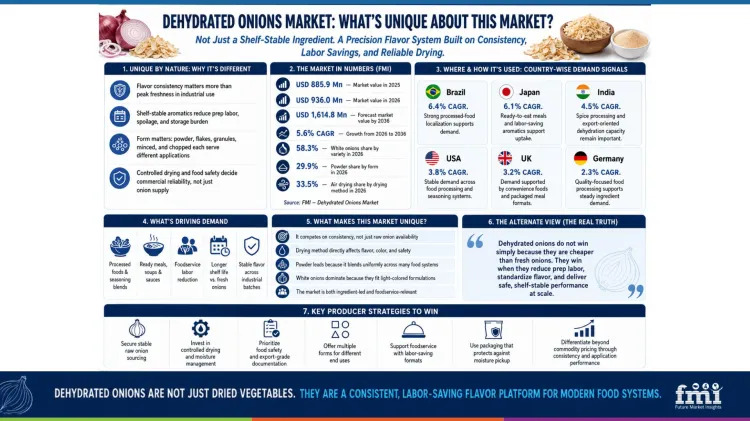
Dehydrated onions may seem to be a very straightforward product. However, the key to understanding this industry lies in processing capacity. It is not that the purchasers of food companies and institutions use dehydrated onions simply for their convenience. They use them because they provide better flavor, longer shelf life, less wastage, and greater predictability compared to fresh onions.
FMI’s Dehydrated Onions Market preview supports this view. The market was valued at USD 885.9 Mn in 2025, reached USD 936.0 Mn in 2026, and is forecast to rise to USD 1,614.8 Mn by 2036 at a 5.6% CAGR. FMI also states that food processors and institutional kitchens are increasingly adopting shelf-stable onion ingredients to ensure consistent flavor profiles and reduce dependence on volatile fresh produce supply.
The first concern with regards to production capacity is the sourcing of onions. Even dehydration will not help in rectifying low quality agriculture products. The size, solids percentage, pungency, moisture content, sugar content, color, and defect rates all contribute to the final product. Therefore, if the raw onions have variations, the final products such as powder, flakes, granules, and mince would also have variations.
White onions are estimated to dominate the total varieties requirement with 58.3% share in 2026. It is logical in food applications on an industrial scale since white onions have the capability of providing the needed spiciness and flavors without compromising the overall aesthetics of the sauces, seasonings, dry mixes, soups, and coatings. Color consistency in food production is just as crucial as flavoring; an inconsistency in the color of the product between batches could lead to quality issues despite good flavor.
The Dehydrated Vegetables Market reinforces the importance of onions within the broader dehydrated vegetable category. FMI states that onions are expected to lead dehydrated vegetable product demand with 40.0% share in 2026, while food manufacturers hold 55.0% end-use demand. This confirms that onion is not a minor ingredient. It anchors seasoning systems, ready meals, soups, sauces, snacks, noodles, and processed food applications.
Form choice is yet another crucial component of the capacity story. According to FMI, the predominant form will be powder with 29.9% of the market share in 2026. This is important to the commercialization process due to the ability of the powder to hydrate rapidly, disperse evenly, and blend into spice blends, sauces, soup bases, snack extrudates, batters, marinades, and meat formulation.
The formats of granules, minced onions, flakes, sliced onions, and crispy fried onions cater to varied requirements. Granules are helpful for texture control and proper rehydration. Formats of minced and chopped onions help where the presence of onions is important. Formats like flakes are helpful for soup, ready meals, and spices in retail packs. Formats of crispy fried onions help for topping and food service uses.
The drying process makes all the difference in terms of the processing technology used. According to FMI, air drying is the most popular drying method with a market share of 33.5% in 2026. The reason for the popularity of air drying is that it provides an efficient compromise between the rate of processing, costs, moisture elimination, and preservation of flavor. But air drying needs to be controlled.
The Food Processing Ingredients Market is useful when discussing dehydrated onions as an industrial input. Food processors need ingredients that reduce production variability. Dehydrated onions help simplify storage, dosing, blending, and inventory planning. But these advantages only hold when processors can rely on consistent specifications.
Moisture content management is vital. In case the moisture content in the dried onions is high, the onions might stick together, get spoilt, lose their ability to flow, or fail to work in dry seasoning processes. In case they are dried in excess or not well processed, flavor and color will be affected.
It is important for food safety as well. Dried products often cross boundaries and enter large manufacturing facilities. The buyer may ask for microbial specifications, pesticide residue, foreign matter, allergens, HACCP program, and traceability. According to FMI, regional processors are under pressure to shift from sun drying to more advanced mechanical drying for meeting stringent microbiological specifications.
The Food Safety Testing Market is relevant because dried ingredients can still carry food safety risks if sourcing, drying, storage, and packaging are poorly controlled. Food manufacturers do not want to reformulate or recall finished foods because of a contaminated dry ingredient. Testing and documentation are part of capacity, not separate from it.
The CAGRs of 6.4% for Brazil and 6.1% for Japan as mentioned by FMI further support the reason why regional requirements for processing vary. The growth rate in Brazil is attributed to localization of processed foods production whereas that of Japan is attributed to consumption of ready-to-eat meals and standardization of aromatics. The 4.5% CAGR of India is attributed to its two-fold nature.
The best suppliers would invest in capacity for contract farming, onion selection, drying, food safety testing, moisture control, and flexibility of format. The supplier which wins in this marketplace is not only the one which has the best onions based on the onion taste factor. Rather, it is the supplier which can provide consistently the same quality in terms of flavor, color, moisture, size, and safety.
What needs to be avoided is the fallacy of dehydrated onions being an agricultural product. For those in industry, inconsistency in the onion powder could mean reformulation, rejected batches, off-flavors, and customer complaints. In this case, processing control becomes an advantage.
Bottom line: Dehydrated onion capacity is not just about drying onions. It is about converting variable agricultural inputs into controlled, safe, shelf-stable flavor systems that food manufacturers can rely on at commercial scale.
FMI Related Links
- Dehydrated Onions Market: Primary link for form share, variety share, drying method, and market value
- Dehydrated Vegetables Market: Use when discussing onion’s role within dehydrated vegetable demand
- Demand for Dehydrated Onions in EU: Use when discussing EU food processing, B2B demand, and conventional supply
- Food Packaging Market: Use when discussing moisture-barrier packaging and retail formats
- Organic Spices Market: Use when discussing premium and organic spice differentiation

