


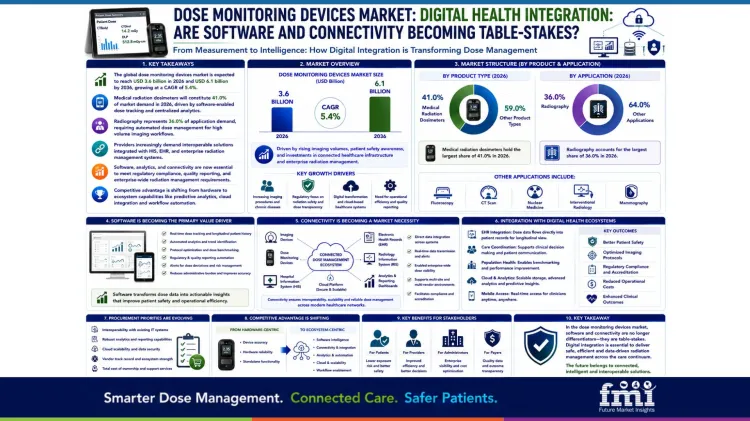
- The global dose monitoring devices market is expected to reach USD 3.6 billion in 2026 and USD 6.1 billion in 2036, growing at a CAGR of 5.4%, driven by increasing investments in connected healthcare infrastructure and enterprise radiation management systems.
- Medical radiation dosimeters will constitute 41.0% of market demand in 2026, with increased benefits from software-enabled dose tracking, cloud-based reporting and centralized radiation analytics capabilities.
- Radiography, which represents 36.0% of the application demand, has substantial needs for automated dose management platforms to facilitate high volume imaging workflows and longitudinal exposure monitoring.
- Healthcare providers are actively seeking dose monitoring solutions which provide interoperability, analytics capability and integration with hospital information systems and electronic health records.
- As hospitals look to do more with less, software platforms and connectivity capabilities are increasingly required to meet basic procurement needs such as regulatory compliance and quality reporting capabilities, and enterprise-wide radiation management.
- Competitive advantage is moving from just hardware performance to ecosystem development, predictive analytics and cloud integration capabilities.
Introduction
The global healthcare industry is undergoing a rapid digital transformation, impacting the design and deployment of medical devices. Dose monitoring technologies in diagnostic imaging and radiation management are transitioning from stand-alone measurement devices to interconnected digital platforms to enable enterprise-wide patient safety and quality management initiatives.
The dose monitoring devices market is estimated at USD 3.6 billion in 2026 and is projected to reach USD 6.1 billion by 2036, at a CAGR of 5.4%. The increasing procedural volumes, awareness about the hazards associated with radiation exposure and investments in healthcare information technologies are driving the demand for advanced dose management solutions.
In the past, dose monitoring systems were mainly used for recording radiation exposure and regulatory purposes. But today, healthcare providers are more and more demanding that these technologies provide real-time analytics, automated reporting, longitudinal tracking, and integration with broader healthcare information systems.
As the digital healthcare ecosystem matures, software functionality and connectivity are quickly becoming minimum market requirements rather than differentiating features.
Market Context
Globally, the use of medical imaging procedures is continuously growing due to the rising prevalence of chronic diseases, aging populations and the growing reliance on sophisticated diagnostic technologies. At the same time, concerns have increased about cumulative radiation exposure and patient safety.
Healthcare providers are under greater pressure than ever to track radiation doses carefully, optimize imaging protocols and stay up to date on changing safety guidelines. The traditional ways of tracking doses, based on manual record-keeping and fragmented reporting systems, are becoming less suitable for the purpose.
As healthcare delivery becomes more complex, there is a growing need for technologies that can aggregate, analyse and share dose information across multiple departments and clinical settings.
The structure of the market reinforces these tendencies. Medical radiation dosimeters are expected to have 41.0% of market demand in 2026. This is owing to the sizeable institutional investments in technologies that facilitate constant dose tracking and radiation management programs. Radiography accounts for 36.0% of the application demand. There is a large amount of radiation data being generated and a growing need for automated data management.
These dynamics are driving the convergence of software, cloud platforms and analytics capabilities into dose-monitoring technologies.
Software Is Becoming the Primary Value Driver
Software functionality is now defining the value proposition of dose monitoring devices.
Traditional dose monitoring systems were mainly dedicated to the measurement and recording of radiation exposure levels. Today's health care settings require far more functionality. Healthcare organizations said dose tracking platforms need to offer more support for automated analytics, protocol optimization, trend detection and enterprise reporting capabilities.
Advanced software platforms can monitor a patient’s radiation dose over time and across facilities and procedures. They facilitate the real-time detection of aberrations in dose and encourage evidence-based imaging to improve patient safety.
Healthcare organizations also depend more on software capabilities to meet quality reporting requirements and ensure regulatory compliance. Automated reporting tools reduce the administrative burden and improve the consistency and accuracy of radiation reporting.
With increasing imaging volumes, manual methods of dose management are becoming increasingly impractical. Automation by software became a necessity for operational efficiency and large-scale radiation management initiatives.
Software is increasingly becoming an integral part of the overall value proposition, not an adjunct to the dose monitoring hardware.
Connectivity Is Becoming a Market Necessity
Connectivity has also become a major factor in purchase decisions.
Healthcare providers are increasingly requesting that dose monitoring technologies be integrated into larger digital health infrastructures. In standalone systems, manual data transfer is becoming increasingly incompatible with modern healthcare workflows.
Connected dose monitoring platforms enable the exchange of data in real time between radiology departments, medical physicists, quality managers and healthcare administrators. The feature allows better oversight of radiation management activities. as well as prompt intervention in case of exceedance of exposure thresholds.
Cloud connectivity adds value by providing a centralized dose management for multiple facilities and imaging departments. Connected platforms are especially appealing as healthcare systems seek greater enterprise visibility into radiation use patterns.
Connectivity also simplifies regulatory reporting and accreditation requirements by streamlining documentation and providing better access to historical dose data.
As healthcare organizations ramp-up their investment in digital transformation initiatives, connected dose monitoring systems are becoming rapidly baseline procurement expectations.
Interoperability: Changing Procurement Priorities
Interoperability is a strategic priority as healthcare information infrastructures grow increasingly complex.
Healthcare organizations are faced with heterogeneous technology environments such as electronic health records, radiology information systems, picture archiving and communication systems, enterprise analytics platforms and clinical decision support applications. In order to maximize value, the dose monitoring devices must work well with these ecosystems.
Procurement teams are placing greater emphasis on interoperability capabilities as part of supplier evaluations. Technologies that do not efficiently exchange information can disrupt workflows and limit the utility of dose-related data.
Integrated platforms allow providers to access radiation information in their existing workflows rather than in a separate application or manually, improving clinical productivity.
As enterprise healthcare systems plan significant digital transformation projects, they are looking more and more for vendors that can deliver integrated interoperability and scalable integration capabilities.
As healthcare information systems continue to evolve, interoperability will be more important to retain market competitiveness.
Segment Insights
Medical radiation dosimeters represent 41.0% of market demand and are the cornerstone of the digital transformation of radiation management.
These products are increasingly incorporating software platforms with automated exposure tracking, analytics and reporting capabilities. They are increasingly strategically important in connected healthcare environments as they become more integrated in enterprise radiation management systems.
Radiography, with 36.0% of application demand, remains one of the highest volume imaging environments in healthcare systems. High procedural volumes generate large volumes of radiation data that require advanced analytics and automated management capabilities.
The increasing demand in these segments is expected to further drive the growing demand for software integration and connectivity in the dose monitoring devices market.
Healthcare providers want technology that allows them to see across the enterprise and to drive continuous quality improvement efforts.
End-User Insights
Hospitals are the greatest consumers of dose monitoring technologies, with increasing numbers of imaging procedures and increasing accountability for radiation safety outcomes.
Healthcare organizations are adopting centralized radiation management programs that rely heavily on software integration and real-time connectivity. Enterprise dose monitoring activities require ongoing information sharing across departments and facilities.
In addition, diagnostics imaging centres are also increasingly investing in connected monitoring platforms as safety of patients and quality reporting emerge as more prominent competitive factors.
Large integrated delivery networks, which can support standardized protocols and centralized oversight across geographically dispersed operations, are increasingly adopting cloud-enabled dose monitoring systems.
All end-user categories require digital solutions to address regulatory needs and improve operational efficiency.
Buyer behaviour and purchasing
‘Procurement priorities are undergoing a sea change and businesses will increasingly need to have digital capabilities.’
Healthcare purchasers no longer evaluate dose monitoring devices purely on hardware performance or measurement accuracy. When customers are making buying decisions, they’re increasingly focused on software functionality, analytics capabilities, interoperability, cybersecurity protections and long-term scalability.
With dose monitoring platforms becoming part of the healthcare information infrastructure, IT departments are playing an increasing role in procurement decisions.
Healthcare organizations are increasingly seeking long-term technology partners that can deliver ongoing software enhancements, cybersecurity updates, integration support, and regulatory compliance capabilities.
Total cost of ownership issues are also becoming more important. Buyers understand that connected platforms that can increase efficiencies in workflows and lower the administrative burden can create significant long-term value.
Competitive Implications
The competitive environment of the dose monitoring devices market is undergoing a paradigm shift, thanks to digital transformation.
Manufacturers are competing on ecosystem capabilities, not just hardware functionality. Companies that can integrate dose monitoring devices with analytics platforms, cloud infrastructure, interoperability support and enterprise reporting capabilities are gaining a competitive advantage.
Suppliers are increasingly turning to strategic partnerships for better software functionality and integration capabilities. The market is becoming more competitive through the collaborations of healthcare information technology companies, imaging equipment manufacturers and analytics providers.
Entry barriers are also rising. Building secure, interoperable and scalable digital health platforms requires significant investment in software engineering, cybersecurity and regulatory expertise.
As software and connectivity become table stakes, delivering digital experiences to healthcare providers will become a key competitive differentiator.
Strategic Implications
The dose monitoring devices market is rapidly evolving into a digitally integrated healthcare technology market where software and connectivity capabilities are the primary drivers of value creation.
Healthcare providers are increasingly looking for technologies that can help support enterprise radiation management and improve workflow efficiency. These priorities are fundamentally transforming procurement strategies and supplier expectations.
Provider requirements are evolving, and manufacturers who continue to focus on hardware innovation may find their competitive challenges increasing. Market leadership will increasingly be defined by the ability to provide end-to-end digital ecosystems that support patient safety, operational efficiency and long-term quality improvement goals.
Leadership in analytics, cloud platforms, interoperability and predictive technologies will remain an important strategic priority throughout the market.
Bottom Line
Software integration and connectivity are quickly becoming table-stakes in the dose monitoring devices market. As healthcare providers invest in enterprise radiation management and digital transformation initiatives, interoperability, analytics capabilities and ecosystem integration are becoming more important than hardware performance alone in driving buying decisions. The manufacturers best positioned to improve their competitive position and capture long-term growth opportunities in a more connected healthcare ecosystem are those that can combine accurate dose monitoring with scalable digital platforms.

