


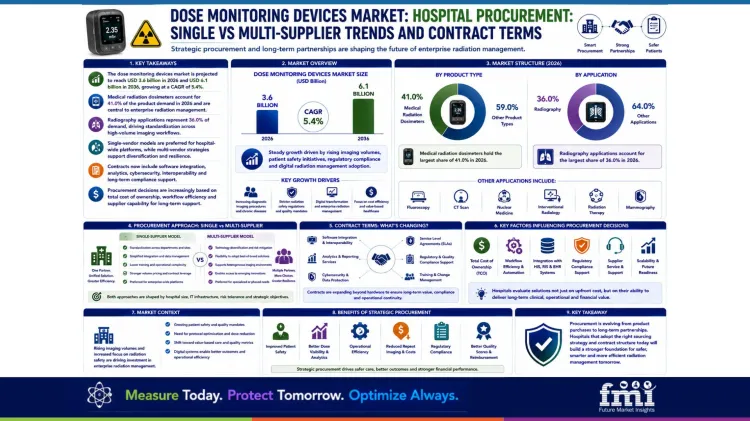
- The dose monitoring devices market is projected to achieve USD 3.6 billion in 2026 and USD 6.1 billion in 2036, expanding at a CAGR of 5.4%, which makes it a steadily growing procurement category in diagnostic imaging and radiation therapy departments.
- Medical radiation dosimeters account for 41.0% of the product demand in 2026 and are a major component of the enterprise radiation management procurement plans.
- Radiography applications represent 36.0% of demand, and healthcare providers are standardizing dose monitoring solutions across high-volume imaging workflows.
- For hospital-wide radiation monitoring platforms, the trend is toward single-vendor procurement models, although multi-vendor approaches continue to play a role in ensuring technology diversification and supply resilience.
- Contract talks now go beyond just buying hardware to cover software integration, analytics services, cyber security support, interoperability commitments, and long-term regulatory compliance support.
- Procurement decisions are now influenced by total cost of ownership, workflow efficiency and the ability of suppliers to support long-term radiation management initiatives.
Introduction
Procurement in diagnostic imaging and radiation management is changing fast as health systems are placing greater emphasis on patient safety, quality improvement and digital transformation. Dose monitoring technologies are becoming an increasingly important part of the enterprise healthcare infrastructure, historically viewed as a regulatory compliance tool.
The dose monitoring devices market is estimated to grow at a CAGR of 5.4% during the forecast period and is expected to reach USD 3.6 billion by 2026 and USD 6.1 billion by 2036. The market is expected to grow due to factors such as increasing imaging volumes, growing awareness on the risks of radiation exposure and rising investments in digital radiation management platforms.
Procurement strategies are evolving to become more sophisticated as healthcare organizations look to optimize clinical workflows and minimize operational risk. “Hospital purchasing departments are now taking a more strategic approach than ever to evaluating supplier relationships, contract structures and technology ecosystems.”
The market for dose monitoring devices is undergoing a fundamental change, shifting from transactional buying to long-term technology partnerships.
Market Context
The increasing use of diagnostic imaging and other procedures that use radiation has increased the need for dose monitoring in healthcare systems. Healthcare providers face mounting demands to lower unnecessary radiation doses, standardize protocols, and comply with rising patient safety requirements.
Dose monitoring technologies support these objectives with real-time exposure monitoring, longitudinal dose analytics and quality management capabilities. Today, their functions are far more than just measuring radiation.
Dose monitoring technologies are being adopted across a wider range of healthcare departments by healthcare organizations in a variety of departments, including radiology, nuclear medicine, interventional imaging and radiation oncology. Procurement has become more complex and vendor selection more strategic through long-term usage.
Healthcare systems are seeking technology that supports enterprise-wide radiation management strategies rather than solutions designed only for individual departments. So procurement priorities are moving toward integration capability, long-term scalability and supplier support services.
The changing needs are impacting the trade-off between single supplier and multi supplier procurement strategies in the market.
Single-Supplier Procurement Strategies
Many hospitals and integrated delivery networks are moving toward single-supplier procurement agreements for dose monitoring technologies.
The single supplier strategy provides operational efficiencies through the standardization of technology across imaging departments and multiple sites. Standardized monitoring platforms help to train staff, reduce variability in workflow and promote consistency in radiation management practices.
Single vendor contracts also enable the enterprise to manage the data centrally and to have integrated analytics capabilities. Such features are gaining importance for healthcare providers in order to support quality reporting, protocol optimization and long term dose tracking initiatives.
Many large healthcare systems embarking on digital transformation programs prefer a full radiation management platform provided by a single vendor relationship. Such arrangements simplify integration and improve long-term technology governance.
Single supplier purchasing also can increase the buying power. Enterprise agreements often include volume pricing, software licenses, implementation support and long-term service commitments that reduce total ownership costs.
As dose monitoring technologies become increasingly embedded in the health information infrastructure, suppliers’ consolidation strategies are likely to further gain momentum.
There is growing interest in standardization, but many healthcare organizations still opt for a multi-vendor procurement strategy.
Large academic medical centers and complex health care systems often have relationships with multiple suppliers to mitigate risks of dependency and to provide flexibility in technology. Different procurement approaches allow providers to explore emerging innovations, and not be tied to one technology roadmap.
Multi-supplier strategies may be particularly relevant for radiation management as imaging environments often contain equipment from multiple manufacturers. Healthcare organizations may seek dose monitoring solutions that are specific to their individual procedural requirements or department workflows.
Multi-supplier models also provide greater bargaining leverage by maintaining competition among providers. A competitive procurement process is often used by procurement teams to get better prices, service terms and opportunities for product customization.
Another critical factor is supply chain resilience. Dependence on a single vendor, particularly with technologies that impact patient safety and regulatory compliance, is an increasing operational risk for healthcare organizations.
This is the reason why many providers strive for diversified procurement models even though supplier consolidation can deliver efficiencies.
Contract Structures Are Becoming More Complex
There have been major changes in terms of contracts in the dose monitoring devices market.
Traditionally, procurement contracts have centered on the duties of buying, installing and maintaining hardware. Today’s contracts increasingly include software services, analytics capabilities, cybersecurity responsibilities, and interoperability requirements.
Providers are demanding more in the way of contractual guarantees regarding platform availability, timing of software updates, data security protections, and technical support responsiveness. These requirements are indicative of the increasing importance of dose monitoring technologies in digital healthcare infrastructures.
Long-term service contracts are becoming more popular. Providers want suppliers who can continue to support evolving imaging standards and reporting requirements, and ensure regulatory compliance capabilities.
The importance of provisions for performance-based contracts is also growing. Procurement teams are increasingly pushing for measurable commitments on implementation timelines, integration support, and system functionality.
These developments show the increasing strategic importance of dose monitoring technologies and the widening scope of supplier responsibilities.
Segment Insights
Medical radiation dosimeters will represent the largest product in the dose monitoring devices market with 41.0% of market demand in 2026. Their dominance reflects growing institutional investments in radiation safety programs and enterprise monitoring initiatives.
Procurement teams often prioritize opportunities for standardization for products that are often deployed across multiple departments and facilities, supporting centralized management and workflow consistency.
Radiography accounts for 36.0 percent of the demand for applications and remains one of the highest volume imaging environments within health-care systems. The high level of procedural activity in radiography encourages health care providers to adopt procurement strategies that can support large-scale deployments and consistent radiation management practices.
The dynamics in these segments underscore the importance of scalable technology platforms and long-term supplier relationships.
Buyer Behavior and Decision-Making
Procurement decision-making is becoming increasingly multidisciplinary.
The evaluation of dose monitoring solutions is actively pursued by radiologists, medical physicists, information technology teams, quality management, and purchasing. This enhanced stakeholder involvement shows the strategic importance of radiation management to healthcare organizations.
The top priorities for clinical stakeholders are patient safety, exposure accuracy, and workflow efficiency. The information technology departments are concerned with interoperability, cybersecurity, and integration capabilities. Financial leaders focus on total cost of ownership and long term economic value.
Procurement teams are increasingly looking for suppliers that can deliver end-to-end support services, software innovation and scalable technology roadmaps.
As healthcare systems look to make durable investments in radiation management infrastructure, vendor stability and potential for long-term relationships are becoming important selection criteria.
Competitive Implications
Procurement transformation is shifting the competitive dynamics in the dose monitoring devices market.
Manufacturers offering integrated radiation management ecosystems are gaining competitive advantages. Healthcare providers are looking for solutions that incorporate monitoring hardware, analytics platforms, enterprise reporting, and interoperability support.
Vendor consolidation trends create opportunities for healthcare providers to work with larger suppliers capable of delivering enterprise-scale implementations and a complete portfolio of services.
At the same time, specialized providers maintain a competitive advantage with niche innovations, customized workflows and advanced analytics capabilities specifically tuned to particular clinical environments.
As suppliers look to extend software functionality and improve integration capabilities, strategic partnerships are becoming more important.
Aligning product portfolios with changing procurement priorities and long-term goals of the healthcare system is increasingly a key to competitive success.
Strategic Implications
Key market structure determinants of the dose monitoring devices market are emerging as hospital procurement strategies.
Providers are evaluating suppliers based on their ability to support enterprise radiation management programs, improve workflow efficiency and maintain long-term regulatory compliance., improve workflow efficiency and support long-term regulatory compliance. Procurement decisions today are about more than just the performance of hardware and the broader issues of digital infrastructure and operational resilience.
Manufacturers that can deliver scalable, interoperable and service-oriented solutions will be best positioned to seize future growth opportunities. "Going forward, success will increasingly hinge on the ability to forge strategic partnerships with healthcare organizations and to align commercial strategies with the changing procurement environment.”
Bottom Line
In the dose monitoring device market, procurement practices are shifting from transactional buying to strategic technology partnerships. Multi-supplier strategies are important to provide flexibility and supply resilience as many healthcare providers move towards single-supplier models for improved standardization and integration. As dose monitoring technologies become more embedded in enterprise radiation management programs, contract arrangements, service capabilities and long-term vendor relationships will become increasingly important determinants of competitive advantage and procurement value.

