


Key Takeaways
- Pharmacovigilance services pricing is dominated by regulatory compliance infrastructure and specialized technology platforms rather than basic case processing, with regulatory fees representing substantial ongoing costs that pharmaceutical companies must absorb regardless of product volume or revenue.
- Service delivery has evolved from manual adverse event reporting to sophisticated AI-powered safety monitoring systems requiring proprietary databases, machine learning capabilities, and integrated regulatory submission platforms that create natural barriers favoring large-scale providers.
- The real margin capture happens in three distinct layers: regulatory expertise and compliance management where established players like IQVIA and Parexel control specialized knowledge, proprietary technology platforms that create client switching costs through integrated safety databases, and global operational infrastructure enabling continuous monitoring across multiple regulatory jurisdictions.
- Smaller service providers have demonstrated that basic pharmacovigilance functions can be delivered at lower costs through standardized processes and offshore capabilities, yet premium providers maintain pricing power through regulatory relationships, compliance track records, and comprehensive service integration that smaller competitors cannot easily replicate.
- Regulatory complexity has fundamentally altered service cost structures, with enhanced documentation requirements, accelerated reporting timelines, and stricter data integrity standards creating operational expenses that scale with pharmaceutical portfolio complexity rather than simple transaction volumes.
Why do pharmaceutical companies increasingly outsource pharmacovigilance functions despite high service costs?
The decision to outsource pharmacovigilance activities reflects fundamental changes in how pharmaceutical companies evaluate internal capabilities versus external expertise. Internal pharmacovigilance operations require substantial fixed investments in specialized personnel, technology platforms, and regulatory compliance systems that many companies cannot justify across their product portfolios.
Building internal capabilities demands hiring qualified persons for pharmacovigilance, safety scientists, regulatory affairs specialists, and database administrators who command premium salaries due to their specialized knowledge. These personnel must maintain continuous training on evolving regulatory requirements across multiple jurisdictions, creating ongoing educational expenses that compound over time.
Technology infrastructure represents another significant barrier to internal operations. Pharmacovigilance requires sophisticated safety databases capable of handling multiple data formats, automated case processing workflows, electronic submission capabilities for regulatory authorities, and integration with clinical trial management systems. These platforms require substantial licensing fees, customization costs, and ongoing maintenance expenses.
The complexity of global regulatory requirements makes internal operations particularly challenging for companies operating across multiple markets. Each regulatory authority maintains distinct reporting requirements, submission formats, and compliance expectations that demand specialized knowledge and dedicated resources to manage effectively.
Where do established service providers capture the highest margins in pharmacovigilance operations?
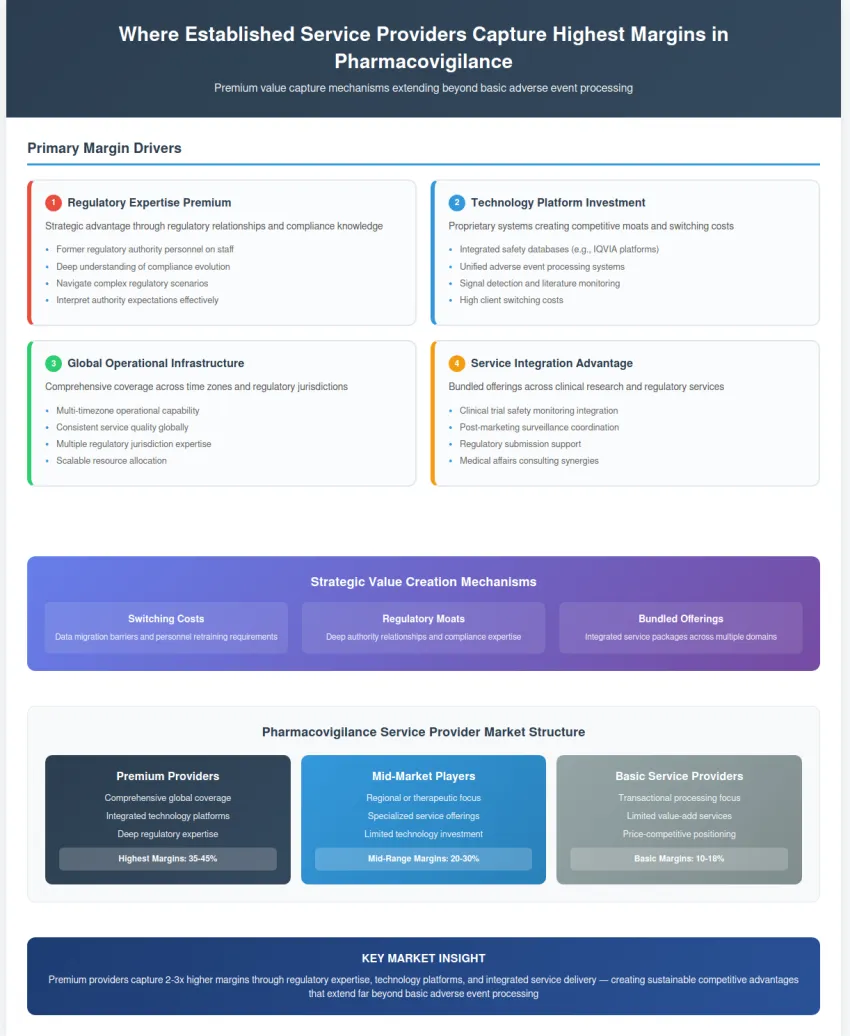
Premium pharmacovigilance service providers have developed sophisticated value capture mechanisms that extend far beyond basic adverse event processing. Their margin structure reflects the strategic positioning they have achieved through regulatory relationships, technology investments, and comprehensive service integration.
Regulatory expertise represents perhaps the most valuable component of their service offering. Established providers maintain teams of former regulatory authority personnel who understand not only current requirements but also how regulations evolve and how authorities interpret compliance expectations. This knowledge enables them to guide clients through complex regulatory scenarios that smaller providers cannot navigate effectively.
Technology platform development creates another layer of competitive advantage. Companies like IQVIA have invested heavily in proprietary safety databases that integrate adverse event processing, signal detection, literature monitoring, and regulatory reporting into unified platforms. These systems create switching costs for clients who would need to migrate data and retrain personnel to change providers.
Global operational infrastructure enables premium providers to offer comprehensive coverage across multiple time zones and regulatory jurisdictions. This capability is particularly valuable for multinational pharmaceutical companies that need consistent service quality and regulatory compliance across their entire product portfolios.
The integration of pharmacovigilance with broader clinical research and regulatory services creates additional value capture opportunities. Providers can offer bundled services that include clinical trial safety monitoring, post-marketing surveillance, regulatory submission support, and medical affairs consulting within integrated service packages.
Why do smaller pharmacovigilance providers struggle to compete despite lower pricing?
Small and medium-sized pharmacovigilance service providers face structural disadvantages that extend beyond simple economies of scale. These challenges create barriers that prevent them from effectively competing with established players even when they offer substantially lower pricing.
Technology infrastructure requirements represent a particularly challenging barrier for smaller providers. Pharmacovigilance databases require substantial upfront investments and ongoing maintenance costs that must be amortized across client bases. Smaller providers often cannot justify these investments or must rely on generic platforms that lack the customization capabilities that larger clients expect.
Regulatory expertise concentration among established providers creates knowledge gaps that smaller competitors struggle to bridge. The specialized nature of pharmacovigilance regulations and the limited pool of qualified personnel mean that smaller providers often cannot attract or retain the regulatory expertise necessary to serve complex clients effectively.
Quality assurance and validation requirements imposed by pharmaceutical company clients create additional barriers for smaller providers. Large pharmaceutical companies typically require extensive quality audits, validation documentation, and compliance certifications that smaller providers may not have the resources to maintain.
Global operational capabilities represent another structural disadvantage for smaller providers. Pharmacovigilance requires continuous monitoring and rapid response capabilities across multiple time zones, which smaller providers cannot cost-effectively maintain without substantial infrastructure investments.
Key Facts
- Pharmacovigilance services pricing reflects the high costs of regulatory compliance infrastructure, specialized technology platforms, and expert personnel rather than simple case processing volumes.
- Established providers like IQVIA and Parexel maintain competitive advantages through regulatory expertise, proprietary technology platforms, and global operational capabilities that smaller competitors cannot easily replicate.
- Technology investments in AI and automation are reshaping competitive dynamics by enabling cost efficiencies while creating new barriers to entry for providers lacking advanced capabilities.
- Smaller providers face structural disadvantages in technology infrastructure, regulatory expertise, and global operations that limit their ability to compete beyond basic price competition.
- Regulatory authority influence through inspections, compliance expectations, and evolving requirements creates additional competitive advantages for established providers with strong regulatory relationships.
Sources
- USA Food and Drug Administration. Prescription Drug User Fee Act: Funding Mechanisms and Regulatory Review Processes.
- European Medicines Agency. Pharmacovigilance Fees and Regulatory Compliance Requirements for Marketing Authorization Holders.
- National Academy of Sciences. Regulatory Processes for Rare Disease Drugs in the United States and European Union: Collaborative Opportunities.
- USA Department of Health and Human Services. FDA User Fees: Economic Benefits and Impact on Medical Product Development.
- University Research Centers. Pharmacovigilance Cost Structure Analysis and Regulatory Compliance Assessment Studies.
- International Conference on Harmonisation. Good Pharmacovigilance Practices and Regulatory Guideline Implementation Studies.

