


Key Takeaways
- Price in plant-based cutlery is the translation of resin volatility, logistics complexity and compostability compliance into a narrow band of EBITDA margins and variable channel spreads.
- PLA pellet prices in Q2 2025 averaged USD 2,105/MT FOB Laem Chabang Thailand (down 9% from Q1) and USD 2,890/MT FOB USGC (up 3%). Bagasse pulp in India trades at INR 1,700 to 3,500 per tonne. Bamboo cutlery from Vietnam shows FOB ranges of USD 0.85 to 3.00 per set.
- Container freight China to Northern Europe averaged USD 2,841 per FEU in late 2024, while Asia to US West Coast fell to USD 1,725 per FEU. Freight represents 10 to 15% of FOB value for PLA cutlery and 30 to 40% for lower-value bagasse items.
- EN 13432 and ASTM D6400 certifications add 5 to 10% to production costs. The EU Single-Use Plastics Directive bans conventional plastic cutlery but creates exemptions for certified compostable alternatives in select member states like Italy.
- NatureWorks operates 150,000 tonnes per year capacity in Nebraska. TotalEnergies Corbion runs 75,000 tonnes per year in Thailand. Distributor margins in foodservice channels range 5 to 12%, with bulk service items at lower end and branded retail packs at upper end.
What makes plant based cutlery pricing structurally different from conventional plastic cutlery?
Plant based cutlery operates under a fundamentally different cost architecture than petroleum-based alternatives. Where conventional PS or PP cutlery ties pricing to crude oil derivatives, plant based variants link to agricultural commodity cycles, limited biopolymer capacity, and compliance-driven validation costs.
PLA pricing tracks upstream corn and sugarcane markets plus fermentation energy costs. Only two major global producers control the bulk of food-grade PLA supply, creating oligopolistic pricing power absent in commodity plastics. Bagasse pricing follows sugarcane harvest cycles. Bamboo costs reflect Vietnamese labor rates and splint quality sorting.
The compliance layer adds a structural floor. EN 13432 certification for EU markets and ASTM D6400 for US acceptance require third-party testing and traceability systems. Conventional plastic cutlery faces no such requirement, creating a 5 to 10% cost disadvantage for compostable alternatives before any material comparison.
How does feedstock cost volatility shape ex-factory pricing for PLA, bagasse and bamboo cutlery?
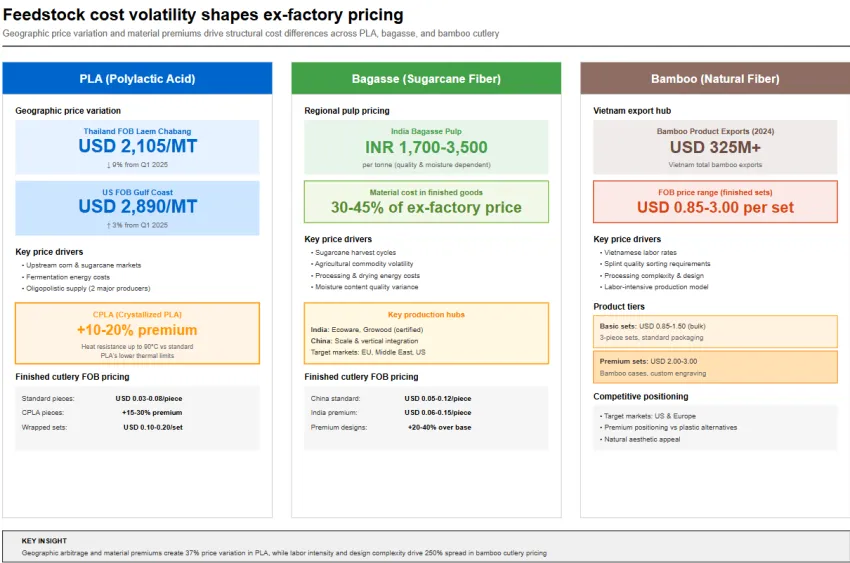
PLA pellet prices demonstrate significant geographic variation. Thailand FOB Laem Chabang averaged USD 2,105/MT in Q2 2025, down 9% from Q1 on capacity expansions from NatureWorks and TotalEnergies Corbion. US FOB USGC prices stood at USD 2,890/MT, up 3% on tighter supply.
CPLA (crystallised PLA with enhanced heat resistance) commands a 10 to 20% premium over standard grades. CPLA cutlery withstands temperatures up to 90°C versus standard PLA's lower thermal limits.
Bagasse pulp derives from sugarcane fibres. Indian suppliers list pulp at INR 1,700 to 3,500 per tonne depending on quality and moisture content. Material cost represents an estimated 30 to 45% of finished goods ex-factory price.
Bamboo raw material for cutlery requires splint-grade processing. Vietnam exported over USD 325 million in bamboo products in 2024. FOB pricing for finished bamboo cutlery sets ranges from USD 0.85 to USD 3.00 per set depending on complexity.
Where does energy intensity create regional cost floors and competitive asymmetry?
Energy manifests across multiple processing stages. PLA production involves fermentation, lactide purification demanding high heat and vacuum, and polymerisation. Industry sources indicate energy represents 8 to 15% of total production cost for biopolymers.
Bagasse pulp moulding requires continuous drying ovens. Drying accounts for a significant portion of processing cost. Bamboo cutlery uses less energy-intensive methods but still incurs power costs for automated lines.
Regional energy cost asymmetry creates competitive positioning differences. EU industrial electricity tariffs significantly exceed those in China, India and Southeast Asia. Chinese and Indian bagasse processors benefit from lower power tariffs in the INR 4 to 6 per kWh range, while EU processors face rates often double or triple Asian levels.
Energy shapes utilisation economics. High-energy processing steps create incentives to run plants at maximum capacity. A plant running at 85 to 90% utilisation compresses cost per unit by 15 to 25% versus one at 60%.
How do logistics and container freight dynamics impact FOB competitiveness across export corridors?
Freight costs exhibit route-specific variation. Asia to Europe container rates peaked above USD 5,000 per TEU in mid-2024 due to Red Sea disruptions. By late 2024, rates declined: Asia to Northern Europe averaged USD 2,841 per FEU, while Asia to US West Coast fell to USD 1,725 per FEU.
A 40-foot container holds approximately 1,000 to 1,500 cartons of cutlery. At USD 2,800 per FEU, freight adds roughly USD 2.00 to 2.80 per carton. For high-value PLA cutlery sets retailing at USD 15 to 25 per carton FOB, freight represents 10 to 15% of FOB value. For lower-value bagasse items at USD 5 to 8 per carton FOB, freight can reach 30 to 40%.
China serves as the largest exporter of PLA-based and bagasse products. India emerged as a significant bagasse producer for EU and Middle Eastern markets, with companies like Ecoware and Growood operating certified facilities. Vietnam positioned itself as a bamboo export hub supplying US and European buyers.
What compliance requirements create pricing floors and market access barriers?
HS code classification determines duty treatment. Plastic cutlery generally classifies under HS 3924. Bamboo cutlery may fall under HS 1401 variants. Proper classification ensures correct duty assessment.
EN 13432 certification for industrial compostability in the EU mandates at least 90% biodegradation into CO₂ within six months under industrial composting conditions. ASTM D6400 provides equivalent standards for the US market, often complemented by BPI certification.
Achieving and maintaining certifications adds 5 to 10% to total production costs. A single EN 13432 test programme costs USD 5,000 to 15,000. BPI certification adds USD 2,000 to 5,000 annually. For a producer manufacturing 10 million units annually, certification overhead translates to USD 0.001 to 0.002 per unit.
The EU Single-Use Plastics Directive, implemented July 2021, bans conventional plastic cutlery. Critically, PLA-based cutlery falls under the plastic definition unless meeting specific exemptions. Italy's national transposition provides an exemption for EN 13432-certified compostable plastics with defined bio-based content.
How do operational economics shape unit costs and margin distribution?
NatureWorks operates a 150,000-tonne-per-year PLA facility in Blair, Nebraska, and commenced construction on a second plant in Thailand targeting 75,000 tonnes annually. TotalEnergies Corbion's Rayong facility produces approximately 75,000 tonnes per year. China's COFCO operates PLA plants producing 30,000 tonnes per year.
Utilisation rates directly impact unit economics. A plant running at 85 to 90% utilisation spreads fixed costs more efficiently than one at 60%, compressing cost per unit by 15 to 25%.
Yield loss occurs at multiple stages. PLA cutlery injection moulding generates scrap rates of 3 to 8%. Bagasse moulding creates yield loss of 5 to 10%. Downtime for mold changeovers affects throughput, with changeover time ranging from 30 minutes to several hours.
Working capital ties up cash in inventory. PLA resin inventory represents 30 to 60 days on hand. Bagasse pulp storage requires dry conditions with suppliers maintaining 15 to 45 days stock.
What margin profiles emerge across PLA resin producers, cutlery converters and distributor channels?
Global PLA resin suppliers (NatureWorks and TotalEnergies Corbion) dominate upstream. Industry observers note biopolymer producers historically achieved EBITDA margins in the 15 to 25% range during strong demand periods.
PLA cutlery manufacturers convert resin into finished goods. Gross margins estimated at 20 to 35% depending on scale and automation. EBITDA margins compress to 8 to 15% after SG&A and compliance costs.
Bagasse cutlery producers in India emphasise certifications to access premium export markets. Gross margins estimated at 18 to 28%. EBITDA margins estimated at 10 to 18%.
Chinese bagasse producers benefit from scale and vertical integration, achieving gross margins in the 20 to 30% range and EBITDA margins of 12 to 20%.
Bamboo cutlery producers in Vietnam operate on labor-intensive models. Gross margins estimated at 25 to 35%. EBITDA margins range 12 to 22%.
Distributor margins in foodservice channels typically range 5 to 12%. Bulk service cutlery to QSR chains commands 5 to 8% due to volume purchasing. Branded retail packs achieve 8 to 12% reflecting marketing support and inventory risk.
How do FOB pricing benchmarks translate across PLA, bagasse and bamboo cutlery formats?
Standard PLA forks, knives and spoons from Chinese converters list at approximately USD 0.03 to 0.08 per piece FOB depending on weight and design. CPLA heat-resistant cutlery commands premiums of 15 to 30% over standard PLA grades. Individually wrapped cutlery sets with napkins range USD 0.10 to 0.20 per set FOB.
Bagasse cutlery from China shows FOB ranges of USD 0.05 to 0.12 per piece for standard items. Premium designs with reinforced edges add 20 to 40% to base FOB. Indian producers targeting premium export markets price at USD 0.06 to 0.15 per piece reflecting certification investments.
Bamboo cutlery sets from Vietnam show FOB ranges of USD 0.85 to 3.00 per set. Basic 3-piece sets in bulk packaging list at USD 0.85 to 1.50 per set FOB. Premium sets with bamboo carrying cases and custom engraving reach USD 2.00 to 3.00 per set FOB.
What role do distributor and channel margins play in final retail pricing?
Direct to QSR chains represents the highest-volume, lowest-margin channel. Distributor margins in this channel compress to 5 to 8% due to volume commitments and competitive bidding.
Retail channels through grocery and specialty retailers command higher distributor margins of 8 to 12%. These channels require branded packaging, UPC coding, and category management support.
Horeca suppliers serving hotels, restaurants and cafes operate at intermediate margin levels of 7 to 10%. Private label retail programs show compressed margins of 3 to 6%.
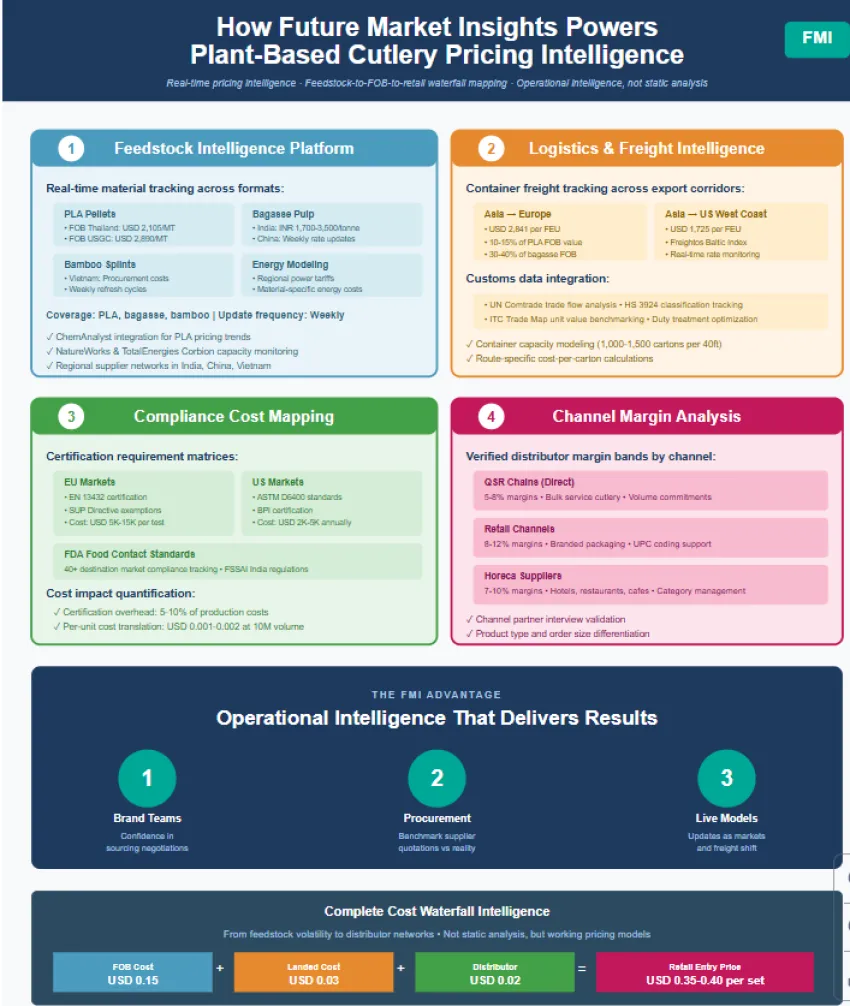
A PLA cutlery set with USD 0.15 FOB cost, USD 0.03 landed cost, USD 0.02 distributor margin and USD 0.04 retail margin reaches shelf at approximately USD 0.24 per set before retail markup. Retail pricing typically applies 40 to 60% markup, resulting in consumer pricing of USD 0.35 to 0.40 per set.
How can Future Market Insights help on pricing in plant based cutlery?
Sources
- ChemAnalyst Polylactic Acid Price Trend Q2 2025 report: FOB pricing Thailand and USGC, quarterly price movements and regional supply dynamics
- NatureWorks LLC facility specifications and capacity disclosures: Blair Nebraska 150,000 tonne facility, Thailand expansion project timeline
- TotalEnergies Corbion annual production capacity: Rayong Thailand 75,000 tonne integrated PLA plant with lactic acid production
- IndiaMART sugarcane bagasse listings: Indian pulp procurement price ranges INR 1,700 to 3,500 per tonne
- Vietnam TradeKey cutlery manufacturer FOB listings: Bamboo cutlery export pricing USD 0.85 to 3.00 per set
- Freightos Baltic Index China-EU and China-US container rates: Asia export corridor freight costs Q4 2024 to Q1 2025
- EU Single-Use Plastics Directive 2019/904: Regulatory compliance requirements, plastic definition, member state exemptions
- EN 13432 and ASTM D6400 compostability certification standards: Biodegradation requirements, testing protocols, cost impacts
- FSSAI Food Safety and Standards Packaging Regulations 2018: Indian market food contact compliance and material specifications
- UN Comtrade and ITC Trade Map HS 3924, 3923 cutlery trade data: Global import-export patterns and unit values

