


Key Takeaways
- Divergent national conditions create no single APAC streaming playbook.
- Language fragmentation and prepaid consumer economies drive India and Southeast Asia.
- Domestic platforms and closed ecosystems dominate China.
- IP licensing cost pressure defines Japan and South Korea commercial viability.
- Sports rights exclusivity and expat premium demand differentiate Australia and Hong Kong.
India: How does mobile-first usage and ultra-low ARPU pricing reshape streaming economics?
India's streaming landscape operates on razor-thin subscription fees. Monthly plans routinely price below $3, with mobile-only tiers dropping under $1.50 to capture prepaid smartphone users. This pricing reflects competition for price-sensitive audiences who view entertainment spend as discretionary. Free ad-supported tiers pull significant viewership, complicating conversion to paid subscriptions. Platforms balance monetization between advertising revenue and subscription income, often finding ad-supported models deliver more reliable cash flow than premium tiers.
Regional-language content drives bidding wars that strain budgets. Tamil, Telugu, Bengali, Marathi and Punjabi programming requires separate production investments or licensing deals. Platforms competing for linguistic breadth face multiplied content costs without proportional revenue gains. A single Hindi blockbuster reaches broader audiences than regional-language films, yet neglecting regional content surrenders entire viewer segments to competitors. This fragmentation dilutes per-subscriber profitability.
Prepaid billing habits complicate retention. Users accustomed to mobile top-ups resist recurring credit card charges. Platforms integrate UPI, mobile wallets and carrier billing to reduce payment friction, but conversion rates remain suppressed. Piracy compounds the challenge. Torrent sites and telegram channels distribute premium content within hours of release. Enforcement remains inconsistent, leaving platforms battling unauthorized distribution that offers identical content at zero cost. India's streaming economics hinge on volume rather than margin, requiring massive subscriber counts to offset ultra-low pricing and content expense.
China: How do national platforms and regulatory controls create an insulated streaming ecosystem?
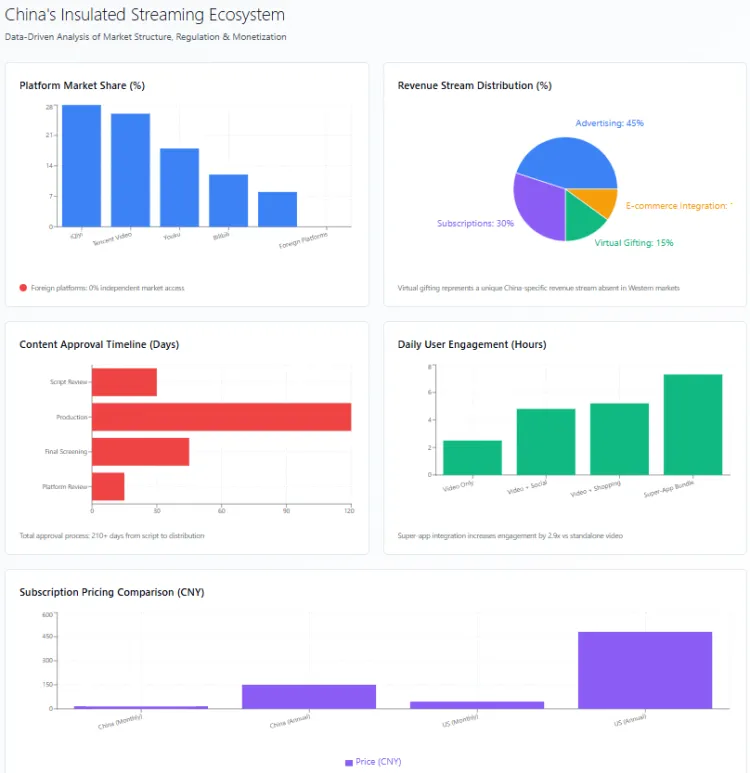
Foreign streaming services cannot operate independently in China. Regulatory frameworks restrict content distribution licenses to domestic entities, forcing international platforms into licensing arrangements with local partners or complete exclusion. This protectionism sustains dominant players like iQiyi, Tencent Video and Youku, which integrate streaming into broader super-app ecosystems. Users access video content alongside social messaging, e-commerce and payments within single platforms, creating switching costs that benefit incumbents.
Content oversight operates through state-aligned approval processes. Scripts undergo review before production, and finished content faces additional screening. Platforms self-censor to avoid delays or rejection, aligning programming with cultural policy expectations. Historical dramas, crime thrillers and supernatural content face particular scrutiny. Algorithm governance rules require platforms to promote state-approved content and limit recommendation engine autonomy. These controls shape catalog strategy from conception through distribution.
Monetization blends advertising, subscriptions and virtual gifting. Live-streaming talent receives digital gifts convertible to revenue, creating income streams absent from Western platforms. Subscription pricing remains competitive but benefits from massive user bases that offset per-subscriber costs. Bundling video access with gaming, music and cloud storage inside super-apps increases perceived value. China's closed ecosystem shields domestic platforms from international competition while imposing content and operational constraints that foreign entrants cannot navigate without local partnership.
Japan: Why does premium IP and high licensing cost slow streaming profitability?
Anime intellectual property commands extraordinary licensing fees. Popular franchises generate revenue through multiple windows including theatrical releases, broadcast television, physical media sales and streaming rights. Studios prioritize higher-margin channels before releasing content to streaming platforms. Exclusive streaming rights for hit anime titles cost millions of dollars, yet Japanese subscribers resist monthly fees exceeding $10. This mismatch between content expense and revenue potential compresses margins.
Legacy broadcasters retain significant power. NHK and commercial networks control relationships with production committees that finance anime and drama series. These broadcasters license content to streaming platforms only after exhausting broadcast and physical media revenue. Delayed streaming availability pushes audiences toward piracy or dampens interest by the time platforms acquire rights. Physical media culture persists longer in Japan than other developed territories. Collectors prize Blu-ray box sets with exclusive artwork and bonus materials, maintaining DVD and Blu-ray sales that cannibalize streaming subscriptions.
Cord-cutting progresses slowly. Households retain cable and satellite subscriptions for live sports, news and variety programming poorly suited to on-demand viewing. Streaming platforms struggle to justify additional monthly costs when audiences already access substantial content through traditional television. Premium IP acquisition costs, delayed rights availability and entrenched viewing habits combine to slow Japanese streaming profitability despite high broadband penetration and affluent demographics.
South Korea: How does global K-drama export success coexist with local margin pressure?
Korean drama production budgets have escalated dramatically. Global demand for high-production-value series drives spending on A-list actors, elaborate sets and extended shooting schedules. Series budgets reaching $20 million or more reflect expectations set by international success stories. Domestic platforms compete with international services for exclusive rights, inflating licensing costs even for local consumption. Production companies prioritize global syndication deals that offer higher returns than domestic streaming exclusivity.
Multiple domestic OTT services fragment the audience. Wavve, Tving and Watcha compete alongside Netflix, Disney+ and Apple TV+ for Korean subscribers. This competition prevents any single platform from achieving dominant scale. Subscriber acquisition costs rise as platforms outbid each other for exclusive content and celebrity talent. Domestic ARPU remains modest relative to production investment, forcing platforms to depend on international licensing revenue to recoup costs.
Global syndication becomes essential for financial viability. Korean platforms produce original series with international distribution in mind, securing pre-sales or co-production arrangements with foreign services. Revenue from international markets often exceeds domestic streaming income for premium titles. This dependency on global distribution creates vulnerability to shifts in international buyer appetite or licensing rate fluctuations. South Korea's streaming environment benefits from content creation strength but suffers margin pressure as domestic competition bids up costs faster than local subscription revenue grows.
Australia: How does sports content pricing drive subscription economics?
Sports rights command premium pricing in Australia. Cricket, rugby, Australian rules football and soccer rights cost platforms hundreds of millions annually. Exclusive access to major sporting events drives subscriptions but imposes cost structures that require high ARPU to sustain. Monthly subscription fees routinely exceed $20, among the highest in APAC. Affluent households justify this expense for live sports access, but price sensitivity among non-sports fans limits addressable audience.
Oligopolistic rights control concentrates power. Foxtel and Optus hold long-term contracts for key sporting leagues, forcing new entrants to negotiate expensive sub-licensing deals or operate without marquee sports content. This dynamic advantages incumbents with established subscriber bases amortizing rights costs. Regulatory scrutiny periodically challenges exclusive arrangements deemed anti-competitive, but structural change progresses slowly. Platforms without sports rights pivot toward entertainment content but face consumer perception that streaming primarily serves sports demand.
Broadcaster-platform conflicts complicate content strategy. Free-to-air networks maintain audiences for live events and news programming, competing directly with subscription platforms for sports broadcasting deals. Platforms acquiring exclusive rights face public backlash when popular sporting events move behind paywalls. Australia's streaming economics revolve around sports content that drives high ARPU but requires massive upfront investment and navigates regulatory and public sentiment challenges around content accessibility.
Southeast Asia: Why do payments friction and telco-led bundles decide monetisation pace?
Credit card penetration remains low across Indonesia, Philippines, Vietnam and Thailand. Subscribers lack traditional payment instruments that Western platforms assume. Cash-based economies resist recurring digital charges. Platforms partner with telecommunications carriers to enable billing through mobile accounts, reducing friction for prepaid mobile users. These telco partnerships deliver subscriber growth but often involve revenue-sharing arrangements that reduce platform profitability per user.
Hybrid monetization models blend advertising and subscription revenue. AVOD tiers attract users unwilling to pay monthly fees, generating advertising income from high-volume viewership. SVOD tiers offer ad-free experiences and exclusive content at price points between $3 and $8 monthly. Platforms experiment with tiered pricing that segments audiences by willingness to pay, device preference and content priority. Prepaid culture encourages short-term subscriptions purchased for specific content releases rather than sustained monthly commitments.
Content localization drives engagement but multiplies costs. Thai, Vietnamese, Bahasa Indonesia and Tagalog programming requires separate production or dubbing investments. Platforms must decide which linguistic segments justify localized content given fragmented audience sizes. Telco-led distribution provides critical infrastructure for monetization but introduces dependency on carrier partnerships that control subscriber relationships and billing mechanics. Southeast Asia's streaming monetization hinges on overcoming payments friction through telco collaboration while managing content localization expense across fragmented linguistic audiences.
Singapore: Why is it the premium-tier testing ground for regional rollouts?
Singapore's affluent population tolerates higher subscription pricing. Households pay $12 to $20 monthly for premium streaming services without the price resistance common elsewhere in APAC. High disposable income and English-language fluency create ideal conditions for international content offerings. Platforms test premium pricing strategies and feature rollouts in Singapore before expanding to larger but lower-ARPU territories. Multi-profile subscriptions, 4K streaming tiers and add-on channels prove viability in Singapore before regional deployment.
Early adoption characterizes consumer behavior. Singapore subscribers embrace new platforms and technologies faster than regional peers. This responsiveness provides platforms with rapid feedback on content strategy, user interface changes and promotional tactics. Concentrated population density and advanced digital infrastructure simplify operational logistics. Platforms establish regional headquarters in Singapore, using local operations as launch pads for Southeast Asian expansion.
Willingness to pay extends beyond entertainment. Subscribers invest in multiple simultaneous subscriptions, maintaining Netflix, Disney+, HBO and local services concurrently. This multi-homing behavior contrasts with price-sensitive territories where users rotate subscriptions. Singapore functions as a premium-tier testing ground because economic conditions, consumer behavior and operational convenience align to support experimentation that informs broader regional strategy despite the city-state's small absolute subscriber base.
Malaysia: How do content censorship rules limit differentiation for international players?
Content approval processes impose genre restrictions. Horror, supernatural themes and LGBTQ representation face censorship or outright prohibition. Platforms submitting content for regulatory clearance must edit scenes depicting violence, sexuality or religious themes deemed inappropriate. These editing requirements add production costs and delay content availability. International platforms launching original series globally must create Malaysia-specific versions, fragmenting content libraries and increasing operational complexity.
Localization of approvals requires dedicated compliance teams. Each title undergoes review by national censorship boards before distribution. Processing backlogs delay releases relative to other territories. Platforms cannot deploy global launch strategies that simultaneously release content across all regions. Malaysian subscribers access libraries missing titles available elsewhere, creating dissatisfaction and piracy incentives. Platforms weigh compliance costs against subscriber revenue potential, sometimes forgoing Malaysian distribution for controversial titles.
Brand positioning suffers when censorship visibly alters content. Platforms promoting edgy or provocative programming internationally cannot deliver equivalent experiences in Malaysia. Competitors differentiating through diverse or inclusive content find those advantages neutralized by regulatory constraints. Malaysia's censorship regime limits how international platforms differentiate from local competitors, compressing competitive space into genres and formats acceptable under national content standards while increasing operational costs through compliance and localization requirements.
Taiwan: How does hardware ecosystem fragmentation challenge platform dominance?
Android TV penetration varies widely. Some households use smart TVs with integrated streaming apps, while others rely on set-top boxes, dongles or game consoles. This hardware fragmentation complicates user acquisition. Platforms must ensure compatibility across diverse devices and navigate relationships with hardware manufacturers, telecom providers and consumer electronics retailers. Pre-installation deals with smart TV brands provide visibility but often involve revenue-sharing terms that reduce per-subscriber profitability.
Telecom-linked distribution channels influence platform adoption. Chunghwa Telecom, Taiwan Mobile and FarEasTone bundle streaming subscriptions with broadband and mobile plans. These partnerships drive subscriber growth but create dependency on telco distribution. Platforms negotiate exclusivity terms, bundling arrangements and revenue splits that shape competitive positioning. Subscribers accessing platforms through telco bundles exhibit different retention patterns than direct subscribers, complicating churn analysis and lifetime value projections.
Local-culture content maintains loyal audiences. Taiwanese dramas, variety shows and talk programs resonate with domestic viewers more strongly than international content. Local platforms leveraging relationships with Taiwanese production studios and television networks secure exclusive content that international services cannot easily replicate. Language and cultural specificity create moats around local platforms despite international competitors' larger content budgets. Taiwan's hardware fragmentation and local content loyalty combine to prevent any single platform from achieving dominance, sustaining competitive plurality across both international and domestic services.
Hong Kong: How does expat demand sustain premium international content pricing?
Expatriate populations support high ARPU. Finance professionals, multinational executives and foreign nationals pay premium prices for English-language content from their home countries. Platforms charge $15 to $25 monthly for services providing American, British and Australian programming. This pricing power exceeds levels sustainable in territories without significant expat populations. Hong Kong's international business hub status creates captive audiences willing to pay for content unavailable through local broadcasters.
Production limitations constrain local content supply. Hong Kong's film and television industry has contracted from its historical peak. Platforms cannot rely on local production to differentiate offerings. Cantonese-language content competes with imports from mainland China and Taiwan. Platforms focus on aggregating international libraries rather than producing original Hong Kong content. This strategy succeeds with affluent expats but offers less appeal to Cantonese-speaking residents seeking culturally specific programming.
Cross-border rights conflicts complicate catalog strategy. Content licensed for Hong Kong distribution may face restrictions preventing availability in mainland China. Platforms must negotiate separate rights for Hong Kong versus broader Greater China territories. Rights holders price Hong Kong separately despite its small population, recognizing willingness to pay and expat demand. These fragmented rights increase licensing complexity and costs. Hong Kong's streaming environment sustains premium pricing through expat demand but faces production constraints and rights fragmentation that prevent platforms from serving all demographic segments equally.
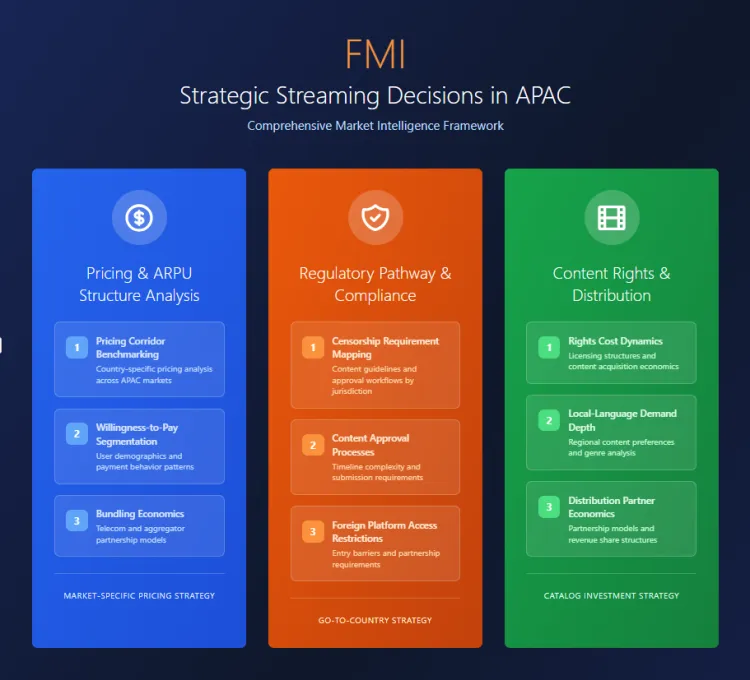
How can Future Market Insights support strategic streaming decisions in APAC?
Sources
-
Netflix Investor Relations (ir.netflix.net): Quarterly earnings reports with regional ARPU data, subscriber metrics, and content investment breakdowns for APAC territories.
- Media Partners Asia (media-partners-asia.com): Industry research covering streaming subscription trends, platform competition analysis, and content rights valuations across Asia-Pacific countries.
- Telecom Regulatory Authority of India (trai.gov.in) and APAC regulatory bodies: Official documentation on OTT platform regulation, content licensing requirements, pricing controls, and censorship frameworks.
- Company financial disclosures from Tencent Holdings, iQIYI, and regional telco operators: Annual reports and investor presentations detailing streaming partnerships, bundling arrangements, revenue-sharing models, and operational metrics.
- Nikkei Asia, South China Morning Post, and regional business publications: Investigative reporting on platform launches, content deal valuations, sports rights negotiations, and competitive dynamics in specific APAC territories.

