


Key Takeaways
- Natural-fiber feedstock volatility from bagasse, bamboo, and recycled paper creates 15-40% cost fluctuation across production cycles
- Energy-intensive thermoforming and molded fiber drying account for 18-25% of direct manufacturing costs
- Custom tooling amortization and low MOQ requirements add 20-35% premium over commodity eco-packaging formats
- Compostability certification (EN 13432, ASTM D6400) and PFAS-free compliance add 8-12% to base manufacturing costs
- Ocean freight volatility for bulky molded fiber packaging creates 25-60% landed-cost swings during supply chain disruptions
Why Does Pricing Volatility Matter in Bespoke Eco Packaging?
Price in bespoke eco packaging is the translation of natural-fiber volatility, biopolymer feedstock variability, energy intensity, tooling complexity and logistics friction into broad ex-factory and FOB price ranges. Unlike commodity plastic packaging where petrochemical feedstock pricing follows established index mechanisms, bespoke eco packaging confronts multiple concurrent volatility sources.
Agricultural seasonality affects bagasse availability from sugarcane processing cycles, bamboo supply depends on harvest timing and geographic concentration in China and Southeast Asia, while recycled fiber quality fluctuates with post-consumer collection infrastructure and contamination rates. Biopolymer feedstock costs for PLA, PHA, and PBS blends track corn, sugar, and starch commodity markets, creating correlation between food prices and packaging input costs.
Raw-material volatility shapes cost structures across molded fiber trays, bamboo packaging, bagasse foodservice containers, and bio-based polymer blends differently than conventional packaging. Direct cost drivers including pulping operations, thermoforming energy consumption, molded fiber drying infrastructure, custom tooling fabrication, and ocean freight for low-density finished goods create predictable cost floors but variable ceilings depending on utilization rates and logistics conditions.
Indirect costs encompassing compostability certification against EN 13432 or ASTM D6400 standards, PFAS-free compliance testing, design iteration cycles, working capital requirements for inventory buffering, and regulatory audit overhead compress EBITDA margins particularly for smaller specialty manufacturers lacking scale advantages.
Customization fundamentally alters packaging economics through minimum order quantity constraints, tooling amortization across limited production runs, and brand-side willingness to absorb premium pricing for differentiated sustainable packaging supporting marketing narratives. Luxury eco-packaging for cosmetics, personal care, spirits, and gourmet foods tolerates higher price points than commodity foodservice applications, creating bifurcated market dynamics.
Fixed-cost absorption challenges intensify for bespoke formats where mold fabrication costs between USD 5,000 and USD 25,000 must amortize across potentially small initial orders before brands commit to volume production. This structure transfers volatility risk disproportionately onto packaging manufacturers who must balance inventory holding costs against responsiveness to brand demand variability while managing feedstock procurement timing against seasonal availability windows.
How Do Operational and Processing Economics Influence Pricing?
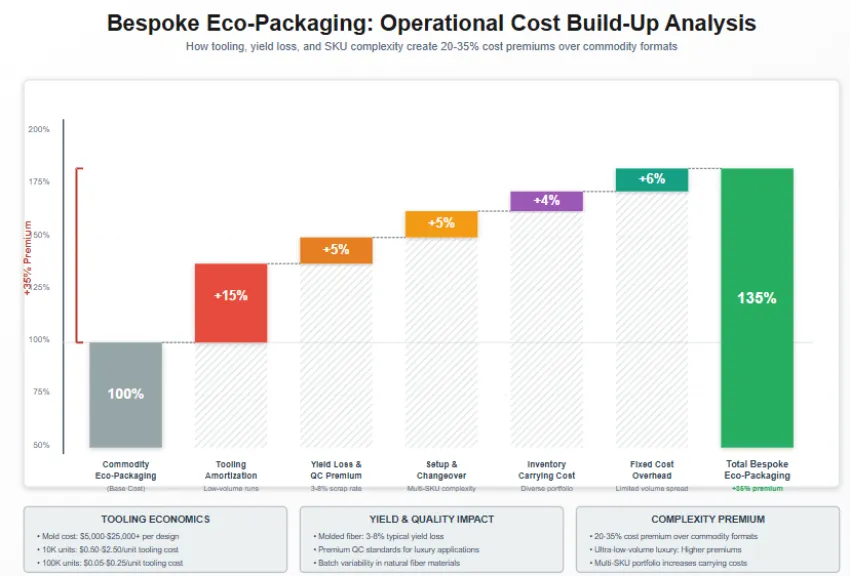
Tooling cost for bespoke shapes represents the highest fixed-cost barrier in custom eco-packaging, with mold fabrication ranging from USD 5,000 for simple single-cavity molded fiber molds to USD 25,000 or more for multi-cavity molds with complex geometries, undercuts, or fine detail requirements. Aluminum molds offer lower upfront costs but shorter lifespan, while steel molds require higher initial investment but support hundreds of thousands of production cycles.
Mold fabrication time spans 6-12 weeks for standard complexity, extending lead times between design approval and first production. Amortization across production volumes directly affects per-unit costs, with 10,000-unit runs carrying USD 0.50 to USD 2.50 tooling cost per unit versus USD 0.05 to USD 0.25 for 100,000-unit runs.
Yield loss and quality control requirements impose additional costs particularly for natural-fiber materials with inherent variability. Molded fiber production typically experiences 3-8% yield loss from edge defects, incomplete forming, surface imperfections, or dimensional variance outside specification tolerances. Bagasse fiber variability based on sugarcane source and processing history creates batch-to-batch inconsistency requiring process adjustments and potentially higher scrap rates.
Quality control inspection requirements for premium bespoke packaging targeting luxury goods applications exceed commodity packaging standards, with visual defect rejection criteria, dimensional measurement protocols, and functional testing adding labor costs.
SKU complexity and low-volume production economics fundamentally alter cost structures versus commodity packaging. Manufacturers producing dozens or hundreds of distinct bespoke formats incur setup costs, changeover time, and inventory carrying costs across diverse product portfolios. Small production runs prevent fixed-cost absorption advantages, with manufacturing overhead, facility costs, and administrative expenses spreading across limited unit volumes.
According to packaging industry operational disclosures, bespoke formats typically carry 20-35% cost premiums over comparable commodity eco-packaging due to these complexity factors, with premiums escalating further for ultra-low-volume luxury applications.
What Margin Profiles Exist Across Different Player Types?
Global eco-packaging manufacturers including Huhtamaki, Stora Enso, Mondi, and WestRock operating diversified product portfolios report gross margins typically ranging 18-28% and EBITDA margins of 8-15% according to annual financial disclosures. These larger players leverage procurement scale for feedstock purchasing, multi-site manufacturing networks enabling capacity optimization, and established customer relationships supporting relatively stable pricing.
However, commodity-oriented business mixes and competitive intensity in standard formats constrain margin expansion. Bespoke custom packaging represents smaller revenue portions for these manufacturers but often commands premium pricing supporting higher margins on successfully executed programs.
Regional molded-fiber specialists focused on specific geographic markets or application segments demonstrate more variable margin profiles depending on competitive positioning and feedstock access. Asian manufacturers serving export markets report operating margins ranging 6-12% reflecting intense price competition and sensitivity to freight-cost volatility, while also benefiting from lower labor and energy input costs. European regional specialists targeting premium foodservice and retail packaging applications achieve higher margins through differentiation, customer service, and faster lead times but face higher input costs and labor rates.
Boutique bespoke packaging houses serving luxury cosmetics, spirits, and gourmet food brands operate entirely different economic models with gross margins potentially reaching 35-50% on successfully designed and executed custom programs. These specialty providers charge for industrial design services, prototype development, and small-batch production at premium pricing justified by brand differentiation value rather than cost-plus manufacturing economics.
However, these businesses face substantial volatility as individual customer programs may represent significant revenue portions, customer concentration risk runs high, and design cycles create lumpy revenue recognition. Working capital intensity increases substantially due to tooling investment, inventory holding for natural materials, and customer payment terms.
Volatility impacts margin stability across all player types through several mechanisms. Feedstock cost increases cannot always pass through immediately to customers with negotiated annual contracts, creating margin compression during input-cost inflation cycles. Ocean freight volatility directly impacts export-oriented manufacturers with limited ability to renegotiate FOB pricing mid-contract.
Energy cost surges compress margins for manufacturers without fuel adjustment mechanisms in customer contracts. Smaller specialists lack hedging capabilities and purchasing power to buffer volatility, experiencing more pronounced margin fluctuation than diversified global manufacturers with natural hedges across geographic markets and product categories.
How Do Trade Flows Shape Natural-Material Packaging Economics?
China dominates molded fiber and bagasse packaging exports globally, shipping approximately 60-70% of internationally traded volumes according to UN Comtrade data for relevant harmonized system codes covering molded fiber articles, tableware of vegetable materials, and bamboo products. Indian exports focus particularly on bagasse foodservice packaging leveraging domestic sugarcane processing infrastructure, with substantial shipments to European Union, United Kingdom, United States, and Middle Eastern markets. Vietnamese molded fiber and bamboo packaging exports have grown rapidly serving both regional ASEAN markets and long-haul destinations, benefiting from favorable trade agreements and competitive labor costs.
Major importing markets include European Union countries collectively representing the largest destination for natural-material packaging imports, driven by Single-Use Plastics Directive compliance requirements and corporate sustainability commitments. United States imports have accelerated as foodservice chains, QSR brands, and retailers adopt compostable packaging for environmental positioning and state-level regulatory compliance.
Australian imports serve growing domestic demand for sustainable foodservice packaging where local manufacturing capacity remains limited. Ocean freight volatility disproportionately affects these long-haul trade routes, with container rates from Asian origins to European and North American destinations experiencing 300-400% increases during 2021-2022 supply chain disruptions before normalizing partially in 2023-2024.
Trade-unit values derived from customs data provide approximate FOB pricing benchmarks, though substantial variation exists based on product specifications, quality tiers, and buyer-supplier relationships. Specific value not disclosed in the public documents reviewed for precise FOB ranges across all product categories.
However, trade data indicates molded fiber trays and containers generally command FOB values ranging from USD 0.08 to USD 0.35 per unit for commodity foodservice formats, escalating to USD 0.50 to USD 2.50 per unit for retail-ready packaging with printing, coatings, and custom shapes. Bamboo rigid boxes for premium applications demonstrate FOB values from USD 1.50 to USD 8.00 per unit depending on size, finish quality, and design complexity. Bagasse clamshell containers occupy similar ranges to molded fiber given comparable manufacturing processes and material costs.
What Margin Structures Exist in Distribution Channels?
B2B channel structures for bespoke eco-packaging involve multiple intermediary layers between manufacturers and end-user brands, each capturing margin for services provided. Custom packaging studios and design consultancies working directly with luxury brands charge industrial design fees, prototype development costs, and project management overhead, typically marking up manufacturing costs by 25-50% while also billing separately for creative services. These studios provide brand strategy, structural design, graphic design, and supplier management services justifying premium positioning beyond pure product markup.
Distributors for foodservice eco-packaging serving restaurant chains, catering companies, and institutional buyers operate on thinner margins given competitive intensity and customer price sensitivity. Distributor margins typically range 5-12% according to packaging industry channel assessments, providing warehousing, inventory financing, delivery logistics, and customer service. Distributors absorb working capital requirements holding inventory and extending payment terms to customers while negotiating tighter payment terms with manufacturers, creating cash conversion advantages even on modest percentage margins. Volume commitments and exclusive distribution agreements sometimes support higher margins for distributors taking demand forecasting risk and minimum purchase commitments.
Direct brand procurement for large consumer goods companies, cosmetics manufacturers, and spirits producers eliminates distribution layers but requires brands to manage supplier relationships, quality assurance, logistics coordination, and inventory planning directly. These direct relationships enable manufacturer margins to expand by 8-15 percentage points versus distribution channel sales, though requiring dedicated account management resources and potentially accepting larger minimum order quantities.
Bespoke formats inherently create less commoditized purchasing dynamics where technical collaboration, design iteration, and tooling investment generate switching costs and relationship stickiness, strengthening manufacturer negotiation leverage compared to commodity packaging where price competition dominates purchasing decisions. Premium brands prioritizing packaging differentiation and sustainability narratives demonstrate higher willingness to accept premium pricing, supporting healthier margins across the supply chain from manufacturer through any distribution intermediaries to final brand purchaser.
How Future Market Insights Can Help
Sources
- FAO agricultural production statistics and USDA Forest Service bamboo cultivation data for bagasse and bamboo supply variability quantification
- Annual reports and sustainability disclosures from Huhtamaki, Stora Enso, Mondi, and WestRock for margin profiles and operational energy cost structures
- Plastics News biopolymer market coverage and PLA resin pricing trends for feedstock cost volatility correlation with agricultural commodity markets
- EU Single-Use Plastics Directive, US state PFAS legislation, and Biodegradable Products Institute certification protocols for compliance cost requirements and compostability standards
- UN Comtrade harmonized system codes for molded fiber articles, vegetable tableware, and bamboo products for trade flow analysis and FOB value benchmarks

