


Key Takeaways
- Electronics adhesives pricing is dominated by raw material volatility rather than manufacturing complexity, with epoxy resins and silicone precursors representing the majority of production costs and directly tracking petrochemical price cycles.
- Thermal conductivity enhancement through specialized fillers creates massive cost disparities: basic acrylic adhesives sell at commodity levels while silver-filled conductive systems command premium pricing from established brands like Henkel Loctite and 3M.
- The cost structure reveals three distinct pricing tiers: commodity-level adhesives for basic applications, mid-tier functional systems with ceramic fillers, and premium conductive formulations where filler content dominates total material costs.
- Manufacturing scale advantages concentrate in thermal management and substrate compatibility rather than raw chemistry, with leading brands capturing margin through application engineering and qualification support rather than feedstock access.
- Supply chain resilience has become a competitive differentiator as dramatic epoxy resin price swings during supply disruptions force smaller manufacturers out of long-term contracts while established players absorb volatility through vertical integration.
- The real profitability battleground sits in specialized applications—automotive qualification, aerospace certification, and semiconductor packaging—where technical service capabilities justify premium pricing over commodity alternatives.
How raw material cost structure drives electronics adhesives pricing?
Electronics adhesives cost structures are fundamentally different from traditional industrial adhesives because performance requirements demand expensive specialty inputs rather than bulk commodity resins. Academic research from polymer science journals confirms that thermal conductivity improvements require substantial filler loadings, dramatically altering the economics compared to unfilled systems.
Base epoxy resins start from petrochemical feedstocks including epichlorohydrin and bisphenol-A, making production costs highly sensitive to crude oil price variations. Recent crude oil price volatility directly impacts epoxy resin pricing and creates margin pressure throughout the supply chain. For manufacturers like Henkel and 3M, this volatility represents both risk and opportunity depending on contract structures and inventory management capabilities.
Silicone-based systems face similar upstream pressure through siloxane intermediate pricing, which depends on global energy costs, geopolitical stability, and environmental regulations. Supply chain disruptions at the feedstock level create ripple effects that can eliminate margins for smaller producers while strengthening the position of vertically integrated manufacturers with secure supplier relationships.
The critical insight is that filler materials often represent a larger cost component than the base resin itself. Silver flakes for electrically conductive applications, aluminum nitride for thermal management, and boron nitride for high-performance thermal interface materials all command premium pricing and create distinct value tiers within the electronics adhesives category.
How thermal conductivity requirements reshape cost and pricing dynamics?
Thermal management has become the primary performance differentiator in electronics adhesives as device miniaturization increases power density and heat generation. Research published in academic journals demonstrates that unfilled epoxy systems exhibit minimal thermal conductivity, while metal-filled adhesives can achieve dramatically higher thermal performance through strategic filler selection and processing optimization.
This performance gap translates directly into pricing disparities that reflect both material costs and market positioning. Basic thermal interface materials sell at moderate price points, while high-performance silicone systems from established manufacturers like Henkel and Shin-Etsu command substantial premiums. The pricing reflects not just silver or ceramic filler content, but also the technical service infrastructure required to support complex applications.
Manufacturing thermally conductive materials creates additional cost layers beyond raw material procurement. Academic research on polymer composites reveals that achieving uniform filler dispersion requires specialized mixing equipment, controlled processing conditions, and quality control systems that monitor thermal conductivity consistency across production batches.
The economics become more complex when considering that different applications demand different thermal management approaches. Power electronics in electric vehicles require thermal interface materials that withstand extreme temperature cycling, while smartphone assembly demands thin-film adhesives with high in-plane thermal conductivity. Each application creates its own cost structure and pricing opportunity.
How brand positioning and the technical service premium shape market dynamics?
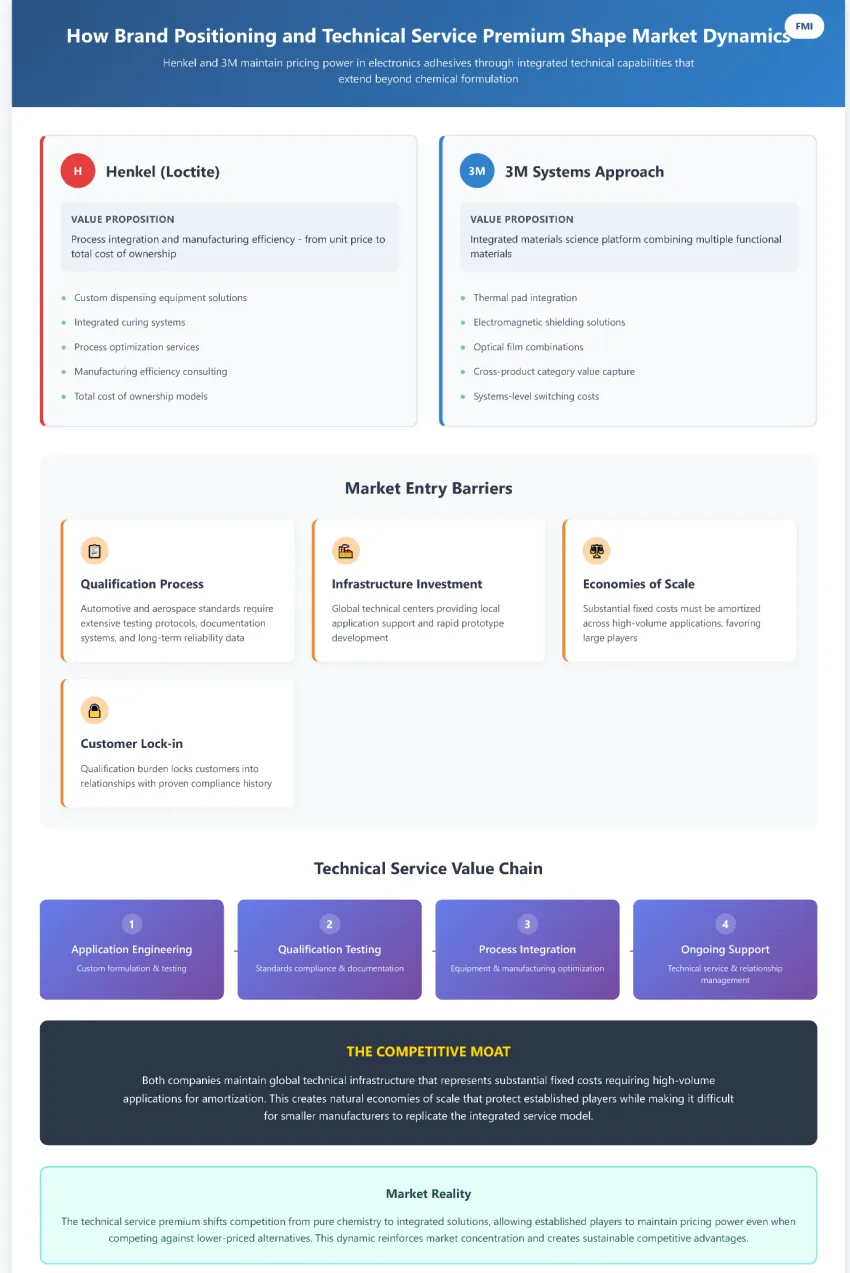
Henkel and 3M maintain pricing power in electronics adhesives through technical service capabilities that extend far beyond the chemical formulation itself. Both companies invest heavily in application engineering, qualification testing, and customer support infrastructure that smaller manufacturers cannot easily replicate.
The qualification process for automotive and aerospace applications creates natural barriers to entry that protect established suppliers. Meeting automotive industry standards requires extensive testing protocols, documentation systems, and long-term reliability data that can take years to develop. This qualification burden effectively locks customers into relationships with proven suppliers who can demonstrate compliance history.
3M leverages its materials science platform to develop integrated solutions that combine adhesives with other functional materials like thermal pads, electromagnetic shielding, and optical films. This systems approach allows the company to capture value across multiple product categories while creating switching costs for customers who would need to requalify multiple suppliers to achieve equivalent performance.
Henkel's Loctite brand focuses on process integration and manufacturing efficiency, offering customers not just adhesive chemistry but also dispensing equipment, curing systems, and process optimization services. This business model shifts the value proposition from unit price to total cost of ownership, allowing Henkel to maintain margins even when competing against lower-priced alternatives.
Both companies maintain global technical centers that provide local application support, custom formulation services, and rapid prototype development. This infrastructure represents a substantial fixed cost that must be amortized across high-volume applications, creating natural economies of scale that favor large, established players.
How Asia Pacific is Emerging as the Dominator?
Asia-Pacific dominates electronics adhesives manufacturing due to proximity to electronics assembly operations, but cost advantages are narrowing as environmental regulations and labor costs increase. The region accounts for the majority of global electronics production, creating natural clustering effects that reduce logistics costs and enable close customer collaboration.
Chinese manufacturers have built scale in commodity-grade electronics adhesives by focusing on cost optimization and local supply chain integration. However, they often struggle to capture value in high-performance applications where technical service capabilities and long-term reliability matter more than unit cost.
European and North American manufacturers maintain competitive positions through specialization in demanding applications where regulatory compliance, technical support, and supply chain reliability justify premium pricing. The automotive industry's shift toward electric vehicles creates particular opportunities for thermal management specialists who can support battery thermal systems and power electronics cooling.
Supply chain resilience has become increasingly important as geopolitical tensions and trade restrictions affect material availability. Manufacturers with diversified supplier bases and regional production capabilities can maintain supply continuity during disruptions, creating competitive advantages that extend beyond pure cost considerations.
The trend toward nearshoring electronics manufacturing creates both challenges and opportunities for adhesives suppliers. While labor cost advantages may diminish, proximity to end markets enables more responsive customer service and reduced logistics costs for specialty products with short shelf lives or special handling requirements.
Sources
- American Chemical Society (ACS). Advances in Electronics Adhesives: Chemistry, Performance, and Market Trends.
- International Journal of Adhesion and Adhesives. Thermal Conductivity and Filler Distribution in Electronics Adhesives: Implications for Performance and Pricing.
- Journal of Applied Polymer Science. The Role of Epoxy and Silicone-Based Adhesives in Electronics Manufacturing: Economic and Technical Considerations.
- Materials Research Society (MRS). Trends in Electronics Packaging and Thermal Management: The Growing Role of Adhesives and Sealants.
- European Adhesives and Sealants Industry (FEICA). Market Dynamics and Innovation in Electronics Adhesives for Consumer Electronics and Automotive Applications.

