


Key Takeaways
- Teleradiology pricing is dominated by radiologist compensation and technology infrastructure rather than simple per-study interpretation costs, with personnel costs representing the majority of total service expenses according to university hospital cost analyses, while platform maintenance and connectivity create ongoing operational overhead.
- The real margin capture happens in three distinct layers: radiologist expertise where board-certified subspecialists command premium rates for complex interpretations, technology platform control that manages PACS integration and workflow optimization, and service delivery models that provide around-the-clock coverage with guaranteed turnaround times.
- Service delivery has shifted from basic image transmission to sophisticated AI-powered workflow systems requiring substantial infrastructure investments, making cloud-based platforms, cybersecurity measures, and integration capabilities critical cost drivers beyond raw interpretation fees.
- Established providers like University Radiology and large hospital networks maintain structural advantages through scale economics, subspecialist recruitment, and comprehensive service delivery, while smaller teleradiology companies struggle with higher per-unit infrastructure costs and limited bargaining power with hospitals.
- The uncomfortable reality is that technology infrastructure creates a two-tier industry where platform scale determines viability, forcing smaller providers to either partner with established players or accept commodity-level margins in basic interpretation services.
- Supply chain disruptions and rising cybersecurity requirements have fundamentally altered teleradiology cost structures, with HIPAA compliance, data encryption, and system redundancy creating permanent increases in operational complexity that must be absorbed across the service model.
Why do teleradiology services cost more than basic radiologist fees suggest?
Teleradiology represents a convergence of medical expertise, sophisticated technology infrastructure, and continuous operational requirements that extend far beyond simple image interpretation. Unlike traditional radiology where images are reviewed locally, teleradiology requires complex technical platforms, secure data transmission, and continuous system monitoring that creates hidden cost layers throughout the service delivery model.
The technology infrastructure reveals where costs actually accumulate beyond radiologist compensation. Picture Archiving and Communication Systems integration, secure VPN networks, and cloud-based storage platforms require substantial upfront investments and ongoing maintenance that can represent significant operational expenses. University hospital cost analyses demonstrate extensive technology requirements that extend interpretation workflows when accounting for image transmission, quality verification, and report delivery across multiple examination categories.
Academic research on teleradiology economics demonstrates that personnel costs dominate the expense structure, representing the majority of total service costs. However, these personnel expenses extend beyond radiologist interpretation time to include technical support staff, quality assurance specialists, and system administrators who maintain the complex infrastructure required for secure image transmission and regulatory compliance.
The integration challenge extends beyond equipment procurement to encompass workflow optimization, staff training, and ongoing technical support. Teleradiology platforms must interface with existing hospital information systems, maintain compatibility across different imaging modalities, and provide seamless integration with physician workflow patterns. Each integration point requires custom development work, extensive testing, and ongoing maintenance that compounds the total cost structure.
Where do technology infrastructure costs actually drive teleradiology economics?
Cloud-based platforms and cybersecurity requirements have become the primary cost drivers in modern teleradiology services. Federal research on teleradiology implementation demonstrates that robust digital infrastructure investments, including high-performance image analysis platforms and secure telecommunication technology, require substantial initial capital deployment and ongoing operational expenses for system reliability and healthcare compliance.
The processing bottleneck creates cascading cost effects throughout teleradiology operations. High-resolution medical images require significant bandwidth for transmission, specialized compression algorithms to maintain diagnostic quality, and redundant storage systems to ensure data availability. These technical requirements demand continuous investment in network infrastructure, server capacity, and backup systems that scale with service volume and complexity.
Data security and compliance represent another substantial cost layer that traditional radiology practices avoid. HIPAA compliance, data encryption during transmission and storage, audit trail maintenance, and cybersecurity monitoring create ongoing operational expenses that must be distributed across all interpretation services. Academic studies on teleradiology implementation identify cybersecurity measures as critical infrastructure requirements that significantly impact service economics.
The complexity multiplies when serving diverse hospital clients with different technical specifications, workflow requirements, and integration needs. Teleradiology providers must maintain compatibility with multiple PACS systems, support various imaging modalities, and accommodate different reporting formats while ensuring consistent service quality and regulatory compliance across all client relationships.
Why smaller teleradiology providers face structural disadvantages in service delivery?
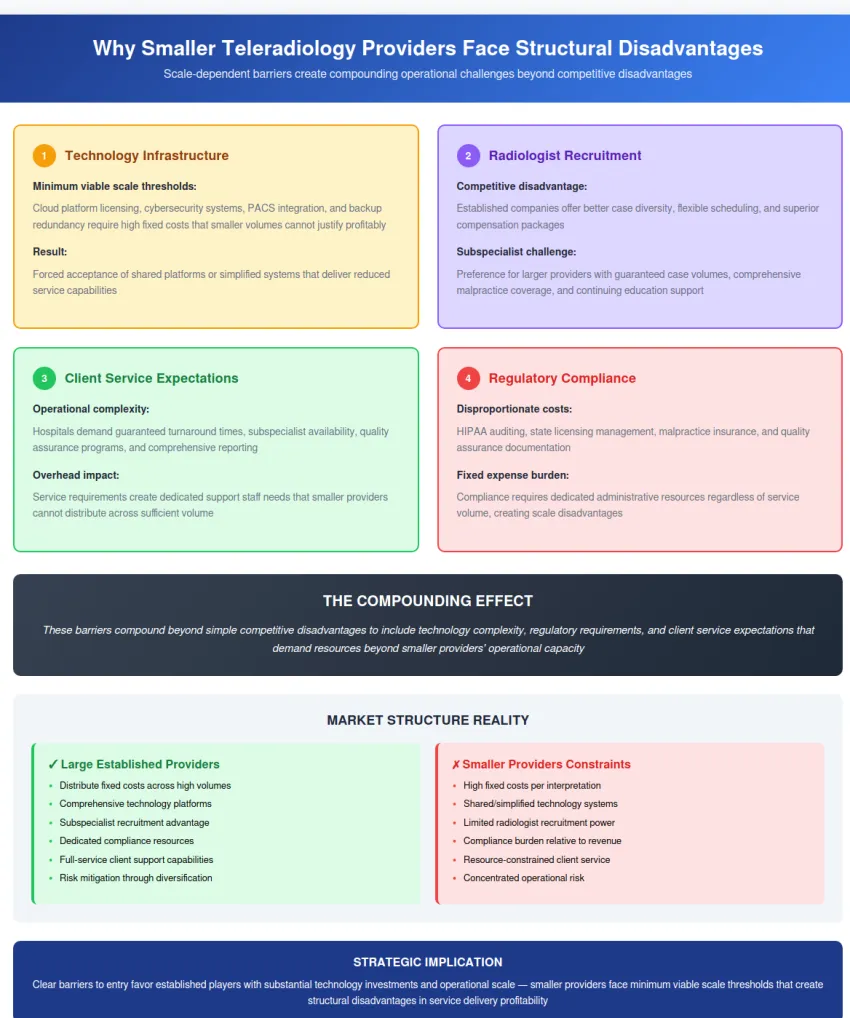
The teleradiology market exhibits clear barriers to entry that favor established players with substantial technology investments and operational scale. Smaller providers encounter multiple challenges that compound beyond simple competitive disadvantages to include technology complexity, regulatory requirements, and client service expectations that demand resources beyond their operational capacity.
Technology infrastructure requirements create minimum viable scale thresholds that smaller providers struggle to achieve profitably. Cloud platform licensing, cybersecurity systems, PACS integration capabilities, and backup redundancy systems have high fixed costs that cannot be justified by limited interpretation volumes. This forces smaller providers to accept shared technology platforms or simplified systems that deliver reduced service capabilities.
Radiologist recruitment becomes increasingly difficult for smaller teleradiology providers competing against established companies that offer better case diversity, more flexible scheduling, and superior compensation packages. Subspecialist radiologists particularly favor larger providers that can guarantee consistent case volumes in their areas of expertise while providing comprehensive malpractice coverage and continuing education support.
Client service expectations create operational complexity that exceeds smaller providers' capabilities. Hospitals demand guaranteed turnaround times, subspecialist availability, quality assurance programs, and comprehensive reporting that require dedicated support staff and management systems. These service requirements create operational overhead that smaller providers cannot distribute across sufficient client volume to maintain competitive pricing.
Regulatory compliance adds disproportionate costs for smaller teleradiology operations. HIPAA auditing, state licensing management, malpractice insurance, and quality assurance documentation require dedicated administrative resources regardless of service volume. These compliance costs represent fixed expenses that create scale disadvantages for providers serving limited client bases.
What technology disruption means for teleradiology competitive positioning?
Artificial intelligence and automated workflow systems are creating new competitive dynamics that require substantial technology investments while potentially reducing interpretation complexity for routine studies. Academic research on AI implementation in radiology demonstrates significant return on investment potential through labor time reductions and improved diagnostic accuracy, but these benefits require platform-level integration that favors established providers.
The AI integration challenge reveals where competitive advantages will concentrate in future teleradiology markets. Successful AI implementation requires extensive training data, continuous algorithm refinement, and workflow integration that smaller providers cannot develop independently. Established teleradiology companies with large case volumes and comprehensive technology platforms are better positioned to leverage AI capabilities for competitive advantage.
Processing automation creates opportunities for efficiency improvements while potentially commoditizing routine interpretation services. AI-powered triage systems, automated preliminary readings, and workflow optimization tools can reduce operational costs for high-volume providers while making basic interpretation services more price-competitive. This technological evolution may force smaller providers toward specialized niche services where AI cannot easily replicate human expertise.
Platform consolidation appears inevitable as technology requirements increase and client service expectations become more sophisticated. Hospitals increasingly prefer comprehensive teleradiology solutions that integrate seamlessly with their existing systems rather than managing multiple vendor relationships for different service components. This trend favors established providers with comprehensive platform capabilities over specialized service providers.
Sources
- European Radiology. Teleradiology from the provider's perspective: cost analysis for a mid-size university hospital.
- PMC - National Center for Biotechnology Information. University-Based Teleradiology in the United States.
- PMC - National Center for Biotechnology Information. Obstacles and Solutions Driving the Development of a National Teleradiology Network.
- Journal of the American College of Radiology. Unlocking the Value: Quantifying the Return on Investment of Hospital Artificial Intelligence.
- PMC - National Center for Biotechnology Information. Barriers and Facilitators Experienced During the Implementation of Web-Based Teleradiology System in Public Hospitals.
- BMJ Publishing Group. An economic analysis of teleradiology versus a visiting radiologist service.

