


Key Takeaways
- Price in industrial robotics is the translation of component sourcing, localisation incentives and scale driven assembly into competitive ex factory price bands and variable dealer margins.
- China's robot density reached 470 units per 10,000 employees in 2023, surpassing Germany and Japan to rank third globally. Domestic manufacturers captured 52% market share in 2024, up from 47% in 2023. Estun holds 9.5% market share, Inovance 8.8%.
- Chinese robots price 10 to 15 percent below comparable foreign models due to localized supply chains. Component costs for servomotors, harmonic reducers, and controllers represent 50 to 65 percent of ex-factory robot price.
- China produced 556,400 industrial robots in 2024, up 14.2 percent year on year. First half 2025 exports surged 60 percent to 94,200 units, with Vietnam, Mexico, Thailand, and India as key destinations. Estun exports represent 34 percent of revenue, Efort 44 percent.
- Provincial automation subsidies and Made in China 2025 directives provide margin support. Siasun received RMB 588 million in subsidies over three years. EFORT announced RMB 1.9 billion factory investment to reach 100,000 units annual capacity by 2029.
What Makes Price in Industrial Robotics the Translation of Component Sourcing Into Competitive Ex Factory Price Bands?
Price in industrial robotics is the translation of component sourcing, localisation incentives and scale driven assembly into competitive ex factory price bands and variable dealer margins. China's automation surge has reshaped cost structures across articulated robots, SCARA systems, and collaborative robots, with domestic OEMs leveraging local component supply chains to undercut global suppliers while capturing government subsidies that amplify margin advantages.
Chinese robots price 10 to 15 percent below comparable foreign models according to HSBC Qianhai Securities estimates, driven by localized supply chains that eliminate import duties and reduce logistics costs. Component costs for servomotors, harmonic reducers, controllers, and sensors represent 50 to 65 percent of ex-factory robot price, with domestic suppliers like Inovance in motion control and Leaderdrive in harmonic gears growing faster than the broader market. This pricing waterfall embeds multiple cost drivers: component procurement accounts for 50 to 65 percent of manufacturing cost, energy and machining absorb 8 to 15 percent, assembly and testing add 10 to 18 percent, and logistics from coastal production clusters to end users contribute 5 to 10 percent.
Direct cost drivers include servo motor and reducer sourcing from domestic or imported suppliers, energy intensity for precision machining and heat treatment, and assembly line utilization rates. Indirect drivers amplify competitive positioning: Made in China 2025 policy targets and provincial subsidies create structural margin support for domestic OEMs. Extended payment terms and aftermarket service capture shift profitability toward integrated solutions.
Domestic manufacturers operating at food-grade specifications for food and beverage applications achieve gross margins of 20 to 35 percent when utilization exceeds 75 percent, translating to EBITDA margins estimated at 8 to 15 percent after R&D and compliance costs. System integrators serving automotive and electronics sectors operate at 12 to 20 percent gross margins with integration services commanding premium pricing over standalone robot sales.
How Does Component Cost Structure Shape Chinese Robot Manufacturing Economics?
Servomotors, harmonic drives or planetary reducers, controllers and drives, encoders, machine vision systems, end effectors, cabling and enclosures constitute the critical bill of materials lines for articulated and collaborative robots. Component costs dominate manufacturing economics, accounting for 50 to 65 percent of ex-factory price depending on payload capacity and precision requirements.
Estun achieved second place domestically and fourth globally in SCARA robot shipments according to its 2024 semi-annual report. The company's industrial robots and intelligent manufacturing systems segment contributed 75.6 percent of RMB 4,008.8 million total revenue in 2024, with automation core components adding 24.3 percent. Inovance supplied 27.3 percent of all SCARA robots sold in China in 2024, leveraging its motion control and servo system expertise developed since 2003. The company's industrial robot business contributes less than 5 percent to revenue currently, but automotive body-in-white applications signal ambitions in multi-axis robotics.
Local component sourcing reduces landed cost versus imported parts by eliminating tariffs, shortening lead times, and enabling rapid customization. Harmonic reducer costs for domestic Chinese suppliers undercut Japanese imports by 20 to 30 percent, while servomotor pricing from Inovance and similar domestic providers achieves 15 to 25 percent cost advantages. Scale economies compress average selling prices as production volumes increase: EFORT's planned capacity expansion from current levels to 100,000 units annually by 2029 through a RMB 1.9 billion factory investment in Wuhu, Anhui province targets high-end and specialized robots with improved unit economics.
Estun launched a 700-kilogram payload industrial robot for heavy machinery, automotive, and construction materials sectors, with development underway for one-ton payload systems. EFORT's latest heavy-duty model sold over 100 units in 2024. Inovance developed six-axis robots handling up to 220 kilograms. Product structure shifts toward medium and large payload robots command higher ASPs but require sustained R&D investment. Estun allocated RMB 442 million to R&D in 2024, representing 12.55 percent of revenue, employing 1,032 R&D personnel or 28.89 percent of its 3,572 workforce.
Where Does Energy Intensity Create Regional Cost Floors and Competitive Asymmetry?
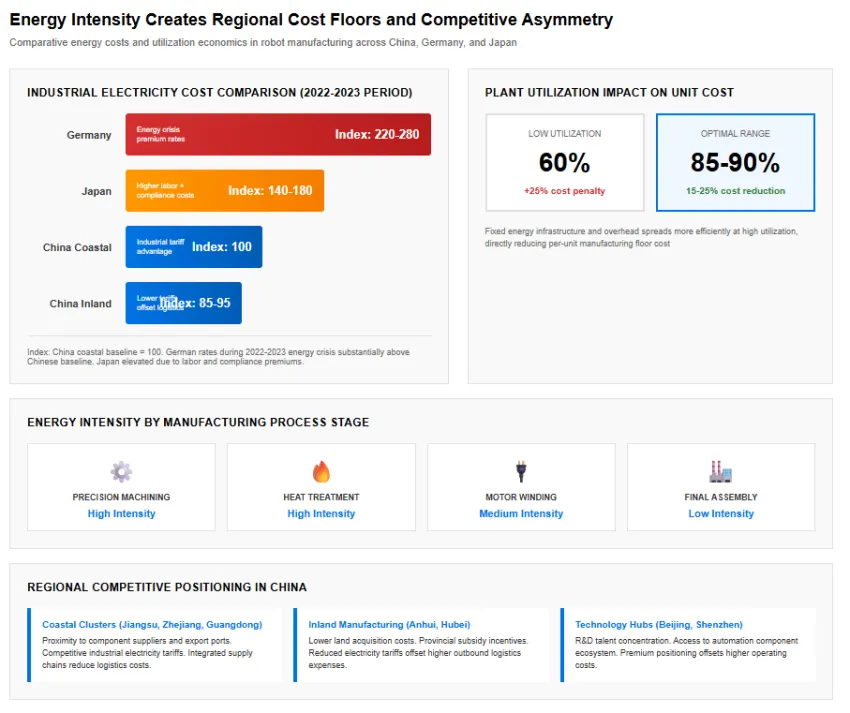
Energy consumption for machining precision components, heat treatment of gear teeth, motor winding, and final assembly establishes manufacturing cost floors for robot production. Specific value not disclosed in the public documents reviewed for plant-level energy intensity metrics. Regional energy cost asymmetry across Chinese provinces creates competitive positioning differences, with coastal manufacturing clusters benefiting from industrial electricity tariffs while inland facilities leverage lower land costs offset by higher logistics expenses.
Compared to Japan and Germany, Chinese manufacturing energy costs provide structural advantages. German industrial electricity rates during 2022 to 2023 energy crisis periods reached levels substantially above Chinese baseline tariffs. Japanese producers face higher labor and compliance costs despite efficient production systems. Energy and plant footprint shape per unit manufacturing floor cost through utilization sensitivity: a plant running at 85 to 90 percent capacity spreads fixed energy infrastructure and overhead 15 to 25 percent more efficiently than one at 60 percent utilization.
How Do Logistics and Plant Location Economics Impact Robotics Competitiveness?
Inbound parts flows for high precision components including harmonic reducers, encoders, and machine vision systems require temperature-controlled transport and contamination protection. Outbound finished robot containerization depends on payload: collaborative robots under 20 kilograms ship in standard containers with protective packaging, while heavy-duty articulated robots require specialized crating and handling.
Coastal production clusters in Jiangsu, Zhejiang, and Guangdong provinces capture structural advantages through proximity to component suppliers and export ports. Estun's Nanjing headquarters and manufacturing base benefits from integrated supply chains in Jiangsu province robotics cluster. Inovance's Shenzhen location provides access to electronics and automation component suppliers. Inland localisation incentives in provinces like Anhui where EFORT operates balance higher logistics costs with lower land acquisition expenses and targeted provincial subsidies.
Duty regimes affecting imported subsystems add 8 to 12 percent to landed costs for foreign-supplied controllers, sensors, and precision reducers. Domestic content requirements under Made in China 2025 encourage vertical integration or local supplier partnerships, creating de facto price protection for Chinese component manufacturers.
What Policy Measures Create De Facto Margin Boosts for Domestic Suppliers?
Central and provincial subsidy programmes, local content encouragement, tax allowances, preferential loan programmes, and trade measures create structural margin advantages for domestic robot manufacturers. Made in China 2025 targets automation and intelligent manufacturing as strategic priorities, channeling subsidies through provincial industrial development funds and directed lending from state banks.
Siasun received RMB 588 million in subsidies over three years according to annual report disclosures. Beijing established a RMB 10 billion robotics industry fund in January alongside Shougang Group to accelerate sector development. Provincial governments offer tax holidays, reduced electricity tariffs for designated automation parks, and land use subsidies for greenfield factory investments.
Policy acts as de facto margin boost by reducing effective tax rates, subsidizing R&D expenditures, and providing working capital through preferential financing. Import-reliant OEMs face cost penalties through tariffs on critical subsystems, while fully localized manufacturers capture full subsidy benefits and avoid currency exposure on component procurement.
How Do Operational Economics Shape Unit Costs Across Chinese Robot Manufacturers?
Estun's installed capacity and utilization metrics show market-leading shipment volumes ranking first among domestic manufacturers for seven consecutive years, achieving second place overall in Chinese industrial robot market by shipment volume in 2024 with market share exceeding 10 percent in Q1 2025. Specific cycle time, yield, and repeatability metrics not disclosed in public documents reviewed.
Automation assembly lines for robot production require test benches for load testing, calibration processes for encoder alignment and motion accuracy verification, and quality control systems for ISO certification. Fixed overhead for these systems scales with capacity, creating strong incentives for high utilization. SKU complexity across payload ranges, mounting configurations, and industry-specific configurations influences changeover costs: transitioning production lines between 6-axis articulated robots and SCARA systems requires tooling changes and calibration revalidation extending several hours.
Working capital requirements tie up cash in component inventory, work-in-process for multi-week assembly cycles, and finished goods for distributor networks. Payment terms to automotive OEMs and electronics manufacturers extend 60 to 90 days, inflating working capital needs during capacity expansions.
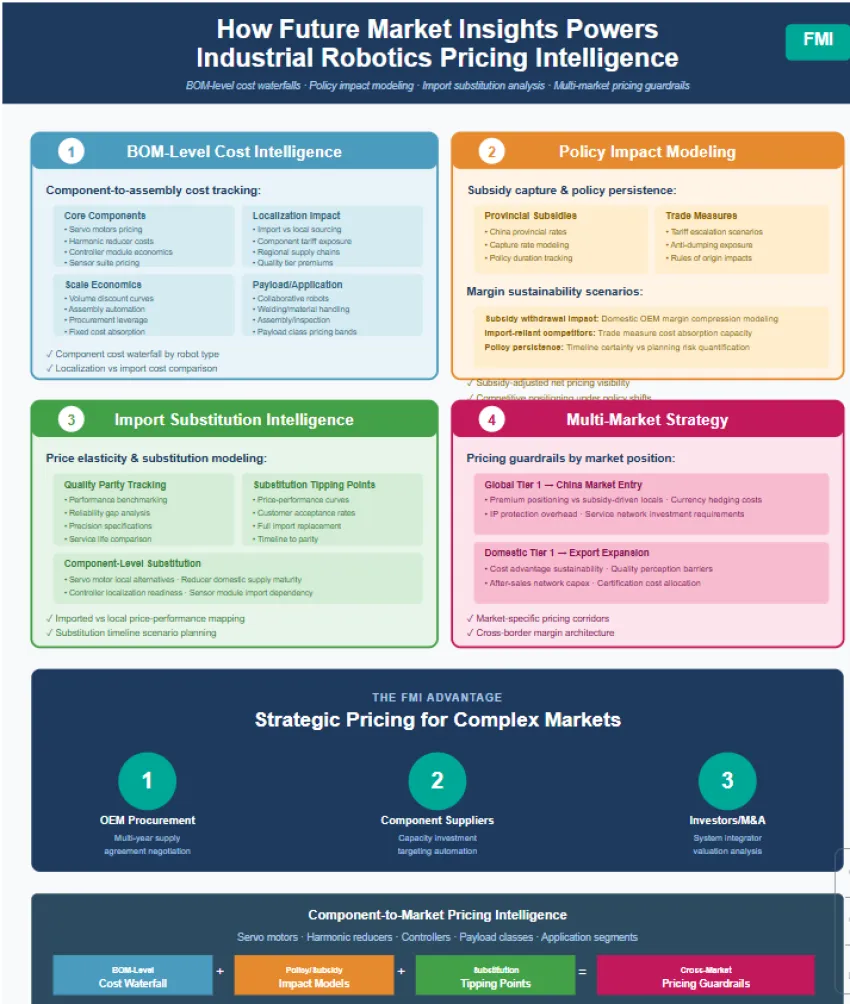
How Can Future Market Insights Help on Pricing in Industrial Robotics?
Sources
- International Federation of Robotics World Robotics 2024 Report: China robot density 470 units per 10,000 employees in 2023, 276,300 new installations, 51 percent of global total
- Estun Automation 2024 Semi-Annual Report: RMB 4,008.8 million revenue, 75.6 percent from industrial robots, 9.5 percent market share, 34 percent export revenue
- Inovance Technology disclosures: 27.3 percent SCARA market share 2024, less than 5 percent revenue from robots, motion control and automation integration capabilities
- EFORT Intelligent Robot announcements: RMB 1.9 billion factory investment, 100,000 units annual capacity target by 2029, 44 percent export revenue 2024
- China Robot Industry and manufacturing data: 556,400 industrial robots produced in 2024 up 14.2 percent, first half 2025 exports 94,200 units up 60 percent year on year

