

- Industry Size (2026)
- USD 65.1 Bn
- Forecast (2036)
- USD 8.8 Bn
- CAGR (2026 to 2036)
- 23.9%
Private 5G MEC for Industrial Automation Market Size, Market Forecast and Outlook By FMI
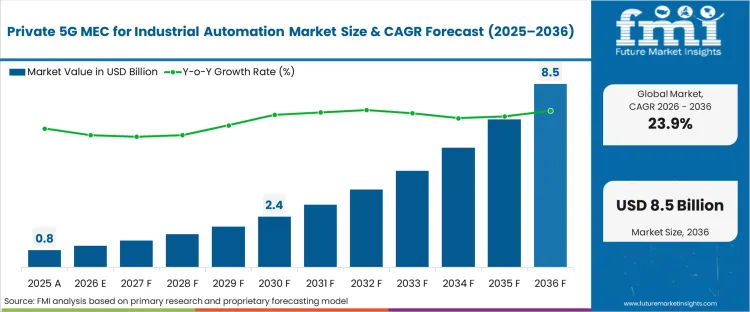
The Private 5G MEC for Industrial Automation Market was estimated to be valued at USD 0.8 billion in 2025, showed a substantial growth of USD 1.0 billion in 2026 at a CAGR of 23.9% during the forecast period. The industry growth being forecasted to accomplishing a total of USD 8.8 billion through 2036 as manufacturers transition toward industrial edge computing with 5G to support high-stakes robotics, reflecting a broader mandate for private 5G for factories, where legacy wireless fails to meet modern throughput needs.
Modern site managers are currently shifting away from the limitations of legacy Wi-Fi toward localized industrial private 5G network market infrastructures. This transformation is driven by the need for industrial edge ai connectivity, processing massive sensor data streams at the source to eliminate the jitter of centralized clouds. Buyers are forced to decide between restrictive cabling or a wireless-first floor plan that supports rapid line reconfigurations. Many are asking why do factories need MEC with private 5G; the answer lies in trapped productivity, as high-bandwidth tasks like edge server processing cannot scale without the localized compute capacity that MEC in manufacturing market solutions provide.
Summary of Private 5G MEC for Industrial Automation Market
- Definition:
- The industrial private 5G edge computing market represents the convergence of high-speed cellular connectivity and localized compute, establishing a secure environment that bypasses the congestion inherent in public networks.
- Demand Drivers in the Market:
- The transition toward modular production lines compels plant managers to evaluate if they can buy private 5G edge platform for smart factory use to reduce reconfiguration downtime.
- Sustained growth in private 5G MEC for AGV AMR fleets requires the ultra-reliable low-latency communication that only dedicated network slicing can provide at scale.
- Stringent data sovereignty requirements obligate manufacturers to keep mission-critical data on-premises, a core reason why do factories need MEC with private 5G over cloud-only architectures.
- Key Segments Analyzed in the FMI Report:
- Hardware: Hardware is expected to grab 38.0% share in 2026, as the initial market phase is dominated by radio units and factory floor edge ai industrial pcs.
- On-Premises Edge: This segment is expected to hold 61.0% share in 2026, answering the question of on-prem edge vs cloud edge for factories by prioritizing local control.
- Standalone Private 5G SA: Standalone architectures are predicted to account for 42.0% share, enabling high-precision private 5G SA for robotics.
- China: 27.8% CAGR, fueled by the China 5G factory edge computing market initiatives that subsidize large-scale infrastructure deployment.
- Analyst Opinion at FMI:
- Rahul Pandita, Principal Analyst, Technology, at FMI, opines, "When we compare private 5G MEC and wi-fi 6 for industrial automation, the debate often settles on determinism rather than speed. While Wi-Fi 6 offers improvements, it lacks the fine-grained control over network slicing required for safety-critical tasks. We are seeing that the private 5G MEC vendors for manufacturing who succeed are those that treat the network as an industrial tool rather than a standard IT asset. The real value is realized when industrial edge AI connectivity is used to solve the 'moving target' problem, where machines, parts, and robots are constantly in motion and need a ubiquitous, high-reliability connection that wires simply cannot provide."
- Strategic Implications / Executive Takeaways:
- Operations directors should investigate private 5G MEC RFQ for factory automation now to avoid future bottlenecks when retrofitting legacy machines.
- System integrators should focus on industrial private 5G MEC solution providers who can bridge the gap between IT-centric 5G and OT-centric protocols.
- Cybersecurity leads must address how secure is private 5G for factory networks, ensuring that localized edge nodes do not become isolated vulnerabilities.
The structural gate for this sector is the shift to private 5G SA for robotics and ultra-low latency architectures. While initial trials used existing LTE cores, the inflection point occurs when a private 5G core for smart factory use is deployed on-site. This allows operations directors to guarantee dedicated bandwidth for mission-critical industrial automation tasks. This transition makes deterministic wireless for industrial automation as reliable as wired predecessors, finally unlocking the full potential of autonomous floor assets.
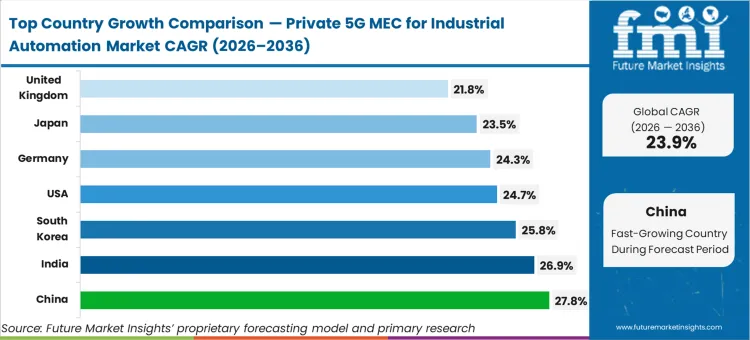
China leads the geographic expansion with a 27.8% CAGR, followed by India at 26.9% and South Korea at 25.8%. The United States private 5G MEC market is anticipated to advance at 24.7%, while Germany follows at 24.3%. Japan is expected to record a 23.5% CAGR, with the United Kingdom projected to garner 21.8% growth through 2036. This divergence is driven by the speed of spectrum allocation; markets like Germany have established industrial campus network solutions using dedicated licenses, allowing firms to deploy 5G enterprise private network systems independent of public carriers.
Private 5G MEC for Industrial Automation Market Definition
It comprises the hardware, software, and services used to deploy dedicated cellular networks integrated with Multi-access Edge Computing (MEC) within industrial facilities. Unlike public 5G, these are 5G non-public network manufacturing systems providing ultra-reliable low-latency communication (URLLC). The market is defined by the functional requirement to process data at the edge to support private 5G MEC for remote robot control and high-bandwidth sensing.
Private 5G MEC for Industrial Automation Market Inclusions
Scope includes on-site 5G small cells, core network software, MEC platforms, and ruggedized edge gateways. It covers specialized 5G industrial IoT devices and on-prem MEC for machine vision hardware designed for harsh manufacturing environments. Additionally, managed services for network orchestration and security solutions tailored for private 5G campus network for factories are included in the valuation.
Private 5G MEC for Industrial Automation Market Exclusions
The market excludes public 5G subscriptions provided by mobile network operators for general consumer use. It also excludes standard cloud computing services where data processing occurs in remote data centers rather than on-site edge nodes, as highlighted in MEC vs cloud for manufacturing comparisons. General-purpose IT networking equipment, such as consumer-grade 5G smartphones, is outside the scope as these do not meet industrial performance requirements.
Private 5G MEC for Industrial Automation Market Research Methodology
- Primary Research: FMI conducted interviews with CTOs and industrial architects to understand the what components make up a private 5G MEC industrial deployment roadmap for Tier-1 manufacturers.
- Desk Research: Data was aggregated from spectrum regulatory filing databases and technical archives to explain the private 5G MEC market for industrial automation through verified deployment figures.
- Market-Sizing and Forecasting: The baseline anchors to reported shipments of industrial-grade 5G radio units and capital expenditure allocated to smart factory digital transformation projects.
- Data Validation and Update Cycle: Forecasts were cross-validated against independent data streams to give me market size and CAGR for private 5G MEC in factories that are historically defensible.
Segmental Analysis
Private 5G MEC for Industrial Automation Market Analysis by Offering
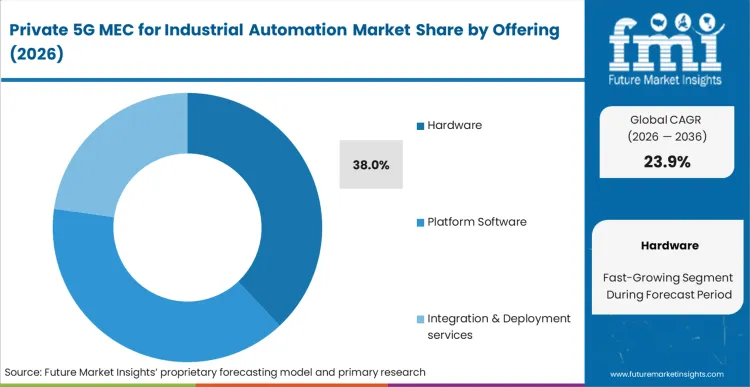
Initial investment cycles are currently dominated by the physical rollout of radio access networks. According to FMI's assessment, hardware holds 38.0% of the market share as firms prioritize the deployment of multi access edge computing hardware. This phase is characterized by the question can private 5G replace wi-fi in manufacturing; plant engineers are finding that while software is the goal, the immediate hurdle is installing ruggedized 5G small cells. As manufacturers move beyond pilot projects, the focus is shifting toward industrial private 5G MEC solution providers who offer integrated radio-compute stacks.
- Interference Mitigation: High-density 5G radio configurations allow for consistent signal propagation in metal-dense environments. Operations leads use this to solve connectivity gaps in 5G machine vision factory setups.
- Compute Localized: Ruggedized nodes enable sub-10ms processing for private 5G MEC for machine vision inspection lines. Quality managers capture immediate rejection data without cloud-related round-trip latency.
- Hardware Lifecycle: The durable design of industrial 5G modems aligns with the long-term capital equipment cycles. Procurement heads value this alignment when evaluating what components make up a private 5G MEC industrial deployment.
Private 5G MEC for Industrial Automation Market Analysis by Deployment Model
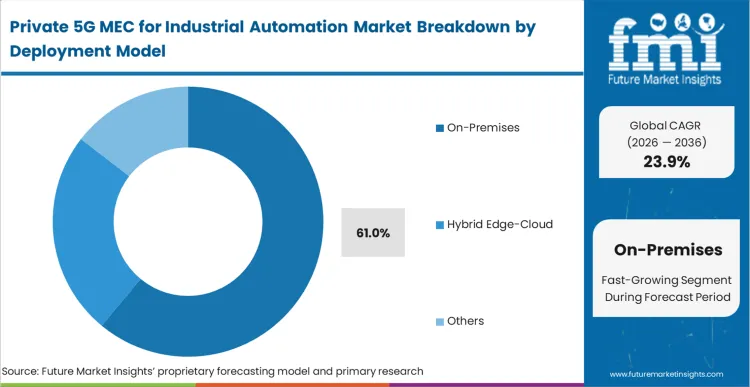
FMI analysts opine that manufacturers are carefully weighing on-prem edge vs cloud edge for factories, often choosing the former to ensure operational continuity. The requirement for absolute data sovereignty forces a structural preference for on-premises edge, holding 61.0% of the market share. The decision to keep the 5G core on-site is a physical necessity for private 5G MEC for remote robot control where even minor delays can cause synchronization failures. As the ecosystem matures, managed private 5G for industrial plants is emerging as a preferred model for firms wanting the performance of on-prem edge without the internal engineering burden.
- Data Sovereignty: Keeping all traffic within the facility eliminates the risk of sensitive production telemetry traversing public backbones. This answers the query how secure is private 5G for factory networks.
- Operational Autonomy: Localized 5G cores ensure that automation remains functional during external outages. Production leads mitigate downtime through this disconnected capability.
- Latency Floor: On-site nodes provide a consistent latency profile. Technical buyers often ask how much latency can private 5G MEC deliver in factories; the answer is a deterministic sub-10ms floor that public networks cannot match.
Private 5G MEC for Industrial Automation Market Analysis by Application
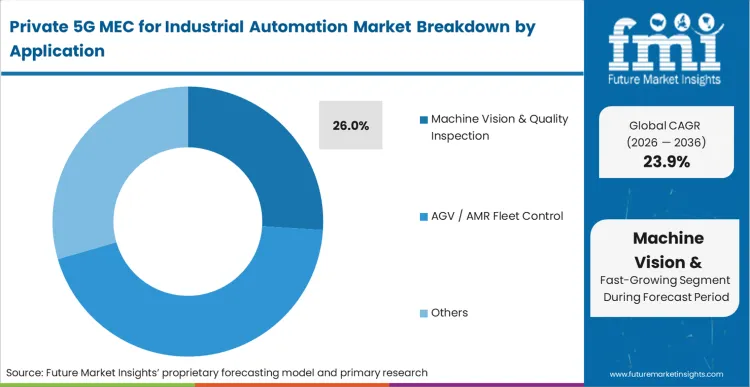
High-resolution visual data processing is the primary catalyst for dedicated cellular networks. In FMI's view, machine vision and quality inspection leads the application segment with 26.0% share, often serving as a flagship for 5G smart factory use cases. Legacy networks often choke when multiple cameras stream simultaneous data for manufacturing execution systems analysis. Private 5G provides the necessary uplink capacity to handle these streams wirelessly, enabling mobile inspection stations. This flexibility is transforming QA into a real-time, in-line corrective Mechanism that is central to the MEC vs cloud for machine vision economic debate.
- Vision Uplink: High-bandwidth slices support simultaneous 4K video feeds. Technical leads use this to scale private 5G MEC for machine vision inspection.
- AMR Coordination: Deterministic wireless links allow for the orchestration of private 5G MEC for AGV AMR fleets, preventing collisions. Logistics managers capture higher throughput by optimizing travel paths.
- Process Digital: Low-latency feedback loops enable high-fidelity private 5G MEC for digital twins integration. Maintenance teams use this to predict component failure before it occurs.
Private 5G MEC for Industrial Automation Market Analysis by Network Architecture
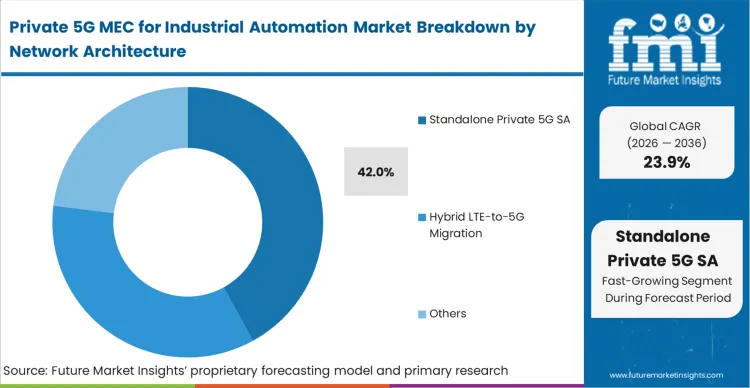
The shift toward native functionality is accelerating the adoption of Standalone (SA) architectures, holding 42.0% share. FMI notes that buyers are increasingly comparing private LTE vs private 5G for factories, finding that legacy cores act as a performance ceiling. As SA chipsets become affordable, the tension between "making do" with LTE and investing in a native 5G environment is resolving. Manufacturers are realizing that the SA core is the foundational gate to advanced features like 5G LAN, which are critical for private 5G SA for robotics.
- Slicing Capability: Native SA cores allow for dedicated virtual networks for safety-critical traffic. Network administrators use this to isolate administrative data.
- Protocol Evolution: Standalone architectures support Time Sensitive Networking (TSN). Engineers utilize this to replace specialized cables in non-public 5G industrial automation scenarios.
- Migration Path: While initial costs are higher, SA avoids the technical debt of legacy cores. CFOs favor the long-term efficiency of a single, future-proof network standard.
Private 5G MEC for Industrial Automation Market Drivers, Restraints, and Opportunities
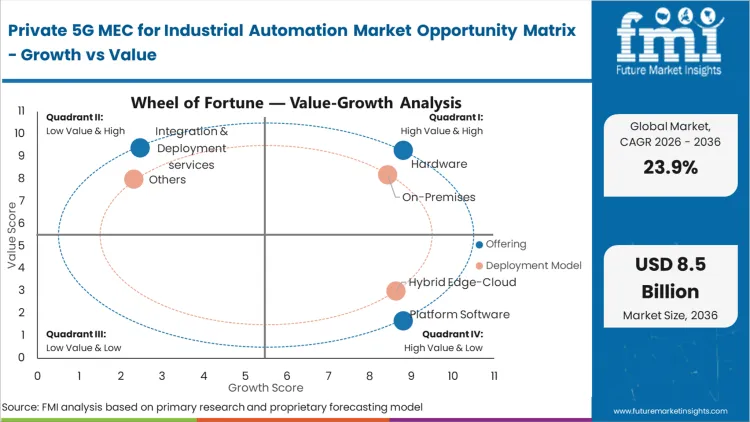
The global push toward the "modularization" of manufacturing serves as the primary structural catalyst compelling a shift in network architecture. As consumer preferences shift, factory automation and industrial controls must change layouts in hours. This requires evaluating private 5G edge computing for smart factory use to remove the fixed cabling that acts as a tether to productivity. Production directors are being forced to choose between the high labor cost of manual rewiring and the capital investment of a wireless-first floor. Those who act capture a significant advantage in time-to-market.
A fundamental organizational bottleneck exists in the form of a "skills gap" between traditional operational technology (OT) and modern IT specialists. Unlike Wi-Fi, industrial private 5G edge computing market deployments require complex RF planning that most factory teams do not possess. This is not a temporary cost; it is an organizational hurdle. The private 5G vs Wi-Fi 6 for industrial automation debate often further highlights the integration complexity with industrial IOT legacy protocols, which requires specialized industrial private 5G system integrators to bridge.
Opportunities in the Private 5G MEC for Industrial Automation Market
- Managed Service Models: The high complexity enables managed private 5G for industrial plants, where vendors handle the cellular core and RF tuning for SMEs.
- Predictive Optimization: High-density sensor data supports private 5G MEC for predictive maintenance at the edge. Maintenance teams capture labor efficiency by reducing unplanned downtime.
- Worker Connectivity: The bandwidth of 5G supports private 5G MEC for worker safety wearables. Safety officers can track real-time biometrics and location in hazardous zones.
Regional Analysis
The deployment of private cellular infrastructure coupled with edge intelligence follows a diverse global trajectory shaped by local spectrum availability and industrial maturity. FMI analyzes the private 5G MEC for industrial automation landscape across more than 40 countries to identify structural growth hotspots. Based on the regional analysis, the market is segmented into North America, Latin America, Europe, South Asia & Pacific, East Asia, and the Middle East & Africa across 40 plus countries.
.webp "Top Country Growth Comparison Private 5g Mec For Industrial Automation Market Cagr (2026 2036)")
| Country | CAGR (2026 to 2036) |
|---|---|
| China | 27.8% |
| India | 26.9% |
| South Korea | 25.8% |
| United States | 24.7% |
| Germany | 24.3% |
| Japan | 23.5% |
| United Kingdom | 21.8% |
Source: Future Market Insights (FMI) analysis, based on proprietary forecasting model and primary research
Asia-Pacific Private 5G MEC for Industrial Automation Market Analysis
Industrial policy and massive state-led digital mandates serve as the primary engines for the China 5G factory edge computing market and its regional neighbors. These "mega-sites" provide the necessary density for MEC to become an economically viable alternative to traditional wired backbones. Adoption timelines in this region are significantly more compressed than global averages, as firms view non-public 5G industrial automation as a non-negotiable requirement for next-generation labor productivity. The regional transition is signaling a move toward "lights-out" manufacturing where humans are replaced by ultra-reliable wireless control systems. FMI suggests that practitioners in the Asia-Pacific corridor are increasingly prioritizing SA cores to ensure their vision-based lines remain the fastest in the world.
- China: A CAGR of 27.8% is expected for the China 5G factory edge computing market through 2036. The aggressive rollout of "5G + Industrial Internet" national strategies has already created the world's most dense concentration of pilot projects. Manufacturers who capture government subsidies early are establishing a defensible cost-per-unit advantage over international peers. Demand for industrial private 5G edge computing market technologies is set to grow as these subsidized sites move into full-scale production. This state-led momentum allows Chinese firms to bypass the ROI-hesitation that often slows adoption in purely market-driven economies.
- India: The India private 5G industrial automation market is benefiting from a leapfrog effect where factories bypass legacy upgrades in favor of 5G Standalone cores. The market is projected to register a CAGR of 26.9% as the "Make in India" initiative pushes for world-class digital floor plans. This growth is naturally linked to the broader regional trend of absorbing displaced manufacturing capacity through high-tech, wireless-first infrastructures. Local operators and integrators are focusing on frugal innovation to make MEC viable for the massive SME sector. As India scales its electronics and automotive production, the need for deterministic wireless becomes the structural backbone of its industrial expansion.
- South Korea: South Korea’s electronics manufacturing private 5G sector is poised for 25.8% growth as semiconductor giants integrate zero-latency sensing. The high density of high-tech facilities in the Seoul-Incheon corridor necessitates the processing of massive sensor data streams at the network edge. Procurement directors are moving away from hybrid models to capture the full benefits of native 5G LAN features. This evolution ensures that South Korean assembly lines can maintain high-speed synchronization without the physical constraints of cabling. Competitive pressure from regional neighbors ensures that South Korean firms maintain a rapid capital refresh cycle for their wireless infrastructure.
- Japan: By bypassing carrier negotiation delays, Japanese manufacturers can move directly to production-scale deployment for high-precision robotics. This regulatory head start has positioned Japan as a primary laboratory for testing private 5G SA for robotics in complex brownfield environments. The Japan local 5G manufacturing market is expected to expand at a CAGR of 23.5% over the forecast period. This trajectory is supported by the early release of "Local 5G" licenses by the Ministry of Internal Affairs and Communications. These licenses allow Japanese firms to own and operate their networks entirely independent of public mobile carriers.
FMI's report includes additional coverage of markets in Taiwan and Southeast Asian manufacturing hubs. These markets show a structural pattern of "fast-follower" behavior, where firms wait for the Chinese and Japanese ecosystems to standardize hardware costs before initiating their own large-scale rollouts.
North America Private 5G MEC for Industrial Automation Market Analysis
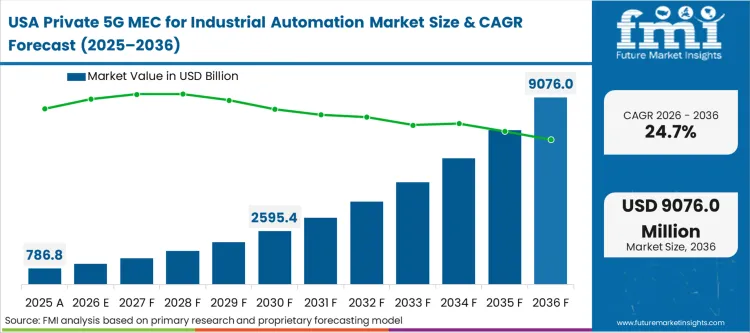
Economics and the pursuit of labor efficiency define the adoption model in North American industrial clusters. FMI notes that the availability of CBRS spectrum has democratized access to industrial private 5G network market solutions for even mid-sized hubs. Re-shoring initiatives are acting as a secondary driver, as new "greenfield" sites are designed from the ground up to be wireless-first. The adoption curve here is highly sensitive to ROI proof points, leading to a pragmatic evaluation of private LTE vs private 5G for factories. Organizations are prioritizing on-prem MEC for machine vision to ensure that data remains sovereign while achieving the necessary performance for automated inspection.
- United States: Greenfield factories in the "Battery Belt" are utilizing private 5G edge computing for smart factory designs to avoid the retrofit costs inherent in older facilities. This strategic investment allows U.S. manufacturers to scale autonomous fleets without the limitations of traditional Wi-Fi. The United States private 5G MEC market is anticipated to advance at 24.7% CAGR, reflecting a massive push toward domestic EV and battery production. Many firms are utilizing managed private 5G for industrial plants to outsource the complexity of RF planning. This approach ensures that technical leads can focus on production throughput rather than the intricacies of cellular core management.
FMI's report includes Canada and Mexico, where a structural pattern of "cross-border supply chain integration" is emerging. Manufacturers in Mexico are increasingly adopting industrial lte and 5G for critical communications to remain compatible with the high-tech procurement standards of their USA-based customers.
Europe Private 5G MEC for Industrial Automation Market Analysis
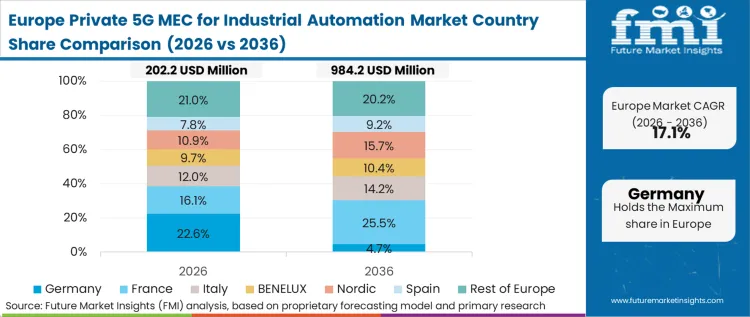
European adoption is shaped by the rigorous qualification standards and engineering-first culture of its automotive and machinery sectors. Germany's move to allocate dedicated industrial spectrum created a structural advantage for firms looking to own their industrial campus network solutions. However, the region faces the challenge of a high "brownfield" density, requiring sophisticated RF engineering to penetrate legacy metal structures. Adoption is often complicated by complex labor union regulations regarding worker tracking and data privacy. FMI suggests that the region is a leader in integrating MEC with private 5G MEC for digital twins to optimize complex manufacturing workflows.
- Germany: Germany is expected to demonstrate a CAGR of 24.3% as the "Industry 4.0" ecosystem treats 5G as a foundational engineering requirement. The Germany private 5G campus network market is already seeing automotive giants replace flexible cabling with native 5G LAN features. This evolution allows for truly modular assembly lines that can be reconfigured in hours rather than days. Procurement directors are focusing on the long-term reliability of deterministic wireless for industrial automation to reduce unplanned downtime. Germany remains the primary laboratory for testing 3GPP Release 16 and 17 features in real-world heavy industry.
- United Kingdom: UK firms are leading the way in using MEC in manufacturing market solutions to process real-time process telemetry at the edge. The integration of high-bandwidth wireless allows for mobile inspection stations that can be deployed anywhere on the production floor. This flexibility is transforming UK pharmaceutical manufacturing into a more responsive and data-driven environment. The pharma factory private 5G automation sector in the UK is forecast to observe a CAGR of 21.8%. This growth reflects a specific focus on high-value, low-volume manufacturing where traceability and uptime are paramount.
FMI's report includes France, Italy, and the Nordics, where a structural pattern of "sovereign cloud" development is driving the demand for on-premises MEC. These additional countries are following the German model of dedicated industrial spectrum to ensure long-term technological independence.
Competitive Aligners for Market Players
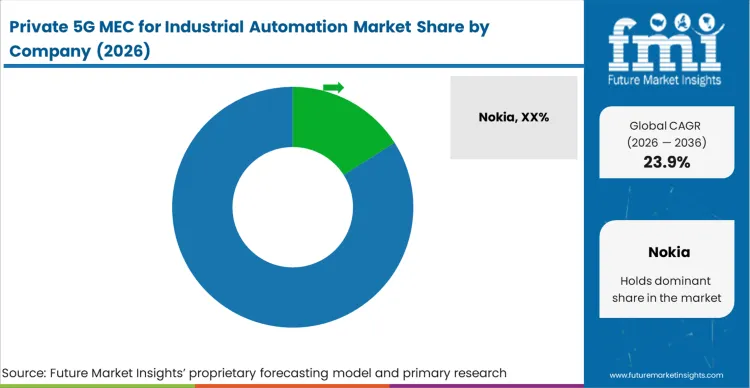
The competitive structure of the private 5G MEC for industrial automation market is moderately concentrated. According to FMI's estimates, buyers do not simply choose on radio performance; they select who are the leading vendors in private 5G MEC for manufacturing based on ecosystem depth. Leading companies like Nokia, Ericsson, and Siemens hold their positions by offering pre-integrated bundles that combine cores with MEC platforms. In the nokia vs ericsson private 5G industrial debate, the primary variable is the ability to provide a "single pane of glass" management interface for factory IT teams.
Incumbents like HPE Aruba Networking and Cisco possess a structural advantage in their established relationships with manufacturing CIOs. These firms are not just selling a 5G edge cloud network and services; they are selling an extension of existing enterprise networks. For a challenger to replicate this, they must build deep system integration capabilities. The advantage persists because once a vendor's core is qualified for automotive private 5G MEC, the switching costs for end-devices become prohibitively high.
The long-term trajectory toward 2036 involves a structural tension between proprietary lock-in and the "Open RAN" movement. Large buyers in the chemical plant private 5G edge sector are increasingly resisting single-vendor ecosystems to avoid long-term pricing pressure. As standardized interfaces allow manufacturers to mix radio units from one vendor with cores from another, dominance will shift toward those providing the best industrial private 5G MEC solution providers at the application and software layer.
Key Players in Private 5G MEC for Industrial Automation Market
- Nokia
- Ericsson
- Siemens
- HPE Aruba Networking
- Cisco
- Samsung Electronics
- NTT DATA
- Huawei Technologies
- ZTE Corporation
- AT&T
- Verizon Communications
- Dell Technologies
- Kyndryl
- Amazon Web Services (AWS)
Scope of the Report
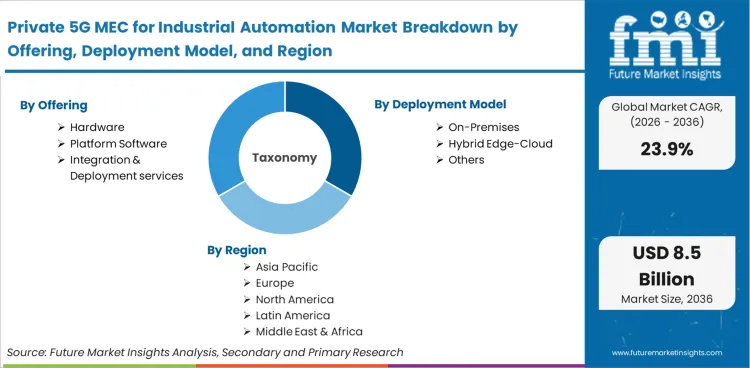
| Metric | Value |
|---|---|
| Quantitative Units | USD 1.0 billion to USD 8.8 billion, at a CAGR of 23.9% |
| Market Definition | Hardware, software, and services for localized 5G cellular networks with integrated Multi-access Edge Computing for industrial use. |
| Offering Segmentation | Hardware, Platform software, Integration & deployment services, Managed services, Security & orchestration |
| Deployment Model Segmentation | On-premises edge, Hybrid edge-cloud, Carrier-hosted / managed edge |
| Application Segmentation | Machine vision, AGV/AMR fleets, Predictive maintenance, Digital twins, Worker safety, Remote robot control |
| End-use Industry Segmentation | Automotive, Electronics, Chemicals, Pharma, Metals & machinery, Food & beverage |
| Regions Covered | North America, Latin America, Europe, East Asia, South Asia & Pacific, Middle East & Africa |
| Countries Covered | China, India, South Korea, United States, Germany, Japan, United Kingdom, and 40 plus countries |
| Key Companies Profiled | Nokia, Ericsson, Siemens, HPE Aruba Networking, Cisco, Samsung Electronics, NTT DATA |
| Forecast Period | 2026 to 2036 |
| Approach | FMI utilized a bottom-up model anchored to radio unit shipments and verified capital expenditure. Data was validated through interviews with OT leads and analysis of spectrum trends. |
Source: Future Market Insights (FMI) analysis, based on proprietary forecasting model and primary research
Segments
Offering:
- Hardware
- Platform software
- Integration & deployment services
- Managed services
- Security & orchestration
Deployment Model:
- On-premises edge
- Hybrid edge-cloud
- Carrier-hosted / managed edge
Application:
- Machine vision & quality inspection
- AGV / AMR fleet control
- Predictive maintenance & condition monitoring
- Digital twin & process optimization
- Worker safety / AR-assisted operations
- Remote robot control
End-use Industry:
- Automotive
- Electronics & semiconductors
- Chemicals & process manufacturing
- Pharma & life sciences
- Metals, machinery & heavy industry
- Food & beverage
Network Architecture:
- Standalone private 5G SA
- Hybrid LTE-to-5G migration
- Integrated private-public roaming architecture
- Neutral-host industrial campus architecture
Regions:
- North America
- United States
- Canada
- Latin America
- Brazil
- Mexico
- Europe
- Germany
- United Kingdom
- France
- Italy
- Spain
- Asia-Pacific
- China
- Japan
- South Korea
- India
- Rest of Asia-Pacific
Bibliography
- ETSI. (2025, June). Multi-access Edge Computing (MEC); Use Cases and Requirements (ETSI GS MEC 002 V4.1.1).
- Federal Communications Commission. (2025, August). The Transformation of the Network. AIWG Final Report.
- Global mobile Suppliers Association. (2026, February). Private Mobile Networks February 2026.
- International Federation of Robotics. (2025, September). World Robotics 2025 report – INDUSTRIAL ROBOTS.
- 5G-ACIA. (2025, May). Assessment of 5G Reduced Capability (RedCap) Devices for Industrial IoT.
- Xiao, Y., et al. (2024, November). Research on High-Quality Paths and Strategies for 5G Industrial Private Networks. Proceedings of the 4th International Conference on Signal Processing and Communication Technology
- Siemens AG. (2025, January). Industrial 5G: The Connectivity for Industry 4.0.
This bibliography is provided for reader reference. The full FMI report contains the complete reference list with primary source documentation.
This Report Addresses
- Market intelligence to support strategic decision making across dedicated radio access networks, 5G SA cores, and ruggedized edge compute nodes.
- Market size estimation and 10-year revenue forecasts from 2026 to 2036, supported by verified industrial robot density and campus spectrum licensing data.
- Growth opportunity mapping across hardware, software, and services with a focus on the structural transition from LTE cores to native 5G Standalone architectures.
- Segment and regional revenue forecasts covering automotive, electronics, and chemical manufacturing across localized spectrum regulatory environments.
- Competition strategy assessment including vendor ecosystem depth, the structural lock-in of integrated 5G stacks, and the emergence of Open RAN alternatives.
- Technology development tracking including 3GPP Release 16/17 features, URLLC performance thresholds, and 5G RedCap compliance.
- Market access analysis covering Citizens Broadband Radio Service (CBRS) in the U.S., Local 5G licenses in Japan, and industrial campus allocation in Germany.
- Market report delivery in PDF, Excel, PPT, and interactive dashboard formats for executive strategy, smart factory planning, and operational benchmarking.
Frequently Asked Questions
What is private 5G MEC in industrial automation?
It is a dedicated on-site cellular network integrated with edge computing to provide the sub-10ms latency and high security required for mission-critical robotic control.
How large is the private 5G MEC for industrial automation market in 2026?
The market is projected to reach a valuation of USD 1.0 billion in 2026.
What will it be valued at by 2036?
The industry is estimated to reach USD 8.8 billion by 2036 as digital transformation scales globally.
What CAGR is projected for the forecast period?
The market is expected to grow at a CAGR of 23.9% from 2026 to 2036.
Which offering segment leads the market?
Hardware leads with 38.0% share because initial infrastructure rollouts require significant capital investment in radio units and edge nodes.
Which deployment model is most dominant?
On-premises edge dominates with 61.0% share because manufacturers prioritize data sovereignty and the absolute lowest latency for factory floor assets.
Why does Standalone (SA) architecture lead the network segment?
Standalone architectures lead with 42.0% share as they are structurally required to enable native 5G features like network slicing and URLLC.
What drives the rapid growth of private 5G in factories?
The primary driver is the shift toward modular production, which requires replacing restrictive physical cabling with high-performance wireless backbones.
What is the primary restraint for adoption?
The primary restraint is the significant skills gap between traditional industrial engineering and specialized 5G network management.
Which country grows the fastest and why?
China grows the fastest at 27.8% CAGR due to massive state-led subsidies and national strategies for 5G-enabled industrial clusters.
How does network slicing benefit industrial automation?
Network slicing allows a single physical network to be divided into isolated virtual lanes to guarantee performance for safety-critical traffic.
What role does MEC play in machine vision applications?
MEC enables real-time processing of high-resolution video streams on-site, allowing for immediate defect detection without cloud-related delays.
Is private 5G intended to replace industrial Wi-Fi?
5G is replacing Wi-Fi for deterministic and mission-critical automation, though Wi-Fi remains used for non-essential administrative tasks.
What is the difference between NSA and SA 5G for a factory?
Non-Standalone (NSA) relies on legacy 4G cores, while Standalone (SA) uses a native 5G core necessary for true ultra-low latency control.
Why is the automotive industry the leading end-user?
Automotive plants lead with 29.0% share due to their high density of AGV fleets and the need for modular assembly line flexibility.
Does this report cover 5G RedCap devices?
Yes, the report addresses 5G RedCap as a structural enabler for connecting high volumes of mid-tier industrial sensors at lower costs.
What are the cybersecurity implications of MEC?
MEC improves security by keeping data on-premises but requires a new zero-trust architecture to protect the expanded cellular attack surface.
How does FMI validate the forecast data?
FMI cross-references industrial robot shipment data with radio unit sales and spectrum licensing trends to ensure forecast accuracy.
Are managed services becoming more common in this market?
Managed services are rising as manufacturers choose to outsource network complexity to specialized vendors to focus on core production.
What is the ROI of private 5G MEC in smart factories?
Manufacturers achieve ROI through reduced reconfiguration downtime, higher throughput for AMRs, and lower maintenance costs via predictive analytics.
What components are required in a private 5G MEC industrial deployment?
A deployment requires 5G small cells, a Standalone core, edge compute servers, and specialized industrial 5G modems.
How much latency can private 5G MEC deliver in factories?
Technical buyers can expect a deterministic latency floor of sub-10 milliseconds, which is mandatory for real-time closed-loop control.
Preview the report firsthand - request a free sample
Get SampleGet the brochure for pricing and purchase details.
Get PDFTable of Content
- Executive Summary
- Global Market Outlook
- Demand-side Trends
- Supply-side Trends
- Technology Roadmap Analysis
- Analysis and Recommendations
- Market Overview
- Market Coverage / Taxonomy
- Market Definition / Scope / Limitations
- Research Methodology
- Chapter Orientation
- Analytical Lens and Working Hypotheses
- Market Structure, Signals, and Trend Drivers
- Benchmarking and Cross-market Comparability
- Market Sizing, Forecasting, and Opportunity Mapping
- Research Design and Evidence Framework
- Desk Research Programme (Secondary Evidence)
- Company Annual and Sustainability Reports
- Peer-reviewed Journals and Academic Literature
- Corporate Websites, Product Literature, and Technical Notes
- Earnings Decks and Investor Briefings
- Statutory Filings and Regulatory Disclosures
- Technical White Papers and Standards Notes
- Trade Journals, Industry Magazines, and Analyst Briefs
- Conference Proceedings, Webinars, and Seminar Materials
- Government Statistics Portals and Public Data Releases
- Press Releases and Reputable Media Coverage
- Specialist Newsletters and Curated Briefings
- Sector Databases and Reference Repositories
- FMI Internal Proprietary Databases and Historical Market Datasets
- Subscription Datasets and Paid Sources
- Social Channels, Communities, and Digital Listening Inputs
- Additional Desk Sources
- Expert Input and Fieldwork (Primary Evidence)
- Primary Modes
- Qualitative Interviews and Expert Elicitation
- Quantitative Surveys and Structured Data Capture
- Blended Approach
- Why Primary Evidence is Used
- Field Techniques
- Interviews
- Surveys
- Focus Groups
- Observational and In-context Research
- Social and Community Interactions
- Stakeholder Universe Engaged
- C-suite Leaders
- Board Members
- Presidents and Vice Presidents
- R&D and Innovation Heads
- Technical Specialists
- Domain Subject-matter Experts
- Scientists
- Physicians and Other Healthcare Professionals
- Governance, Ethics, and Data Stewardship
- Research Ethics
- Data Integrity and Handling
- Primary Modes
- Tooling, Models, and Reference Databases
- Desk Research Programme (Secondary Evidence)
- Data Engineering and Model Build
- Data Acquisition and Ingestion
- Cleaning, Normalisation, and Verification
- Synthesis, Triangulation, and Analysis
- Quality Assurance and Audit Trail
- Market Background
- Market Dynamics
- Drivers
- Restraints
- Opportunity
- Trends
- Scenario Forecast
- Demand in Optimistic Scenario
- Demand in Likely Scenario
- Demand in Conservative Scenario
- Opportunity Map Analysis
- Product Life Cycle Analysis
- Supply Chain Analysis
- Investment Feasibility Matrix
- Value Chain Analysis
- PESTLE and Porter’s Analysis
- Regulatory Landscape
- Regional Parent Market Outlook
- Production and Consumption Statistics
- Import and Export Statistics
- Market Dynamics
- Global Market Analysis 2021 to 2025 and Forecast, 2026 to 2036
- Historical Market Size Value (USD Million) Analysis, 2021 to 2025
- Current and Future Market Size Value (USD Million) Projections, 2026 to 2036
- Y-o-Y Growth Trend Analysis
- Absolute $ Opportunity Analysis
- Global Market Pricing Analysis 2021 to 2025 and Forecast 2026 to 2036
- Global Market Analysis 2021 to 2025 and Forecast 2026 to 2036, By Offering
- Introduction / Key Findings
- Historical Market Size Value (USD Million) Analysis By Offering , 2021 to 2025
- Current and Future Market Size Value (USD Million) Analysis and Forecast By Offering , 2026 to 2036
- Hardware
- Platform Software
- Integration & Deployment services
- Hardware
- Y-o-Y Growth Trend Analysis By Offering , 2021 to 2025
- Absolute $ Opportunity Analysis By Offering , 2026 to 2036
- Global Market Analysis 2021 to 2025 and Forecast 2026 to 2036, By Deployment Model
- Introduction / Key Findings
- Historical Market Size Value (USD Million) Analysis By Deployment Model, 2021 to 2025
- Current and Future Market Size Value (USD Million) Analysis and Forecast By Deployment Model, 2026 to 2036
- On-Premises
- Hybrid Edge-Cloud
- Others
- On-Premises
- Y-o-Y Growth Trend Analysis By Deployment Model, 2021 to 2025
- Absolute $ Opportunity Analysis By Deployment Model, 2026 to 2036
- Global Market Analysis 2021 to 2025 and Forecast 2026 to 2036, By Application
- Introduction / Key Findings
- Historical Market Size Value (USD Million) Analysis By Application, 2021 to 2025
- Current and Future Market Size Value (USD Million) Analysis and Forecast By Application, 2026 to 2036
- Machine Vision & Quality Inspection
- AGV / AMR Fleet Control
- Others
- Machine Vision & Quality Inspection
- Y-o-Y Growth Trend Analysis By Application, 2021 to 2025
- Absolute $ Opportunity Analysis By Application, 2026 to 2036
- Global Market Analysis 2021 to 2025 and Forecast 2026 to 2036, By Network Architecture
- Introduction / Key Findings
- Historical Market Size Value (USD Million) Analysis By Network Architecture, 2021 to 2025
- Current and Future Market Size Value (USD Million) Analysis and Forecast By Network Architecture, 2026 to 2036
- Standalone Private 5G SA
- Hybrid LTE-to-5G Migration
- Others
- Standalone Private 5G SA
- Y-o-Y Growth Trend Analysis By Network Architecture, 2021 to 2025
- Absolute $ Opportunity Analysis By Network Architecture, 2026 to 2036
- Global Market Analysis 2021 to 2025 and Forecast 2026 to 2036, By Region
- Introduction
- Historical Market Size Value (USD Million) Analysis By Region, 2021 to 2025
- Current Market Size Value (USD Million) Analysis and Forecast By Region, 2026 to 2036
- North America
- Latin America
- Western Europe
- Eastern Europe
- East Asia
- South Asia and Pacific
- Middle East & Africa
- Market Attractiveness Analysis By Region
- North America Market Analysis 2021 to 2025 and Forecast 2026 to 2036, By Country
- Historical Market Size Value (USD Million) Trend Analysis By Market Taxonomy, 2021 to 2025
- Market Size Value (USD Million) Forecast By Market Taxonomy, 2026 to 2036
- By Country
- USA
- Canada
- Mexico
- By Offering
- By Deployment Model
- By Application
- By Network Architecture
- By Country
- Market Attractiveness Analysis
- By Country
- By Offering
- By Deployment Model
- By Application
- By Network Architecture
- Key Takeaways
- Latin America Market Analysis 2021 to 2025 and Forecast 2026 to 2036, By Country
- Historical Market Size Value (USD Million) Trend Analysis By Market Taxonomy, 2021 to 2025
- Market Size Value (USD Million) Forecast By Market Taxonomy, 2026 to 2036
- By Country
- Brazil
- Chile
- Rest of Latin America
- By Offering
- By Deployment Model
- By Application
- By Network Architecture
- By Country
- Market Attractiveness Analysis
- By Country
- By Offering
- By Deployment Model
- By Application
- By Network Architecture
- Key Takeaways
- Western Europe Market Analysis 2021 to 2025 and Forecast 2026 to 2036, By Country
- Historical Market Size Value (USD Million) Trend Analysis By Market Taxonomy, 2021 to 2025
- Market Size Value (USD Million) Forecast By Market Taxonomy, 2026 to 2036
- By Country
- Germany
- UK
- Italy
- Spain
- France
- Nordic
- BENELUX
- Rest of Western Europe
- By Offering
- By Deployment Model
- By Application
- By Network Architecture
- By Country
- Market Attractiveness Analysis
- By Country
- By Offering
- By Deployment Model
- By Application
- By Network Architecture
- Key Takeaways
- Eastern Europe Market Analysis 2021 to 2025 and Forecast 2026 to 2036, By Country
- Historical Market Size Value (USD Million) Trend Analysis By Market Taxonomy, 2021 to 2025
- Market Size Value (USD Million) Forecast By Market Taxonomy, 2026 to 2036
- By Country
- Russia
- Poland
- Hungary
- Balkan & Baltic
- Rest of Eastern Europe
- By Offering
- By Deployment Model
- By Application
- By Network Architecture
- By Country
- Market Attractiveness Analysis
- By Country
- By Offering
- By Deployment Model
- By Application
- By Network Architecture
- Key Takeaways
- East Asia Market Analysis 2021 to 2025 and Forecast 2026 to 2036, By Country
- Historical Market Size Value (USD Million) Trend Analysis By Market Taxonomy, 2021 to 2025
- Market Size Value (USD Million) Forecast By Market Taxonomy, 2026 to 2036
- By Country
- China
- Japan
- South Korea
- By Offering
- By Deployment Model
- By Application
- By Network Architecture
- By Country
- Market Attractiveness Analysis
- By Country
- By Offering
- By Deployment Model
- By Application
- By Network Architecture
- Key Takeaways
- South Asia and Pacific Market Analysis 2021 to 2025 and Forecast 2026 to 2036, By Country
- Historical Market Size Value (USD Million) Trend Analysis By Market Taxonomy, 2021 to 2025
- Market Size Value (USD Million) Forecast By Market Taxonomy, 2026 to 2036
- By Country
- India
- ASEAN
- Australia & New Zealand
- Rest of South Asia and Pacific
- By Offering
- By Deployment Model
- By Application
- By Network Architecture
- By Country
- Market Attractiveness Analysis
- By Country
- By Offering
- By Deployment Model
- By Application
- By Network Architecture
- Key Takeaways
- Middle East & Africa Market Analysis 2021 to 2025 and Forecast 2026 to 2036, By Country
- Historical Market Size Value (USD Million) Trend Analysis By Market Taxonomy, 2021 to 2025
- Market Size Value (USD Million) Forecast By Market Taxonomy, 2026 to 2036
- By Country
- Kingdom of Saudi Arabia
- Other GCC Countries
- Turkiye
- South Africa
- Other African Union
- Rest of Middle East & Africa
- By Offering
- By Deployment Model
- By Application
- By Network Architecture
- By Country
- Market Attractiveness Analysis
- By Country
- By Offering
- By Deployment Model
- By Application
- By Network Architecture
- Key Takeaways
- Key Countries Market Analysis
- USA
- Pricing Analysis
- Market Share Analysis, 2025
- By Offering
- By Deployment Model
- By Application
- By Network Architecture
- Canada
- Pricing Analysis
- Market Share Analysis, 2025
- By Offering
- By Deployment Model
- By Application
- By Network Architecture
- Mexico
- Pricing Analysis
- Market Share Analysis, 2025
- By Offering
- By Deployment Model
- By Application
- By Network Architecture
- Brazil
- Pricing Analysis
- Market Share Analysis, 2025
- By Offering
- By Deployment Model
- By Application
- By Network Architecture
- Chile
- Pricing Analysis
- Market Share Analysis, 2025
- By Offering
- By Deployment Model
- By Application
- By Network Architecture
- Germany
- Pricing Analysis
- Market Share Analysis, 2025
- By Offering
- By Deployment Model
- By Application
- By Network Architecture
- UK
- Pricing Analysis
- Market Share Analysis, 2025
- By Offering
- By Deployment Model
- By Application
- By Network Architecture
- Italy
- Pricing Analysis
- Market Share Analysis, 2025
- By Offering
- By Deployment Model
- By Application
- By Network Architecture
- Spain
- Pricing Analysis
- Market Share Analysis, 2025
- By Offering
- By Deployment Model
- By Application
- By Network Architecture
- France
- Pricing Analysis
- Market Share Analysis, 2025
- By Offering
- By Deployment Model
- By Application
- By Network Architecture
- India
- Pricing Analysis
- Market Share Analysis, 2025
- By Offering
- By Deployment Model
- By Application
- By Network Architecture
- ASEAN
- Pricing Analysis
- Market Share Analysis, 2025
- By Offering
- By Deployment Model
- By Application
- By Network Architecture
- Australia & New Zealand
- Pricing Analysis
- Market Share Analysis, 2025
- By Offering
- By Deployment Model
- By Application
- By Network Architecture
- China
- Pricing Analysis
- Market Share Analysis, 2025
- By Offering
- By Deployment Model
- By Application
- By Network Architecture
- Japan
- Pricing Analysis
- Market Share Analysis, 2025
- By Offering
- By Deployment Model
- By Application
- By Network Architecture
- South Korea
- Pricing Analysis
- Market Share Analysis, 2025
- By Offering
- By Deployment Model
- By Application
- By Network Architecture
- Russia
- Pricing Analysis
- Market Share Analysis, 2025
- By Offering
- By Deployment Model
- By Application
- By Network Architecture
- Poland
- Pricing Analysis
- Market Share Analysis, 2025
- By Offering
- By Deployment Model
- By Application
- By Network Architecture
- Hungary
- Pricing Analysis
- Market Share Analysis, 2025
- By Offering
- By Deployment Model
- By Application
- By Network Architecture
- Kingdom of Saudi Arabia
- Pricing Analysis
- Market Share Analysis, 2025
- By Offering
- By Deployment Model
- By Application
- By Network Architecture
- Turkiye
- Pricing Analysis
- Market Share Analysis, 2025
- By Offering
- By Deployment Model
- By Application
- By Network Architecture
- South Africa
- Pricing Analysis
- Market Share Analysis, 2025
- By Offering
- By Deployment Model
- By Application
- By Network Architecture
- USA
- Market Structure Analysis
- Competition Dashboard
- Competition Benchmarking
- Market Share Analysis of Top Players
- By Regional
- By Offering
- By Deployment Model
- By Application
- By Network Architecture
- Competition Analysis
- Competition Deep Dive
- Nokia
- Overview
- Product Portfolio
- Profitability by Market Segments (Product/Age /Sales Channel/Region)
- Sales Footprint
- Strategy Overview
- Marketing Strategy
- Product Strategy
- Channel Strategy
- Ericsson
- Siemens
- HPE Aruba Networking
- Cisco
- Samsung Electronics
- Nokia
- Competition Deep Dive
- Assumptions & Acronyms Used


