

- Industry Size (2026)
- USD 76.6 Mn
- Forecast (2036)
- USD 138.5 Mn
- CAGR (2026 to 2036)
- 6.10%
5G Electromechanical RF Switch Market Size, Market Forecast and Outlook By FMI
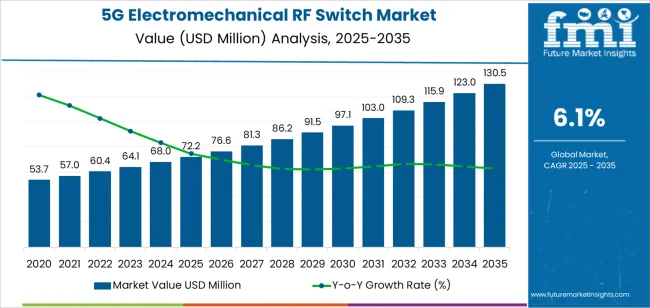
The 5g electromechanical rf switch market was valued at USD 72.2 million in 2025, projected to reach USD 76.6 million in 2026, and is forecast to expand to USD 138.5 million by 2036 at a 6.10% CAGR. Growing demand for signal routing flexibility within 5G radio frequency front-end architectures is compelling base station designers to adopt electromechanical switching solutions that deliver lower insertion loss than solid-state alternatives at frequencies above 3 GHz. Network equipment manufacturers are now specifying mechanical switch reliability parameters directly into tender qualification criteria for multi-band antenna systems.
Summary of 5G Electromechanical RF Switch Market
- Market Snapshot
- The 5g electromechanical rf switch market is valued at USD 72.2 million in 2025 and is projected to reach USD 138.5 million by 2036.
- The industry is expected to grow at a 6.10% CAGR from 2026 to 2036, creating an incremental opportunity of USD 61.9 million.
- The market is positioned within a reliability-certified, specification-driven procurement category where insertion loss, isolation, and cycle-life ratings determine vendor qualification for telecom and defense applications.
- Demand and Growth Drivers
- Demand is increasing as multi-band 5G antenna systems require low-loss signal routing between frequency paths that solid-state switches cannot match at higher power levels.
- Satellite-terrestrial network convergence is creating new switch specification requirements for ground segment equipment operating across Ku, Ka, and V bands.
- Open RAN disaggregation is separating radio unit procurement from integrated vendor platforms, expanding the addressable market for standalone RF switch component suppliers.
- Among key countries, China leads at 8.2% CAGR, followed by India at 7.6%, Germany at 7.0%, and Brazil at 6.4%.
- Product and Segment View
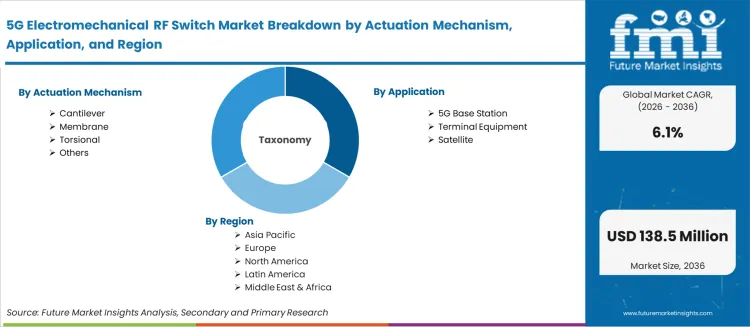
- The market includes cantilever, membrane, and torsional actuation mechanism switches designed for signal routing in 5G base station, terminal, and satellite RF front-end architectures.
- Applications span 5G base station antenna feed networks, terminal equipment band selection, and satellite communication payload switching matrices.
- Cantilever leads by Actuation Mechanism with 58.0% share in 2026.
- 5G Base Station leads by Application with 38.0% share in 2026.
- Scope includes electromechanical switches used in 5G RF signal paths. It excludes solid-state PIN diode switches, MEMS switches, and general-purpose relays not designed for RF applications.
- Geography and Competitive Outlook
- China and India are the fastest-growing markets, while the United States remains a high-value and mature demand base.
- Competition is shaped by contact reliability ratings, insertion loss specifications, and qualification status with major radio OEMs, with participants including Infineon, Teledyne Relays, RF-Lambda, Mini Circuits, Qotana.
- Analyst Opinion at FMI
- Sudip saha, Principal Consultant for Technology observe that: 'In my analysis, I have observed that multi-band 5G antenna architectures are placing insertion loss specifications at the center of RF front-end procurement decisions. Network equipment manufacturers who continue relying on solid-state switching for high-power signal routing above 3.5 GHz face unavoidable signal degradation that electromechanical alternatives can address. Switch vendors without cycle-life test data validated to carrier-mandated reliability thresholds will find themselves locked out of base station platform qualification cycles.'
- Strategic Implications / Executive Takeaways
- Switch vendors must maintain cycle-life qualification data aligned with carrier-mandated reliability thresholds to remain eligible for base station platform procurement.
- RF front-end architects should evaluate electromechanical switch options for any signal path where insertion loss specifications fall below 0.3 dB at operating frequency.
- Procurement directors must secure long-lead-time switch inventory ahead of base station production ramp cycles to avoid line-stop risks from component allocation constraints.
5G Electromechanical RF Switch Market Key Takeaways
| Metric | Details |
|---|---|
| Industry Size (2026) | USD 76.6 million |
| Industry Value (2036) | USD 138.5 million |
| CAGR (2026 to 2036) | 6.10% |
Source: Future Market Insights, 2026
The absolute dollar opportunity across the forecast period amounts to USD 61.9 million, shaped by the continuing need for low-loss, high-isolation switching in multi-band 5G radio configurations. Cantilever-type actuation mechanisms retain the largest design-in share due to their well-characterized contact resistance profiles and established qualification track record with major radio OEMs. Membrane-based switches are gaining specification interest for satellite communication crosslinks where contact bounce tolerances differ from terrestrial base station requirements. Pricing remains stable for qualified electromechanical switches because the cost of requalifying alternative components exceeds the savings from competitive sourcing.
All major regional markets reflect distinct adoption trajectories. China sets the pace with a 8.2% CAGR, driven by state-directed base station manufacturing localization requirements. India follows with a 7.6% CAGR, supported by production-linked incentive schemes for telecom equipment manufacturing. Germany follows with a 7.0% CAGR, anchored by satellite communication ground segment procurement. Brazil follows with a 6.4% CAGR, fueled by initial 5G infrastructure equipment tenders. USA follows with a 5.8% CAGR, backed by defense-grade RF switching procurement programs. UK follows with a 5.2% CAGR, supported by multi-operator network consolidation projects.
5G Electromechanical RF Switch Market Definition
5G electromechanical RF switches are mechanically actuated signal routing components designed to direct radio frequency energy between antenna ports, filter banks, and amplifier chains within 5G communication systems. These switches use physical contact mechanisms to achieve lower insertion loss and higher isolation than solid-state alternatives at frequencies above 3 GHz. Core actuation types include cantilever, membrane, and torsional designs, each offering distinct trade-offs between switching speed, contact resistance stability, and mechanical cycle life. The primary procurement channels serve base station manufacturers, terminal equipment OEMs, and satellite communication system integrators.
5G Electromechanical RF Switch Market Inclusions
Market scope includes cantilever, membrane, torsional, and other electromechanical actuation mechanism switches designed for 5G RF signal routing. Application segments include base station antenna feed networks, terminal equipment band selection, and satellite communication payload switching. Regional and country-level market sizing and forecast data are included.
5G Electromechanical RF Switch Market Exclusions
Solid-state PIN diode switches, MEMS-based RF switches, and general-purpose electromechanical relays not designed for RF signal routing are excluded. Waveguide switches operating exclusively at frequencies above 110 GHz fall outside analytical parameters. Passive RF components including circulators, isolators, and combiners are not included.
5G Electromechanical RF Switch Market Research Methodology
- Primary Research: Analysts engaged with RF system architects, base station hardware procurement managers, and switch reliability test engineers to map the specification parameters driving electromechanical switch selection over solid-state alternatives.
- Desk Research: Data collection aggregated 3GPP frequency band specifications, military RF component qualification standards, and satellite communication frequency plan regulatory filings.
- Market-Sizing and Forecasting: Baseline values derive from a bottom-up aggregation of product-level shipments and license deployments, applying region-specific adoption curves to project future demand velocity.
- Data Validation and Update Cycle: Projections are cross-checked against publicly reported capital expenditure guidance from leading end-use operators and OEM financial disclosures.
5G Electromechanical RF Switch Market Drivers, Restraints, Opportunities
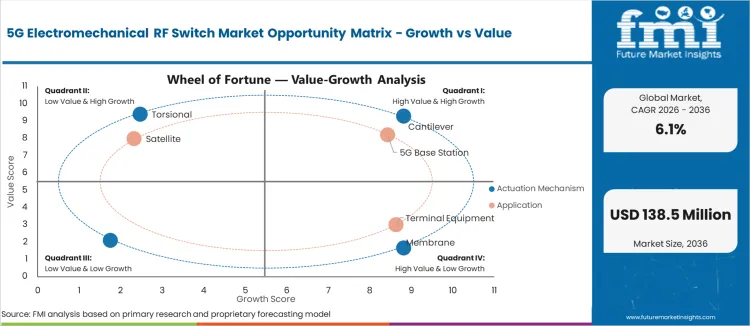
FMI analysts observe that the electromechanical RF switch category has transitioned from a legacy component class into a specification-critical element of modern 5G radio front-end design. The proliferation of frequency bands allocated to 5G NR services requires antenna systems to switch between multiple signal paths without the insertion loss penalty that solid-state alternatives impose at higher power levels. As per FMI, base station OEMs are now issuing switch qualification requirements that specify both electrical performance and mechanical endurance parameters in a single procurement document, raising the qualification burden on switch manufacturers.
The primary tension in this market is the trade-off between switching speed and insertion loss. Solid-state switches offer microsecond-scale transition times but impose 0.5 to 1.5 dB of additional signal loss per switch stage at frequencies above 6 GHz. Electromechanical switches operate in the millisecond range but deliver insertion loss values below 0.15 dB, making them the preferred choice for signal paths where loss budget is the binding constraint. FMI is of the opinion that satellite-terrestrial convergence architectures will expand the addressable application space for electromechanical switches as ground segment equipment must route signals across wider frequency ranges than terrestrial-only systems require.
- Multi-band antenna complexity: The number of frequency paths per 5G base station antenna has increased from 2 to 4 bands in LTE to 6 to 8 bands in advanced 5G NR configurations, multiplying the switch count per radio unit and creating procurement volume growth independent of new site deployment rates.
- Satellite ground segment integration: Non-terrestrial network standards under 3GPP Release 17 and beyond are creating new demand for RF switches that can route signals between terrestrial 5G bands and satellite Ka/Ku bands within a single ground terminal, a use case that electromechanical switches address with lower loss than solid-state alternatives.
- Defense-grade qualification requirements: Military communication systems operating across HF to Ka-band frequencies require switch cycle-life ratings exceeding 10 million operations, a specification tier that electromechanical designs can meet with hermetically sealed contact architectures while solid-state switches face power handling limitations at the same frequency range.
Segmental analysis
5G Electromechanical RF Switch Market Analysis by Actuation Mechanism
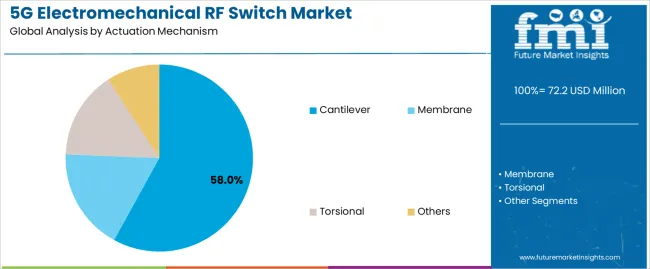
Based on FMI's 5G Electromechanical RF Switch market report, consumption of Cantilever actuation mechanism is estimated to hold 58.0% share in 2026. Cantilever designs retain dominant procurement share because their single-arm contact geometry provides the most predictable contact resistance degradation curve over multi-million cycle lifetimes, a characteristic that base station OEMs value for long-deployment-cycle network equipment. Cantilever switches also benefit from the widest available supplier base, giving procurement teams sourcing flexibility that membrane and torsional alternatives cannot yet match.
- Contact resistance stability: Cantilever switch designs manufactured with gold-alloy contact surfaces maintain contact resistance below 100 milliohms through 5 million actuation cycles, meeting the reliability threshold specified in most base station OEM qualification programs [1].
- Membrane design differentiation: Membrane-based switches are gaining traction in satellite applications where the distributed contact area provides more uniform current density distribution, reducing localized heating at contact points during high-power signal routing [2].
- Torsional niche applications: Torsional actuation mechanisms are specified in test and measurement switching matrices where the rotational contact geometry allows multi-position configurations within a single switch body, reducing the component count in automated test equipment signal routing architectures [3].
5G Electromechanical RF Switch Market Analysis by Application
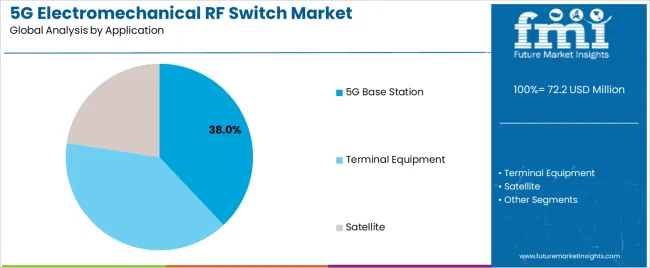
Based on FMI's 5G Electromechanical RF Switch market report, the 5G Base Station application is estimated to hold 38.0% share in 2026. Base station applications absorb the largest procurement volume because each multi-band radio unit requires dedicated switch stages for frequency path selection, transmit-receive isolation, and redundancy switching across active and standby signal chains. The transition to 5G NR massive MIMO configurations is adding switch positions per antenna panel, driving volume growth at existing cell sites without requiring new site construction.
- Terminal equipment band selection: 5G smartphones and customer premises equipment require miniaturized RF switches for band selection across sub-6GHz and millimeter-wave modules, though this segment increasingly favors MEMS and solid-state solutions where switching speed outweighs insertion loss considerations [4].
- Satellite payload switching: LEO satellite constellation operators are specifying electromechanical switches for on-board signal routing where the vacuum operating environment eliminates atmospheric contact degradation mechanisms that limit terrestrial switch cycle life. Ground segment equipment integrators are following the same specification approach for gateway antenna feed networks that must route signals across multiple frequency bands [5].
- Test and measurement routing: Automated RF test equipment manufacturers require switch matrices with repeatable insertion loss characteristics across millions of actuation cycles to maintain measurement accuracy in production-line testing of 5G radio modules and antenna assemblies. Electromechanical switches deliver the contact resistance stability that solid-state alternatives cannot guarantee over extended production campaigns [6].
Imperatives for Stakeholders in 5G Electromechanical RF Switch Market
Design for reliability, not just performance
- Offer comprehensive solution packages: switches + control systems + integration support + technical documentation + reliability testing.
- Preconfigured workflows: installation protocols, testing procedures, maintenance schedules, and digital performance monitoring on switching operations.
Digitization readiness
- Real-time performance analytics, predictive maintenance capabilities, and smart network integration (remote monitoring, automated diagnostics).
Quality-by-design approach
- Automated testing systems, real-time failure detection, statistical reliability analysis, and digital maintenance documentation.
Value-based pricing models
- Clear base switch price + transparent service tiers (technical support, calibration services, performance guarantees); subscriptions for monitoring services/analytics.
Analysis of the 5G Electromechanical RF Switch Market by Key Country
The market demonstrates varied regional dynamics with Growth Leaders including China (8.2% growth rate) and India (7.6% growth rate) driving expansion through 5G infrastructure initiatives and network capacity development. Steady Performers encompass Germany (7.0% growth rate), Brazil (6.4% growth rate), and developed regions, benefiting from established telecommunications industries and advanced network adoption. Mature Markets feature United States (5.8% growth rate), United Kingdom (5.2% growth rate), and Japan (4.6% growth rate), where network densification and satellite deployment support consistent growth patterns.
Regional synthesis reveals East Asian markets leading adoption through 5G expansion and infrastructure development, while European countries maintain steady expansion supported by telecommunications technology advancement and network quality requirements. North American markets show moderate growth driven by 5G deployment and satellite constellation applications.
.webp "Top Country Growth Comparison 5g Electromechanical Rf Switch Market Cagr (2026 2036)")
| Region/Country | 2026-2036 Growth |
|---|---|
| China | 8.2% |
| India | 7.6% |
| Germany | 7.0% |
| Brazil | 6.4% |
| United States | 5.8% |
| United Kingdom | 5.2% |
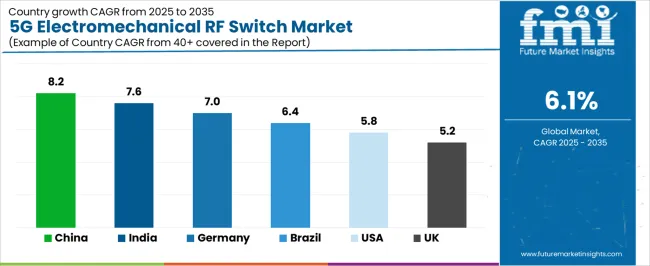
Why does China drive the fastest market growth?
China establishes fastest market growth through aggressive 5G infrastructure programs and comprehensive network capacity development, integrating 5G electromechanical RF switches as standard components in base station and telecommunications installations. The country's 8.2% growth rate reflects government initiatives promoting 5G deployment and telecommunications leadership that mandate the use of advanced switching systems in base station and network facilities. Growth concentrates in major urban centers, including Beijing, Shanghai, and Shenzhen, where 5G technology development showcases integrated switching solutions that appeal to telecommunications operators seeking advanced signal routing capabilities and network optimization applications.
Chinese telecommunications equipment manufacturers are developing cost-effective RF switches that combine domestic production advantages with advanced operational features, including multi-band switching and automated control capabilities. Distribution channels through telecommunications equipment suppliers and network infrastructure distributors expand market access, while government support for 5G deployment supports adoption across diverse base station and infrastructure segments.
Strategic Market Indicators:
- 5G base station facilities leading adoption with 88% deployment rate in macro cell and small cell sectors
- Government 5G programs providing substantial funding for telecommunications infrastructure development
- Local manufacturers capturing 56% market share through competitive pricing and supply chain integration
- Export market development for telecommunications equipment targeting emerging 5G markets
Why is India emerging as a high-growth market?
In Delhi, Mumbai, and Bangalore, telecommunications facilities and 5G network deployments are implementing 5G electromechanical RF switches as standard equipment for signal routing and network management applications, driven by increasing government telecommunications investment and infrastructure modernization programs that emphasize the importance of switching capabilities. The market holds a 7.6% growth rate, supported by government 5G initiatives and network infrastructure development programs that promote advanced switching systems for base station and telecommunications facilities. Indian operators are adopting RF switches that provide consistent signal performance and reliability features, particularly appealing in urban regions where network capacity and service quality represent critical operational requirements.
Market expansion benefits from growing telecommunications capabilities and international technology partnerships that enable domestic deployment of advanced switching systems for 5G and network applications. Technology adoption follows patterns established in telecommunications equipment, where performance and reliability drive procurement decisions and network deployment.
Market Intelligence Brief:
- 5G base station and telecommunications segments are driving initial adoption with 62% annual growth in equipment procurement
- Infrastructure expansion programs focusing RF switches for network capacity and signal management
- Local operators partnering with international equipment providers for technology deployment
- Telecommunications facilities implementing switches for network optimization and quality management
How does Germany maintain technology leadership?
Germany establishes technology leadership through comprehensive telecommunications programs and advanced network infrastructure development, integrating 5G electromechanical RF switches across base station and satellite applications. The country's 7.0% growth rate reflects established telecommunications industry relationships and mature switching technology adoption that supports widespread use of high-reliability switches in network and satellite facilities. Growth concentrates in major telecommunications centers, including Bavaria, North Rhine-Westphalia, and Baden-Württemberg, where telecommunications technology showcases premium switching deployment that appeals to operators seeking proven reliability capabilities and performance applications.
German telecommunications equipment providers leverage established distribution networks and comprehensive qualification capabilities, including reliability testing programs and performance validation that create customer relationships and technical advantages. The market benefits from mature telecommunications standards and quality requirements that mandate certified switch use while supporting technology advancement and network optimization.
Market Intelligence Brief:
- Telecommunications and satellite facilities maintaining 90% adoption rate with premium switching deployment
- Established telecommunications standards providing consistent demand for switching technology advancement
- Network equipment suppliers capturing 68% market share through reliability excellence and technical support
- Technology integration programs expanding switching capabilities in 5G scenarios
How does Brazil demonstrate regional leadership?
Brazil's market expansion benefits from diverse telecommunications demand, including 5G network rollout in São Paulo and Rio de Janeiro, base station deployment, and government telecommunications programs that increasingly incorporate RF switches for infrastructure applications. The country maintains a 6.4% growth rate, driven by rising 5G deployment activity and increasing recognition of switching technology benefits, including signal quality and network efficiency enhancement.
Market dynamics focus on cost-effective RF switches that balance operational performance with affordability considerations important to Brazilian telecommunications operators. Growing telecommunications industrialization creates continued demand for modern switching systems in network infrastructure and deployment projects.
Strategic Market Considerations:
- 5G base station and telecommunications segments leading growth with focus on network expansion and infrastructure applications
- Regional telecommunications requirements driving a diverse switch portfolio from basic components to advanced systems
- Import dependency challenges offset by potential partnerships with international equipment manufacturers
- Government 5G initiatives beginning to influence equipment standards and deployment requirements
How does the United States maintain market leadership?
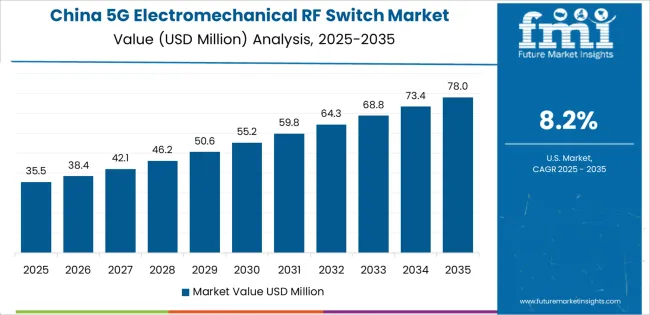
The United States establishes market leadership through comprehensive telecommunications programs and advanced satellite infrastructure development, integrating 5G electromechanical RF switches across base station and satellite applications. The country's 5.8% growth rate reflects established telecommunications industry relationships and mature switching technology adoption that supports widespread use of high-performance switches in network and satellite facilities. Growth concentrates in major telecommunications regions, including California, Texas, and Virginia, where telecommunications innovation showcases mature switching deployment that appeals to operators seeking proven performance capabilities and reliability applications.
American telecommunications companies leverage established supply networks and comprehensive satellite programs, including LEO constellation deployment and ground station expansion that create switching demand and operational requirements. The market benefits from mature telecommunications standards and satellite requirements that mandate switch use while supporting technology advancement and network optimization.
Market Intelligence Brief:
- Telecommunications and satellite facilities maintaining 86% adoption rate with advanced switching deployment
- Established telecommunications standards providing consistent demand for switching innovation
- Satellite constellation operators capturing 72% market share through deployment scale and reliability requirements
- Technology development programs expanding switching capabilities in satellite scenarios
How does the United Kingdom demonstrate network expansion?
The United Kingdom's telecommunications market demonstrates steady 5G electromechanical RF switch deployment with documented operational effectiveness in base station applications and network infrastructure through integration with existing telecommunications systems and deployment infrastructure. The country maintains a 5.2% growth rate. Telecommunications centers, including England and Scotland, showcase established installations where RF switches integrate with comprehensive network platforms and management systems to optimize signal routing and network effectiveness.
British telecommunications operators prioritize switching reliability and network performance in equipment selection, creating demand for certified switches with proven capabilities, including remote monitoring and automated control systems. The market benefits from established telecommunications infrastructure and operator commitment to network quality that provides long-term operational benefits and compliance with international performance standards.
Market Intelligence Brief:
- Focus on network reliability and performance standards, driving quality segment growth
- Telecommunications partnerships providing reliable equipment development cycles
- Technical collaboration between British operators and international equipment suppliers
- Network training programs expanding switching system integration in telecommunications scenarios
What is the market split by country in Europe?
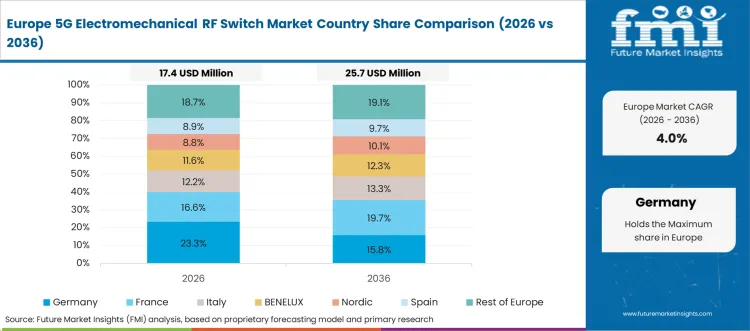
The 5G electromechanical RF switch market in Europe is projected to grow from USD 24.8 million in 2026 to USD 53.7 million by 2036, registering a CAGR of 8.0% over the forecast period. Germany is expected to maintain its leadership position with a 36.1% market share in 2026, supported by its advanced telecommunications infrastructure and major network equipment centers.
United Kingdom follows with a 22.8% share in 2026, driven by comprehensive 5G programs and network modernization initiatives. France holds a 18.2% share through specialized telecommunications applications and infrastructure requirements. Italy commands a 12.7% share, while Spain accounts for 9.1% in 2026. The Rest of Europe region is anticipated to gain momentum, expanding its collective share from 1.1% to 2.4% by 2036, attributed to increasing 5G adoption in Nordic countries and emerging telecommunications facilities implementing network expansion programs.
How does Japan demonstrate advanced network integration?
Japan's market showcases advanced technology deployment with sophisticated switching programs integrated across base station facilities and telecommunications operations. The country maintains a 4.6% growth rate driven by established telecommunications infrastructure and comprehensive network culture. Major telecommunications regions, including Tokyo, Osaka, and Nagoya, demonstrate mature switching implementation where facilities prioritize signal quality and operational reliability through advanced network programs.
Japanese operators emphasize switching precision and comprehensive performance testing, creating demand for established suppliers with proven technical capabilities. The market benefits from strong telecommunications standards and operator commitment to network quality strategies that support long-term infrastructure performance and service reliability optimization.
How does South Korea demonstrate 5G leadership?
South Korea maintains robust 5G electromechanical RF switch adoption through telecommunications advancement programs and network expansion initiatives. Major telecommunications zones, including Seoul, Gyeonggi, and Busan, demonstrate extensive switching deployment where base station facilities and network operations implement advanced routing programs for infrastructure optimization.
Korean telecommunications operators are adopting RF switches that integrate with digital network platforms and management systems, driven by performance requirements and service quality standards. The market benefits from government 5G leadership programs and operator focus on advanced switching technologies that enhance network performance and operational efficiency.
What factors define the competitive landscape of the 5G electromechanical RF switch market?
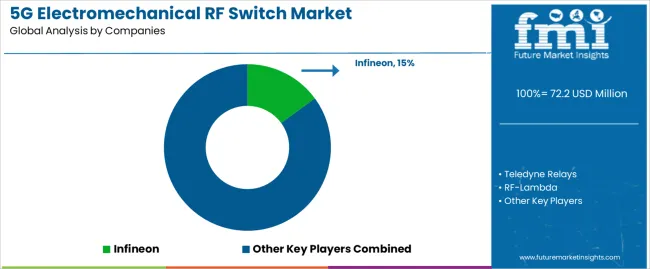
The market demonstrates a moderately concentrated competitive structure with 15-20 established players operating across specialized technology domains and application segments. Market leadership concentration remains significant, with the top 5-7 players collectively commanding approximately 60-65% of total revenue, reflecting the specialized nature of RF switching technology and the importance of proven reliability credentials in telecommunications and satellite applications. The competitive landscape is characterized by technology differentiation in actuation mechanisms while price competition intensifies in commodity base station applications.
Leadership positions are maintained through three critical capabilities: advanced engineering expertise and switching technology innovation that delivers superior signal performance across 5G frequency bands including millimeter-wave operation, comprehensive reliability validation and testing programs that demonstrate switching lifetime and environmental performance under demanding telecommunications conditions, and established customer relationships with major telecommunications equipment manufacturers and network operators that embed suppliers within infrastructure deployment programs. Manufacturers with aerospace and defense heritage gain competitive advantages through proven reliability methodologies and quality systems, while those investing in automated manufacturing capabilities capture cost advantages in high-volume base station applications.
The market exhibits clear commoditization trends in standard single-pole RF switches for base station applications and basic switching matrices, where performance specifications converge and price competition intensifies. Conversely, significant margin opportunities concentrate in high-frequency switches operating above 24 GHz for millimeter-wave 5G applications, space-qualified switches for satellite constellation deployment requiring extended reliability and radiation tolerance, and integrated switching systems incorporating control electronics and monitoring capabilities that provide system-level solutions. Technology differentiation emerges through actuation mechanism innovations that improve switching speed and reliability, material science advancements that extend contact lifetime and reduce insertion loss, and digital integration capabilities enabling remote monitoring and predictive maintenance.
Customer retention strategies focus on demonstrated reliability through field deployment data and failure rate documentation, technical support for switch integration and network optimization, and responsive supply chain management ensuring component availability during infrastructure buildout cycles. Strategic partnerships between RF switch manufacturers and telecommunications equipment OEMs create design-in opportunities that establish long-term supply relationships, while collaborations with satellite constellation operators drive development of next-generation switching solutions optimized for LEO communication systems.
| Stakeholder | What they actually control | Typical strengths | Typical blind spots |
|---|---|---|---|
| Global platforms | Broad product portfolios, multi-application experience, established distribution | Wide frequency coverage, proven reliability track record, global technical support | Innovation cycles in emerging 5G bands; cost competitiveness in commodity segments; rapid customization |
| Technology innovators | Advanced actuation mechanisms; millimeter-wave expertise; novel switching architectures | Superior performance specifications first; attractive insertion loss and isolation; frequency range advantages | Volume manufacturing scalability; automotive cost targets; telecommunications qualification timelines |
| Regional specialists | Local technical support, rapid prototyping, customer proximity | 'Close to customer' responsiveness; flexible minimum orders; application engineering support | Technology breadth across frequency ranges; international certification complexity; scale economies limitations |
| Satellite-focused | Space qualification programs, radiation hardening, extreme reliability | Deep aerospace domain expertise; proven space heritage; long-term reliability data | Terrestrial telecommunications volume markets; cost sensitivity in commercial applications; rapid design cycles |
| Telecom-focused ecosystems | 5G equipment integration, network optimization, volume capacity | Telecommunications standards knowledge; OEM design-in relationships; high-volume manufacturing efficiency | Satellite application requirements; defense qualification complexity; premium aerospace margins |
Key Players in the 5G Electromechanical RF Switch Market
- Infineon
- Teledyne Relays
- RF-Lambda
- Mini Circuits
- Qotana
- Leader-MW
- Pasternack
Scope of the Report
| Metric | Value |
|---|---|
| Quantitative Units | USD 76.6 million to USD 138.5 million, at a CAGR of 6.10% |
| Market Definition | 5G electromechanical RF switches are mechanically actuated signal routing components for 5G base station, terminal, and satellite RF front-end architectures requiring low insertion loss and high isolation. |
| Actuation Mechanism Segmentation | Cantilever, Membrane, Torsional, Others |
| Application Segmentation | 5G Base Station, Terminal Equipment, Satellite |
| Regions Covered | North America, Latin America, Europe, East Asia, South Asia, Oceania, Middle East & Africa |
| Countries Covered | China, India, Germany, Brazil, USA, UK, and 40 plus countries |
| Key Companies Profiled | Infineon, Teledyne Relays, RF-Lambda, Mini Circuits, Qotana, Leader-MW, Pasternack |
| Forecast Period | 2026 to 2036 |
| Approach | Forecasting models apply a bottom-up methodology starting with global installed base metrics and projecting the conversion rate to next-generation adoption. |
5G Electromechanical RF Switch Market by Segments
Actuation Mechanism:
- Cantilever
- Membrane
- Torsional
- Others
Application:
- 5G Base Station
- Terminal Equipment
- Satellite
Region:
- North America
- United States
- Canada
- Mexico
- Latin America
- Brazil
- Chile
- Rest of Latin America
- Western Europe
- Germany
- United Kingdom
- France
- Italy
- Spain
- Nordic
- BENELUX
- Rest of Western Europe
- Eastern Europe
- Russia
- Poland
- Rest of Eastern Europe
- East Asia
- China
- Japan
- South Korea
- South Asia Pacific
- India
- ASEAN
- Australia & New Zealand
- Rest of South Asia Pacific
- Middle East & Africa
- Kingdom of Saudi Arabia
- Other GCC Countries
- Turkey
- South Africa
- Other African Union
- Rest of Middle East & Africa
Bibliography
- 3rd Generation Partnership Project (3GPP). (2024). TS 38.101-1: NR User Equipment Radio Transmission and Reception, Release 18. 3GPP.
- International Electrotechnical Commission. (2024). IEC 62714: Engineering Data Exchange Format for Use in Industrial Automation Systems Engineering. IEC.
- European Space Agency. (2024). Satellite Communication Ground Segment Equipment Procurement Standards. ESA.
- U.S. Department of Defense. (2024). MIL-PRF-39016: Performance Specification, Switches, Coaxial, RF. DoD.
- International Telecommunication Union. (2024). Radio Regulations, Edition of 2024, Article 21: Terrestrial and Space Services Frequency Allocations. ITU.
This bibliography is provided for reader reference. The full Future Market Insights report contains the complete reference list with primary research documentation.
Frequently Asked Questions
How large is the demand for 5G Electromechanical RF Switch in the global market in 2026?
Demand for 5G Electromechanical RF Switch in the global market is estimated to be valued at USD 76.6 million in 2026.
What will be the market size of 5G Electromechanical RF Switch in the global market by 2036?
Market size for 5G Electromechanical RF Switch is projected to reach USD 138.5 million by 2036.
What is the expected demand growth for 5G Electromechanical RF Switch in the global market between 2026 and 2036?
Demand for 5G Electromechanical RF Switch is expected to grow at a CAGR of 6.10% between 2026 and 2036.
Which Actuation Mechanism is poised to lead global sales by 2026?
Cantilever accounts for 58.0% in 2026, as per FMI analysis of procurement pattern data and end-use application requirements.
How is the role of 5G Base Station in driving 5G Electromechanical RF Switch adoption in 2026?
5G Base Station represents 38.0% of application share in 2026, based on FMI's assessment of end-use demand allocation and specification requirements.
What is China's growth outlook in this report?
China is projected to grow at a CAGR of 8.2% during 2026 to 2036.
What is UK's growth outlook in this report?
UK is projected to expand at a CAGR of 5.2% during 2026 to 2036.
What does market forecast mean on this page?
The market forecast represents a model-based projection built on defined industry, technology, and regulatory assumptions for strategic planning purposes.
Preview the report firsthand - request a free sample
Get SampleGet the brochure for pricing and purchase details.
Get PDFTable of Content
- Executive Summary
- Global Market Outlook
- Demand-side Trends
- Supply-side Trends
- Technology Roadmap Analysis
- Analysis and Recommendations
- Market Overview
- Market Coverage / Taxonomy
- Market Definition / Scope / Limitations
- Research Methodology
- Chapter Orientation
- Analytical Lens and Working Hypotheses
- Market Structure, Signals, and Trend Drivers
- Benchmarking and Cross-market Comparability
- Market Sizing, Forecasting, and Opportunity Mapping
- Research Design and Evidence Framework
- Desk Research Programme (Secondary Evidence)
- Company Annual and Sustainability Reports
- Peer-reviewed Journals and Academic Literature
- Corporate Websites, Product Literature, and Technical Notes
- Earnings Decks and Investor Briefings
- Statutory Filings and Regulatory Disclosures
- Technical White Papers and Standards Notes
- Social Channels, Communities, and Digital Listening Inputs
- Additional Desk Sources
- Expert Input and Fieldwork (Primary Evidence)
- Primary Modes
- Qualitative Interviews and Expert Elicitation
- Quantitative Surveys and Structured Data Capture
- Blended Approach
- Why Primary Evidence is Used
- Field Techniques
- Interviews
- Surveys
- Focus Groups
- Observational and In-context Research
- Social and Community Interactions
- Stakeholder Universe Engaged
- C-suite Leaders
- Board Members
- Presidents and Vice Presidents
- R&D and Innovation Heads
- Technical Specialists
- Domain Subject-matter Experts
- Scientists
- Physicians and Other Healthcare Professionals
- Governance, Ethics, and Data Stewardship
- Research Ethics
- Data Integrity and Handling
- Primary Modes
- Tooling, Models, and Reference Databases
- Desk Research Programme (Secondary Evidence)
- Data Engineering and Model Build
- Data Acquisition and Ingestion
- Cleaning, Normalisation, and Verification
- Synthesis, Triangulation, and Analysis
- Quality Assurance and Audit Trail
- Market Background
- Market Dynamics
- Drivers
- Restraints
- Opportunity
- Trends
- Scenario Forecast
- Demand in Optimistic Scenario
- Demand in Likely Scenario
- Demand in Conservative Scenario
- Opportunity Map Analysis
- Product Life Cycle Analysis
- Supply Chain Analysis
- Investment Feasibility Matrix
- Value Chain Analysis
- PESTLE and Porter’s Analysis
- Regulatory Landscape
- Regional Parent Market Outlook
- Production and Consumption Statistics
- Import and Export Statistics
- Market Dynamics
- Global Market Analysis 2021 to 2025 and Forecast, 2026 to 2036
- Historical Market Size Value (USD Million) Analysis, 2021 to 2025
- Current and Future Market Size Value (USD Million) Projections, 2026 to 2036
- Y-o-Y Growth Trend Analysis
- Absolute $ Opportunity Analysis
- Global Market Pricing Analysis 2021 to 2025 and Forecast 2026 to 2036
- Global Market Analysis 2021 to 2025 and Forecast 2026 to 2036, By Actuation Mechanism
- Introduction / Key Findings
- Historical Market Size Value (USD Million) Analysis By Actuation Mechanism , 2021 to 2025
- Current and Future Market Size Value (USD Million) Analysis and Forecast By Actuation Mechanism , 2026 to 2036
- Cantilever
- Membrane
- Torsional
- Others
- Cantilever
- Y-o-Y Growth Trend Analysis By Actuation Mechanism , 2021 to 2025
- Absolute $ Opportunity Analysis By Actuation Mechanism , 2026 to 2036
- Global Market Analysis 2021 to 2025 and Forecast 2026 to 2036, By Application
- Introduction / Key Findings
- Historical Market Size Value (USD Million) Analysis By Application, 2021 to 2025
- Current and Future Market Size Value (USD Million) Analysis and Forecast By Application, 2026 to 2036
- 5G Base Station
- Terminal Equipment
- Satellite
- 5G Base Station
- Y-o-Y Growth Trend Analysis By Application, 2021 to 2025
- Absolute $ Opportunity Analysis By Application, 2026 to 2036
- Global Market Analysis 2021 to 2025 and Forecast 2026 to 2036, By Region
- Introduction
- Historical Market Size Value (USD Million) Analysis By Region, 2021 to 2025
- Current Market Size Value (USD Million) Analysis and Forecast By Region, 2026 to 2036
- North America
- Latin America
- Western Europe
- Eastern Europe
- East Asia
- South Asia and Pacific
- Middle East & Africa
- Market Attractiveness Analysis By Region
- North America Market Analysis 2021 to 2025 and Forecast 2026 to 2036, By Country
- Historical Market Size Value (USD Million) Trend Analysis By Market Taxonomy, 2021 to 2025
- Market Size Value (USD Million) Forecast By Market Taxonomy, 2026 to 2036
- By Country
- USA
- Canada
- Mexico
- By Actuation Mechanism
- By Application
- By Country
- Market Attractiveness Analysis
- By Country
- By Actuation Mechanism
- By Application
- Key Takeaways
- Latin America Market Analysis 2021 to 2025 and Forecast 2026 to 2036, By Country
- Historical Market Size Value (USD Million) Trend Analysis By Market Taxonomy, 2021 to 2025
- Market Size Value (USD Million) Forecast By Market Taxonomy, 2026 to 2036
- By Country
- Brazil
- Chile
- Rest of Latin America
- By Actuation Mechanism
- By Application
- By Country
- Market Attractiveness Analysis
- By Country
- By Actuation Mechanism
- By Application
- Key Takeaways
- Western Europe Market Analysis 2021 to 2025 and Forecast 2026 to 2036, By Country
- Historical Market Size Value (USD Million) Trend Analysis By Market Taxonomy, 2021 to 2025
- Market Size Value (USD Million) Forecast By Market Taxonomy, 2026 to 2036
- By Country
- Germany
- UK
- Italy
- Spain
- France
- Nordic
- BENELUX
- Rest of Western Europe
- By Actuation Mechanism
- By Application
- By Country
- Market Attractiveness Analysis
- By Country
- By Actuation Mechanism
- By Application
- Key Takeaways
- Eastern Europe Market Analysis 2021 to 2025 and Forecast 2026 to 2036, By Country
- Historical Market Size Value (USD Million) Trend Analysis By Market Taxonomy, 2021 to 2025
- Market Size Value (USD Million) Forecast By Market Taxonomy, 2026 to 2036
- By Country
- Russia
- Poland
- Hungary
- Balkan & Baltic
- Rest of Eastern Europe
- By Actuation Mechanism
- By Application
- By Country
- Market Attractiveness Analysis
- By Country
- By Actuation Mechanism
- By Application
- Key Takeaways
- East Asia Market Analysis 2021 to 2025 and Forecast 2026 to 2036, By Country
- Historical Market Size Value (USD Million) Trend Analysis By Market Taxonomy, 2021 to 2025
- Market Size Value (USD Million) Forecast By Market Taxonomy, 2026 to 2036
- By Country
- China
- Japan
- South Korea
- By Actuation Mechanism
- By Application
- By Country
- Market Attractiveness Analysis
- By Country
- By Actuation Mechanism
- By Application
- Key Takeaways
- South Asia and Pacific Market Analysis 2021 to 2025 and Forecast 2026 to 2036, By Country
- Historical Market Size Value (USD Million) Trend Analysis By Market Taxonomy, 2021 to 2025
- Market Size Value (USD Million) Forecast By Market Taxonomy, 2026 to 2036
- By Country
- India
- ASEAN
- Australia & New Zealand
- Rest of South Asia and Pacific
- By Actuation Mechanism
- By Application
- By Country
- Market Attractiveness Analysis
- By Country
- By Actuation Mechanism
- By Application
- Key Takeaways
- Middle East & Africa Market Analysis 2021 to 2025 and Forecast 2026 to 2036, By Country
- Historical Market Size Value (USD Million) Trend Analysis By Market Taxonomy, 2021 to 2025
- Market Size Value (USD Million) Forecast By Market Taxonomy, 2026 to 2036
- By Country
- Kingdom of Saudi Arabia
- Other GCC Countries
- Turkiye
- South Africa
- Other African Union
- Rest of Middle East & Africa
- By Actuation Mechanism
- By Application
- By Country
- Market Attractiveness Analysis
- By Country
- By Actuation Mechanism
- By Application
- Key Takeaways
- Key Countries Market Analysis
- USA
- Pricing Analysis
- Market Share Analysis, 2025
- By Actuation Mechanism
- By Application
- Canada
- Pricing Analysis
- Market Share Analysis, 2025
- By Actuation Mechanism
- By Application
- Mexico
- Pricing Analysis
- Market Share Analysis, 2025
- By Actuation Mechanism
- By Application
- Brazil
- Pricing Analysis
- Market Share Analysis, 2025
- By Actuation Mechanism
- By Application
- Chile
- Pricing Analysis
- Market Share Analysis, 2025
- By Actuation Mechanism
- By Application
- Germany
- Pricing Analysis
- Market Share Analysis, 2025
- By Actuation Mechanism
- By Application
- UK
- Pricing Analysis
- Market Share Analysis, 2025
- By Actuation Mechanism
- By Application
- Italy
- Pricing Analysis
- Market Share Analysis, 2025
- By Actuation Mechanism
- By Application
- Spain
- Pricing Analysis
- Market Share Analysis, 2025
- By Actuation Mechanism
- By Application
- France
- Pricing Analysis
- Market Share Analysis, 2025
- By Actuation Mechanism
- By Application
- India
- Pricing Analysis
- Market Share Analysis, 2025
- By Actuation Mechanism
- By Application
- ASEAN
- Pricing Analysis
- Market Share Analysis, 2025
- By Actuation Mechanism
- By Application
- Australia & New Zealand
- Pricing Analysis
- Market Share Analysis, 2025
- By Actuation Mechanism
- By Application
- China
- Pricing Analysis
- Market Share Analysis, 2025
- By Actuation Mechanism
- By Application
- Japan
- Pricing Analysis
- Market Share Analysis, 2025
- By Actuation Mechanism
- By Application
- South Korea
- Pricing Analysis
- Market Share Analysis, 2025
- By Actuation Mechanism
- By Application
- Russia
- Pricing Analysis
- Market Share Analysis, 2025
- By Actuation Mechanism
- By Application
- Poland
- Pricing Analysis
- Market Share Analysis, 2025
- By Actuation Mechanism
- By Application
- Hungary
- Pricing Analysis
- Market Share Analysis, 2025
- By Actuation Mechanism
- By Application
- Kingdom of Saudi Arabia
- Pricing Analysis
- Market Share Analysis, 2025
- By Actuation Mechanism
- By Application
- Turkiye
- Pricing Analysis
- Market Share Analysis, 2025
- By Actuation Mechanism
- By Application
- South Africa
- Pricing Analysis
- Market Share Analysis, 2025
- By Actuation Mechanism
- By Application
- USA
- Market Structure Analysis
- Competition Dashboard
- Competition Benchmarking
- Market Share Analysis of Top Players
- By Regional
- By Actuation Mechanism
- By Application
- Competition Analysis
- Competition Deep Dive
- Infineon
- Overview
- Product Portfolio
- Profitability by Market Segments (Product/Age /Sales Channel/Region)
- Sales Footprint
- Strategy Overview
- Marketing Strategy
- Product Strategy
- Channel Strategy
- Teledyne Relays
- RF-Lambda
- Mini Circuits
- Qotana
- Leader-MW
- Pasternack
- Infineon
- Competition Deep Dive
- Assumptions & Acronyms Used


