

- Industry Size (2026)
- USD 254.22 Mn
- Forecast (2036)
- USD 459.57 Mn
- CAGR (2026 to 2036)
- 6.1%
5G Gain Block Amplifier Market Size, Market Forecast and Outlook By FMI
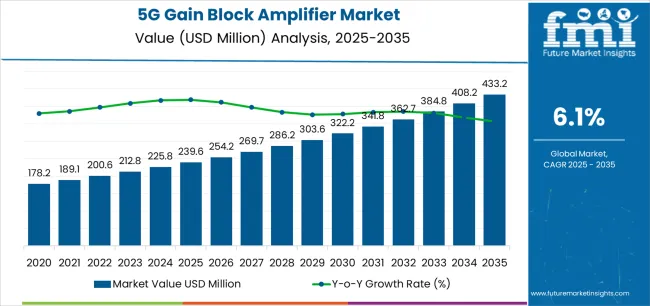
The 5G Gain Block Amplifier market was valued at USD 239.60 million in 2025, projected to reach USD 254.22 million in 2026, and is forecast to expand to USD 459.57 million by 2036 at a 6.1% CAGR. As per FMI, the absolute dollar opportunity across the forecast period amounts to USD 205.35 million, reflecting accelerating conversion of latent demand into measurable procurement activity across industrial and commercial buyer segments.
Summary of 5G Gain Block Amplifier Market
- Market Snapshot
- The market is valued at USD 239.60 million in 2025 and is projected to reach USD 459.57 million by 2036.
- The industry is expected to grow at a 6.1% CAGR from 2026 to 2036, creating an incremental opportunity of USD 205.35 million.
- The market remains a technology-driven category where network architecture decisions, regulatory spectrum policy, and system integration capabilities define competitive positioning.
- Demand and Growth Drivers
- Demand is rising as end-use sectors face tightening connectivity performance requirements and digital transformation mandates that favour 5G-native system architectures.
- Technology upgrade cycles across telecommunications, industrial, and healthcare verticals are accelerating procurement schedules for 5G-compatible components and platforms.
- Growth is further supported by government spectrum allocation programmes and digital infrastructure investment incentives in Asia Pacific, North America, and Europe.
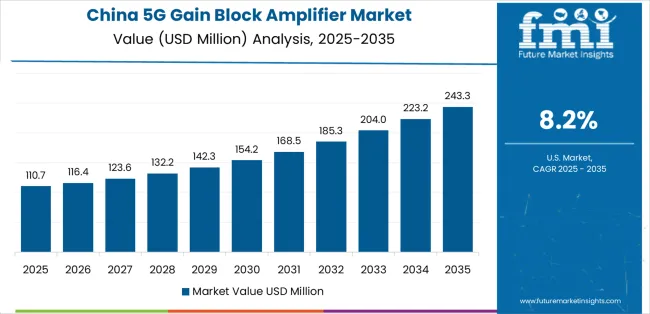
- Among key countries, China at 8.2%, India at 7.6%, Germany at 7%, Brazil at 6.4%, USA at 5.8%, UK at 5.2%, Japan at 4.6%.
- Product and Segment View
- The market includes 5g gain block amplifiers are broadband monolithic microwave integrated circuit devices designed to provide flat gain across specified frequency bands within 5g base station, terminal, and test equipment signal chains.
- GaAs Amplifier leads by Type with 58.3% share in 2026.
- 5G Base Station leads by Application with 71.2% share in 2026.
- Scope includes market scope includes global and regional revenue sizing for 5g gain block amplifiers segmented by type, application, frequency band, and package type.
- Geography and Competitive Outlook
- China and India are the fastest-growing markets, while North America and Western Europe maintain high-value demand bases with mature operator deployment cycles.
- Competition is shaped by technology integration capabilities, spectrum access strategy, and ecosystem partnership breadth.
- Key players include Renesas, Qorvo, Analog Devices, Mini Circuits, Agile MW, BeRex, Skyworks Solutions.
- Analyst Opinion at FMI
- Nikhil Kaitwade, Principal Consultant for Industrial Automation, opines,, opines: 'In my analysis, I have observed that the 5G Gain Block Amplifier market is transitioning from early-adopter pilot deployments to scaled commercial procurement cycles. Organizations that delay 5G-native architecture integration risk operational capability gaps as competitors lock multi-year supply agreements with qualified vendors. Capital allocation toward certified platforms and regional deployment footprint expansion will define competitive survivability through the forecast period.'
- Strategic Implications / Executive Takeaways
- Suppliers must secure interoperability certifications and ecosystem partnerships ahead of procurement cycle deadlines to qualify for multi-year contract awards.
- Capital project directors should prioritize deployment in high-growth geographies where government incentive frameworks and spectrum availability reduce time-to-revenue.
- Product development teams must invest in next-generation technology integration to maintain specification competitiveness as 5G standards evolve through 3GPP Release 19 and beyond.
5G Gain Block Amplifier Market Key Takeaways
| Metric | Details |
|---|---|
| Industry Size (2026) | USD 254.22 million |
| Industry Value (2036) | USD 459.57 million |
| CAGR (2026-2036) | 6.1% |
Source: Future Market Insights, 2026
Future Market Insights analysis indicates that the global 5G base station densification cycle and the concurrent expansion of millimeter wave coverage cells are the primary volume drivers for gain block amplifiers. Each macro cell and small cell deployment requires multiple amplifier stages in the transmit and receive signal chains, with GaAs MMIC amplifiers holding specification advantages in noise figure and linearity that sustain their dominant position in sub-6 GHz infrastructure builds. GaN amplifier designs are gaining share in high-power applications where output power density per unit die area reduces module count. FMI is of the opinion that the transition from sub-6 GHz to millimeter wave spectrum allocations will incrementally shift amplifier technology mix toward wideband GaN and SiGe BiCMOS designs through the forecast period.
All tracked country markets reflect differentiated growth trajectories. China leads at 8.2% CAGR, propelled by China Mobile, China Telecom, and China Unicom 5G base station densification targets exceeding 4 million cumulative sites. India leads at 7.6% CAGR, supported by Reliance Jio and Bharti Airtel 5G rollout capital expenditure cycles across tier-1 and tier-2 cities. Germany leads at 7% CAGR, driven by Deutsche Telekom and Vodafone Germany millimeter wave small cell deployment programmes. Brazil leads at 6.4% CAGR, backed by 5G spectrum auction-mandated coverage obligations and Claro/Vivo network build schedules. USA leads at 5.8% CAGR, anchored by T-Mobile, Verizon, and AT&T C-band and mmWave densification procurement cycles. UK leads at 5.2% CAGR, sustained by Vodafone UK and Three UK mid-band network expansion and Open RAN trial procurements. Japan registers a 4.6% pace, driven by NTT DOCOMO, KDDI, and SoftBank 5G SA core migration and millimeter wave site activation targets.
5G Gain Block Amplifier Market Definition
5G gain block amplifiers are broadband monolithic microwave integrated circuit devices designed to provide flat gain across specified frequency bands within 5G base station, terminal, and test equipment signal chains. The market covers GaAs, GaN, SiGe, and CMOS amplifier technologies packaged in surface mount, connectorized, and die form configurations. Primary applications span 5G macro cell and small cell infrastructure, user equipment RF front-ends, and network test and measurement instrumentation.
5G Gain Block Amplifier Market Inclusions
Market scope includes global and regional revenue sizing for 5G gain block amplifiers segmented by type, application, frequency band, and package type. Coverage spans GaAs, GaN, SiGe, and CMOS amplifier technologies across base station, terminal, and test equipment applications with a 2026 to 2036 forecast period and country-level breakdowns.
5G Gain Block Amplifier Market Exclusions
The scope excludes power amplifiers rated above 10W output power, low-noise amplifiers with dedicated noise-figure optimization, and variable gain amplifiers with digital attenuation control. Discrete transistor amplifier assemblies without monolithic integration and 4G LTE-only amplifier products are excluded. Complete radio unit modules and base station systems fall outside the valuation boundary.
5G Gain Block Amplifier Market Research Methodology
- Primary Research: Analysts engaged with network architecture leads, procurement directors, and system integration engineers to map the decision gates triggering deployment commitments.
- Desk Research: Data collection phases aggregated regulatory spectrum allocation records, 3GPP standards documentation, operator capital expenditure guidance, and company disclosure filings.
- Market-Sizing and Forecasting: Baseline values derive from a bottom-up aggregation of equipment shipments, software licence values, and service contract revenues, applying region-specific deployment curves to project demand velocity.
- Data Validation and Update Cycle: Projections are tested against publicly reported revenue guidance from leading equipment vendors and cross-referenced with operator network deployment disclosures.
Why is the 5G Gain Block Amplifier Market Growing?
Market expansion is being supported by the increasing global emphasis on 5G network deployment and the corresponding shift toward high-performance RF amplification systems that can provide superior frequency response characteristics while meeting user requirements for reliable signal amplification and cost-effective infrastructure solutions. Modern telecommunications users are increasingly focused on incorporating amplification systems that can enhance network performance while satisfying demands for consistent, precisely controlled signal gain and optimized power consumption practices. 5G gain block amplifiers' proven ability to deliver frequency response excellence, power efficiency benefits, and diverse application possibilities makes them essential components for network-focused operators and quality-focused telecommunications professionals.
The growing emphasis on network optimization and telecommunications equipment performance is driving demand for high-performance amplifier systems that can support distinctive signal processing outcomes and comprehensive RF management across base station implementations, device manufacturing applications, and premium telecommunications installations. User preference for amplification solutions that combine functional excellence with power efficiency is creating opportunities for innovative implementations in both traditional and emerging 5G network applications. The rising influence of advanced antenna technologies and beamforming systems is also contributing to increased adoption of intelligent amplifier solutions that can provide authentic performance benefits and reliable signal processing characteristics.
What Is the Segmental Analysis of the 5G Gain Block Amplifier Market?
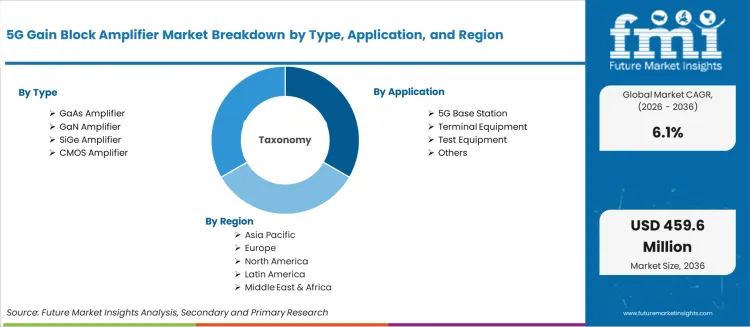
The market is segmented by type, application, frequency band, package type, and region. By type, the market is divided into GaAs amplifier, GaN amplifier, SiGe amplifier, and CMOS amplifier. Based on application, the market is categorized into 5G base station, terminal equipment, test equipment, and others. By frequency band, the market includes sub-6 GHz, millimeter wave, and multi-band categories. By package type, the market encompasses surface mount, connectorized, and die form configurations. Regionally, the market is divided into North America, Europe, Asia Pacific, Latin America, Middle East & Africa, and other regions.
By Type, the GaAs Amplifier Segment Accounts for 58.3% Market Share
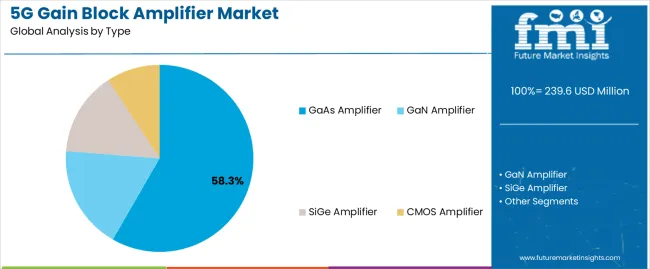
The GaAs amplifier segment is projected to account for 58.3% of the 5G gain block amplifier market in 2026, reaffirming its position as the leading type category. Telecommunications users and equipment manufacturers increasingly utilize GaAs systems for their superior frequency response characteristics, established performance standards, and essential functionality in diverse high-frequency amplification applications across multiple 5G network sectors. GaAs amplifiers' proven performance characteristics and established cost-effectiveness directly address user requirements for reliable signal processing and optimal frequency response in telecommunications and network infrastructure applications.
This type segment forms the foundation of modern RF amplification performance patterns, as it represents the amplifier technology with the greatest frequency coverage capabilities and established compatibility across multiple 5G equipment systems. Telecommunications investments in advanced semiconductor technology and performance optimization continue to strengthen adoption among network-focused users. With manufacturers prioritizing signal integrity and frequency response reliability, GaAs systems align with both efficiency objectives and performance requirements, making them the central component of comprehensive RF amplification strategies.
By Application, 5G Base Station Segment Shows Strong Market Dominance
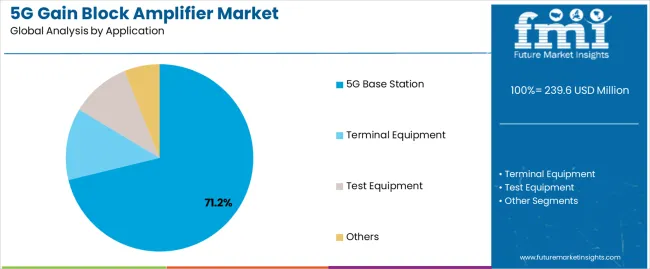
5G base station is projected to represent 71.2% of the 5G gain block amplifier market in 2026, underscoring its critical role as the primary application for network-focused users seeking superior signal processing benefits and enhanced telecommunications infrastructure management credentials. Base station users and network operators prefer 5G base station applications for their established operational requirements, proven performance demand, and ability to maintain exceptional amplification precision while supporting versatile frequency coverage during diverse network activities. Positioned as essential applications for efficiency-focused operators, base station offerings provide both operational excellence and network optimization advantages.
The segment is supported by continuous improvement in 5G technology and the widespread availability of established telecommunications standards that enable performance assurance and premium positioning at the infrastructure level. Additionally, base station users are optimizing amplifier selections to support frequency-specific applications and comprehensive network deployment strategies. As 5G technology continues to advance and operators seek efficient amplification methods, base station applications will continue to drive market growth while supporting network efficiency and coverage optimization strategies.
What are the Drivers, Restraints, and Key Trends of the 5G Gain Block Amplifier Market?
The 5G gain block amplifier market is advancing rapidly due to increasing 5G network deployment and growing need for high-frequency amplification solutions that emphasize superior signal processing performance across telecommunications segments and network infrastructure applications. However, the market faces challenges, including competition from integrated RF solutions, design complexity considerations, and initial development cost factors affecting adoption rates. Innovation in semiconductor efficiency enhancement and advanced packaging materials continues to influence market development and expansion patterns.
Expansion of Millimeter Wave and Advanced Antenna Applications
The growing adoption of 5G gain block amplifiers with millimeter-wave frequency support and advanced antenna integration is enabling users to develop amplification strategies that provide distinctive frequency coverage benefits while commanding enhanced signal processing and improved multi-band performance analysis characteristics. Millimeter-wave applications provide superior frequency response while allowing more sophisticated beamforming features across various telecommunications categories. Users are increasingly recognizing the operational advantages of specialized amplifier positioning for comprehensive network optimization outcomes and technology-integrated infrastructure management.
Integration of Advanced Thermal Management and Power Efficiency Systems
Modern 5G gain block amplifier manufacturers are incorporating advanced thermal dissipation systems, real-time temperature monitoring capabilities, and power optimization technologies to enhance operational precision, improve equipment reliability effectiveness, and meet telecommunications demands for efficient RF amplification solutions. These systems improve operational effectiveness while enabling new applications, including continuous thermal monitoring programs and automated power management protocols. Advanced thermal integration also allows users to support high-density positioning and performance assurance beyond traditional amplifier operation requirements.
How Is the 5G Gain Block Amplifier Market Analyzed by Key Country?
.webp "Top Country Growth Comparison 5g Gain Block Amplifier Market Cagr (2026 2036)")
| Country | CAGR (2026-2036) |
|---|---|
| China | 8.2% |
| India | 7.6% |
| Germany | 7.0% |
| Brazil | 6.4% |
| USA | 5.8% |
| UK | 5.2% |
| Japan | 4.6% |
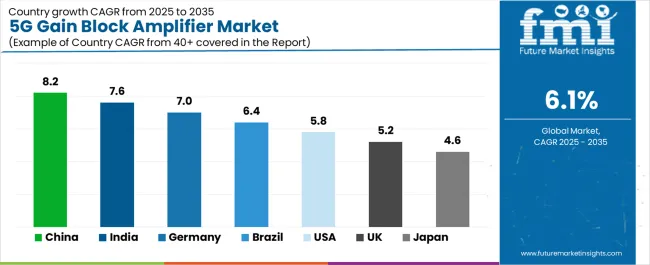
The 5G gain block amplifier market is experiencing robust growth globally, with China leading at an 8.2% CAGR through 2036, driven by the expanding 5G network infrastructure, growing telecommunications equipment manufacturing, and increasing adoption of advanced RF amplification systems. India follows at 7.6%, supported by rising 5G deployment initiatives, expanding telecommunications infrastructure development, and growing acceptance of advanced communication technologies. Germany shows growth at 7.0%, emphasizing established telecommunications standards and comprehensive 5G infrastructure development. Brazil records 6.4%, focusing on telecommunications modernization and network expansion growth. The USA demonstrates 5.8% growth, prioritizing advanced 5G technologies and network optimization.
The report covers an in-depth analysis of 40+ countries, top-performing countries are highlighted below.
How Is China Driving Growth in the 5G Gain Block Amplifier Market?
Revenue from 5G gain block amplifier consumption and sales in China is projected to exhibit exceptional growth with a CAGR of 8.2% through 2036, driven by the country's rapidly expanding 5G network infrastructure, favorable government policies toward telecommunications modernization, and initiatives promoting advanced RF technologies across major telecommunications regions. China's position as a global 5G deployment leader and increasing focus on network optimization systems are creating substantial demand for high-quality gain block amplifiers in both domestic and export markets. Major telecommunications equipment companies and RF component distributors are establishing comprehensive amplifier capabilities to serve growing demand and emerging 5G opportunities.
- Established telecommunications culture and expanding 5G consciousness are driving demand for gain block amplifiers across network infrastructure, base station equipment, and comprehensive RF processing systems throughout Chinese telecommunications markets.
- Strong manufacturing infrastructure and technology adoption initiatives are supporting the rapid adoption of premium amplifiers among network-focused operators seeking to meet evolving 5G standards and performance requirements.
What Role Does India Play in the Expansion of the 5G Gain Block Amplifier Market?
Revenue from 5G gain block amplifier products in India is expanding at a CAGR of 7.6%, supported by rising 5G deployment investment, growing telecommunications consciousness, and expanding equipment distributor capabilities. The country's developing 5G infrastructure and increasing investment in telecommunications technologies are driving demand for amplifiers across both traditional and modern network applications. International telecommunications companies and domestic distributors are establishing comprehensive operational networks to address growing market demand for RF components and efficient amplification solutions.
- Rising telecommunications development and expanding 5G capabilities are creating opportunities for gain block amplifier adoption across network operators, modern infrastructure projects, and distributor companies throughout major Indian telecommunications regions.
- Growing 5G awareness initiatives and RF technology advancement are driving the adoption of specialized amplifier products and services among telecommunications users seeking to enhance their network performance and meet increasing coverage demand.
How Is Germany Contributing to the Development of the 5G Gain Block Amplifier Market?
Revenue from 5G gain block amplifier products in Germany is projected to grow at a CAGR of 7.0% through 2036, supported by the country's mature telecommunications standards, established 5G deployment regulations, and leadership in RF technology development. Germany's sophisticated telecommunications standards and strong support for advanced 5G systems are creating steady demand for both traditional and innovative amplifier varieties. Leading telecommunications manufacturers and specialty distributors are establishing comprehensive operational strategies to serve both domestic markets and growing export opportunities.
- Advanced RF technology capabilities and established telecommunications-focused markets are driving demand for premium gain block amplifiers across network infrastructure, base station equipment, and comprehensive telecommunications companies seeking superior performance profiles and engineering innovation.
- Strong engineering excellence culture and regulatory leadership are supporting the adoption of innovative amplifier technology among users prioritizing network reliability and engineering precision in 5G deployment applications.
How Is Brazil Shaping the 5G Gain Block Amplifier Market?
Revenue from 5G gain block amplifier products in Brazil is projected to grow at a CAGR of 6.4% through 2036, driven by the country's emphasis on telecommunications development, network modernization growth, and growing RF distributor capabilities. Brazilian telecommunications users and network operators consistently seek technology-focused equipment that enhances operational efficiency and supports modernization excellence for both traditional and modern 5G applications. The country's position as a Latin American telecommunications leader continues to drive innovation in specialized RF applications and network infrastructure standards.
- Expanding telecommunications culture and growing 5G markets are driving demand for industrial gain block amplifiers across network consumers, RF providers, and efficiency-focused distributors seeking superior signal processing and distinctive operational profiles.
- Increasing focus on network efficiency and telecommunications modernization systems is supporting the adoption of specialty amplifier varieties among users and distributors seeking authentic Brazilian technology-focused products in regional markets with established telecommunications expertise.
How Is the United States Leading Technological Advancements in the 5G Gain Block Amplifier Market?
Revenue from 5G gain block amplifier products in the USA is projected to grow at a CAGR of 5.8% through 2036, supported by the country's emphasis on telecommunications technology advancement, 5G network optimization, and advanced RF system integration requiring efficient signal processing solutions. American telecommunications users and network-focused facilities prioritize performance reliability and operational precision, making specialized gain block amplifiers essential components for both traditional and modern 5G network applications. The country's comprehensive telecommunications technology leadership and advancing 5G patterns support continued market expansion.
- Advanced telecommunications technology capabilities and growing precision network management are driving demand for gain block amplifiers across specialty applications, modern network formats, and technology-integrated 5G programs serving domestic markets with increasing operational requirements.
- Strong focus on network optimization and performance excellence is encouraging users and distributors to adopt amplifier solutions that support efficiency objectives and meet American quality standards for 5G network applications.
What Impact Is the UK Having on the 5G Gain Block Amplifier Market?
Revenue from 5G gain block amplifier products in the UK is projected to grow at a CAGR of 5.2% through 2036, supported by established telecommunications standards, mature 5G markets, and emphasis on network reliability across telecommunications and infrastructure sectors. British telecommunications users and network professionals prioritize quality performance and operational consistency, creating steady demand for premium amplifier solutions. The country's comprehensive market maturity and established telecommunications practices support continued development in specialized applications.
- Established telecommunications markets and mature 5G industry are driving demand for quality gain block amplifiers across network operations, infrastructure facilities, and professional telecommunications companies throughout British network regions.
- Strong emphasis on quality standards and network reliability is supporting the adoption of premium amplifier varieties among users seeking proven performance and established telecommunications credentials in 5G applications.
How Is Japan Advancing the 5G Gain Block Amplifier Market?
Revenue from 5G gain block amplifier products in Japan is projected to grow at a CAGR of 4.6% through 2036, supported by the country's emphasis on advanced telecommunications, operational excellence, and sophisticated technology integration requiring efficient RF amplification solutions. Japanese telecommunications users and network-focused facilities prioritize technical performance and precision engineering, making specialized gain block amplifiers essential components for both traditional and modern 5G network applications. The country's comprehensive telecommunications leadership and advancing precision patterns support continued market expansion.
- Advanced precision telecommunications technology capabilities and growing technical 5G applications are driving demand for gain block amplifiers across specialty network applications, modern precision formats, and technology-integrated telecommunications programs serving domestic markets with increasing quality requirements.
- Strong focus on technical precision and operational excellence is encouraging users and distributors to adopt amplifier solutions that support telecommunications objectives and meet Japanese precision standards for 5G network applications.
How Is the European 5G Gain Block Amplifier Market Split by Country?
The Europe 5G gain block amplifier market is projected to grow from USD 71.8 million in 2026 to USD 121.4 million by 2036, recording a CAGR of 5.4% over the forecast period. Germany leads the region with a 41.8% share in 2026, moderating slightly to 41.3% by 2036, supported by its strong telecommunications engineering traditions and demand for premium, precision-manufactured amplifier solutions. The United Kingdom follows with 22.3% in 2026, easing to 21.9% by 2036, driven by a mature 5G deployment market and emphasis on network reliability and quality performance. France accounts for 15.2% in 2026, rising to 15.7% by 2036, reflecting steady adoption of 5G infrastructure technologies and network optimization. Italy holds 9.1% in 2026, expanding to 9.8% by 2036 as telecommunications modernization and specialty 5G applications grow. Spain contributes 6.4% in 2026, growing to 6.7% by 2036, supported by expanding telecommunications development and 5G awareness modernization. The Nordic countries rise from 3.4% in 2026 to 3.7% by 2036 on the back of strong engineering consciousness and advanced telecommunications methodologies. BENELUX remains at 1.8% share across both 2026 and 2036, reflecting mature, technology-focused telecommunications markets.
What Does the Competitive Landscape Look Like in the 5G Gain Block Amplifier Market?
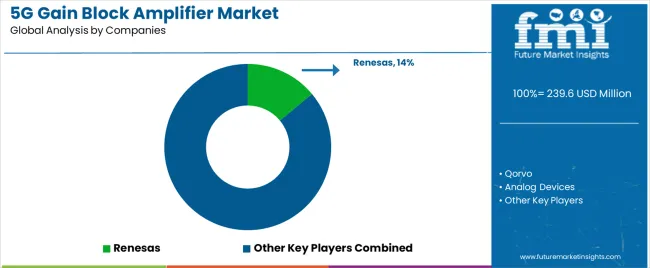
The 5G gain block amplifier market is characterized by competition among established semiconductor manufacturers, specialized RF component companies, and integrated telecommunications equipment providers. Companies are investing in advanced semiconductor technologies, specialized materials engineering, product innovation capabilities, and comprehensive distribution networks to deliver consistent, high-quality, and reliable amplifier systems. Innovation in semiconductor process optimization, packaging technology advancement, and telecommunications-focused product development is central to strengthening market position and customer satisfaction.
Renesas leads the market with 14% share with a strong focus on semiconductor technology innovation and comprehensive RF solutions, offering telecommunications and network systems with emphasis on performance excellence and engineering heritage. Qorvo provides integrated RF solutions with a focus on 5G market applications and advanced amplification networks. Analog Devices delivers comprehensive amplifier technology solutions with a focus on telecommunications positioning and operational efficiency. Mini Circuits specializes in comprehensive RF systems with an emphasis on telecommunications applications. Agile MW focuses on comprehensive microwave components with advanced design and premium positioning capabilities.
Global 5G Gain Block Amplifier Market - Stakeholder Contribution Framework
The success of 5G gain block amplifiers in meeting telecommunications performance demands, network efficiency requirements, and operational integration will not only enhance telecommunications performance outcomes but also strengthen global 5G technology manufacturing capabilities. It will consolidate emerging regions' positions as hubs for efficient RF component production and align advanced economies with comprehensive 5G systems. This calls for a concerted effort by all stakeholders -- governments, industry bodies, manufacturers, distributors, and investors. Each can be a crucial enabler in preparing the market for its next phase of growth.
How Governments Could Spur Local Production and Adoption?
- Targeted Incentives: Introduce 5G infrastructure modernization subsidies for companies adopting advanced amplifier production technologies in telecommunications and network regions, and production-linked incentives for facilities producing devices for domestic consumption and export markets.
- Trade Agreements: Accelerate export growth through bilateral and multilateral agreements that classify 5G gain block amplifiers under "telecommunications equipment," easing cross-border regulatory approvals and network safety certifications.
- Facilitate Innovation: Establish Centers of Excellence for 5G technology innovation and amplifier engineering. Fund R&D into efficient semiconductor systems, material optimization, and telecommunications-standard integration for network and infrastructure applications.
How Industry Bodies Could Support Market Development?
- Foster Connectivity: Constitute a global 5G technology consortium linking amplifier manufacturers, telecommunications equipment suppliers, users, and policymakers to align production targets with network efficiency and 5G commitments.
- Promote Exports: Work with export councils to brand 5G gain block amplifiers as premium, engineering-focused telecommunications solutions. Facilitate trade fairs to connect RF technology innovators with global buyers in telecommunications, infrastructure, and network sectors.
- Upskilling Programs: Develop curricula on advanced amplifier manufacturing, semiconductor technology, 5G network processes, and efficiency optimization to prepare manufacturers and operators for premium telecommunications market opportunities.
How Distributors and Telecommunications Players Could Strengthen the Ecosystem?
- Drive Integration: Bundle 5G gain block amplifiers with telecommunications-focused marketing and efficiency messaging systems. Position specialized amplifiers as part of holistic "5G network optimization solutions."
- Forge Partnerships: Collaborate with amplifier manufacturers and technology providers for joint R&D on telecommunications applications, efficiency enhancement initiatives, and global quality assurance for premium markets.
How Manufacturers Could Navigate the Shift?
- Capture Premium Markets: Leverage government incentives and rising 5G demand to offer gain block amplifiers into growth markets where general amplification solutions face performance and reliability challenges.
- Invest in Technology: Partner with technology providers to advance efficient semiconductor workflows, telecommunications-grade quality, and advanced manufacturing practices.
- Build Capabilities: Train technical staff and telecommunications specialists to demonstrate amplifiers' operational advantages, repositioning network relationships toward long-term 5G partnerships.
Who Are the Key Players in the 5G Gain Block Amplifier Market?
- Renesas
- Qorvo
- Analog Devices
- Mini Circuits
- Agile MW
- BeRex
- Skyworks Solutions
- Broadcom
- Sanan Optoelectronics
- Maxscend
- UNISOC
- MACOM
- CML Microcircuits
- Guerrilla RF
- Marki Microwave
- Tagore Technology
Scope of the Report
| Metric | Value |
|---|---|
| Quantitative Units | USD 254.22 million to USD 459.57 million, at a CAGR of 6.1% |
| Market Definition | 5G gain block amplifiers are broadband monolithic microwave integrated circuit devices designed to provide flat gain across specified frequency bands within 5G base station, terminal, and test equipment signal chains. The market covers GaAs, GaN, SiGe, and CMOS amplifier technologies packaged in surface mount, connectorized, and die form configurations. |
| Segmentation | Type: GaAs Amplifier, GaN Amplifier, SiGe Amplifier, CMOS Amplifier; Application: 5G Base Station, Terminal Equipment, Test Equipment, Others; Frequency Band: Sub-6 GHz, Millimeter Wave, Multi-Band; Package Type: Surface Mount, Connectorized, Die Form |
| Regions Covered | North America, Latin America, Europe, East Asia, South Asia, Oceania, Middle East & Africa |
| Countries Covered | China, India, Germany, Brazil, USA, UK, Japan, and 40 plus countries |
| Key Companies Profiled | Renesas, Qorvo, Analog Devices, Mini Circuits, Agile MW, BeRex, Skyworks Solutions, Broadcom, Sanan Optoelectronics, Maxscend, UNISOC, MACOM, CML Microcircuits, Guerrilla RF, Marki Microwave, Tagore Technology |
| Forecast Period | 2026 to 2036 |
| Approach | Forecasting models apply a bottom-up methodology starting with global installed base metrics and projecting conversion rates to 5G-native architectures. |
5G Gain Block Amplifier Market by Segments
Type:
- GaAs Amplifier
- GaN Amplifier
- SiGe Amplifier
- CMOS Amplifier
Application:
- 5G Base Station
- Terminal Equipment
- Test Equipment
- Others
Frequency Band:
- Sub-6 GHz
- Millimeter Wave
- Multi-Band
Package Type:
- Surface Mount
- Connectorized
- Die Form
Region:
- North America
- United States
- Canada
- Mexico
- Europe
- Germany
- United Kingdom
- France
- Italy
- Spain
- Nordic
- BENELUX
- Rest of Europe
- East Asia
- China
- Japan
- South Korea
- South Asia & Pacific
- India
- ASEAN
- Australia & New Zealand
- Rest of South Asia & Pacific
- Latin America
- Brazil
- Chile
- Argentina
- Rest of Latin America
- Middle East & Africa
- Kingdom of Saudi Arabia
- Other GCC Countries
- Turkiye
- South Africa
- Other African Union
- Rest of Middle East & Africa
Bibliography
- 1. 3rd Generation Partnership Project. (2024). 3GPP TS 38.104: NR base station radio transmission and reception. 3GPP.
- 2. European Telecommunications Standards Institute. (2024). ETSI TS 138 141-1: 5G NR base station conformance testing. ETSI.
- 3. Qorvo, Inc. (2025). Annual Report 2024: Infrastructure and defense products segment review. Qorvo.
- 4. Semiconductor Industry Association. (2025). 2025 State of the USA Semiconductor Industry. SIA.
- 5. Federal Communications Commission. (2025). 5G deployment progress report: Spectrum utilization and infrastructure buildout. FCC.
This bibliography is provided for reader reference. The full Future Market Insights report contains the complete reference list with primary research documentation.
Frequently Asked Questions
How large is the demand for 5G Gain Block Amplifier in the global market in 2026?
Demand for 5G Gain Block Amplifier in the global market is estimated to be valued at USD 254.22 million in 2026.
What will be the market size of 5G Gain Block Amplifier in the global market by 2036?
Market size for 5G Gain Block Amplifier is projected to reach USD 459.57 million by 2036.
What is the expected demand growth for 5G Gain Block Amplifier in the global market between 2026 and 2036?
Demand for 5G Gain Block Amplifier is expected to grow at a CAGR of 6.1% between 2026 and 2036.
Which Type is poised to lead global sales by 2026?
GaAs Amplifier accounts for 58.3% in 2026 based on established deployment patterns and installed base requirements across primary end-use sectors.
What is driving demand in China?
China leads with a 8.2% CAGR through 2036, driven by expanding network infrastructure investment, policy support frameworks, and growing end-user adoption across commercial and institutional buyer segments.
What is the India growth outlook in this report?
India is projected to grow at a CAGR of 7.6% during 2026 to 2036.
What is 5G Gain Block Amplifier and what is it mainly used for?
5G gain block amplifiers are broadband monolithic microwave integrated circuit devices designed to provide flat gain across specified frequency bands within 5G base station, terminal, and test equipment signal chains. The market covers GaAs, GaN, SiGe, and CMOS amplifier technologies packaged in surface mount, connectorized, and die form configurations.
How does FMI build and validate the 5G Gain Block Amplifier forecast?
Forecasting models apply a bottom-up methodology starting with global installed base metrics and cross-validate projections against quarterly industry revenue volumes and primary research inputs.
Preview the report firsthand - request a free sample
Get SampleGet the brochure for pricing and purchase details.
Get PDFTable of Content
- Executive Summary
- Global Market Outlook
- Demand-side Trends
- Supply-side Trends
- Technology Roadmap Analysis
- Analysis and Recommendations
- Market Overview
- Market Coverage / Taxonomy
- Market Definition / Scope / Limitations
- Research Methodology
- Chapter Orientation
- Analytical Lens and Working Hypotheses
- Market Structure, Signals, and Trend Drivers
- Benchmarking and Cross-market Comparability
- Market Sizing, Forecasting, and Opportunity Mapping
- Research Design and Evidence Framework
- Desk Research Programme (Secondary Evidence)
- Company Annual and Sustainability Reports
- Peer-reviewed Journals and Academic Literature
- Corporate Websites, Product Literature, and Technical Notes
- Earnings Decks and Investor Briefings
- Statutory Filings and Regulatory Disclosures
- Technical White Papers and Standards Notes
- Trade Journals, Industry Magazines, and Analyst Briefs
- Conference Proceedings, Webinars, and Seminar Materials
- Government Statistics Portals and Public Data Releases
- Press Releases and Reputable Media Coverage
- Specialist Newsletters and Curated Briefings
- Sector Databases and Reference Repositories
- FMI Internal Proprietary Databases and Historical Market Datasets
- Subscription Datasets and Paid Sources
- Social Channels, Communities, and Digital Listening Inputs
- Additional Desk Sources
- Expert Input and Fieldwork (Primary Evidence)
- Primary Modes
- Qualitative Interviews and Expert Elicitation
- Quantitative Surveys and Structured Data Capture
- Blended Approach
- Why Primary Evidence is Used
- Stakeholder Universe Engaged
- C-suite Leaders
- Board Members
- Presidents and Vice Presidents
- R&D and Innovation Heads
- Technical Specialists
- Domain Subject-matter Experts
- Scientists
- Physicians and Other Healthcare Professionals
- Governance, Ethics, and Data Stewardship
- Research Ethics
- Data Integrity and Handling
- Primary Modes
- Tooling, Models, and Reference Databases
- Desk Research Programme (Secondary Evidence)
- Data Engineering and Model Build
- Data Acquisition and Ingestion
- Cleaning, Normalisation, and Verification
- Synthesis, Triangulation, and Analysis
- Quality Assurance and Audit Trail
- Market Background
- Market Dynamics
- Drivers
- Restraints
- Opportunity
- Trends
- Scenario Forecast
- Demand in Optimistic Scenario
- Demand in Likely Scenario
- Demand in Conservative Scenario
- Opportunity Map Analysis
- Product Life Cycle Analysis
- Supply Chain Analysis
- Investment Feasibility Matrix
- Value Chain Analysis
- PESTLE and Porter’s Analysis
- Regulatory Landscape
- Regional Parent Market Outlook
- Production and Consumption Statistics
- Import and Export Statistics
- Market Dynamics
- Global Market Analysis 2021 to 2025 and Forecast, 2026 to 2036
- Historical Market Size Value (USD Million) Analysis, 2021 to 2025
- Current and Future Market Size Value (USD Million) Projections, 2026 to 2036
- Y-o-Y Growth Trend Analysis
- Absolute $ Opportunity Analysis
- Global Market Pricing Analysis 2021 to 2025 and Forecast 2026 to 2036
- Global Market Analysis 2021 to 2025 and Forecast 2026 to 2036, By Type
- Introduction / Key Findings
- Historical Market Size Value (USD Million) Analysis By Type , 2021 to 2025
- Current and Future Market Size Value (USD Million) Analysis and Forecast By Type , 2026 to 2036
- GaAs Amplifier
- GaN Amplifier
- SiGe Amplifier
- CMOS Amplifier
- GaAs Amplifier
- Y-o-Y Growth Trend Analysis By Type , 2021 to 2025
- Absolute $ Opportunity Analysis By Type , 2026 to 2036
- Global Market Analysis 2021 to 2025 and Forecast 2026 to 2036, By Application
- Introduction / Key Findings
- Historical Market Size Value (USD Million) Analysis By Application, 2021 to 2025
- Current and Future Market Size Value (USD Million) Analysis and Forecast By Application, 2026 to 2036
- 5G Base Station
- Terminal Equipment
- Test Equipment
- Others
- 5G Base Station
- Y-o-Y Growth Trend Analysis By Application, 2021 to 2025
- Absolute $ Opportunity Analysis By Application, 2026 to 2036
- Global Market Analysis 2021 to 2025 and Forecast 2026 to 2036, By Frequency Band
- Introduction / Key Findings
- Historical Market Size Value (USD Million) Analysis By Frequency Band, 2021 to 2025
- Current and Future Market Size Value (USD Million) Analysis and Forecast By Frequency Band, 2026 to 2036
- Sub-6 GHz
- Millimeter Wave
- Multi-Band
- Sub-6 GHz
- Y-o-Y Growth Trend Analysis By Frequency Band, 2021 to 2025
- Absolute $ Opportunity Analysis By Frequency Band, 2026 to 2036
- Global Market Analysis 2021 to 2025 and Forecast 2026 to 2036, By Package Type
- Introduction / Key Findings
- Historical Market Size Value (USD Million) Analysis By Package Type, 2021 to 2025
- Current and Future Market Size Value (USD Million) Analysis and Forecast By Package Type, 2026 to 2036
- Surface Mount
- Connectorized
- Die Form
- Surface Mount
- Y-o-Y Growth Trend Analysis By Package Type, 2021 to 2025
- Absolute $ Opportunity Analysis By Package Type, 2026 to 2036
- Global Market Analysis 2021 to 2025 and Forecast 2026 to 2036, By Region
- Introduction
- Historical Market Size Value (USD Million) Analysis By Region, 2021 to 2025
- Current Market Size Value (USD Million) Analysis and Forecast By Region, 2026 to 2036
- North America
- Latin America
- Western Europe
- Eastern Europe
- East Asia
- South Asia and Pacific
- Middle East & Africa
- Market Attractiveness Analysis By Region
- North America Market Analysis 2021 to 2025 and Forecast 2026 to 2036, By Country
- Historical Market Size Value (USD Million) Trend Analysis By Market Taxonomy, 2021 to 2025
- Market Size Value (USD Million) Forecast By Market Taxonomy, 2026 to 2036
- By Country
- USA
- Canada
- Mexico
- By Type
- By Application
- By Frequency Band
- By Package Type
- By Country
- Market Attractiveness Analysis
- By Country
- By Type
- By Application
- By Frequency Band
- By Package Type
- Key Takeaways
- Latin America Market Analysis 2021 to 2025 and Forecast 2026 to 2036, By Country
- Historical Market Size Value (USD Million) Trend Analysis By Market Taxonomy, 2021 to 2025
- Market Size Value (USD Million) Forecast By Market Taxonomy, 2026 to 2036
- By Country
- Brazil
- Chile
- Rest of Latin America
- By Type
- By Application
- By Frequency Band
- By Package Type
- By Country
- Market Attractiveness Analysis
- By Country
- By Type
- By Application
- By Frequency Band
- By Package Type
- Key Takeaways
- Western Europe Market Analysis 2021 to 2025 and Forecast 2026 to 2036, By Country
- Historical Market Size Value (USD Million) Trend Analysis By Market Taxonomy, 2021 to 2025
- Market Size Value (USD Million) Forecast By Market Taxonomy, 2026 to 2036
- By Country
- Germany
- UK
- Italy
- Spain
- France
- Nordic
- BENELUX
- Rest of Western Europe
- By Type
- By Application
- By Frequency Band
- By Package Type
- By Country
- Market Attractiveness Analysis
- By Country
- By Type
- By Application
- By Frequency Band
- By Package Type
- Key Takeaways
- Eastern Europe Market Analysis 2021 to 2025 and Forecast 2026 to 2036, By Country
- Historical Market Size Value (USD Million) Trend Analysis By Market Taxonomy, 2021 to 2025
- Market Size Value (USD Million) Forecast By Market Taxonomy, 2026 to 2036
- By Country
- Russia
- Poland
- Hungary
- Balkan & Baltic
- Rest of Eastern Europe
- By Type
- By Application
- By Frequency Band
- By Package Type
- By Country
- Market Attractiveness Analysis
- By Country
- By Type
- By Application
- By Frequency Band
- By Package Type
- Key Takeaways
- East Asia Market Analysis 2021 to 2025 and Forecast 2026 to 2036, By Country
- Historical Market Size Value (USD Million) Trend Analysis By Market Taxonomy, 2021 to 2025
- Market Size Value (USD Million) Forecast By Market Taxonomy, 2026 to 2036
- By Country
- China
- Japan
- South Korea
- By Type
- By Application
- By Frequency Band
- By Package Type
- By Country
- Market Attractiveness Analysis
- By Country
- By Type
- By Application
- By Frequency Band
- By Package Type
- Key Takeaways
- South Asia and Pacific Market Analysis 2021 to 2025 and Forecast 2026 to 2036, By Country
- Historical Market Size Value (USD Million) Trend Analysis By Market Taxonomy, 2021 to 2025
- Market Size Value (USD Million) Forecast By Market Taxonomy, 2026 to 2036
- By Country
- India
- ASEAN
- Australia & New Zealand
- Rest of South Asia and Pacific
- By Type
- By Application
- By Frequency Band
- By Package Type
- By Country
- Market Attractiveness Analysis
- By Country
- By Type
- By Application
- By Frequency Band
- By Package Type
- Key Takeaways
- Middle East & Africa Market Analysis 2021 to 2025 and Forecast 2026 to 2036, By Country
- Historical Market Size Value (USD Million) Trend Analysis By Market Taxonomy, 2021 to 2025
- Market Size Value (USD Million) Forecast By Market Taxonomy, 2026 to 2036
- By Country
- Kingdom of Saudi Arabia
- Other GCC Countries
- Turkiye
- South Africa
- Other African Union
- Rest of Middle East & Africa
- By Type
- By Application
- By Frequency Band
- By Package Type
- By Country
- Market Attractiveness Analysis
- By Country
- By Type
- By Application
- By Frequency Band
- By Package Type
- Key Takeaways
- Key Countries Market Analysis
- USA
- Pricing Analysis
- Market Share Analysis, 2025
- By Type
- By Application
- By Frequency Band
- By Package Type
- Canada
- Pricing Analysis
- Market Share Analysis, 2025
- By Type
- By Application
- By Frequency Band
- By Package Type
- Mexico
- Pricing Analysis
- Market Share Analysis, 2025
- By Type
- By Application
- By Frequency Band
- By Package Type
- Brazil
- Pricing Analysis
- Market Share Analysis, 2025
- By Type
- By Application
- By Frequency Band
- By Package Type
- Chile
- Pricing Analysis
- Market Share Analysis, 2025
- By Type
- By Application
- By Frequency Band
- By Package Type
- Germany
- Pricing Analysis
- Market Share Analysis, 2025
- By Type
- By Application
- By Frequency Band
- By Package Type
- UK
- Pricing Analysis
- Market Share Analysis, 2025
- By Type
- By Application
- By Frequency Band
- By Package Type
- Italy
- Pricing Analysis
- Market Share Analysis, 2025
- By Type
- By Application
- By Frequency Band
- By Package Type
- Spain
- Pricing Analysis
- Market Share Analysis, 2025
- By Type
- By Application
- By Frequency Band
- By Package Type
- France
- Pricing Analysis
- Market Share Analysis, 2025
- By Type
- By Application
- By Frequency Band
- By Package Type
- India
- Pricing Analysis
- Market Share Analysis, 2025
- By Type
- By Application
- By Frequency Band
- By Package Type
- ASEAN
- Pricing Analysis
- Market Share Analysis, 2025
- By Type
- By Application
- By Frequency Band
- By Package Type
- Australia & New Zealand
- Pricing Analysis
- Market Share Analysis, 2025
- By Type
- By Application
- By Frequency Band
- By Package Type
- China
- Pricing Analysis
- Market Share Analysis, 2025
- By Type
- By Application
- By Frequency Band
- By Package Type
- Japan
- Pricing Analysis
- Market Share Analysis, 2025
- By Type
- By Application
- By Frequency Band
- By Package Type
- South Korea
- Pricing Analysis
- Market Share Analysis, 2025
- By Type
- By Application
- By Frequency Band
- By Package Type
- Russia
- Pricing Analysis
- Market Share Analysis, 2025
- By Type
- By Application
- By Frequency Band
- By Package Type
- Poland
- Pricing Analysis
- Market Share Analysis, 2025
- By Type
- By Application
- By Frequency Band
- By Package Type
- Hungary
- Pricing Analysis
- Market Share Analysis, 2025
- By Type
- By Application
- By Frequency Band
- By Package Type
- Kingdom of Saudi Arabia
- Pricing Analysis
- Market Share Analysis, 2025
- By Type
- By Application
- By Frequency Band
- By Package Type
- Turkiye
- Pricing Analysis
- Market Share Analysis, 2025
- By Type
- By Application
- By Frequency Band
- By Package Type
- South Africa
- Pricing Analysis
- Market Share Analysis, 2025
- By Type
- By Application
- By Frequency Band
- By Package Type
- USA
- Market Structure Analysis
- Competition Dashboard
- Competition Benchmarking
- Market Share Analysis of Top Players
- By Regional
- By Type
- By Application
- By Frequency Band
- By Package Type
- Competition Analysis
- Competition Deep Dive
- Renesas
- Overview
- Product Portfolio
- Profitability by Market Segments (Product/Age /Sales Channel/Region)
- Sales Footprint
- Strategy Overview
- Marketing Strategy
- Product Strategy
- Channel Strategy
- Qorvo
- Analog Devices
- Mini Circuits
- Agile MW
- BeRex
- Skyworks Solutions
- Broadcom
- Sanan Optoelectronics
- Maxscend
- UNISOC
- MACOM
- CML Microcircuits
- Guerrilla RF
- Marki Microwave
- Tagore Technology
- Renesas
- Competition Deep Dive
- Assumptions & Acronyms Used


