

- Industry Size (2026)
- USD 554.32 Mn
- Forecast (2036)
- USD 1050.35 Mn
- CAGR (2026 to 2036)
- 6.6%
5G Solid State Switches Market Size, Market Forecast and Outlook By FMI
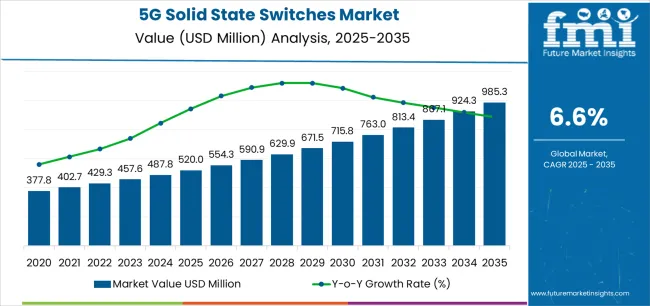
The 5G Solid State Switches market was valued at USD 519.95 million in 2025, projected to reach USD 554.32 million in 2026, and is forecast to expand to USD 1050.35 million by 2036 at a 6.6% CAGR. As per FMI, the absolute dollar opportunity across the forecast period amounts to USD 496.03 million, reflecting accelerating conversion of latent demand into measurable procurement activity across industrial and commercial buyer segments.
Summary of 5G Solid State Switches Market
- Market Snapshot
- The market is valued at USD 519.95 million in 2025 and is projected to reach USD 1050.35 million by 2036.
- The industry is expected to grow at a 6.6% CAGR from 2026 to 2036, creating an incremental opportunity of USD 496.03 million.
- The market remains a technology-driven category where network architecture decisions, regulatory spectrum policy, and system integration capabilities define competitive positioning.
- Demand and Growth Drivers
- Demand is rising as end-use sectors face tightening connectivity performance requirements and digital transformation mandates that favour 5G-native system architectures.
- Technology upgrade cycles across telecommunications, industrial, and healthcare verticals are accelerating procurement schedules for 5G-compatible components and platforms.
- Growth is further supported by government spectrum allocation programmes and digital infrastructure investment incentives in Asia Pacific, North America, and Europe.
- Among key countries, China at 8.9%, India at 8.3%, Germany at 7.6%, Brazil at 6.9%, USA at 6.3%, UK at 5.6%, Japan at 5%.
- Product and Segment View
- The market includes 5g solid-state switches are semiconductor-based rf switching devices that route signals between transmit and receive paths in 5g radio access network equipment, satellite communication payloads, and electronic warfare systems.
- PIN Diode Switch leads by Type with 41.7% share in 2026.
- 5G Base Station leads by Application with 52.3% share in 2026.
- Scope includes market scope includes global and regional revenue sizing for 5g solid-state switches segmented by type, application, and end-use industry.
- Geography and Competitive Outlook
- China and India are the fastest-growing markets, while North America and Western Europe maintain high-value demand bases with mature operator deployment cycles.
- Competition is shaped by technology integration capabilities, spectrum access strategy, and ecosystem partnership breadth.
- Key players include Infineon, Renesas, Qorvo, Analog Devices, BeRex, ERAVANT, Fairview Microwave.
- Analyst Opinion at FMI
- Nikhil Kaitwade, Principal Consultant for Industrial automation, opines,: 'In my analysis, I have observed that the 5G Solid State Switches market is transitioning from early-adopter pilot deployments to scaled commercial procurement cycles. Organizations that delay 5G-native architecture integration risk operational capability gaps as competitors lock multi-year supply agreements with qualified vendors. Capital allocation toward certified platforms and regional deployment footprint expansion will define competitive survivability through the forecast period.'
- Strategic Implications / Executive Takeaways
- Suppliers must secure interoperability certifications and ecosystem partnerships ahead of procurement cycle deadlines to qualify for multi-year contract awards.
- Capital project directors should prioritize deployment in high-growth geographies where government incentive frameworks and spectrum availability reduce time-to-revenue.
- Product development teams must invest in next-generation technology integration to maintain specification competitiveness as 5G standards evolve through 3GPP Release 19 and beyond.
5G Solid State Switches Market Key Takeaways
| Metric | Details |
|---|---|
| Industry Size (2026) | USD 554.32 million |
| Industry Value (2036) | USD 1050.35 million |
| CAGR (2026-2036) | 6.6% |
Source: Future Market Insights, 2026
FMI opines that the growing density of 5G radio access networks and the parallel expansion of satellite communication ground infrastructure are the structural demand drivers for solid-state RF switches. Time-division duplex operation in 5G NR base stations requires high-speed transmit/receive switching with sub-nanosecond transition times and low insertion loss that only solid-state switch technologies can deliver at millimeter wave frequencies. PIN diode switches retain dominance in high-power base station front-end modules, while GaAs FET and GaN HEMT switch topologies gain share in applications requiring broadband frequency agility and integrated control logic. Defense electronic warfare and satellite payload reconfiguration represent secondary demand channels where switch performance under extreme environmental conditions justifies premium pricing.
All tracked country markets reflect differentiated growth trajectories. China leads at 8.9% CAGR, propelled by domestic 5G base station self-sufficiency mandates and satellite communication ground segment expansion. India leads at 8.3% CAGR, supported by ISRO satellite communication payload procurement and 5G infrastructure densification switch volume requirements. Germany leads at 7.6% CAGR, driven by Airbus Defence and Space electronic warfare programmes and 5G campus network radio access front-end procurement. Brazil leads at 6.9% CAGR, backed by Embraer defence electronics modernization and 5G base station deployment across metropolitan areas. USA leads at 6.3% CAGR, anchored by DoD electronic warfare system upgrades, DARPA wideband switch programmes, and commercial 5G RAN buildout. UK leads at 5.6% CAGR, sustained by MoD electronic countermeasure programmes and OneWeb ground station switch component procurement. Japan registers a 5% pace, driven by JAXA satellite transponder switch procurement and NTT DOCOMO base station front-end module refresh cycles.
5G Solid State Switches Market Definition
5G solid-state switches are semiconductor-based RF switching devices that route signals between transmit and receive paths in 5G radio access network equipment, satellite communication payloads, and electronic warfare systems. The market covers PIN diode, GaAs FET, GaN HEMT, and other solid-state switch topologies used in base station front-end modules, terminal equipment, and satellite transponders. Primary end-use industries include telecommunications infrastructure, mobile communications, satellite communications, aerospace and defense, automotive electronics, and test and measurement.
5G Solid State Switches Market Inclusions
Market scope includes global and regional revenue sizing for 5G solid-state switches segmented by type, application, and end-use industry. Coverage spans PIN diode, GaAs FET, and GaN switch technologies across telecom, satellite, defense, and automotive applications with a 2026 to 2036 forecast period and country-level breakdowns.
5G Solid State Switches Market Exclusions
The scope excludes electromechanical RF relays, MEMS-based RF switches, and waveguide mechanical switches. 4G LTE-only switch products and DC/low-frequency solid-state relays without RF performance specifications are excluded. Complete radio frequency front-end modules and antenna tuning assemblies fall outside the valuation boundary unless the switch component value is isolated.
5G Solid State Switches Market Research Methodology
- Primary Research: Analysts engaged with network architecture leads, procurement directors, and system integration engineers to map the decision gates triggering deployment commitments.
- Desk Research: Data collection phases aggregated regulatory spectrum allocation records, 3GPP standards documentation, operator capital expenditure guidance, and company disclosure filings.
- Market-Sizing and Forecasting: Baseline values derive from a bottom-up aggregation of equipment shipments, software licence values, and service contract revenues, applying region-specific deployment curves to project demand velocity.
- Data Validation and Update Cycle: Projections are tested against publicly reported revenue guidance from leading equipment vendors and cross-referenced with operator network deployment disclosures.
Why is the 5G Solid State Switches Market Growing?
Market expansion rests on three fundamental shifts driving adoption across telecommunications and 5G infrastructure sectors. 5G deployment growth creates compelling advantages through solid state switching systems that provide comprehensive semiconductor properties with operational compatibility, enabling manufacturers to manage increasing performance requirements and maintain quality standards while ensuring high-frequency operations and justifying investment over traditional switching methods. Advanced switching modernization accelerates as companies worldwide seek reliable switches that deliver superior performance directly to 5G systems, enabling frequency optimization that aligns with operational expectations and maximizes telecommunications productivity. Infrastructure transformation drives adoption from telecommunications operators requiring specialized switches that maximize performance while maintaining high-quality reliability during 5G and telecommunications operations.
Growth faces headwinds from advanced semiconductor cost variations that differ across switch suppliers regarding pricing stability and supply chain reliability, potentially limiting margin consistency in price-sensitive telecommunications categories. Manufacturing complexity also persists regarding switching specifications and 5G requirements that may increase production costs in facilities with demanding quality standards.
Opportunity Pathways - 5G Solid State Switches Market
The 5G solid state switches market represents a compelling intersection of telecommunications innovation, switching performance advancement, and 5G infrastructure optimization management. With robust growth projected from USD 520 million in 2025 to USD 985.3 million by 2035 at a 6.6% CAGR, this market is driven by increasing 5G deployment expansion trends, advanced semiconductor requirements, and demand for high-performance switching formats.
The market's expansion reflects a fundamental shift in how telecommunications facilities and 5G operators approach switching infrastructure. Strong growth opportunities exist across diverse applications, from 5G base station operations requiring high-frequency switches to terminal equipment demanding reliable switching components. Geographic expansion is particularly pronounced in Asia-Pacific markets, led by China (8.9% CAGR) and India (8.3% CAGR), while established markets in North America and Europe drive innovation and specialized segment development.
The dominance of PIN Diode Switch and 5G base station applications underscores the importance of proven switching technology and telecommunications reliability in driving adoption. Switching standardization and performance complexity remain key challenges, creating opportunities for companies that can deliver seamless switching performance while maintaining signal integrity.
- Pathway A - 5G Infrastructure Expansion. Development of specialized solid state switches for 5G applications, base station infrastructure, and communication systems with enhanced switching performance, signal integrity, and compatibility with 5G standards. Focus on operational efficiency and integration with 5G protocols. Expected revenue pool: USD 298.4-399.4 million.
- Pathway B - Geographic Expansion & Telecommunications Penetration. Strong growth opportunities in China (8.9% CAGR) and India (8.3% CAGR) through partnerships with telecommunications companies, region-specific switching requirements, and compliance with local 5G standards. Localization addresses cost requirements and enables market penetration. Revenue opportunity: USD 248.5-332.7 million.
- Pathway C - Terminal Equipment Applications. Developing specialized switches for terminal equipment, mobile devices, and communication systems. Focus on signal integrity, miniaturization, and compatibility with terminal equipment manufacturing. Pool: USD 199-266.4 million.
- Pathway D - Advanced PIN Diode Technology Development. Specialized products incorporating enhanced semiconductor technologies, improved switching performance, advanced 5G capabilities, and superior frequency characteristics where premium performance and base station applications justify enhanced specifications. Focus on high-performance telecommunications and signal integrity. Revenue uplift: USD 149.2-199.7 million.
- Pathway E - Switch Type Diversification Programs. Systems designed for specialized switching applications, custom switch solutions, advanced telecommunications systems, and precision 5G operations that appeal to infrastructure manufacturers and equipment producers. Integration of switching specifications and telecommunications requirements. Expected upside: USD 124.8-167.2 million.
- Pathway F - Custom Switch Solutions & Application Engineering. Incorporating specialized semiconductor compositions for custom applications, engineered solutions, technical services, and specialized telecommunications production that enhance switching capabilities while providing performance optimization. Focus on customer-specific requirements and technical support systems. Innovation pool: USD 99.7-133.5 million.
- Pathway G - Research & Development Integration. Tailored solutions incorporating laboratory-grade specifications, testing services, and precision switching systems for university research programs and telecommunications R&D facilities. Enhanced appeal for academic institutions and telecommunications research companies. Strategic value: USD 74.8-100.2 million.
What Is the Segmental Analysis of the 5G Solid State Switches Market?
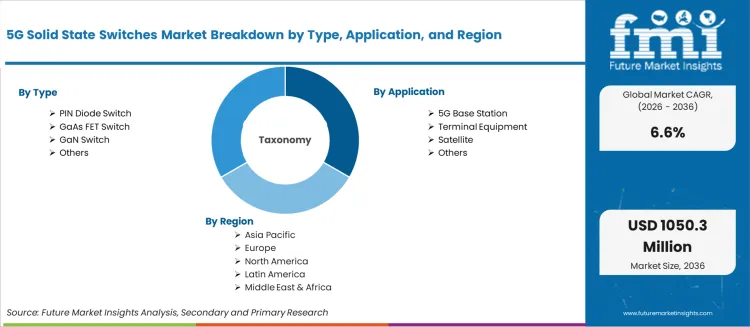
- Primary Classification: The market segments by type into PIN Diode Switch, GaAs FET Switch, GaN Switch, and others categories, representing the evolution from standard switching solutions to high-performance semiconductor switching systems for comprehensive operations.
- Secondary Breakdown: Application segmentation divides the market into 5G base station, terminal equipment, satellite, and others sectors, reflecting distinct requirements for switching characteristics, signal specifications, and operational performance.
- Tertiary Classification: End-use industry segmentation covers telecommunications infrastructure, mobile communications, satellite communications, aerospace and defense, automotive electronics, and test and measurement, representing diverse requirements for switching specifications and application performance.
- Regional Classification: Geographic distribution covers North America, Europe, Asia Pacific, Latin America, and the Middle East & Africa, with developed telecommunications markets leading innovation while emerging economies show accelerating growth patterns driven by 5G deployment programs.
The segmentation structure reveals technology progression from standard switching systems toward integrated high-performance platforms with enhanced switching capabilities and precision performance, while application diversity spans from 5G base station systems to satellite communications requiring comprehensive switching properties and intelligent signal solutions.
By Type, the PIN Diode Switch Segment Accounts for Dominant Market Share
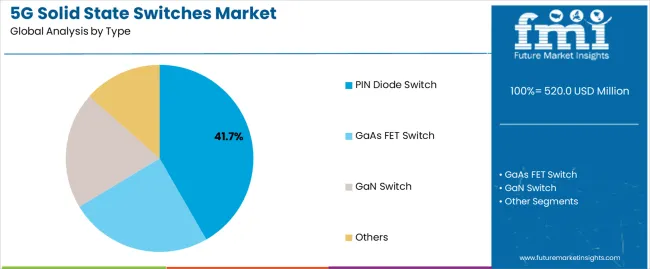
PIN Diode Switch segment is estimated to account for 41.7% of the 5G solid state switches market share in 2026. The segment's leading position stems from its fundamental role as a critical component in modern 5G applications and its extensive use across multiple telecommunications and communication sectors. The PIN Diode Switch range's dominance is attributed to its superior switching properties, including excellent frequency response, signal isolation, and balanced cost-effectiveness that make it indispensable for 5G base station operations.
- Market Position: PIN Diode Switch command the leading position in the 5G solid state switches market through advanced switching technologies, including comprehensive semiconductor properties, uniform performance, and reliable switching characteristics that enable operators to deploy switches across diverse 5G environments.
- Value Drivers: The segment benefits from telecommunications preference for proven switching interfaces that provide exceptional switching performance without requiring ultra-premium connectivity costs. Efficient semiconductor implementation enables deployment in 5G base station, terminal equipment, and satellite applications where switching reliability and frequency compatibility represent critical selection requirements.
- Competitive Advantages: PIN Diode Switch differentiate through excellent switching capacity, proven telecommunications reliability, and compatibility with standard 5G processes that enhance switching capabilities while maintaining economical frequency profiles suitable for diverse telecommunications applications.
Key market characteristics:
- Advanced switching systems with precision frequency control, consistent semiconductor properties, and specialized manufacturing capabilities
- Switch optimization enabling comprehensive 5G integration with minimal signal impact
- Telecommunications accessories, including switching equipment, signal systems, and quality control tools for high-volume operations
By Application, the 5G Base Station Segment Accounts for the Largest Market Share
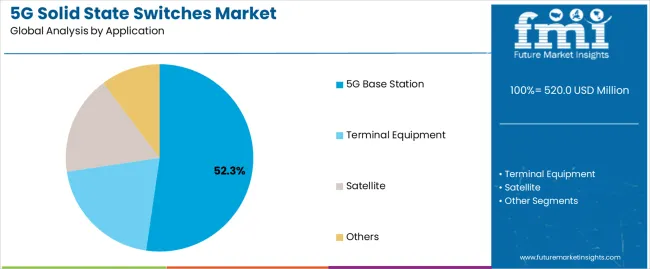
5G Base Station segment is projected to hold 52.3% of the 5G solid state switches market share in 2026. The segment's market leadership is driven by the extensive use of solid state switches in base station infrastructure, communication systems, 5G network manufacturing, and wireless infrastructure, where switches serve as both a switching component and signal solution. The 5G base station sector's consistent demand for reliable switching systems supports the segment's dominant position.
Market Context: 5G base station applications dominate the market due to widespread adoption of efficient switching solutions and increasing focus on 5G performance, signal optimization, and operational management that support base station operations while maintaining quality standards.
Appeal Factors: 5G base station consumers prioritize switching durability, frequency performance, and integration with standard base station systems that enable coordinated deployment across multiple 5G needs. The segment benefits from substantial wireless infrastructure growth and 5G development that emphasize reliable switches for communication applications.
Growth Drivers: Base station programs incorporate solid state switches as standard components for wireless systems and communication programs. Telecommunications compliance initiatives are increasing demand for advanced features that comply with 5G standards and enhance system performance.
Market Challenges: Switch cost fluctuations and standardization requirements may limit deployment flexibility in ultra-price-sensitive markets or regions with varying 5G requirements.
Application dynamics include:
- Strong growth in 5G companies and base station infrastructure manufacturers requiring standardized switching formats
- Increasing adoption in communication manufacturers and wireless integrators for enhanced 5G development
- Rising integration with telecommunications systems and base station infrastructure control programs
By End-Use Industry, the Telecommunications Infrastructure Segment Demonstrates Strong Growth
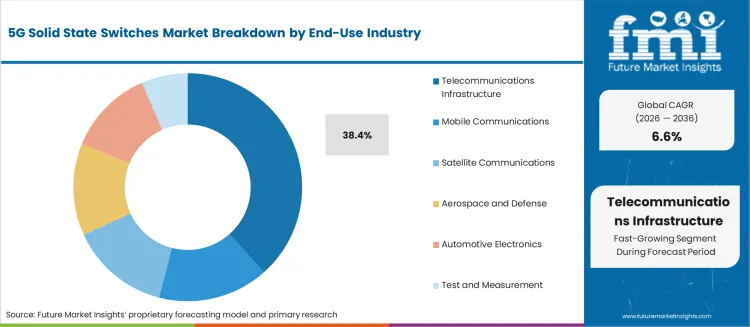
Telecommunications Infrastructure segment is anticipated to capture 38.4% of the 5G solid state switches market share in 2026. The segment's growth is driven by increasing wireless equipment demand, telecommunications infrastructure initiatives, and sophisticated switching requirements that require high-quality frequency systems. The telecommunications industry's expansion and focus on switching efficiency support this segment's robust performance.
Market Position: Telecommunications applications leverage solid state switches for wireless systems in telecommunications equipment, infrastructure manufacturing, installation operations, and component integration where switching quality and frequency precision are critical performance factors.
Growth Catalysts: Rising wireless equipment production, telecommunications development trends, and expanding 5G capabilities drive demand for specialized switches that deliver consistent performance across diverse telecommunications applications.
What are the Drivers, Restraints, and Key Trends of the 5G Solid State Switches Market?
Growth Accelerators: 5G infrastructure expansion drives primary adoption as solid state switching systems provide exceptional semiconductor properties that enable 5G development without performance compromise, supporting switching advancement and operational efficiency that require reliable switching formats. Advanced switching growth accelerates market expansion as companies seek specialized switches that maintain performance during operation while enhancing 5G convenience through standardized specifications and compatibility. Telecommunications awareness increases worldwide, creating continued demand for solid state switching systems that complement 5G routines and provide operational advantages in switching performance.
Growth Inhibitors: Advanced semiconductor cost volatility challenges differ across switching markets regarding price stability and supply chain consistency, which may limit margin predictability and cost planning in price-sensitive telecommunications categories with demanding affordability requirements. Manufacturing complexity persists regarding switching specifications and 5G standards that may increase production costs in facilities with complex quality protocols. Market fragmentation across multiple switching specifications and application standards creates compatibility concerns between different switching systems and existing telecommunications infrastructure.
Market Evolution Patterns: Adoption accelerates in 5G and telecommunications sectors where switching benefits justify equipment investments, with geographic concentration in developed markets transitioning toward mainstream adoption in emerging economies driven by 5G deployment and telecommunications expansion. Technology advancement focuses on enhanced switching properties, improved telecommunications performance, and integration with automated systems that optimize 5G performance and quality control. The market could face disruption if alternative switching technologies or telecommunications changes significantly challenge traditional solid state switching advantages in 5G applications.
How Is the 5G Solid State Switches Market Analyzed by Key Country?
The 5G solid state switches market demonstrates varied regional dynamics with growth leaders including China (8.9% CAGR) and India (8.3% CAGR) driving expansion through 5G infrastructure growth and telecommunications modernization. Steady Performers encompass Germany (7.6% CAGR), Brazil (6.9% CAGR), and the USA (6.3% CAGR), benefiting from established 5G systems and advanced switching adoption.
.webp "Top Country Growth Comparison 5g Solid State Switches Market Cagr (2026 2036)")
| Country | CAGR (2026-2036) |
|---|---|
| China | 8.9% |
| India | 8.3% |
| Germany | 7.6% |
| Brazil | 6.9% |
| USA | 6.3% |
| UK | 5.6% |
| Japan | 5% |
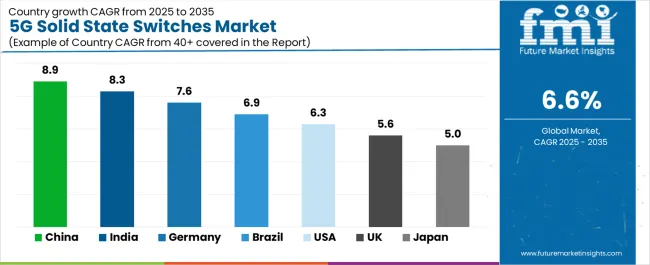
Regional synthesis reveals Asia-Pacific markets leading growth through 5G deployment and telecommunications development, while European countries maintain steady expansion supported by specialized applications and precision switching requirements. North American markets show strong growth driven by 5G demand and telecommunications facility upgrades.
How Is China Contributing to the Growth of the 5G Solid State Switches Market?
China establishes regional leadership through rapid 5G deployment and comprehensive telecommunications modernization, integrating advanced solid state switching systems as standard components in base station manufacturing and wireless operations. The country's 8.9% CAGR through 2036 reflects 5G growth promoting infrastructure switching and telecommunications infrastructure development that mandate the use of reliable switching systems in 5G operations. Growth concentrates in major technology centers, including Beijing, Shanghai, and Shenzhen, where 5G networks showcase integrated switching systems that appeal to manufacturers seeking enhanced production efficiency and international quality standards.
Chinese manufacturers are developing innovative solid state switching solutions that combine local production advantages with international telecommunications specifications, including advanced semiconductor compositions and enhanced switching capabilities.
Strategic Market Indicators:
- 5G infrastructure growth providing substantial support for domestic telecommunications development
- Base station infrastructure capacity expansion driven by 5G development and switching demand
- Research sector development for cost-effective switching solutions targeting domestic and export applications
What Is India’s Role in Advancing the 5G Solid State Switches Market?
The Indian market emphasizes 5G infrastructure applications, including rapid telecommunications development and comprehensive connectivity expansion that increasingly incorporates solid state switches for 5G enhancement and wireless applications. The country is projected to show a 8.3% CAGR through 2036, driven by massive 5G activity under digitalization initiatives and demand for standardized, high-quality switching systems. Indian 5G facilities prioritize cost-effectiveness with solid state switches delivering telecommunications efficiency through economical switching usage and reliable performance capabilities.
Technology deployment channels include major 5G companies, telecommunications integrators, and switching institutions that support high-volume usage for 5G and wireless applications.
Performance Metrics:
- 5G facilities in Delhi, Mumbai, and Chennai leading solid state switching adoption for telecommunications operations
- Telecommunications development compliance with 5G standards, driving quality selection criteria
How Is Germany Shaping the 5G Solid State Switches Market?
The German market emphasizes advanced 5G infrastructure features, including innovative switching technologies and integration with comprehensive telecommunications platforms that manage base station operations, 5G facilities, and institutional applications through unified switching systems. The country is projected to show a 7.6% CAGR through 2036, driven by 5G expansion under telecommunications development trends and demand for premium, reliable switching systems. German 5G institutions prioritize precision with solid state switches delivering comprehensive telecommunications performance through enhanced quality protection and operational innovation.
Technology deployment channels include major 5G companies, telecommunications institutions, and switching equipment manufacturers that support custom development for premium operations.
Performance Metrics:
- 5G companies in Baden-Württemberg, Bavaria, and North Rhine-Westphalia leading solid state switching adoption for telecommunications operations
- Telecommunications compatibility with 5G requirements, driving specification selection criteria
What Role Does Brazil Play in the Expansion of the 5G Solid State Switches Market?
In São Paulo, Rio de Janeiro, and Belo Horizonte, Brazilian 5G facilities and telecommunications operators are implementing advanced solid state switching systems to enhance switching capabilities and support operational performance that aligns with telecommunications protocols and 5G standards. The Brazilian market demonstrates continued growth with a 6.9% CAGR through 2036, driven by 5G compliance programs and telecommunications investments that emphasize reliable switching systems for 5G and wireless applications. Brazilian 5G facilities are prioritizing solid state switching systems that provide exceptional switching properties while maintaining compliance with telecommunications standards and minimizing operational complexity, particularly important in 5G and wireless facility operations.
Market expansion benefits from telecommunications programs that mandate enhanced switching compliance in 5G specifications, creating continued demand across Brazil's 5G and wireless sectors, where switching frequency and system consistency represent critical requirements.
Strategic Market Indicators:
- 5G operators and telecommunications companies leading adoption with compliance programs requiring reliable switching systems
- 5G standards providing framework support for high-performance switching acquisition
- Quality control requirements driving demand for certified systems with performance testing documentation
- Specialized telecommunications segments adopting comprehensive solid state switching solutions for 5G facilities and wireless projects
How Is the United States Leading the 5G Solid State Switches Market?
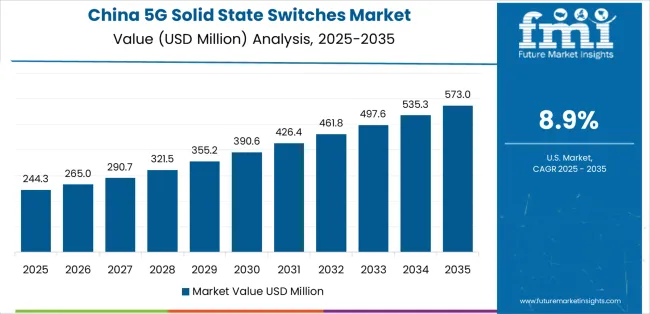
The USA market emphasizes 5G infrastructure features, including innovative switching technologies and integration with comprehensive telecommunications platforms that manage base station operations, 5G facilities, and commercial applications through unified switching systems. The country is projected to show a 6.3% CAGR through 2036, driven by 5G expansion under telecommunications development trends and industry demand for premium, reliable switching systems. American 5G companies prioritize innovation with solid state switches delivering comprehensive telecommunications performance through enhanced quality protection and operational advancement.
Technology deployment channels include major 5G companies, telecommunications institutions, and switching manufacturers that support custom development for 5G operations.
Performance Metrics:
- 5G companies in California, Virginia, and Texas leading solid state switching adoption for telecommunications operations
- Switch compatibility with 5G development requirements, driving specification selection criteria
How Is the UK Driving Innovation in the 5G Solid State Switches Market?
The UK market demonstrates advanced 5G infrastructure deployment, growing at 5.6% CAGR, with documented operational excellence in telecommunications control and 5G applications through integration with existing telecommunications systems and quality assurance infrastructure. The country leverages engineering expertise in 5G manufacturing and switching science to maintain market leadership. Telecommunications centers, including London, Manchester, and Birmingham, showcase advanced installations where solid state switching systems integrate with comprehensive 5G platforms and telecommunications systems to optimize 5G development and operational efficiency.
British 5G facilities prioritize switching precision and system consistency in product selection, creating demand for premium solid state switching systems with advanced features, including enhanced semiconductor compositions and integration with automated telecommunications systems. The market benefits from established 5G infrastructure and willingness to invest in specialized switching technologies that provide superior quality and telecommunications compliance.
Market Intelligence Brief:
- Precision focus on switching quality and system uniformity, driving telecommunications segment growth
- Technology collaboration between British 5G manufacturers and international switching companies
- Premium telecommunications systems expanding solid state switching integration in base station infrastructure and 5G applications
What Impact Is Japan Having on the 5G Solid State Switches Market?
Japan's advanced 5G market demonstrates meticulous solid state switching deployment, growing at 5% CAGR, with documented operational excellence in telecommunications control and base station applications through integration with existing 5G systems and quality assurance infrastructure. The country leverages engineering expertise in 5G manufacturing and switching technology to maintain market leadership. 5G centers, including Tokyo, Osaka, and Nagoya, showcase advanced installations where solid state switching systems integrate with comprehensive telecommunications platforms and quality systems to optimize 5G development and operational efficiency.
Japanese 5G facilities prioritize switching precision and system consistency in product selection, creating demand for premium solid state switching systems with advanced features, including ultra-high quality and integration with automated telecommunications protocols. The market benefits from established 5G infrastructure and willingness to invest in specialized switching technologies that provide superior performance and telecommunications compliance.
Market Intelligence Brief:
- Precision focus on switching quality and frequency uniformity, driving telecommunications segment growth
- Technology collaboration between Japanese 5G manufacturers and international switching companies
- Premium telecommunications systems expanding solid state switching integration in base station infrastructure and 5G applications
How Is the European 5G Solid State Switches Market Split by Country?
The 5G solid state switches market in Europe is projected to grow from USD 147.4 million in 2026 to USD 279.2 million by 2036, registering a CAGR of 6.6% over the forecast period. Germany is expected to maintain its leadership position with a 36.8% market share in 2026, declining slightly to 36.5% by 2036, supported by its telecommunications excellence and major 5G centers, including Baden-Württemberg and Bavaria.
France follows with a 25.3% share in 2026, projected to reach 25.6% by 2036, driven by comprehensive 5G programs and telecommunications facility initiatives. The United Kingdom holds a 19.7% share in 2026, expected to maintain 19.9% by 2036 through established telecommunications sectors and 5G adoption. Italy commands a 12.4% share, while Spain accounts for 4.2% in 2026. The Rest of Europe region is anticipated to gain momentum, expanding its collective share from 1.6% to 1.8% by 2036, attributed to increasing 5G development in Eastern European countries and emerging telecommunications programs implementing standardized switching systems.
What Does the Competitive Landscape Look Like in the 5G Solid State Switches Market?
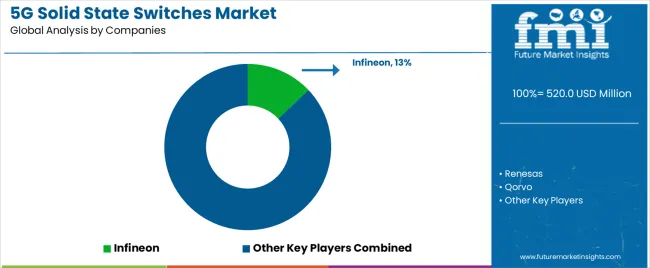
The 5G solid state switches market operates with moderate concentration, featuring approximately 15-22 participants, where leading companies control roughly 58-64% of the global market share through established distribution networks and comprehensive product portfolio capabilities. Competition emphasizes switching performance, telecommunications reliability, and frequency optimization rather than premium feature rivalry.
Market leaders encompass Infineon, Renesas, and Qorvo, which maintain competitive advantages through extensive 5G infrastructure expertise, regional distribution networks, and comprehensive technical support capabilities that create telecommunications industry loyalty and support 5G requirements. These companies leverage decades of switching experience and ongoing telecommunications technology investments to develop advanced solid state switching systems with exceptional quality and 5G features.
Specialty challengers include regional manufacturers and switching specialists, which compete through specialized application innovation focus and efficient production solutions that appeal to telecommunications buyers seeking reliable performance formats and custom switching flexibility. These companies differentiate through operational efficiency emphasis and specialized market focus.
Market dynamics favor participants that combine consistent switching performance with advanced telecommunications support, including automated systems and distribution capabilities. Competitive pressure intensifies as traditional switching manufacturers expand into solid state switching systems. Specialized 5G producers challenge established players through innovative manufacturing methods and cost-effective production targeting emerging telecommunications segments.
Who Are the Key Players in the 5G Solid State Switches Market?
- Infineon
- Renesas
- Qorvo
- Analog Devices
- BeRex
- ERAVANT
- Fairview Microwave
- Finwave Semiconductor
- MACOM
- Mini Circuits
- Mountain Microwave Technology
- Nisshinbo Micro Devices Inc
- Skyworks Solutions
- Yerson Technology
- Pasternack Enterprises
- Qotana
- Quantic PMI
- RF-Lambda
- Saluki Technology
- Signal Hound
Scope of the Report
| Metric | Value |
|---|---|
| Quantitative Units | USD 554.32 million to USD 1050.35 million, at a CAGR of 6.6% |
| Market Definition | 5G solid-state switches are semiconductor-based RF switching devices that route signals between transmit and receive paths in 5G radio access network equipment, satellite communication payloads, and electronic warfare systems. The market covers PIN diode, GaAs FET, GaN HEMT, and other solid-state switch topologies used in base station front-end modules, terminal equipment, and satellite transponders. |
| Segmentation | Type: PIN Diode Switch, GaAs FET Switch, GaN Switch, Others; Application: 5G Base Station, Terminal Equipment, Satellite, Others; End-Use Industry: Telecommunications Infrastructure, Mobile Communications, Satellite Communications, Aerospace and Defense, Automotive Electronics, Test and Measurement |
| Regions Covered | North America, Latin America, Europe, East Asia, South Asia, Oceania, Middle East & Africa |
| Countries Covered | China, India, Germany, Brazil, USA, UK, Japan, and 40 plus countries |
| Key Companies Profiled | Infineon, Renesas, Qorvo, Analog Devices, BeRex, ERAVANT, Fairview Microwave, Finwave Semiconductor, MACOM, Mini Circuits, Mountain Microwave Technology, Nisshinbo Micro Devices Inc, Skyworks Solutions, Yerson Technology, Pasternack Enterprises, Qotana, Quantic PMI, RF-Lambda, Saluki Technology, Signal Hound |
| Forecast Period | 2026 to 2036 |
| Approach | Forecasting models apply a bottom-up methodology starting with global installed base metrics and projecting conversion rates to 5G-native architectures. |
5G Solid State Switches Market by Segments
Type:
- PIN Diode Switch
- GaAs FET Switch
- GaN Switch
- Others
Application:
- 5G Base Station
- Terminal Equipment
- Satellite
- Others
End-Use Industry:
- Telecommunications Infrastructure
- Mobile Communications
- Satellite Communications
- Aerospace and Defense
- Automotive Electronics
- Test and Measurement
Region:
- North America
- United States
- Canada
- Mexico
- Europe
- Germany
- France
- United Kingdom
- Italy
- Spain
- Nordic
- BENELUX
- Rest of Europe
- Asia Pacific
- China
- Japan
- India
- South Korea
- ASEAN
- Australia & New Zealand
- Rest of Asia Pacific
- Latin America
- Brazil
- Chile
- Rest of Latin America
- Middle East & Africa
- Kingdom of Saudi Arabia
- Other GCC Countries
- Turkey
- South Africa
- Other African Union
- Rest of Middle East & Africa
Bibliography
- 1. 3rd Generation Partnership Project. (2024). 3GPP TS 38.101-2: NR user equipment radio transmission and reception, range 2. 3GPP.
- 2. Infineon Technologies AG. (2025). Annual Report 2024: Connected secure systems segment review. Infineon.
- 3. United States Department of Defense. (2024). Electronic warfare technology roadmap: RF component requirements. DoD.
- 4. European Space Agency. (2024). Satellite communication payload technology development plan. ESA.
- 5. International Electrotechnical Commission. (2024). IEC 62236: Railway electromagnetic compatibility for RF switching systems. IEC.
This bibliography is provided for reader reference. The full Future Market Insights report contains the complete reference list with primary research documentation.
Frequently Asked Questions
How large is the demand for 5G Solid State Switches in the global market in 2026?
Demand for 5G Solid State Switches in the global market is estimated to be valued at USD 554.32 million in 2026.
What will be the market size of 5G Solid State Switches in the global market by 2036?
Market size for 5G Solid State Switches is projected to reach USD 1050.35 million by 2036.
What is the expected demand growth for 5G Solid State Switches in the global market between 2026 and 2036?
Demand for 5G Solid State Switches is expected to grow at a CAGR of 6.6% between 2026 and 2036.
Which Type is poised to lead global sales by 2026?
PIN Diode Switch accounts for 41.7% in 2026 based on established deployment patterns and installed base requirements across primary end-use sectors.
What is driving demand in China?
China leads with a 8.9% CAGR through 2036, driven by expanding network infrastructure investment, policy support frameworks, and growing end-user adoption across commercial and institutional buyer segments.
What is the India growth outlook in this report?
India is projected to grow at a CAGR of 8.3% during 2026 to 2036.
What is 5G Solid State Switches and what is it mainly used for?
5G solid-state switches are semiconductor-based RF switching devices that route signals between transmit and receive paths in 5G radio access network equipment, satellite communication payloads, and electronic warfare systems. The market covers PIN diode, GaAs FET, GaN HEMT, and other solid-state switch topologies used in base station front-end modules, terminal equipment, and satellite transponders.
How does FMI build and validate the 5G Solid State Switches forecast?
Forecasting models apply a bottom-up methodology starting with global installed base metrics and cross-validate projections against quarterly industry revenue volumes and primary research inputs.
Preview the report firsthand - request a free sample
Get SampleGet the brochure for pricing and purchase details.
Get PDFTable of Content
- Executive Summary
- Demand-side Trends
- Supply-side Trends
- Technology Roadmap Analysis
- Analysis and Recommendations
- Market Coverage / Taxonomy
- Market Definition / Scope / Limitations
- Research Methodology
- Chapter Orientation
- Analytical Lens and Working Hypotheses
- Market Structure, Signals, and Trend Drivers
- Benchmarking and Cross-market Comparability
- Market Sizing, Forecasting, and Opportunity Mapping
- Research Design and Evidence Framework
- Desk Research Programme (Secondary Evidence)
- Company Annual and Sustainability Reports
- Peer-reviewed Journals and Academic Literature
- Corporate Websites, Product Literature, and Technical Notes
- Earnings Decks and Investor Briefings
- Statutory Filings and Regulatory Disclosures
- Technical White Papers and Standards Notes
- Trade Journals, Industry Magazines, and Analyst Briefs
- Conference Proceedings, Webinars, and Seminar Materials
- Government Statistics Portals and Public Data Releases
- Press Releases and Reputable Media Coverage
- Specialist Newsletters and Curated Briefings
- Expert Input and Fieldwork (Primary Evidence)
- Primary Modes
- Qualitative Interviews and Expert Elicitation
- Quantitative Surveys and Structured Data Capture
- Blended Approach
- Why Primary Evidence is Used
- Field Techniques
- Interviews
- Surveys
- Focus Groups
- Observational and In-context Research
- Social and Community Interactions
- Stakeholder Universe Engaged
- C-suite Leaders
- Board Members
- Presidents and Vice Presidents
- R&D and Innovation Heads
- Technical Specialists
- Domain Subject-matter Experts
- Scientists
- Physicians and Other Healthcare Professionals
- Governance, Ethics, and Data Stewardship
- Research Ethics
- Data Integrity and Handling
- Primary Modes
- Tooling, Models, and Reference Databases
- Data Engineering and Model Build
- Data Acquisition and Ingestion
- Cleaning, Normalisation, and Verification
- Synthesis, Triangulation, and Analysis
- Quality Assurance and Audit Trail
- Desk Research Programme (Secondary Evidence)
- Market Background
- Market Dynamics
- Drivers
- Restraints
- Opportunity
- Trends
- Scenario Forecast
- Demand in Optimistic Scenario
- Demand in Likely Scenario
- Demand in Conservative Scenario
- Opportunity Map Analysis
- Product Life Cycle Analysis
- Supply Chain Analysis
- Investment Feasibility Matrix
- Value Chain Analysis
- PESTLE and Porter’s Analysis
- Regulatory Landscape
- Regional Parent Market Outlook
- Production and Consumption Statistics
- Import and Export Statistics
- Market Dynamics
- Global Market Analysis 2021 to 2025 and Forecast, 2026 to 2036
- Historical Market Size Value (USD Million) Analysis, 2021 to 2025
- Current and Future Market Size Value (USD Million) Projections, 2026 to 2036
- Y-o-Y Growth Trend Analysis
- Absolute $ Opportunity Analysis
- Global Market Pricing Analysis 2021 to 2025 and Forecast 2026 to 2036
- Global Market Analysis 2021 to 2025 and Forecast 2026 to 2036, By Type
- Introduction / Key Findings
- Historical Market Size Value (USD Million) Analysis By Type , 2021 to 2025
- Current and Future Market Size Value (USD Million) Analysis and Forecast By Type , 2026 to 2036
- PIN Diode Switch
- GaAs FET Switch
- GaN Switch
- Others
- PIN Diode Switch
- Y-o-Y Growth Trend Analysis By Type , 2021 to 2025
- Absolute $ Opportunity Analysis By Type , 2026 to 2036
- Global Market Analysis 2021 to 2025 and Forecast 2026 to 2036, By Application
- Introduction / Key Findings
- Historical Market Size Value (USD Million) Analysis By Application, 2021 to 2025
- Current and Future Market Size Value (USD Million) Analysis and Forecast By Application, 2026 to 2036
- 5G Base Station
- Terminal Equipment
- Satellite
- Others
- 5G Base Station
- Y-o-Y Growth Trend Analysis By Application, 2021 to 2025
- Absolute $ Opportunity Analysis By Application, 2026 to 2036
- Global Market Analysis 2021 to 2025 and Forecast 2026 to 2036, By End-Use Industry
- Introduction / Key Findings
- Historical Market Size Value (USD Million) Analysis By End-Use Industry, 2021 to 2025
- Current and Future Market Size Value (USD Million) Analysis and Forecast By End-Use Industry, 2026 to 2036
- Telecommunications Infrastructure
- Mobile Communications
- Satellite Communications
- Aerospace and Defense
- Automotive Electronics
- Test and Measurement
- Telecommunications Infrastructure
- Y-o-Y Growth Trend Analysis By End-Use Industry, 2021 to 2025
- Absolute $ Opportunity Analysis By End-Use Industry, 2026 to 2036
- Global Market Analysis 2021 to 2025 and Forecast 2026 to 2036, By Region
- Introduction
- Historical Market Size Value (USD Million) Analysis By Region, 2021 to 2025
- Current Market Size Value (USD Million) Analysis and Forecast By Region, 2026 to 2036
- North America
- Latin America
- Western Europe
- Eastern Europe
- East Asia
- South Asia and Pacific
- Middle East & Africa
- Market Attractiveness Analysis By Region
- North America Market Analysis 2021 to 2025 and Forecast 2026 to 2036, By Country
- Historical Market Size Value (USD Million) Trend Analysis By Market Taxonomy, 2021 to 2025
- Market Size Value (USD Million) Forecast By Market Taxonomy, 2026 to 2036
- By Country
- USA
- Canada
- Mexico
- By Type
- By Application
- By End-Use Industry
- By Country
- Market Attractiveness Analysis
- By Country
- By Type
- By Application
- By End-Use Industry
- Key Takeaways
- Latin America Market Analysis 2021 to 2025 and Forecast 2026 to 2036, By Country
- Historical Market Size Value (USD Million) Trend Analysis By Market Taxonomy, 2021 to 2025
- Market Size Value (USD Million) Forecast By Market Taxonomy, 2026 to 2036
- By Country
- Brazil
- Chile
- Rest of Latin America
- By Type
- By Application
- By End-Use Industry
- By Country
- Market Attractiveness Analysis
- By Country
- By Type
- By Application
- By End-Use Industry
- Key Takeaways
- Western Europe Market Analysis 2021 to 2025 and Forecast 2026 to 2036, By Country
- Historical Market Size Value (USD Million) Trend Analysis By Market Taxonomy, 2021 to 2025
- Market Size Value (USD Million) Forecast By Market Taxonomy, 2026 to 2036
- By Country
- Germany
- UK
- Italy
- Spain
- France
- Nordic
- BENELUX
- Rest of Western Europe
- By Type
- By Application
- By End-Use Industry
- By Country
- Market Attractiveness Analysis
- By Country
- By Type
- By Application
- By End-Use Industry
- Key Takeaways
- Eastern Europe Market Analysis 2021 to 2025 and Forecast 2026 to 2036, By Country
- Historical Market Size Value (USD Million) Trend Analysis By Market Taxonomy, 2021 to 2025
- Market Size Value (USD Million) Forecast By Market Taxonomy, 2026 to 2036
- By Country
- Russia
- Poland
- Hungary
- Balkan & Baltic
- Rest of Eastern Europe
- By Type
- By Application
- By End-Use Industry
- By Country
- Market Attractiveness Analysis
- By Country
- By Type
- By Application
- By End-Use Industry
- Key Takeaways
- East Asia Market Analysis 2021 to 2025 and Forecast 2026 to 2036, By Country
- Historical Market Size Value (USD Million) Trend Analysis By Market Taxonomy, 2021 to 2025
- Market Size Value (USD Million) Forecast By Market Taxonomy, 2026 to 2036
- By Country
- China
- Japan
- South Korea
- By Type
- By Application
- By End-Use Industry
- By Country
- Market Attractiveness Analysis
- By Country
- By Type
- By Application
- By End-Use Industry
- Key Takeaways
- South Asia and Pacific Market Analysis 2021 to 2025 and Forecast 2026 to 2036, By Country
- Historical Market Size Value (USD Million) Trend Analysis By Market Taxonomy, 2021 to 2025
- Market Size Value (USD Million) Forecast By Market Taxonomy, 2026 to 2036
- By Country
- India
- ASEAN
- Australia & New Zealand
- Rest of South Asia and Pacific
- By Type
- By Application
- By End-Use Industry
- By Country
- Market Attractiveness Analysis
- By Country
- By Type
- By Application
- By End-Use Industry
- Key Takeaways
- Middle East & Africa Market Analysis 2021 to 2025 and Forecast 2026 to 2036, By Country
- Historical Market Size Value (USD Million) Trend Analysis By Market Taxonomy, 2021 to 2025
- Market Size Value (USD Million) Forecast By Market Taxonomy, 2026 to 2036
- By Country
- Kingdom of Saudi Arabia
- Other GCC Countries
- Turkiye
- South Africa
- Other African Union
- Rest of Middle East & Africa
- By Type
- By Application
- By End-Use Industry
- By Country
- Market Attractiveness Analysis
- By Country
- By Type
- By Application
- By End-Use Industry
- Key Takeaways
- Key Countries Market Analysis
- USA
- Pricing Analysis
- Market Share Analysis, 2025
- By Type
- By Application
- By End-Use Industry
- Canada
- Pricing Analysis
- Market Share Analysis, 2025
- By Type
- By Application
- By End-Use Industry
- Mexico
- Pricing Analysis
- Market Share Analysis, 2025
- By Type
- By Application
- By End-Use Industry
- Brazil
- Pricing Analysis
- Market Share Analysis, 2025
- By Type
- By Application
- By End-Use Industry
- Chile
- Pricing Analysis
- Market Share Analysis, 2025
- By Type
- By Application
- By End-Use Industry
- Germany
- Pricing Analysis
- Market Share Analysis, 2025
- By Type
- By Application
- By End-Use Industry
- UK
- Pricing Analysis
- Market Share Analysis, 2025
- By Type
- By Application
- By End-Use Industry
- Italy
- Pricing Analysis
- Market Share Analysis, 2025
- By Type
- By Application
- By End-Use Industry
- Spain
- Pricing Analysis
- Market Share Analysis, 2025
- By Type
- By Application
- By End-Use Industry
- France
- Pricing Analysis
- Market Share Analysis, 2025
- By Type
- By Application
- By End-Use Industry
- India
- Pricing Analysis
- Market Share Analysis, 2025
- By Type
- By Application
- By End-Use Industry
- ASEAN
- Pricing Analysis
- Market Share Analysis, 2025
- By Type
- By Application
- By End-Use Industry
- Australia & New Zealand
- Pricing Analysis
- Market Share Analysis, 2025
- By Type
- By Application
- By End-Use Industry
- China
- Pricing Analysis
- Market Share Analysis, 2025
- By Type
- By Application
- By End-Use Industry
- Japan
- Pricing Analysis
- Market Share Analysis, 2025
- By Type
- By Application
- By End-Use Industry
- South Korea
- Pricing Analysis
- Market Share Analysis, 2025
- By Type
- By Application
- By End-Use Industry
- Russia
- Pricing Analysis
- Market Share Analysis, 2025
- By Type
- By Application
- By End-Use Industry
- Poland
- Pricing Analysis
- Market Share Analysis, 2025
- By Type
- By Application
- By End-Use Industry
- Hungary
- Pricing Analysis
- Market Share Analysis, 2025
- By Type
- By Application
- By End-Use Industry
- Kingdom of Saudi Arabia
- Pricing Analysis
- Market Share Analysis, 2025
- By Type
- By Application
- By End-Use Industry
- Turkiye
- Pricing Analysis
- Market Share Analysis, 2025
- By Type
- By Application
- By End-Use Industry
- South Africa
- Pricing Analysis
- Market Share Analysis, 2025
- By Type
- By Application
- By End-Use Industry
- USA
- Market Structure Analysis
- Competition Dashboard
- Competition Benchmarking
- Market Share Analysis of Top Players
- By Regional
- By Type
- By Application
- By End-Use Industry
- Competition Analysis
- Competition Deep Dive
- Infineon
- Overview
- Product Portfolio
- Profitability by Market Segments (Product/Age /Sales Channel/Region)
- Sales Footprint
- Strategy Overview
- Marketing Strategy
- Product Strategy
- Channel Strategy
- Renesas
- Qorvo
- Analog Devices
- BeRex
- ERAVANT
- Fairview Microwave
- Finwave Semiconductor
- MACOM
- Mini Circuits
- Mountain Microwave Technology
- Nisshinbo Micro Devices Inc
- Skyworks Solutions
- Yerson Technology
- Pasternack Enterprises
- Qotana
- Quantic PMI
- RF-Lambda
- Saluki Technology
- Signal Hound
- Infineon
- Competition Deep Dive
- Assumptions & Acronyms Used


