Key Takeaways
- Biophotonics is not one technology but a stack of illumination, optics, tissue interaction, detection, algorithms and workflow integration, and product risk sits at different points in that stack for diagnostics, imaging and surgery
- In diagnostics and non-invasive imaging, mature platforms such as optical coherence tomography and fluorescence imaging already have strong clinical evidence and standard of care status in niches like ophthalmology and oncology, so the product question is usually which niche and workflow you target, not whether the physics works.
- In surgery, intraoperative biophotonic systems such as fluorescence guided imaging add a second set of eyes in the operating room, but adoption is governed by field of view, latency, ease of interpretation and how well images integrate with open, laparoscopic or robotic workflows.
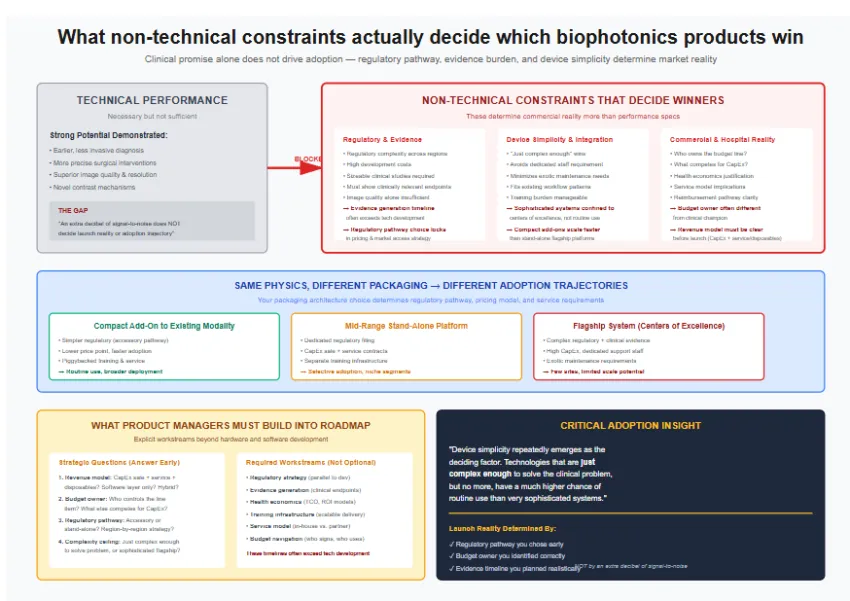
- The hardest problems for product managers are often non technical: regulatory classification, clinical trial design, reimbursement, device simplicity and training, which determine whether a hospital will pay for, use and maintain biophotonics systems at scale
How should product managers think about the biophotonics technology stack?
For product managers, biophotonics is best understood as a pipeline rather than a buzzword. At the front end you choose a light source and wavelength regime, for example near infrared fluorescence, broadband low coherence light for optical coherence tomography, or lasers for Raman spectroscopy. That choice encodes depth, resolution, penetration and safety constraints.
The light then interacts with tissue through absorption, scattering, fluorescence or nonlinear effects. That interaction determines what contrast mechanism you are actually selling: structure, function, molecular composition or blood flow. Downstream of that, optics and detectors define how much of that contrast you capture and at what speed. The final layers are computational: image reconstruction, registration, analytics and decision support
From a product lens, risk and cost cluster in three places. First, in the light source and safety regime, because this drives hardware cost and regulatory classification. Second, in the reconstruction and analytics stack, because this is where false positives, false negatives and latency live. Third, in the user interface and workflow integration layer, which decides whether clinicians adopt or bypass the system. When you map your roadmap, you want clear choices about which layer is your differentiator and which layers you deliberately commoditise or buy.
Where is biophotonics already proven in diagnostics and imaging?
In diagnostics and non invasive imaging, there are already workhorse biophotonics platforms. Optical coherence tomography is embedded in ophthalmology worldwide for cross sectional imaging of the retina and choroid, allowing early detection and monitoring of macular disease and glaucoma. It has expanded into cardiology, dermatology and dentistry, with ongoing development of handheld and intraoperative probes.
For a product manager, OCT is less an experimental technology and more a mature platform with questions like which clinical micro indication you pursue, whether you differentiate through probe design, software or connectivity, and how you handle data standards and integration with existing imaging archives. In practice, your competitive edge often comes from ergonomics, automation and analytics rather than the core interferometer
On the molecular and functional side, fluorescence imaging, Raman spectroscopy and related modalities are used for cancer detection, metabolic imaging and margin assessment in research and early translational settings. Biophotonics for cancer diagnostics leverages the fact that light at specific wavelengths is sensitive to biochemical and structural changes long before gross anatomical changes appear, so you can position products as tools for earlier, less invasive diagnosis or treatment monitoring. The trade off is that these systems often require contrast agents, complex interpretation or high quality motion control, which complicates both regulation and workflow integration.
The field guide implication is simple. Whenever you hear a biophotonics proposal for diagnostics, force the team to write down three things: the exact clinical decision that should change, the existing gold standard they are competing with or complementing, and the minimal data package a hospital or lab director would need to trust that decision. Without that, you may ship an impressive device that remains stuck in pilot mode.
How should product managers approach biophotonics in surgery?
In surgery, biophotonics mostly shows up as an extra layer of vision. Fluorescence guided surgery using agents such as indocyanine green or targeted probes is used to visualise perfusion, lymphatics or tumour margins in real time and can be deployed in open, laparoscopic and robotic procedures. Reviews highlight improved detection of residual disease and more precise resections in several oncology indications, but also flag variability in image interpretation and signal to noise.
From a product standpoint, your constraints are brutal. Surgeons need wide fields of view, stable images, minimal extra hardware in already crowded operating rooms and extremely low latency. Training time must be short and images have to map clearly onto actionable steps such as where to cut, where not to cut, and when to stop. Systems that demand constant manual tuning, complex interpretation or separate displays tend to be used only by champions, not by the wider surgical team.
Emerging biophotonics systems for surgery also combine multiple modalities and artificial intelligence, for example fluorescence with preoperative CT or MRI, or Raman imaging with automated tissue classification. That creates a powerful value story but compounds integration complexity, cybersecurity surface area and clinical validation burden. As a product manager you need to decide whether you are building a stand alone surgical adjunct, an integrated module for existing endoscopy or robotics platforms, or a full stack guidance ecosystem with long sales cycles and deep partnership needs.
Sources
- Baldini, F., et al. (2025). Shining a light on the future of biophotonics. PhotoniX.
- Cheng, H., et al. (2024). Illuminating the future of precision cancer surgery with fluorescence guided imaging. npj Precision Oncology. Marcu, L. (2018). Biophotonics: The big picture. Journal of Biomedical Optics.
- Ong, J., et al. (2022). Advances in optical coherence tomography imaging technology and techniques for choroidal and retinal disorders. Journal of Clinical Medicine, 11(17), 5139.
- Pan, T., et al. (2021). Biophotonic probes for bio detection and imaging. Light: Science and Applications.
- Sajedi, S., et al. (2018). Intraoperative biophotonic imaging systems for image guided surgery. Journal of Biomedical Optics.
- Zysk, A. M., et al. (2007). Optical coherence tomography: A review of clinical development from bench to bedside. Journal of Biomedical Optics. Additional context from: MDPI Photonics special issue on biophotonics in medical diagnosis, health monitoring and therapeutics, and Frontiers collections on biophotonics for cancer diagnostics and treatment.