

- Market Size (2026)
- USD 186.4 Mn
- Forecast (2036)
- USD 346.6 Mn
- CAGR (2026 to 2036)
- 6.4%
Multi-Residue Detoxifying Field Wash Aid Market Size, Market Forecast and Outlook By FMI
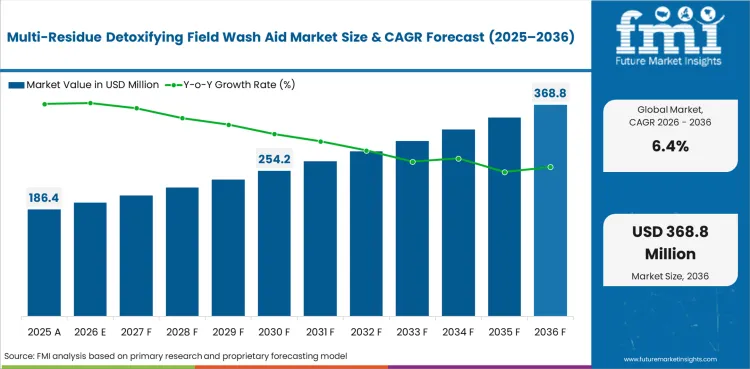
The multi-residue detoxifying field wash aid market was valued at USD 175.2 million in 2025. The market is set to reach USD 186.4 million by 2026-end and grow at a CAGR of 6.4% between 2026 and 2036 to reach USD 346.6 million by 2036. Liquid concentrate is projected to dominate the form segment with 62.0%, while export packhouses are projected to lead the end user segment with 37.0%.
Summary of the Multi-Residue Detoxifying Field Wash Aid Market
- Demand and Growth Drivers
- Export horticulture gives this market a stronger value base. Rejection risk creates a direct payback case.
- Organized packhouses use wash aids more often than fragmented local handlers. Dosing control is easier in formal operations.
- Compliance based residue checks keep demand active in commercial produce handling alongside the food safety testing services.
- Product and Segment View
- Surfactant-led cleaners hold a larger share. Strong surface contact improves residue lift across commercial wash lines.
- Liquid concentrate leads format demand. Packhouse systems handle dosing more easily in this format.
- Product relevance also connects with the post-harvest treatment market, and the food-contact surface sanitizers market.
- Geography and Competitive Outlook
- India and Mexico show faster gains. South Africa follows closely as export produce programs expand from a smaller organized base.
- AgroFresh and DECCO hold stronger relevance through crop-focused portfolios. Ecolab and BioSafe remain visible through technical service reach.
- Analyst Opinion
- Nikhil Kaitwade, Principal Analyst states, “Adoption is accelerating significantly within residue‑sensitive fruit programs, where packhouse operators face the highest compliance and rejection risk. In this environment, supplier leadership is determined by chemistry that integrates seamlessly with wash‑line architecture and demonstrates proven performance across specific crop profiles”
- Multi-Residue Detoxifying Field Wash Aid Market Value Analysis
- Market size increases from USD 186.4 million in 2026 to USD 346.6 million in 2036.
- Organized produce handling drives most market expansion.
- Export packhouses create the clearest use base for repeat wash chemistry.
- Shipment quality control and residue acceptance support stronger use in formal produce lines.
- Market links are also visible across the packaged fresh fruits market and the fresh produce trays market.
- Market growth drivers
- Export rejection risk raises the value of residue-lifting wash chemistry.
- Organized packhouse expansion improves dosing control and repeat product use.
- Fresh produce programs with stricter hygiene checks support higher wash-aid demand.
- Liquid concentrates fit existing wash systems with less operational disruption.
Key Takeaways
- Market value reached USD 175.2 million in 2025.
- Market value is projected at USD 346.6 million by 2036.
- Forecast expansion stands at a 6.4% CAGR across 2026 to 2036.
- Liquid concentrate is expected to account for 62.0% share in 2026.
- India at 7.6% CAGR and Mexico at 7.3% CAGR are the two fastest-growth countries in this study.
- Export-linked produce lines and organized wash programs support market growth.
Multi-Residue Detoxifying Field Wash Aid Market Definition
Multi-residue detoxifying field wash aid covers commercial chemistry used in fresh produce wash systems. It supports harvest-adjacent handling and packhouse workflows aimed at residue reduction. It also supports cleaner produce surfaces. Commercial use also supports export quality needs and retail-facing appearance standards.
Multi-Residue Detoxifying Field Wash Aid Market Inclusions
Scope includes surfactant blends and oxidizing wash chemistries. It includes enzyme blends and organic-acid cleaners. Wash-water treatment products are included. Low-foam liquid concentrates are included. Crop-specific cleaners used in commercial fresh produce wash systems fall within scope. Product scope aligns with the food & beverage industrial disinfection and cleaning market.
Multi-Residue Detoxifying Field Wash Aid Market Exclusions
Scope excludes household fruit wash products and analytical testing services. Standalone sanitation audits are excluded. Non-chemical washing equipment sold without chemistry falls outside direct market scope. Crop protection sprays used before harvest are excluded from this wash market. Broad disinfection products unrelated to produce washing are excluded. Full produce safety analytics are outside scope. Frozen processing demand is excluded. Ingredient transformation demand is excluded. Links can still appear through the IQF fruits and vegetables market. Links can still appear through the fruit and vegetable ingredient market.
Multi-Residue Detoxifying Field Wash Aid Market Research Methodology
- Primary Research: Interviews with post-harvest chemistry participants and produce handlers.
- Desk Research: Review of public company pages and regulatory pages. Review also included public technical literature.
- Market sizing and forecasting: Bottom-up model built from organized produce handling volume and packhouse chemistry use.
- Data validation: Cross-checks using company portfolios and country export logic.
Why is the Multi-Residue Detoxifying Field Wash Aid Market Growing?
- Export-linked produce lines need residue-control support without slowing wash throughput.
- Liquid concentrates suit existing packhouse dosing systems better than slower formats.
- Market relevance is rising in fruit lines with tighter hygiene needs. Relevance is visible in operations linked with the food diagnostics market. Relevance is visible in operations linked with the food authenticity market.
Commercial demand builds first in operations handling higher-value fruit and export-sensitive produce. Shipment acceptance creates a direct reason for residue-lifting wash chemistry. Retail checks also strengthen this need. Visual finish matters across lines using brush beds and flumes.
Packhouse format matters more than total crop volume. Small handlers can wash produce with basic water routines. Organized lines gain more from stable dosing and repeatable surface cleaning.
Crop surface profile shapes use. Waxy skin can change chemistry choice. Field dust can change chemistry choice in similar conditions. Residue layering matters. Supplier success depends on crop fit instead of broad all-produce claims.
Market Segmentation Analysis
- Surfactant blends are projected to lead the chemistry type segment with 29.0% in 2026. Strong wetting action improves residue lift.
- Residue removal is projected to lead the function segment with 34.0% in 2026. Mixed residue load reduction defines the core value of this market.
- Packhouse wash is projected to lead the application stage segment with 41.0% in 2026. Formal lines allow repeatable dosing.
- Citrus is projected to lead the crop type segment with 24.0% in 2026. Citrus lines use structured washing at high frequency.
- Liquid concentrate is projected to lead the form segment with 62.0% in 2026. Mixing works better in commercial wash systems.
- Export packhouses are projected to lead the end user segment with 37.0% in 2026. Residue-sensitive shipment programs carry a clearer payback case.
- Conventional products are projected to lead the positioning segment with 45.0% in 2026. Large-volume produce lines still favor established wash routines.
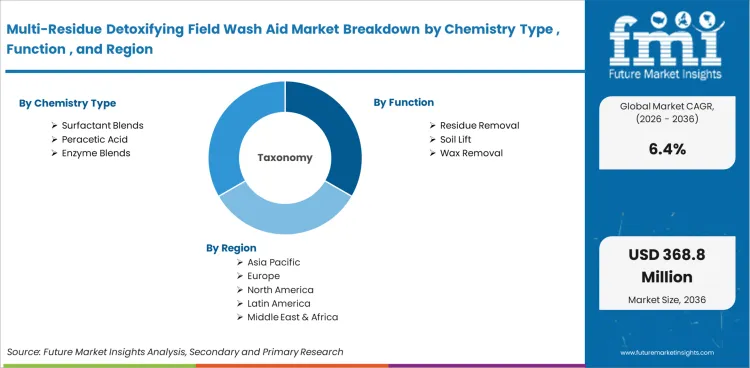
The market is divided into chemistry type and function. Application stage and crop type add a second layer. Form and end user add a third layer. Positioning completes the structure. Chemistry type covers surfactant blends and peracetic acid. It covers enzyme blends and organic acids. Oxidizing blends and mixed detergents complete this segment. Function includes residue removal and soil lift. Wax removal and surface sanitizing add the next group. Water conditioning and biofilm control complete the function segment. Application stage covers packhouse wash and drench. Brush wash and flume wash follow in commercial lines. Final rinse and dip tank complete the application segment.
Insights into the Chemistry Type Segment
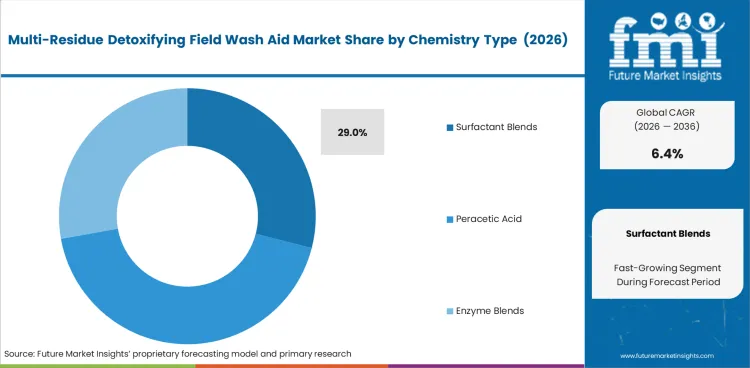
- Surfactant blends are projected to lead the chemistry type segment with 29.0% in 2026. Wetting action improves residue lift across commercial produce lines.
- Peracetic acid and oxidizing blends matter more in wash-water treatment and sanitation-led produce programs.
Insights into the Function Segment
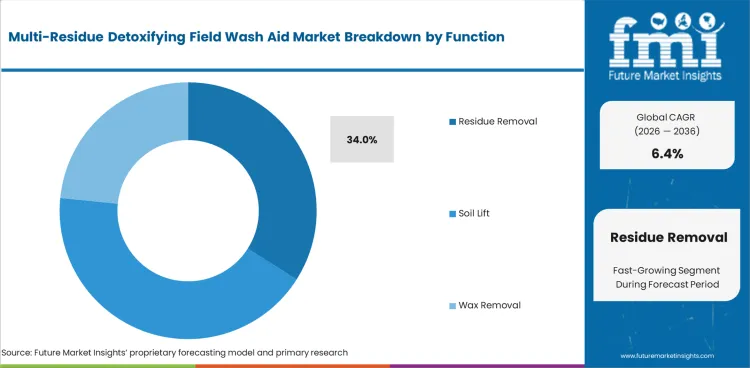
- Residue removal is projected to lead the function segment with 34.0% in 2026. Mixed residue load reduction creates the clearest reason for wash-aid use.
- Soil lift and wax removal create supporting demand in crop-specific handling programs.
Insights into the Application Stage Segment
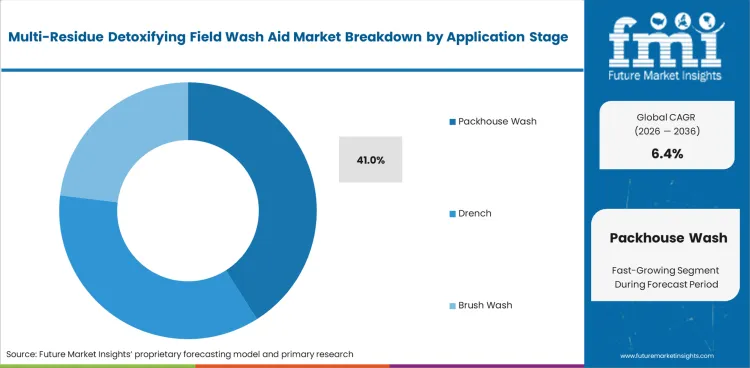
- Packhouse wash is projected to lead the application stage segment with 41.0% in 2026. Controlled dosing is easier in formal wash lines.
- Flume wash and final rinse generate demand in operations balancing hygiene and line throughput.
Insights into the Crop Type Segment
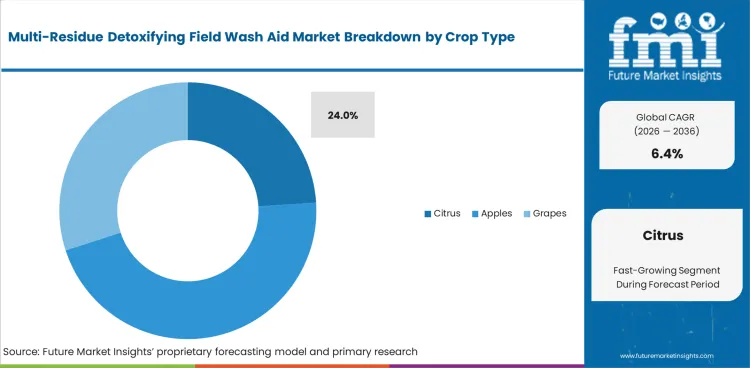
- Citrus is projected to lead the crop type segment with 24.0% in 2026. Citrus packhouses use brush wash at scale.
- Apples and grapes support demand in export and storage channels. Berries and leafy greens support demand in fresh-cut programs.
Insights into the Form Segment
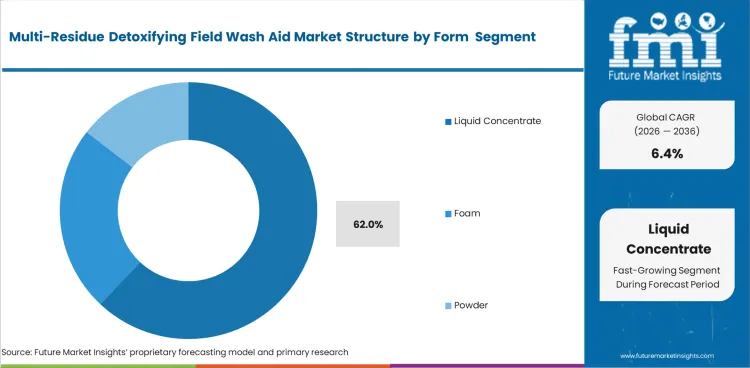
- Liquid concentrate is expected to account for 62.0% share in 2026. Dosing and mixing work better in commercial produce systems. Storage and line integration support the same format.
- Foam and powder formats keep niche use in selected programs. Liquid feed systems retain the stronger operational fit.
Insights into the End User Segment
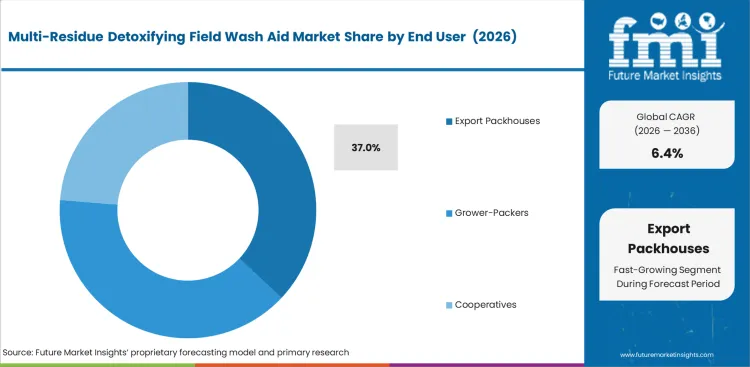
- Export packhouses are projected to contribute 37.0% of total demand in 2026. Residue checks carry a clearer financial impact in this segment.
- Grower-packers and cooperatives contribute to total market volume in domestic trade. Formal chemistry use stays lower in less standardized wash setups.
Insights into the Positioning Segment
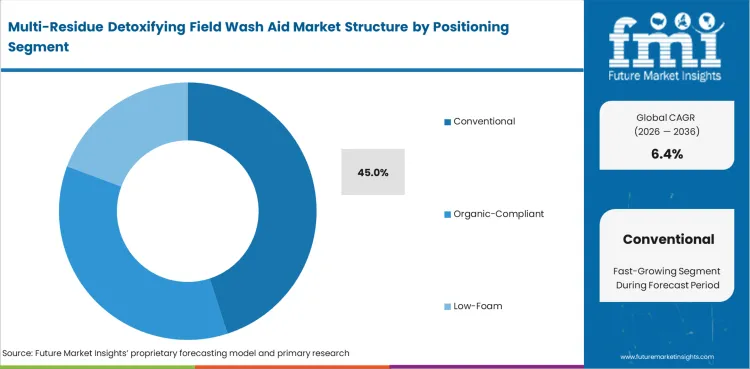
- Conventional products are projected to lead the positioning segment with 45.0% in 2026. Large-scale fruit lines still favor established wash routines.
- Organic-compliant and chlorine-free products are more attractive in premium produce programs. This preference aligns with broader shifts seen in the chlorine-free sanitizing chemicals market.
Multi-Residue Detoxifying Field Wash Aid Market Drivers, Restraints, and Opportunities
- Export residue scrutiny and organized produce handling support market expansion.
- Adoption slows in fragmented local channels. Process control is weaker in such operations.
- Organic-compliant and low-residue product lines create room for product portfolio expansion.
Market value grows through organized packhouse use and crop-specific wash needs. Repeatable wash procedures support this expansion. Higher operating cost can slow broader adoption. Rinse-performance issues can slow adoption. Better wash-water control creates room for supplier expansion.
Export Compliance and Packhouse Adoption
FAO states that food commodities accounted for 86 percent of total trade of crop and livestock products in 2024. FAO states that fruits and vegetables accounted for 21 percent of total value of food exports in 2024. Export programs create stronger demand because shipment quality and residue acceptance carry direct commercial cost. Packhouses handling fruit for distant channels gain more from repeatable chemistry use than handlers serving less formal local routes. [1]
Low-Foam Chemistry and Line-Speed Fit
Ecolab promotes fresh produce processing solutions built around wash-water control and disinfectants. Its offer includes detergents and packing-line integration for fruit and vegetable processing. Low-foam chemistry gains attention in lines running continuous wash and rinse stages. Dosing accuracy affects operating speed. Wash-water control affects operating speed in the same lines. Products that fit existing wash architecture with less disruption are preferred. This operating pattern connects with the harvesting aids and trimming equipment market.
Analysis of Multi-Residue Detoxifying Field Wash Aid Market By Key Countries
.webp "Top Country Growth Comparison Multi Residue Detoxifying Field Wash Aid Market Cagr (2026 2036)")
| Country | CAGR |
|---|---|
| India | 7.6% |
| Mexico | 7.3% |
| South Africa | 7.1% |
| China | 6.9% |
| Spain | 6.3% |
| Italy | 5.9% |
| United States | 5.6% |
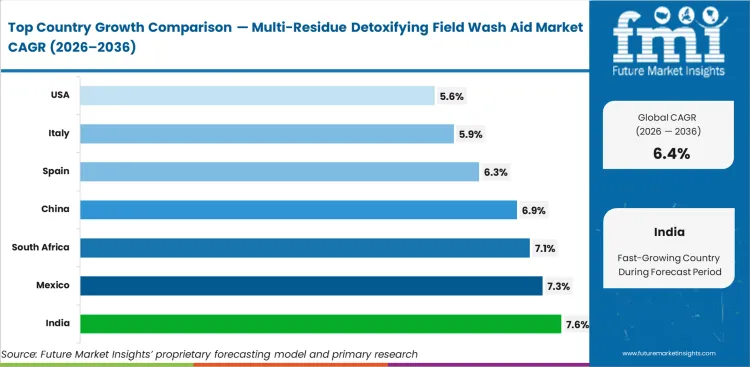
Source: FMI analysis based on primary research and proprietary forecasting model
Multi-Residue Detoxifying Field Wash Aid Market Cagr Analysis By Country
- India is projected to advance at a CAGR of 7.6%. Export horticulture and modern packhouse expansion support formal wash chemistry demand.
- Mexico is projected to expand at a CAGR of 7.3%. Fruit-export intensity and stronger wash-line relevance support shipment-driven programs.
- South Africa is forecast to record a CAGR of 7.1%. Citrus and table grape exports create stronger residue-management value.
- China is projected to record a CAGR of 6.9%. Modern packhouse investment supports quality-driven produce handling.
- Spain is expected to register a CAGR of 6.3%. Citrus export systems and packhouse know-how are well established.
- Italy is likely to progress at a CAGR of 5.9%. Premium fruit handling and export-linked quality management support demand.
- United States is projected to record a CAGR of 5.6%. Large-scale produce handling already starts from a stronger installed base.
The country mix shows healthy demand across mature produce-handling hubs and faster-scaling export horticulture markets.
Demand Outlook for Multi-Residue Detoxifying Field Wash Aid in India
India’s growth outlook benefits from expanding export fruit and vegetable handling. A wider modern packhouse base supports more formal wash programs. Demand for Multi-Residue Detoxifying Field Wash Aid in India is anticipated to rise at a CAGR of 7.6% through 2036. Export quality programs and packhouse standardization support this pace. Organized grading and washing create a stronger market base in fruit clusters.
- Export-linked horticulture builds a clearer chemistry payback case.
- Organized packhouses create better dosing control.
- Crop mix diversity supports broader product trials.
Future Outlook for Multi-Residue Detoxifying Field Wash Aid in Mexico
Mexico benefits from large fruit and vegetable export corridors serving North American buyers. Sales of Multi-Residue Detoxifying Field Wash Aid in Mexico are expected to increase at a CAGR of 7.3% during the forecast period. Produce-export volume and residue-sensitive shipment programs support this pace. Cross-border produce operations create more room for formal wash chemistry use.
- Export logistics favor formal wash routines.
- Retail quality checks support residue-lift chemistry.
- Packhouse density improves repeat use.
Opportunity Analysis of Multi-Residue Detoxifying Field Wash Aid in South Africa
South Africa has strong relevance in citrus and table grape handling. The Multi-Residue Detoxifying Field Wash Aid market in South Africa is projected to expand at a CAGR of 7.1% through 2036. Export packhouse activity and fruit quality management support this pace. Lines balancing appearance retention and long transit requirements create stronger revenue potential.
- Citrus lines support regular wash-chemistry use.
- Export fruit channels favor formal process steps.
- Service-led suppliers gain an edge.
In-depth Analysis of Multi-Residue Detoxifying Field Wash Aid in China
China has broad crop throughput and rising formalization in higher-value fresh produce channels. China is projected to record a CAGR of 6.9% in Multi-Residue Detoxifying Field Wash Aid during the assessment period. Modern packhouse investment and quality-driven produce handling support this pace. Growth is more visible in larger commercial operations than in fragmented local trade.
- Large fruit output supports scale.
- Modern retail channels encourage cleaner produce flow.
- Organized handling raises adoption potential.
Sales Analysis of Multi-Residue Detoxifying Field Wash Aid in Spain
Spain holds a mature export fruit base and strong post-harvest know-how. Multi-Residue Detoxifying Field Wash Aid adoption in Spain is projected to rise at a CAGR of 6.3% by 2036. Citrus and grape export programs use disciplined wash routines. Established packhouse networks support premium service and crop-specific chemistry placement.
- Export fruit handling is well developed.
- Citrus programs support routine wash stages.
- Technical service helps product retention.
Demand Outlook for Multi-Residue Detoxifying Field Wash Aid in Italy
Italy has fresh produce exports and a mature post-harvest service environment. Italy is projected to record a 5.9% CAGR in the Multi-Residue Detoxifying Field Wash Aid market through 2036. Fruit quality management and export-linked compliance needs support this pace. Premium produce channels and longer shipment windows support better supplier returns.
- Fruit quality expectations support wash-step control.
- Premium categories favor appearance retention.
- Technical field support adds value.
Future Outlook for Multi-Residue Detoxifying Field Wash Aid in the United States
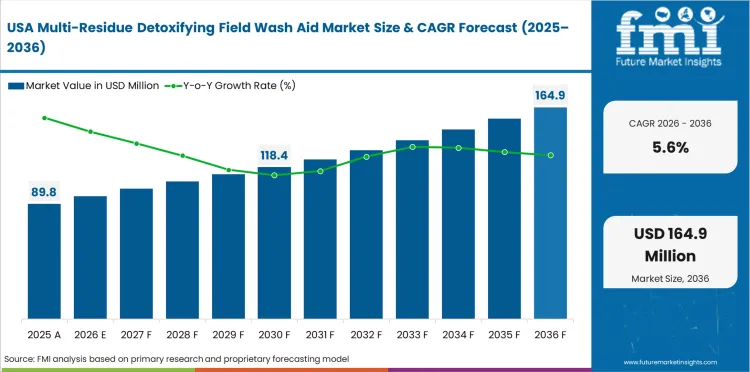
United States demand starts from a larger installed base in produce handling and food safety management. The market for Multi-Residue Detoxifying Field Wash Aid in the United States is expected to grow at a CAGR of 5.6% during the study period. Residue-monitoring awareness and formal wash-water practices support this pace. Growth remains slower than in India or Mexico. Larger produce operations still offer attractive value density.
- Large-scale produce handling sustains steady demand.
- Food safety culture supports wash chemistry use.
- Service reliability matters in account retention.
Competitive Landscape and Strategic Positioning
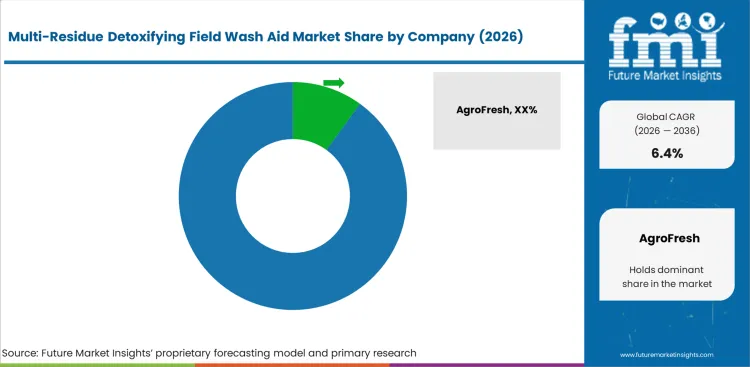
- Leading suppliers compete on post-harvest portfolio breadth and produce-line fit.
- Entry barriers come from crop-specific validation and line compatibility.
- Strategy centers on portfolio expansion and crop specialization.
The competitive landscape divides clearly between produce‑specialist suppliers and broader sanitation‑chemistry providers. AgroFresh and DECCO maintain strong positions through comprehensive post‑harvest portfolios and long‑standing relationships with growers and exporters, which reinforce account stability and repeat adoption. By contrast, Ecolab and BioSafe draw strength from antimicrobial chemistry and wash‑water management expertise, extending their relevance through system control and technical service depth.
Barriers to entry remain high. Market adoption is shaped less by headline residue‑removal claims and more by demonstrated, crop‑specific performance within commercial wash lines. Suppliers that fail to deliver consistent line‑level outcomes struggle to retain accounts, as rinse behavior and surface performance ultimately determine customer stickiness.
Competitive Benchmarking: Multi-Residue Detoxifying Field Wash Aid
| Company | Produce Wash Fit | Postharvest Portfolio | Technical Service | Geographic Footprint |
|---|---|---|---|---|
| AgroFresh | High | High | Strong | Global |
| DECCO Postharvest | High | High | Strong | Global |
| Ecolab | Medium | Medium | Strong | Global |
| BioSafe Systems | Medium | Medium | Medium | North America |
Source: Future Market Insights competitive analysis, 2026. Ratings reflect relative positioning based on produce wash fit and technical service depth.
Key Developments in Multi-Residue Detoxifying Field Wash Aid
- In March 2024, AgroFresh acquired Pace International LLC. The deal expanded its post-harvest portfolio across produce treatment and equipment. It added technical services. [2]
- In January 2025, DECCO Ibérica received registration for DECCO Zox in Spain for citrus postharvest use. The product became the first azoxystrobin registration in Europe for this application. [3]
- In March 2026, AgroFresh presented its citrus protection portfolio at Citrus Showcase. The portfolio focused on decay reduction and storage extension. Transit performance remained a separate focus. [4]
Key Players in the Multi-Residue Detoxifying Field Wash Aid
Major Global Players:
- AgroFresh
- DECCO Postharvest
- Ecolab
- Pace International
Emerging Players/Startups
- BioSafe Systems
- Enviro Tech Chemical Services
- Sanosil
Report Scope and Coverage
| Parameter | Details |
|---|---|
| Quantitative Units | USD Million, Volume Outlook, CAGR 2026 to 2036 |
| Market Definition | Commercial wash-aid chemistry used to reduce mixed surface residue load and improve produce wash performance in formal handling lines |
| Regions Covered | North America, Latin America, Europe, Asia Pacific, Middle East & Africa |
| Countries Covered | India, Mexico, South Africa, China, Spain, Italy, United States |
| Key Companies Profiled | AgroFresh, Pace International, DECCO Postharvest, Ecolab, BioSafe Systems, Enviro Tech Chemical Services, Sanosil |
| Forecast Period | 2026 to 2036 |
| Approach | Primary interviews, desk research, bottom-up sizing, competitive triangulation |
Multi-Residue Detoxifying Field Wash Aid Market by Segments
Multi-Residue Detoxifying Field Wash Aid Market Segmented by Chemistry Type:
- Surfactant Blends
- Peracetic Acid
- Enzyme Blends
- Organic Acids
- Oxidizing Blends
- Mixed Detergents
Multi-Residue Detoxifying Field Wash Aid Market Segmented by Function:
- Residue Removal
- Soil Lift
- Wax Removal
- Surface Sanitizing
- Water Conditioning
- Biofilm Control
Multi-Residue Detoxifying Field Wash Aid Market Segmented by Application Stage:
- Packhouse Wash
- Drench
- Brush Wash
- Flume Wash
- Final Rinse
- Dip Tank
Multi-Residue Detoxifying Field Wash Aid Market Segmented by Crop Type:
- Citrus
- Apples
- Grapes
- Berries
- Leafy Greens
- Tomatoes
- Tropical Fruit
Multi-Residue Detoxifying Field Wash Aid Market Segmented by Form:
- Liquid Concentrate
- Foam
- Powder
- Ready-to-Use
Multi-Residue Detoxifying Field Wash Aid Market Segmented by End User:
- Export Packhouses
- Grower-Packers
- Cooperatives
- Fresh-Cut Plants
- Contract Packers
- Retail Prep Units
Multi-Residue Detoxifying Field Wash Aid Market Segmented by Positioning:
- Conventional
- Organic-Compliant
- Low-Foam
- Low-Residue
- Chlorine-Free
- No-Rinse
Multi-Residue Detoxifying Field Wash Aid Market Segmented by Region:
- North America
- USA
- Canada
- Mexico
- Latin America
- Brazil
- Chile
- Rest of Latin America
- Western Europe
- Germany
- UK
- Italy
- Spain
- France
- Nordic
- BENELUX
- Rest of Western Europe
- Eastern Europe
- Russia
- Poland
- Hungary
- Balkan & Baltic
- Rest of Eastern Europe
- East Asia
- China
- Japan
- South Korea
- South Asia and Pacific
- India
- ASEAN
- Australia & New Zealand
- Rest of South Asia and Pacific
- Middle East & Africa
- Kingdom of Saudi Arabia
- Other GCC Countries
- Turkiye
- South Africa
- Other African Union
- Rest of Middle East & Africa
Research Sources and Bibliography
- Food and Agriculture Organization of the United Nations. (2025, December). Trade of agrifood products – 2000–2024.
- AgroFresh. (2024, March). AgroFresh Acquires Pace International LLC Expanding Post-Harvest Solutions Portfolio.
- DECCO Global. (2025, January). DECCO Ibérica receives the registration for DECCO Zox: First Product formulated with Azoxystrobin in Europe in Postharvest Citrus Protection.
- AgroFresh. (2026, March). AgroFresh to Demonstrate Leading Portfolio of Citrus Protection Solutions at Citrus Showcase.
- U.S. Food and Drug Administration. (2024, March). Selecting and Serving Produce Safely.
- U.S. Department of Agriculture, Agricultural Marketing Service. (2025, December). Pesticide Data Program Annual Summary: Calendar Year 2024.
- European Food Safety Authority. (2025, May). Pesticides residues in food: what’s the situation in the EU?
- Federal Register. (2024, May). Standards for the Growing, Harvesting, Packing, and Holding of Produce for Human Consumption Relating to Agricultural Water.
This Report Answers
- Can organized packhouses generate the largest value pool in this market?
- Is liquid concentrate the top format by 2026?
- Can surfactant blends keep chemistry leadership through 2036?
- Do export fruit programs create stronger adoption than local handling channels?
- Can India outpace Mexico and South Africa in forecast growth?
- Is crop-specific service a major supplier advantage?
- Do low-foam products gain an edge in continuous wash lines?
- Can organic-compliant products add a distinct premium route?
- Is repeat purchase shaped more by rinse quality than broad product claims?
- Do produce specialists hold an advantage over broader sanitation suppliers?
Frequently Asked Questions
What is the main use of a multi-residue detoxifying field wash aid?
It supports residue lift and wash-stage control in commercial fresh produce handling.
Which format leads market demand?
Liquid concentrate leads because dosing is easier and line integration is better.
Which end user segment generates the highest value?
Export packhouses generate the clearest value because shipment quality and compliance pressure are higher.
Why does citrus hold a leading crop share?
Citrus lines use structured washing and brush handling at high frequency.
Which countries show the fastest expansion?
India and Mexico show the fastest pace in this forecast set. South Africa follows closely in the same country group.
What limits adoption in smaller operations?
Lower process standardization and weaker chemistry payback can slow use.
Which companies hold the strongest visibility?
AgroFresh and DECCO hold strong visibility across adjacent post-harvest programs. Ecolab and BioSafe remain visible through wash-water and sanitation portfolios.
What gives suppliers an edge in account retention?
Crop fit and rinse behavior matter more than broad brand claims.
Preview the report firsthand - request a free sample
Get SampleGet the brochure for pricing and purchase details.
Get PDFTable of Content
- Executive Summary
- Global Market Outlook
- Demand-side Trends
- Supply-side Trends
- Technology Roadmap Analysis
- Analysis and Recommendations
- Market Overview
- Market Coverage / Taxonomy
- Market Definition / Scope / Limitations
- Research Methodology
- Analytical Lens and Working Hypotheses
- Market Structure, Signals, and Trend Drivers
- Benchmarking and Cross-market Comparability
- Market Sizing, Forecasting, and Opportunity Mapping
- Research Design and Evidence Framework
- Desk Research Programme (Secondary Evidence)
- Company Annual and Sustainability Reports
- Peer-reviewed Journals and Academic Literature
- Corporate Websites, Product Literature, and Technical Notes
- Earnings Decks and Investor Briefings
- Statutory Filings and Regulatory Disclosures
- Technical White Papers and Standards Notes
- Trade Journals, Industry Magazines, and Analyst Briefs
- Conference Proceedings, Webinars, and Seminar Materials
- Government Statistics Portals and Public Data Releases
- Press Releases and Reputable Media Coverage
- Specialist Newsletters and Curated Briefings
- Sector Databases and Reference Repositories
- FMI Internal Proprietary Databases and Historical Market Datasets
- Subscription Datasets and Paid Sources
- Social Channels, Communities, and Digital Listening Inputs
- Additional Desk Sources
- Expert Input and Fieldwork (Primary Evidence)
- Primary Modes
- Qualitative Interviews and Expert Elicitation
- Quantitative Surveys and Structured Data Capture
- Blended Approach
- Why Primary Evidence is Used
- Field Techniques
- Interviews
- Surveys
- Focus Groups
- Observational and In-context Research
- Social and Community Interactions
- Stakeholder Universe Engaged
- C-suite Leaders
- Board Members
- Presidents and Vice Presidents
- R&D and Innovation Heads
- Technical Specialists
- Domain Subject-matter Experts
- Scientists
- Physicians and Other Healthcare Professionals
- Governance, Ethics, and Data Stewardship
- Research Ethics
- Global Market Analysis 2021 to 2025 and Forecast, 2026 to 2036
- Historical Market Size Value (USD Million) Analysis, 2021 to 2025
- Current and Future Market Size Value (USD Million) Projections, 2026 to 2036
- Y-o-Y Growth Trend Analysis
- Absolute $ Opportunity Analysis
- Global Market Pricing Analysis 2021 to 2025 and Forecast 2026 to 2036
- Global Market Analysis 2021 to 2025 and Forecast 2026 to 2036, By Chemistry
- Introduction / Key Findings
- Historical Market Size Value (USD Million) Analysis By Chemistry , 2021 to 2025
- Current and Future Market Size Value (USD Million) Analysis and Forecast By Chemistry , 2026 to 2036
- Peracetic Blends
- Chlorine Dioxide
- Hydrogen Peroxide
- Peracetic Blends
- Y-o-Y Growth Trend Analysis By Chemistry , 2021 to 2025
- Absolute $ Opportunity Analysis By Chemistry , 2026 to 2036
- Global Market Analysis 2021 to 2025 and Forecast 2026 to 2036, By Application Stage
- Introduction / Key Findings
- Historical Market Size Value (USD Million) Analysis By Application Stage, 2021 to 2025
- Current and Future Market Size Value (USD Million) Analysis and Forecast By Application Stage, 2026 to 2036
- Packing Lines
- Cold Rooms
- Hydrocoolers
- Packing Lines
- Y-o-Y Growth Trend Analysis By Application Stage, 2021 to 2025
- Absolute $ Opportunity Analysis By Application Stage, 2026 to 2036
- Global Market Analysis 2021 to 2025 and Forecast 2026 to 2036, By End User
- Introduction / Key Findings
- Historical Market Size Value (USD Million) Analysis By End User, 2021 to 2025
- Current and Future Market Size Value (USD Million) Analysis and Forecast By End User, 2026 to 2036
- Packhouses
- Exporters
- Cold Stores
- Packhouses
- Y-o-Y Growth Trend Analysis By End User, 2021 to 2025
- Absolute $ Opportunity Analysis By End User, 2026 to 2036
- Global Market Analysis 2021 to 2025 and Forecast 2026 to 2036, By Region
- Introduction
- Historical Market Size Value (USD Million) Analysis By Region, 2021 to 2025
- Current Market Size Value (USD Million) Analysis and Forecast By Region, 2026 to 2036
- North America
- Latin America
- Western Europe
- Eastern Europe
- East Asia
- South Asia and Pacific
- Middle East & Africa
- Market Attractiveness Analysis By Region
- North America Market Analysis 2021 to 2025 and Forecast 2026 to 2036, By Country
- Historical Market Size Value (USD Million) Trend Analysis By Market Taxonomy, 2021 to 2025
- Market Size Value (USD Million) Forecast By Market Taxonomy, 2026 to 2036
- By Country
- USA
- Canada
- Mexico
- By Chemistry
- By Application Stage
- By End User
- By Country
- Market Attractiveness Analysis
- By Country
- By Chemistry
- By Application Stage
- By End User
- Key Takeaways
- Latin America Market Analysis 2021 to 2025 and Forecast 2026 to 2036, By Country
- Historical Market Size Value (USD Million) Trend Analysis By Market Taxonomy, 2021 to 2025
- Market Size Value (USD Million) Forecast By Market Taxonomy, 2026 to 2036
- By Country
- Brazil
- Chile
- Rest of Latin America
- By Chemistry
- By Application Stage
- By End User
- By Country
- Market Attractiveness Analysis
- By Country
- By Chemistry
- By Application Stage
- By End User
- Key Takeaways
- Western Europe Market Analysis 2021 to 2025 and Forecast 2026 to 2036, By Country
- Historical Market Size Value (USD Million) Trend Analysis By Market Taxonomy, 2021 to 2025
- Market Size Value (USD Million) Forecast By Market Taxonomy, 2026 to 2036
- By Country
- Germany
- UK
- Italy
- Spain
- France
- Nordic
- BENELUX
- Rest of Western Europe
- By Chemistry
- By Application Stage
- By End User
- By Country
- Market Attractiveness Analysis
- By Country
- By Chemistry
- By Application Stage
- By End User
- Key Takeaways
- Eastern Europe Market Analysis 2021 to 2025 and Forecast 2026 to 2036, By Country
- Historical Market Size Value (USD Million) Trend Analysis By Market Taxonomy, 2021 to 2025
- Market Size Value (USD Million) Forecast By Market Taxonomy, 2026 to 2036
- By Country
- Russia
- Poland
- Hungary
- Balkan & Baltic
- Rest of Eastern Europe
- By Chemistry
- By Application Stage
- By End User
- By Country
- Market Attractiveness Analysis
- By Country
- By Chemistry
- By Application Stage
- By End User
- Key Takeaways
- East Asia Market Analysis 2021 to 2025 and Forecast 2026 to 2036, By Country
- Historical Market Size Value (USD Million) Trend Analysis By Market Taxonomy, 2021 to 2025
- Market Size Value (USD Million) Forecast By Market Taxonomy, 2026 to 2036
- By Country
- China
- Japan
- South Korea
- By Chemistry
- By Application Stage
- By End User
- By Country
- Market Attractiveness Analysis
- By Country
- By Chemistry
- By Application Stage
- By End User
- Key Takeaways
- South Asia and Pacific Market Analysis 2021 to 2025 and Forecast 2026 to 2036, By Country
- Historical Market Size Value (USD Million) Trend Analysis By Market Taxonomy, 2021 to 2025
- Market Size Value (USD Million) Forecast By Market Taxonomy, 2026 to 2036
- By Country
- India
- ASEAN
- Australia & New Zealand
- Rest of South Asia and Pacific
- By Chemistry
- By Application Stage
- By End User
- By Country
- Market Attractiveness Analysis
- By Country
- By Chemistry
- By Application Stage
- By End User
- Key Takeaways
- Middle East & Africa Market Analysis 2021 to 2025 and Forecast 2026 to 2036, By Country
- Historical Market Size Value (USD Million) Trend Analysis By Market Taxonomy, 2021 to 2025
- Market Size Value (USD Million) Forecast By Market Taxonomy, 2026 to 2036
- By Country
- Kingdom of Saudi Arabia
- Other GCC Countries
- Turkiye
- South Africa
- Other African Union
- Rest of Middle East & Africa
- By Chemistry
- By Application Stage
- By End User
- By Country
- Market Attractiveness Analysis
- By Country
- By Chemistry
- By Application Stage
- By End User
- Key Takeaways
- Key Countries Market Analysis
- USA
- Pricing Analysis
- Market Share Analysis, 2025
- By Chemistry
- By Application Stage
- By End User
- Canada
- Pricing Analysis
- Market Share Analysis, 2025
- By Chemistry
- By Application Stage
- By End User
- Mexico
- Pricing Analysis
- Market Share Analysis, 2025
- By Chemistry
- By Application Stage
- By End User
- Brazil
- Pricing Analysis
- Market Share Analysis, 2025
- By Chemistry
- By Application Stage
- By End User
- Chile
- Pricing Analysis
- Market Share Analysis, 2025
- By Chemistry
- By Application Stage
- By End User
- Germany
- Pricing Analysis
- Market Share Analysis, 2025
- By Chemistry
- By Application Stage
- By End User
- UK
- Pricing Analysis
- Market Share Analysis, 2025
- By Chemistry
- By Application Stage
- By End User
- Italy
- Pricing Analysis
- Market Share Analysis, 2025
- By Chemistry
- By Application Stage
- By End User
- Spain
- Pricing Analysis
- Market Share Analysis, 2025
- By Chemistry
- By Application Stage
- By End User
- France
- Pricing Analysis
- Market Share Analysis, 2025
- By Chemistry
- By Application Stage
- By End User
- India
- Pricing Analysis
- Market Share Analysis, 2025
- By Chemistry
- By Application Stage
- By End User
- ASEAN
- Pricing Analysis
- Market Share Analysis, 2025
- By Chemistry
- By Application Stage
- By End User
- Australia & New Zealand
- Pricing Analysis
- Market Share Analysis, 2025
- By Chemistry
- By Application Stage
- By End User
- China
- Pricing Analysis
- Market Share Analysis, 2025
- By Chemistry
- By Application Stage
- By End User
- Japan
- Pricing Analysis
- Market Share Analysis, 2025
- By Chemistry
- By Application Stage
- By End User
- South Korea
- Pricing Analysis
- Market Share Analysis, 2025
- By Chemistry
- By Application Stage
- By End User
- Russia
- Pricing Analysis
- Market Share Analysis, 2025
- By Chemistry
- By Application Stage
- By End User
- Poland
- Pricing Analysis
- Market Share Analysis, 2025
- By Chemistry
- By Application Stage
- By End User
- Hungary
- Pricing Analysis
- Market Share Analysis, 2025
- By Chemistry
- By Application Stage
- By End User
- Kingdom of Saudi Arabia
- Pricing Analysis
- Market Share Analysis, 2025
- By Chemistry
- By Application Stage
- By End User
- Turkiye
- Pricing Analysis
- Market Share Analysis, 2025
- By Chemistry
- By Application Stage
- By End User
- South Africa
- Pricing Analysis
- Market Share Analysis, 2025
- By Chemistry
- By Application Stage
- By End User
- USA
- Market Structure Analysis
- Competition Dashboard
- Competition Benchmarking
- Market Share Analysis of Top Players
- By Regional
- By Chemistry
- By Application Stage
- By End User
- Competition Analysis
- Competition Deep Dive
- AgroFresh
- Overview
- Product Portfolio
- Profitability by Market Segments (Product/Age /Sales Channel/Region)
- Sales Footprint
- Strategy Overview
- Marketing Strategy
- Product Strategy
- Channel Strategy
- Solenis
- Ecolab
- Evonik
- BioSafe Systems
- Enviro Tech Chemical Services
- UPL
- AgroFresh
- Competition Deep Dive
- Primary Modes
- Assumptions & Acronyms Used
- Desk Research Programme (Secondary Evidence)
- Analytical Lens and Working Hypotheses


