

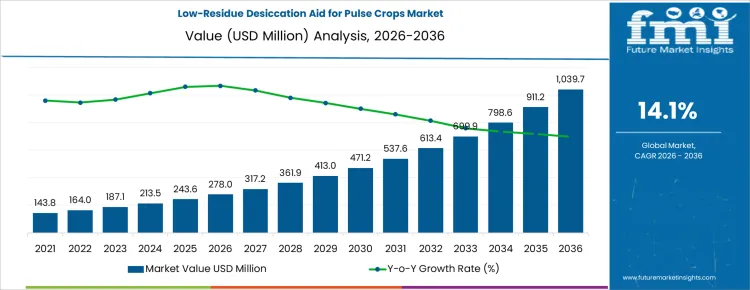
- Industry Size (2026)
- USD 278 Mn
- Forecast (2036)
- USD 1041 Mn
- CAGR (2026 to 2036)
- 14.1%
Low-Residue Desiccation Aid for Pulse Crops Market Forecast and Outlook 2026 to 2036
The low-residue desiccation aid for pulse crops market is set to expand significantly, growing from USD 278 million in 2026 to USD 1,041 million by 2036, with a CAGR of 14.1%. This growth is driven by the increasing demand for eco-friendly solutions to manage crop drying and harvest timing, particularly for pulse crops like lentils, chickpeas, and dry peas. Among desiccation aid types, plant-based & bio-derived desiccants lead the market with a 36% share, due to their environmentally friendly nature and ability to accelerate drying. Other notable desiccation aids include low-residue contact desiccation aids, accelerated senescence biostimulants, and silicone & penetration-assist desiccants. In terms of pulse crop types, lentils hold the largest share at 31%, followed by chickpeas, dry peas, and beans & other pulses.
Quick Stats for Low-Residue Desiccation Aid for Pulse Crops Market
- Low-Residue Desiccation Aid for Pulse Crops Market Value (2026): USD 278 million
- Low-Residue Desiccation Aid for Pulse Crops Market Forecast Value (2036): USD 1,041 million
- Low-Residue Desiccation Aid for Pulse Crops Market Forecast CAGR: 14.1%
- Leading Desiccation Aid in Low-Residue Desiccation Aid for Pulse Crops Market: Plant-Based & Bio-Derived Desiccants (36%)
- Key Growth Regions in Low-Residue Desiccation Aid for Pulse Crops Market: Canada, India, Australia, USA, France
- Key Players in Low-Residue Desiccation Aid for Pulse Crops Market: Drexel Chemical Company, Loveland Products Inc., Kumiai Chemical Industry Co., Ltd., Nissan Chemical Corporation, Sinon Corporation
Canada leads with a 15.3% CAGR, driven by its extensive pulse farming and focus on export-quality crops. India follows closely with 14.8%, benefiting from its growing pulse acreage and demand for low-residue solutions. Australia and the USA grow at 14.4% and 13.6%, respectively, with increasing adoption of efficient desiccation solutions. France sees steady growth at 13.2%, supported by its focus on eco-friendly farming practices. This trend highlights the growing emphasis on reducing residues, improving harvest efficiency, and meeting global food safety standards.
Low‑Residue Desiccation Aid for Pulse Crops Market Key Takeaways
| Metric | Value |
|---|---|
| Industry Value (2026) | USD 278 million |
| Forecast Value (2036) | USD 1,041 million |
| Forecast CAGR (2026 to 2036) | 14.1% |
How is the Global Low‑Residue Desiccation Aid for Pulse Crops Sector Advancing?
The global low‑residue desiccation aid for pulse crops market is growing rapidly as pulse producers seek efficient and eco-friendly solutions to manage crop drying and harvest timing. Desiccation aids are applied before harvest to speed up crop maturation, reduce moisture content, and promote uniform drying, helping to minimize losses due to weather, disease, or uneven ripening. Traditional desiccants often leave residues that can affect seed quality or regulatory compliance, driving demand for low‑residue formulations that meet stricter food safety standards and export requirements while maintaining effectiveness.
The pulse crops segment including peas, lentils, chickpeas, and beans, has seen increased production globally due to rising demand for plant‑based proteins, eco-friendly rotations, and soil health benefits. As growers expand pulse acreage, the need for advanced desiccation strategies that preserve grain quality and enhance operational efficiency has increased. Innovations in low‑residue desiccants focus on improving the uptake, crop selectivity, and breakdown characteristics to ensure that residues diminish to acceptable levels by harvest time, supporting both marketability and regulatory compliance.
Demand is expected to expand strongly as producers adopt precision agronomy practices and seek tools that align with environmental and quality standards. Continued research into formulation performance under diverse climates and pulse varieties will broaden applicability. Challenges such as variability in crop response, the need for region‑specific application guidance, and balancing cost with performance may influence adoption. Despite these factors, the drive toward higher quality, eco-friendly pulse production will sustain demand for low‑residue desiccation aids worldwide.
What is the Segment-Wise Analysis for the Global Low-Residue Desiccation Aid for Pulse Crops Market?
The global low-residue desiccation aid for pulse crops market is segmented by desiccation aid type and pulse crop type. Plant-based & bio-derived desiccants lead the market with a 36% share, offering eco-friendly solutions for pulse crop desiccation. Other significant desiccation aid types include low-residue contact desiccation aids, accelerated senescence biostimulants, and silicone & penetration-assist desiccants. In terms of pulse crop types, lentils hold the largest share at 31%, followed by chickpeas, dry peas, and beans & other pulses.
How Do Plant-Based & Bio-Derived Desiccants Lead the Global Low-Residue Desiccation Aid Market?
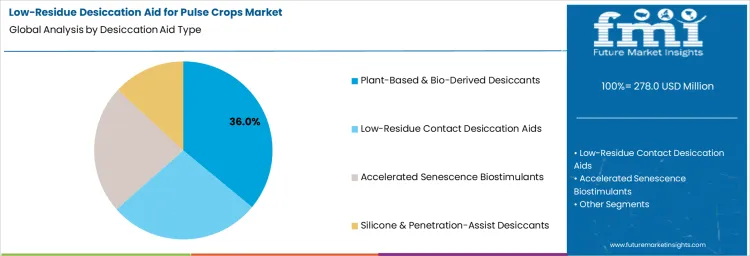
Plant-based & bio-derived desiccants hold a 36% share in the global low-residue desiccation aid for pulse crops market due to their environmentally friendly nature and effectiveness in facilitating rapid and uniform drying. These desiccants, derived from natural sources, reduce the need for synthetic chemicals, making them a eco-friendly choice for pulse crops. They help manage crop moisture content, promoting efficient harvesting and reducing the risk of contamination. As growers increasingly seek eco-friendly solutions, plant-based desiccants continue to lead the market, offering both high performance and minimal environmental impact.
Why Do Lentils Hold the Largest Share in the Global Low-Residue Desiccation Aid for Pulse Crops Market?
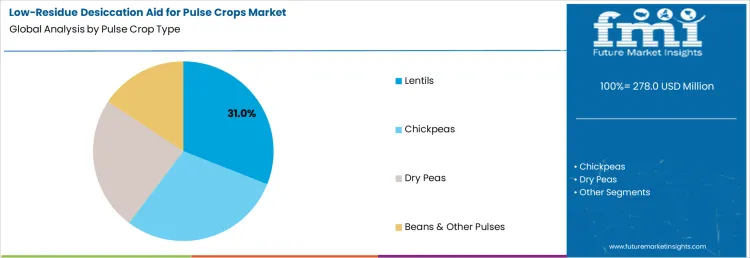
Lentils hold the largest share of 31% in the global low-residue desiccation aid for pulse crops market due to their widespread cultivation and sensitivity to harvest timing. Desiccation aids are critical for lentils to ensure uniform ripening and drying, which helps reduce spoilage and enhances quality. As lentils are often harvested in challenging weather conditions, using desiccation aids like plant-based desiccants and biostimulants ensures efficient moisture management and improves crop yield. The growing demand for lentils in food markets and the need for efficient harvesting solutions continue to drive the adoption of desiccation aids in lentil production.
What is Shaping the Low‑Residue Desiccation Aid for Pulse Crops Market?
The low‑residue desiccation aid for pulse crops market is shaped by the increasing adoption of precision harvest practices and stringent residue standards in global food supply chains. Pulse crops such as peas, lentils, chickpeas, and beans often require desiccation to accelerate dry‑down, uniformity, and harvest timing. Traditional desiccants can leave residues that affect marketability and regulatory compliance. Low‑residue desiccation aids enable growers to achieve efficient crop drying while meeting residue limits and food safety requirements.
What Challenges Are Limiting Adoption of Low‑Residue Desiccation Aids for Pulse Crops?
Adoption is limited by cost concerns and performance variability across environments and crop types. Low‑residue formulations can carry higher upfront prices compared with conventional products, which may deter some growers. Variable efficacy under different climatic conditions such as humidity, temperature, and crop maturity can also create uncertainty. Some producers may be hesitant to switch without clear localized data showing consistent dry‑down benefits and compliant residue levels. Compatibility with existing harvest equipment and crop protection programs requires careful integration and agronomic guidance, which may be limited in certain regions.
What Key Trends Are Shaping the Low‑Residue Desiccation Aid for Pulse Crops Market?
Key trends include the development of multi‑functional desiccation aids that combine low‑residue action with enhanced plant stress tolerance and improved harvest quality. There is rising interest in bio‑based and low‑toxicity formulations that align with sustainability goals and meet increasingly stringent residue regulations. Precision application technologies such as variable‑rate spraying and digital crop status monitoring are helping growers optimise timing and dosage to maximise effectiveness. Collaborations between chemical formulators, agronomists, and pulse growers are driving tailored solutions for regional pulse systems.
What is the Growth Outlook for the Low-Residue Desiccation Aid for Pulse Crops Market by Country?
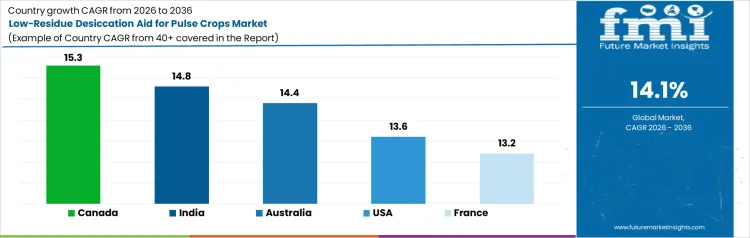
| Country | CAGR (%) |
|---|---|
| Canada | 15.3% |
| India | 14.8% |
| Australia | 14.4% |
| USA | 13.6% |
| France | 13.2% |
The low-residue desiccation aid for pulse crops market is growing steadily, with Canada leading at a 15.3% CAGR, driven by the increasing adoption of pulse crops and the need for effective desiccation solutions with low chemical residue. India follows with 14.8%, supported by its significant pulse crop production and growing demand for safer, low-residue agricultural solutions. Australia’s market grows at 14.4%, driven by the need for efficient and eco-friendly desiccation methods in pulse farming. The USA’s market grows at 13.6%, fueled by rising demand for high-quality pulse crops with minimal pesticide residues. France’s market grows at 13.2%, as farmers increasingly focus on improving crop yield while adhering to food safety standards.
Why is Canada Leading in the Low-Residue Desiccation Aid for Pulse Crops Market?
Canada’s low-residue desiccation aid for pulse crops market is growing at 15.3%, driven by the country’s position as one of the largest producers and exporters of pulse crops like lentils, peas, and chickpeas. With a focus on food safety and export quality, Canadian farmers are adopting desiccation aids that help control the timing of harvest while ensuring minimal residue on crops. As pulse production continues to rise in Canada, there is increasing demand for desiccation solutions that help achieve optimal drying conditions without leaving harmful chemical residues. The market for low-residue desiccation aids is also supported by Canada’s regulatory framework, which emphasizes eco-friendly farming practices and safe food production. As Canadian farmers continue to innovate and meet international quality standards, the adoption of low-residue desiccation aids is expected to grow.
What is Driving the Growth of the Low-Residue Desiccation Aid for Pulse Crops Market in India?
India’s low-residue desiccation aid for pulse crops market is growing at 14.8%, driven by the country’s large pulse crop production, including lentils, chickpeas, and peas, which are essential for both domestic consumption and export markets. The increasing demand for safer agricultural products with minimal chemical residues is pushing Indian farmers to adopt low-residue desiccation aids. These solutions help control the harvest timing and ensure better crop yield without compromising the safety and quality of the pulses. As India focuses on improving crop productivity and meeting international food safety standards, the demand for low-residue desiccation aids is expected to rise. The Indian government’s initiatives to promote eco-friendly agriculture further support the market growth, ensuring the continued adoption of these safe and effective desiccation solutions.
How is the Low-Residue Desiccation Aid for Pulse Crops Market Expanding in Australia?
Australia’s low-residue desiccation aid for pulse crops market is growing at 14.4%, driven by the country’s extensive pulse production, particularly in regions with large-scale lentil and chickpea farming. Australian farmers are increasingly turning to low-residue desiccation aids to ensure their crops meet both local and international quality standards, with minimal chemical residues. The market for desiccation aids is further fueled by Australia’s focus on eco-friendly farming practices and reducing pesticide use. As demand for pulse crops increases, particularly in export markets, farmers are adopting solutions that enhance crop drying efficiency without compromising the quality or safety of the final product. With the rise of precision agriculture and the increasing focus on food safety, the low-residue desiccation aid market in Australia is expected to continue expanding.
What is Contributing to the Growth of the Low-Residue Desiccation Aid for Pulse Crops Market in the USA?
The USA’s low-residue desiccation aid for pulse crops market is growing at 13.6%, driven by the country’s increasing focus on producing high-quality pulse crops such as dry beans, peas, and lentils, which are in high demand for both domestic consumption and export. As food safety regulations become more stringent, there is a growing need for desiccation aids that minimize residue levels while enhancing harvest efficiency. American farmers are adopting low-residue desiccation aids to ensure their crops meet regulatory standards and maintain product integrity. With the increasing demand for cleaner agricultural practices and eco-friendly farming solutions, the market for low-residue desiccation aids is expected to grow steadily, particularly in regions where pulse production is a key agricultural focus.
What is Driving the Growth of the Low-Residue Desiccation Aid for Pulse Crops Market in France?
France’s low-residue desiccation aid for pulse crops market is growing at 13.2%, supported by the country’s focus on eco-friendly farming practices and the rising demand for high-quality pulses. As France continues to prioritize food safety and environmental responsibility in agriculture, the need for low-residue desiccation aids is increasing. These solutions help French farmers effectively manage harvest timing while ensuring minimal chemical residues on crops, which is especially important for meeting both domestic and export quality standards. As the European Union strengthens regulations on pesticide use and residue levels, the demand for low-residue desiccation aids in France is expected to continue growing, ensuring that pulse crops maintain their market appeal while adhering to stringent safety standards.
How Are Companies Competing in the Low‑Residue Desiccation Aid for Pulse Crops Market?
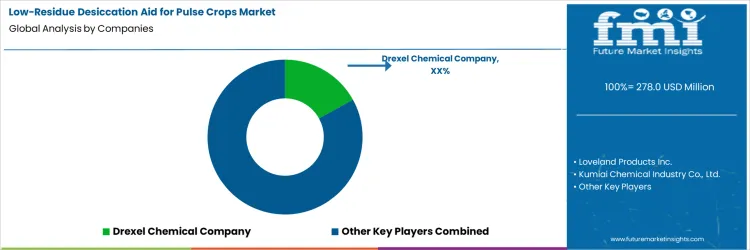
In the low‑residue desiccation aid for pulse crops market Drexel Chemical Company, Loveland Products Inc., Kumiai Chemical Industry Co., Ltd., Nissan Chemical Corporation, Sinon Corporation, and others are positioned with product brochures that emphasize effective crop dry‑down with minimal residue. At Drexel Chemical Company formulations are described with rapid plant moisture reduction and clean harvest windows. Trial performance highlights and clear use‑rate guidance are provided to help growers plan pre‑harvest applications. Loveland Products Inc. materials present low‑residue solutions alongside agronomic advice, with technical sections that show improved standing and reduced green stems at harvest. Application charts and crop stage recommendations are included to aid decision making.
Kumiai Chemical Industry Co., Ltd. brochures showcase desiccation aids engineered for predictable dry‑down and enhanced harvest efficiency. Performance data is shown with emphasis on pulse crop quality and market standards for low residues. Nissan Chemical Corporation collateral focuses on chemistry that supports uniform crop senescence with minimal leftover active traces. Short product summaries explain tank‑mix options and timing strategies. Sinon Corporation literature highlights desiccants described with compatibility guidance for diverse pulse varieties. Others in the segment bring niche desiccation technologies or region‑specific aid blends that address local climatic and crop conditions.
Key Players in Low-Residue Desiccation Aid for Pulse Crops Market
- Drexel Chemical Company
- Loveland Products Inc.
- Kumiai Chemical Industry Co., Ltd.
- Nissan Chemical Corporation
- Sinon Corporation
- Others
Scope of Report
| Items | Values |
|---|---|
| Quantitative Units (2026) | USD million |
| Desiccation Aid Type | Plant-Based & Bio-Derived Desiccants, Low-Residue Contact Desiccation Aids, Accelerated Senescence Biostimulants, Silicone & Penetration-Assist Desiccants |
| Pulse Crop Type | Lentils, Chickpeas, Dry Peas, Beans & Other Pulses |
| Regions Covered | Asia Pacific, Europe, North America, Latin America, Middle East & Africa |
| Countries Covered | USA, China, Japan, South Korea, India, Australia & New Zealand, ASEAN, Germany, UK, France, Italy, Spain, Nordic, BENELUX, Brazil, Chile, Mexico, Saudi Arabia, Other GCC Countries, Turkey, South Africa, Other African Union |
| Key Companies Profiled | Drexel Chemical Company, Loveland Products Inc., Kumiai Chemical Industry Co., Ltd., Nissan Chemical Corporation, Sinon Corporation, Others |
| Additional Attributes | Dollar sales by desiccation aid type, pulse crop type, and region; regional CAGR and growth outlook; distribution channels including pulse crop suppliers, agricultural product distributors; innovation trends in low-residue desiccation aids; competitive positioning of global vs regional suppliers. |
Low-Residue Desiccation Aid for Pulse Crops Market by Segments
Desiccation Aid Type
- Plant-Based & Bio-Derived Desiccants
- Low-Residue Contact Desiccation Aids
- Accelerated Senescence Biostimulants
- Silicone & Penetration-Assist Desiccants
Pulse Crop Type
- Lentils
- Chickpeas
- Dry Peas
- Beans & Other Pulses
Region:
- Asia Pacific
- China
- Japan
- South Korea
- India
- Australia & New Zealand
- ASEAN
- Rest of Asia Pacific
- Europe
- Germany
- United Kingdom
- France
- Italy
- Spain
- Nordic
- BENELUX
- Rest of Europe
- North America
- United States
- Canada
- Mexico
- Latin America
- Brazil
- Chile
- Rest of Latin America
- Middle East & Africa
- Kingdom of Saudi Arabia
- Other GCC Countries
- Turkey
- South Africa
- Other African Union
- Rest of Middle East & Africa
Frequently Asked Questions
How big is the low-residue desiccation aid for pulse crops market in 2026?
The global low-residue desiccation aid for pulse crops market is estimated to be valued at USD 278.0 million in 2026.
What will be the size of low-residue desiccation aid for pulse crops market in 2036?
The market size for the low-residue desiccation aid for pulse crops market is projected to reach USD 1,039.7 million by 2036.
How much will be the low-residue desiccation aid for pulse crops market growth between 2026 and 2036?
The low-residue desiccation aid for pulse crops market is expected to grow at a 14.1% CAGR between 2026 and 2036.
What are the key product types in the low-residue desiccation aid for pulse crops market?
The key product types in low-residue desiccation aid for pulse crops market are plant-based & bio-derived desiccants, low-residue contact desiccation aids, accelerated senescence biostimulants and silicone & penetration-assist desiccants.
Which pulse crop type segment to contribute significant share in the low-residue desiccation aid for pulse crops market in 2026?
In terms of pulse crop type, lentils segment to command 31.0% share in the low-residue desiccation aid for pulse crops market in 2026.
Preview the report firsthand - request a free sample
Get SampleGet the brochure for pricing and purchase details.
Get PDFTable of Content
- Executive Summary
- Global Market Outlook
- Demand-side Trends
- Supply-side Trends
- Technology Roadmap Analysis
- Analysis and Recommendations
- Market Overview
- Market Coverage / Taxonomy
- Market Definition / Scope / Limitations
- Market Background
- Market Dynamics
- Drivers
- Restraints
- Opportunity
- Trends
- Scenario Forecast
- Demand in Optimistic Scenario
- Demand in Likely Scenario
- Demand in Conservative Scenario
- Opportunity Map Analysis
- Product Life Cycle Analysis
- Supply Chain Analysis
- Investment Feasibility Matrix
- Value Chain Analysis
- PESTLE and Porter’s Analysis
- Regulatory Landscape
- Regional Parent Market Outlook
- Production and Consumption Statistics
- Import and Export Statistics
- Market Dynamics
- Global Market Analysis 2021 to 2025 and Forecast, 2026 to 2036
- Historical Market Size Value (USD Million) Analysis, 2021 to 2025
- Current and Future Market Size Value (USD Million) Projections, 2026 to 2036
- Y-o-Y Growth Trend Analysis
- Absolute $ Opportunity Analysis
- Global Market Pricing Analysis 2021 to 2025 and Forecast 2026 to 2036
- Global Market Analysis 2021 to 2025 and Forecast 2026 to 2036, By Desiccation Aid Type
- Introduction / Key Findings
- Historical Market Size Value (USD Million) Analysis By Desiccation Aid Type , 2021 to 2025
- Current and Future Market Size Value (USD Million) Analysis and Forecast By Desiccation Aid Type , 2026 to 2036
- Plant-Based & Bio-Derived Desiccants
- Low-Residue Contact Desiccation Aids
- Accelerated Senescence Biostimulants
- Silicone & Penetration-Assist Desiccants
- Y-o-Y Growth Trend Analysis By Desiccation Aid Type , 2021 to 2025
- Absolute $ Opportunity Analysis By Desiccation Aid Type , 2026 to 2036
- Global Market Analysis 2021 to 2025 and Forecast 2026 to 2036, By Pulse Crop Type
- Introduction / Key Findings
- Historical Market Size Value (USD Million) Analysis By Pulse Crop Type, 2021 to 2025
- Current and Future Market Size Value (USD Million) Analysis and Forecast By Pulse Crop Type, 2026 to 2036
- Lentils
- Chickpeas
- Dry Peas
- Beans & Other Pulses
- Y-o-Y Growth Trend Analysis By Pulse Crop Type, 2021 to 2025
- Absolute $ Opportunity Analysis By Pulse Crop Type, 2026 to 2036
- Global Market Analysis 2021 to 2025 and Forecast 2026 to 2036, By Region
- Introduction
- Historical Market Size Value (USD Million) Analysis By Region, 2021 to 2025
- Current Market Size Value (USD Million) Analysis and Forecast By Region, 2026 to 2036
- North America
- Latin America
- Western Europe
- Eastern Europe
- East Asia
- South Asia and Pacific
- Middle East & Africa
- Market Attractiveness Analysis By Region
- North America Market Analysis 2021 to 2025 and Forecast 2026 to 2036, By Country
- Historical Market Size Value (USD Million) Trend Analysis By Market Taxonomy, 2021 to 2025
- Market Size Value (USD Million) Forecast By Market Taxonomy, 2026 to 2036
- By Country
- USA
- Canada
- Mexico
- By Desiccation Aid Type
- By Pulse Crop Type
- By Country
- Market Attractiveness Analysis
- By Country
- By Desiccation Aid Type
- By Pulse Crop Type
- Key Takeaways
- Latin America Market Analysis 2021 to 2025 and Forecast 2026 to 2036, By Country
- Historical Market Size Value (USD Million) Trend Analysis By Market Taxonomy, 2021 to 2025
- Market Size Value (USD Million) Forecast By Market Taxonomy, 2026 to 2036
- By Country
- Brazil
- Chile
- Rest of Latin America
- By Desiccation Aid Type
- By Pulse Crop Type
- By Country
- Market Attractiveness Analysis
- By Country
- By Desiccation Aid Type
- By Pulse Crop Type
- Key Takeaways
- Western Europe Market Analysis 2021 to 2025 and Forecast 2026 to 2036, By Country
- Historical Market Size Value (USD Million) Trend Analysis By Market Taxonomy, 2021 to 2025
- Market Size Value (USD Million) Forecast By Market Taxonomy, 2026 to 2036
- By Country
- Germany
- UK
- Italy
- Spain
- France
- Nordic
- BENELUX
- Rest of Western Europe
- By Desiccation Aid Type
- By Pulse Crop Type
- By Country
- Market Attractiveness Analysis
- By Country
- By Desiccation Aid Type
- By Pulse Crop Type
- Key Takeaways
- Eastern Europe Market Analysis 2021 to 2025 and Forecast 2026 to 2036, By Country
- Historical Market Size Value (USD Million) Trend Analysis By Market Taxonomy, 2021 to 2025
- Market Size Value (USD Million) Forecast By Market Taxonomy, 2026 to 2036
- By Country
- Russia
- Poland
- Hungary
- Balkan & Baltic
- Rest of Eastern Europe
- By Desiccation Aid Type
- By Pulse Crop Type
- By Country
- Market Attractiveness Analysis
- By Country
- By Desiccation Aid Type
- By Pulse Crop Type
- Key Takeaways
- East Asia Market Analysis 2021 to 2025 and Forecast 2026 to 2036, By Country
- Historical Market Size Value (USD Million) Trend Analysis By Market Taxonomy, 2021 to 2025
- Market Size Value (USD Million) Forecast By Market Taxonomy, 2026 to 2036
- By Country
- China
- Japan
- South Korea
- By Desiccation Aid Type
- By Pulse Crop Type
- By Country
- Market Attractiveness Analysis
- By Country
- By Desiccation Aid Type
- By Pulse Crop Type
- Key Takeaways
- South Asia and Pacific Market Analysis 2021 to 2025 and Forecast 2026 to 2036, By Country
- Historical Market Size Value (USD Million) Trend Analysis By Market Taxonomy, 2021 to 2025
- Market Size Value (USD Million) Forecast By Market Taxonomy, 2026 to 2036
- By Country
- India
- ASEAN
- Australia & New Zealand
- Rest of South Asia and Pacific
- By Desiccation Aid Type
- By Pulse Crop Type
- By Country
- Market Attractiveness Analysis
- By Country
- By Desiccation Aid Type
- By Pulse Crop Type
- Key Takeaways
- Middle East & Africa Market Analysis 2021 to 2025 and Forecast 2026 to 2036, By Country
- Historical Market Size Value (USD Million) Trend Analysis By Market Taxonomy, 2021 to 2025
- Market Size Value (USD Million) Forecast By Market Taxonomy, 2026 to 2036
- By Country
- Kingdom of Saudi Arabia
- Other GCC Countries
- Turkiye
- South Africa
- Other African Union
- Rest of Middle East & Africa
- By Desiccation Aid Type
- By Pulse Crop Type
- By Country
- Market Attractiveness Analysis
- By Country
- By Desiccation Aid Type
- By Pulse Crop Type
- Key Takeaways
- Key Countries Market Analysis
- USA
- Pricing Analysis
- Market Share Analysis, 2025
- By Desiccation Aid Type
- By Pulse Crop Type
- Canada
- Pricing Analysis
- Market Share Analysis, 2025
- By Desiccation Aid Type
- By Pulse Crop Type
- Mexico
- Pricing Analysis
- Market Share Analysis, 2025
- By Desiccation Aid Type
- By Pulse Crop Type
- Brazil
- Pricing Analysis
- Market Share Analysis, 2025
- By Desiccation Aid Type
- By Pulse Crop Type
- Chile
- Pricing Analysis
- Market Share Analysis, 2025
- By Desiccation Aid Type
- By Pulse Crop Type
- Germany
- Pricing Analysis
- Market Share Analysis, 2025
- By Desiccation Aid Type
- By Pulse Crop Type
- UK
- Pricing Analysis
- Market Share Analysis, 2025
- By Desiccation Aid Type
- By Pulse Crop Type
- Italy
- Pricing Analysis
- Market Share Analysis, 2025
- By Desiccation Aid Type
- By Pulse Crop Type
- Spain
- Pricing Analysis
- Market Share Analysis, 2025
- By Desiccation Aid Type
- By Pulse Crop Type
- France
- Pricing Analysis
- Market Share Analysis, 2025
- By Desiccation Aid Type
- By Pulse Crop Type
- India
- Pricing Analysis
- Market Share Analysis, 2025
- By Desiccation Aid Type
- By Pulse Crop Type
- ASEAN
- Pricing Analysis
- Market Share Analysis, 2025
- By Desiccation Aid Type
- By Pulse Crop Type
- Australia & New Zealand
- Pricing Analysis
- Market Share Analysis, 2025
- By Desiccation Aid Type
- By Pulse Crop Type
- China
- Pricing Analysis
- Market Share Analysis, 2025
- By Desiccation Aid Type
- By Pulse Crop Type
- Japan
- Pricing Analysis
- Market Share Analysis, 2025
- By Desiccation Aid Type
- By Pulse Crop Type
- South Korea
- Pricing Analysis
- Market Share Analysis, 2025
- By Desiccation Aid Type
- By Pulse Crop Type
- Russia
- Pricing Analysis
- Market Share Analysis, 2025
- By Desiccation Aid Type
- By Pulse Crop Type
- Poland
- Pricing Analysis
- Market Share Analysis, 2025
- By Desiccation Aid Type
- By Pulse Crop Type
- Hungary
- Pricing Analysis
- Market Share Analysis, 2025
- By Desiccation Aid Type
- By Pulse Crop Type
- Kingdom of Saudi Arabia
- Pricing Analysis
- Market Share Analysis, 2025
- By Desiccation Aid Type
- By Pulse Crop Type
- Turkiye
- Pricing Analysis
- Market Share Analysis, 2025
- By Desiccation Aid Type
- By Pulse Crop Type
- South Africa
- Pricing Analysis
- Market Share Analysis, 2025
- By Desiccation Aid Type
- By Pulse Crop Type
- USA
- Market Structure Analysis
- Competition Dashboard
- Competition Benchmarking
- Market Share Analysis of Top Players
- By Regional
- By Desiccation Aid Type
- By Pulse Crop Type
- Competition Analysis
- Competition Deep Dive
- Drexel Chemical Company
- Overview
- Product Portfolio
- Profitability by Market Segments (Product/Age /Sales Channel/Region)
- Sales Footprint
- Strategy Overview
- Marketing Strategy
- Product Strategy
- Channel Strategy
- Loveland Products Inc.
- Kumiai Chemical Industry Co., Ltd.
- Nissan Chemical Corporation
- Sinon Corporation
- Others
- Drexel Chemical Company
- Competition Deep Dive
- Assumptions & Acronyms Used
- Research Methodology


