


Key Takeaways
- Technical textile pricing is dominated by specialized fiber costs and conversion processes rather than basic weaving, with high-performance materials like aramids, carbon fiber, and specialty polyesters commanding premium pricing based on molecular engineering and production complexity.
- Manufacturing costs concentrate in three critical areas: fiber production requiring specialized chemistry and controlled environments, fabric conversion involving coating and lamination processes, and performance testing that validates compliance with industry standards across aerospace, automotive, medical, and protective equipment applications.
- Global fiber producers like DuPont, Toray, and DSM maintain structural pricing advantages through proprietary polymer chemistry and vertical integration, while fabric converters compete primarily on application expertise and customer-specific customization capabilities.
- Performance requirements drive cost complexity exponentially, with flame resistance, chemical protection, electromagnetic shielding, and mechanical strength specifications requiring multi-layer constructions and specialized treatments that can multiply base fabric costs.
Why do technical textiles cost dramatically more than commodity fabrics?
Technical textiles represent a fundamental departure from traditional textile manufacturing, where performance specifications drive material selection and processing decisions rather than cost optimization. The fiber layer forms the foundation of technical textile costs, with specialty polymers engineered for specific molecular properties commanding prices that can be multiple times higher than commodity fibers.
Aramid fibers exemplify this cost structure complexity. DuPont's Kevlar and Teijin's Twaron require controlled polymerization processes, specialized spinning equipment, and heat treatment cycles that create inherently higher production costs compared to standard polyester or nylon. These fibers deliver exceptional strength-to-weight ratios and thermal stability, but manufacturing complexity translates directly into raw material costs that ripple through the entire value chain.
Carbon fiber production represents another cost multiplication layer. The conversion from polyacrylonitrile precursor through oxidation and carbonization requires controlled atmospheric conditions, precise temperature management, and extended processing times. Technical grade carbon fibers can cost ten times more per pound than conventional textile fibers, yet aerospace and automotive applications justify these costs through weight reduction and performance benefits that commodity materials cannot deliver.
Beyond fiber costs, technical textiles require specialized conversion processes that add substantial manufacturing complexity. Coating applications, lamination processes, and multi-layer constructions demand equipment investments and processing expertise that traditional textile manufacturers lack. These conversion steps often require clean room environments, precision application systems, and extensive quality control testing that increases both capital requirements and operational costs.
Where do performance specifications create hidden cost multipliers?
Technical textile applications impose performance requirements that cascade through every aspect of manufacturing and testing. Fire resistance standards, for example, require not only flame-retardant fibers but also specialized treatments, seam constructions, and validation testing that adds multiple cost layers beyond base fabric production.
Chemical protection creates another cost dimension through material compatibility requirements and barrier performance specifications. Fabrics designed for chemical protective clothing must resist permeation and degradation from specific hazardous substances while maintaining breathability and flexibility. This requires extensive material testing, often involving accelerated aging studies and exposure to actual chemicals under controlled conditions.
Electromagnetic interference shielding demands metallic fiber integration or conductive coatings that significantly increase material costs while requiring specialized processing equipment. The shielding effectiveness must be validated across specific frequency ranges, necessitating sophisticated testing capabilities that few manufacturers possess internally.
Mechanical performance specifications in applications like geotextiles or industrial filtration require precisely controlled fabric constructions with validated tensile strength, elongation properties, and dimensional stability. These requirements often necessitate custom weaving patterns, specialized finishing treatments, and extensive mechanical testing that adds both time and cost to the manufacturing process.
Medical and pharmaceutical applications impose the most stringent requirements, combining biocompatibility, sterilization resistance, and contamination control standards. These fabrics must often undergo validation testing that can extend over months, with documentation requirements that add substantial overhead to the manufacturing cost structure.
How do fiber producers maintain pricing control in technical applications?
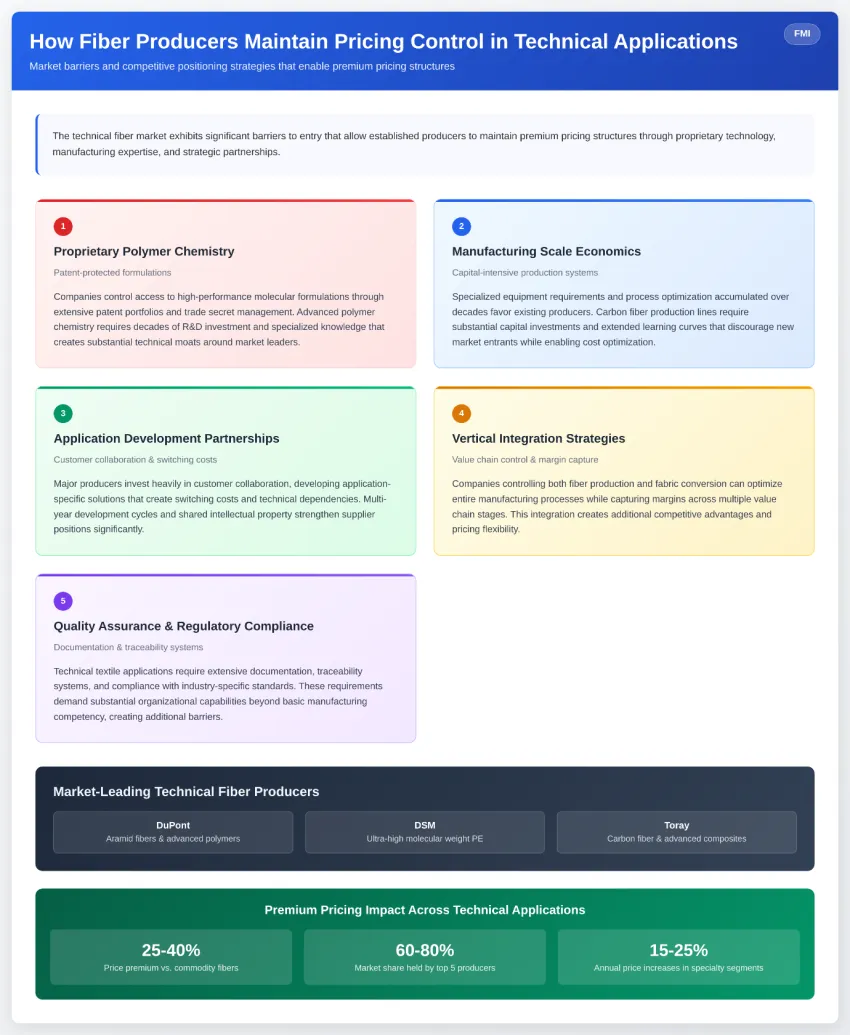
The technical fiber market exhibits significant barriers to entry that allow established producers to maintain premium pricing structures. Proprietary polymer chemistry represents the foundation of competitive positioning, with companies like DuPont, DSM, and Toray controlling access to high-performance molecular formulations through patent protection and trade secret management.
Manufacturing scale economics favor existing producers through specialized equipment requirements and process optimization accumulated over decades of production experience. Carbon fiber production lines, for example, require substantial capital investments and extended learning curves that discourage new market entrants while allowing established producers to optimize costs through operational refinement.
Application development partnerships create another layer of competitive protection. Major fiber producers invest heavily in customer collaboration, developing application-specific solutions that create switching costs and technical dependencies. These relationships often involve multi-year development cycles and shared intellectual property that strengthen supplier positions.
Vertical integration strategies allow major producers to capture value across multiple stages of the technical textile value chain. Companies that control both fiber production and fabric conversion can optimize the entire manufacturing process while capturing margins that would otherwise flow to independent converters.
Quality assurance and regulatory compliance capabilities represent substantial barriers for potential competitors. Technical textile applications often require extensive documentation, traceability systems, and compliance with industry-specific standards that demand significant organizational capabilities beyond basic manufacturing competency.
Why fabric converters struggle with margin compression despite specialization?
Fabric conversion represents the most competitive layer in technical textiles, where numerous companies compete to transform high-performance fibers into application-specific fabrics. This market structure creates inherent margin pressure despite the specialized nature of technical textile applications.
Customer concentration amplifies competitive pressure in many technical textile segments. Aerospace applications, for example, are dominated by a small number of original equipment manufacturers with substantial purchasing power and detailed technical specifications. These customers can pit multiple converters against each other while maintaining strict quality and delivery requirements.
Technology accessibility has increased as coating equipment, lamination systems, and testing capabilities become more widely available through equipment suppliers. This reduces the technical barriers that once protected established converters while increasing the number of competitors capable of serving specific application niches.
Customization requirements create operational complexity that erodes economies of scale. Technical textile applications often require unique fabric constructions, specialized treatments, and customer-specific testing protocols that prevent standardized production runs and increase manufacturing costs.
Investment requirements for new applications create financial strain without guaranteed returns. Each new technical textile application may require equipment modifications, process development, and extensive testing that demands substantial upfront investment with uncertain payback periods.
Raw material cost volatility affects converters disproportionately because they typically cannot pass through cost increases as quickly as fiber producers. Long-term supply agreements with customers may lock in selling prices while input costs fluctuate with fiber market conditions.
Sources
- USA Department of Energy. Advanced Materials and Manufacturing Technologies Office. Fiber and Textile Manufacturing: Energy and Environmental Assessment.
- European Commission - Joint Research Centre. Technical Textiles and Nonwovens: Environmental Impact Assessment and Life Cycle Analysis.
- International Organization for Standardization. Technical Textiles: Performance Standards, Testing Methods, and Certification Requirements.
- Massachusetts Institute of Technology. Materials Science and Engineering: Advanced Polymer Processing and High-Performance Fiber Production.
- University of Manchester. Textile Research Centre. Technical Textiles Manufacturing: Process Engineering and Cost Analysis Studies.
- Federal Aviation Administration. Technical Standards Order: Material and Process Specifications for Aerospace Textile Applications.

