


By Nikhil Kaitwade
Hybrid e-scooters sit in a practical middle ground. They appeal most where riders want lower fuel burn and lower emissions but cannot depend on a dense charging network yet.
That makes the category especially relevant in delivery, shared mobility, and commuter use cases where downtime is expensive. The market is not only about technology preference. It is also about uptime, incentives, and how quickly charging infrastructure catches up with real-world usage.
What is giving the market momentum
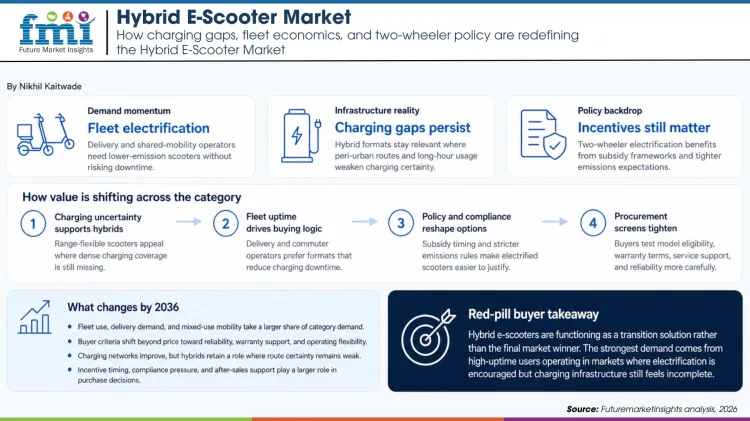
- Last-mile fleets are electrifying on visible deadlines, and that supports demand for range-flexible vehicle formats.
- Policy support remains active, even when subsidy programs are being redesigned or tightened.
Large delivery platforms have made public EV commitments, and those targets put pressure on procurement teams to adopt workable two-wheeler solutions quickly. Hybrid scooters benefit when operators want to lower emissions now but cannot risk long charging breaks during multi-shift operation.
Government support is still a major influence. India moved through EMPS and newer FY2024-25 measures, while the IEA continues to track strong momentum in electric two- and three-wheelers across Asia. In that setting, hybrid models benefit from the broader policy push even if they are often purchased as a bridge technology.
Where real demand is building
- Charging coverage outside core urban districts still leaves room for hybrid platforms.
- Regulatory pressure on conventional scooters is making electrified alternatives easier to justify.
Infrastructure gaps remain a stubborn commercial issue. Many peri-urban and secondary routes still do not support the charging certainty that 0 need, especially when vehicles run for long hours. Hybrid scooters stay attractive in those corridors because they reduce downtime risk without forcing a full return to internal-combustion economics.
Compliance pressure adds another push. EU type-approval rules and tighter emissions expectations raise the long-term cost and risk of staying with pure ICE platforms in many markets. For buyers with export exposure or future regulatory uncertainty, hybrid scooters offer a cleaner hedge while infrastructure matures.
| Market dimension | 2015-2025 | 2026-2036 |
|---|---|---|
| Use case | Private commuting and early experimentation shaped demand. | Fleet uptime, delivery, and mixed-use mobility become more important. |
| Infrastructure context | Limited charging networks slowed pure-electric adoption. | Charging expands, but hybrid formats still benefit where uptime matters. |
| Policy impact | Subsidies created interest but often lacked long-term certainty. | Procurement responds to more formal incentive frameworks and compliance pressure. |
| Buyer criteria | Price and fuel savings led the buying decision. | Reliability, warranty support, and operating flexibility matter more. |
| Competitive pressure | ICE scooters still dominated most routes. | Electrified platforms steadily take share, with hybrids serving transition demand. |
What buyers should test before they commit
- Policy timing and model-level incentive eligibility can change project economics quickly.
- Reliability data matters more in hybrids because buyers are managing both electric and fuel-system risk.
The move from FAME-style support to newer schemes shows how quickly incentive assumptions can change. Buyers should validate subsidy status by model, timing, and geography rather than treating program headlines as guaranteed economics.
Durability and service support need the same discipline. Hybrid scooters combine two powertrain logics, so battery warranty terms, fuel-system components, service intervals, and allocation policies all affect uptime. This is especially important for fleet users who cannot absorb unexpected maintenance complexity.
What the next phase is likely to look like
- The category should stay policy-sensitive through the next few years, even as charging improves.
- Pure battery scooters will gain share over time, but hybrids still have room where route certainty is poor.
Near-term volume will continue to track subsidy frameworks, fleet replacement cycles, and charger rollout. That means the market should remain strongest in places where electrification is encouraged but infrastructure still feels incomplete to high-mileage users.
Over the longer run, hybrid scooters are likely to function as a transition category rather than the final market winner. Even so, the transition can last longer than early forecasts assumed. For segment detail and the 2026-2036 forecast, see the Future Market Insights report: Hybrid E-Scooter Market (2026 - 2036) - https://www.futuremarketinsights.com/reports/hybrid-e-scooter-market
Bibliography
- International Energy Agency, Global EV Outlook 2024: Trends in other light-duty electric vehicles. Https://www.iea.org/reports/global-ev-outlook-2024/trends-in-other-light-duty-electric-vehicles
- Ministry of Heavy Industries, Government of India, EMPS 2024 and FY2024-25 updates (press release PDF). Https://heavyindustries.gov.in/sites/default/files/2025-04/press_release.pdf1.pdf
- EUR-Lex, Regulation (EU) No 168/2013 on the approval and market surveillance of two- or three-wheel vehicles and quadricycles. Https://eur-lex.europa.eu/eli/reg/2013/168/oj/eng
- BikeDekho product page noting Jan 27, 2026 RayZR 125 Fi Hybrid recall window and details. Https://www.bikedekho.com/yamaha-ray-scooters
- IndianRetailer coverage of Swiggy's EV fleet expansion and 2030 target. Https://www.indianretailer.com/news/swiggy-expands-ev-partners-and-models-cut-last-mile-emissions
- Economic Times report on last-mile delivery emissions and public pressure in Bengaluru. Https://economictimes.indiatimes.com/industry/renewables/98-1-bengaluru-respondents-push-for-ev-transition-of-fleets-for-last-mile-delivery-study/articleshow/113201481.cms?from=mdr
- Moneycontrol report on India e-scooter penetration expectations by FY26. Https://www.moneycontrol.com/news/business/e-scooters-to-account-for-20-of-india-s-market-by-fy26-report-12895707.html

