


By Sabyasachi Ghosh
Telepresence robots are moving beyond showcase deployments. Hospitals are now evaluating them as part of routine specialist access, remote rounding, and coverage planning.
That change depends on more than hardware. It reflects a mix of reimbursement clarity, clinician shortages, and the practical value of mobile bedside access in facilities that cannot place every specialist on site.
Why the market has become more budgetable
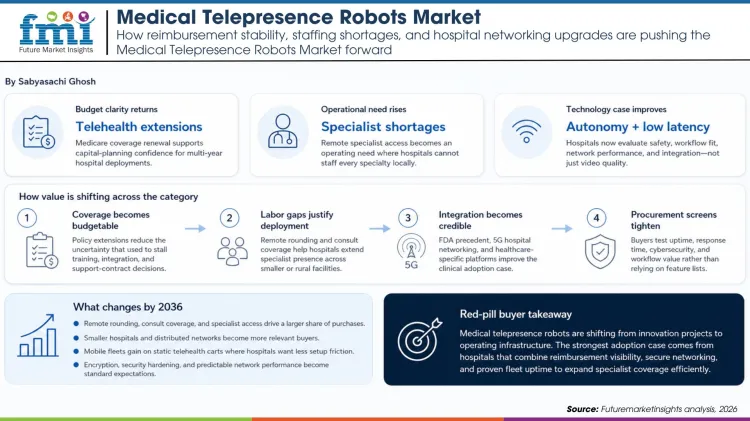
- Medicare telehealth extensions have reduced the policy uncertainty that used to stall multi-year buying decisions.
- Physician shortages are turning remote specialist access into an operating need rather than an innovation project.
Telehealth reimbursement disruptions in 2025 showed exactly how sensitive the market can be to coverage policy. The later extension and two-year renewal restored enough certainty for health systems to think in capital-planning terms again, which is essential for robots that need network integration, training, and support contracts.
Staffing pressure is the other anchor. AAMC shortage projections make it clear that many hospitals will struggle to staff every specialty locally, especially in smaller or rural settings. Telepresence robots help close that gap by putting specialist presence where the labor market cannot.
Where adoption is becoming more credible
- Clinical validation and low-latency connectivity are improving at the same time.
- Vendor strategies are becoming more healthcare-specific and easier for hospitals to integrate.
FDA precedent for autonomous telepresence in hospitals and newer 5G medical networking trials both improve the technology case. Buyers are no longer evaluating only whether a robot can move and stream video. They are evaluating whether it can do so safely, with acceptable latency, inside real clinical workflows.
The supplier landscape is also becoming more purposeful. Healthcare-focused platforms, product repositioning, and virtual-care stack integration have made the category easier to buy as part of a service model. That reduces the friction hospitals used to face when they had to stitch together software, hardware, and support from multiple partners.
| Market dimension | 2015-2025 | 2026-2036 |
|---|---|---|
| Primary role | Pilot programs and novelty deployments were common. | Remote rounding, consult coverage, and specialist access drive more purchases. |
| Policy backdrop | Reimbursement uncertainty slowed larger rollouts. | More stable coverage improves capital planning confidence. |
| Technology baseline | Mobility and video quality were the main selling points. | Autonomy, latency, security, and uptime become core buying criteria. |
| Buyer type | Large systems led most deployments. | Smaller hospitals and distributed networks become more relevant buyers. |
| Vendor expectation | Hardware differentiation carried more weight. | Hospitals prefer integrated support, workflow fit, and security assurance. |
What operational risks still matter
- Revenue assumptions should still be tested against the policy calendar, not treated as permanent.
- Hospitals need proof of uptime, response time, and clinical workflow value, not just feature lists.
Even after recent renewals, coverage remains something buyers must watch carefully. A time-bound reimbursement framework changes the way CFOs evaluate long-lived equipment, especially if a business case assumes broad virtual visit monetization.
Operational evidence matters just as much. Hospitals should ask for documented consult response times, fleet uptime, cybersecurity controls, and examples of transfer avoidance or specialist coverage improvement. In this market, unreliable deployment data can undo a strong hardware pitch very quickly.
What the next buying cycle may reward
- Mobile fleets should gain on static telehealth carts where hospitals want less setup friction.
- Private 5G, stronger encryption, and security hardening are likely to become standard expectations.
The category is likely to tilt further toward self-navigating or easier-to-deploy mobile systems because hospitals are trying to save clinician time, not create more setup work. That makes bedside availability and movement efficiency more important than flashy hardware design.
Security and network quality will also become table stakes. Hospitals that invest in local wireless upgrades will expect vendors to show predictable QoS behavior, strong encryption, and evidence of continuous security maintenance. For the full market outlook through 2036, see the Future Market Insights report: Medical Telepresence Robots Market (2026 - 2036) - https://www.futuremarketinsights.com/reports/medical-telepresence-robots-market
Bibliography
- https://www.ama-assn.org/practice-management/digital-health/medicare-telehealth-coverage-renewed-two-years
- https://www.klgates.com/Climbing-Back-up-the-Telehealth-Cliff-Congress-Extends-Medicare-Flexibilities-Through-30-January-2026-12-9-2025
- https://www.axios.com/2025/11/12/shutdown-deal-extends-medicare-telehealth-coverage
- https://www.aamc.org/news/press-releases/new-aamc-report-shows-continuing-projected-physician-shortage
- https://investor.irobot.com/news-releases/news-release-details/fda-clears-first-autonomous-telemedicine-robot-hospitals
- https://journals.sagepub.com/doi/10.1177/26924366251398400
- https://ohmnilabs.com/healthcare/
- https://www.teladochealth.com/content/tdh-www/us/en/home/newsroom/press/teladoc-health-completes-acquisition-of-intouch-health-creating-single-virtual-care-delivery-leader-from-hospital-to-home.html
- https://pubmed.ncbi.nlm.nih.gov/40780548/
- https://www.frontiersin.org/journals/neurology/articles/10.3389/fneur.2025.1573275/full
- https://arxiv.org/abs/2512.21079

