


- Canned tuna is highly exposed to private-label competition because it is shelf-stable, price-comparable, and frequently bought as a pantry protein.
- Canned light tuna leads product demand because it offers accessible pricing, broad retail availability, and everyday meal utility.
- Chunk tuna leads product form demand because it works across sandwiches, salads, pasta, rice bowls, casseroles, and quick meals.
- Private label pressure is strongest in basic canned light tuna, chunk tuna, multipacks, tuna in water, tuna in brine, and value pantry formats.
- Branded players are safer when they defend trust through sustainability claims, traceability, protein positioning, taste, convenience, and product innovation.
- The biggest misconception is that canned tuna brands are protected by legacy loyalty. In reality, shoppers often compare price per can, pack size, format, and retailer shelf placement first.
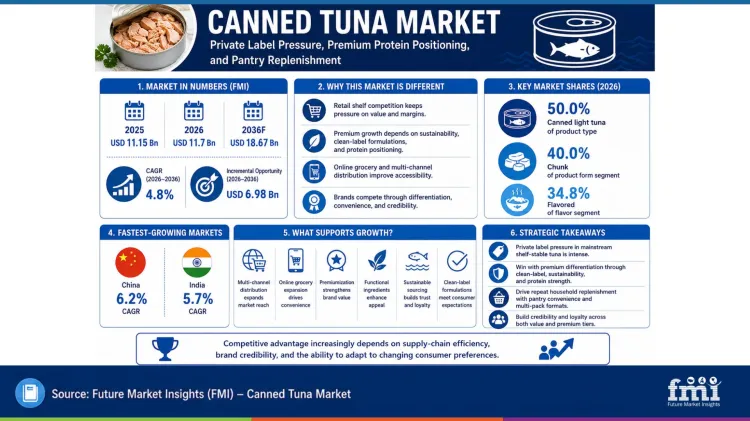
Private label is one of the most important competitive threats in the Canned Tuna Market. Canned tuna is not a niche seafood product for most households. It is a shelf-stable pantry protein that shoppers buy for sandwiches, salads, pasta, rice bowls, quick dinners, school lunches, meal prep, and emergency pantry stocking. This makes it naturally attractive for supermarket and big-box private-label programs.
Market preview from FMI reveals why the category will be prone to retailer domination. The market has been estimated to be valued at USD 11.15 Bn in 2025, is expected to hit USD 11.7 Bn in 2026, and is projected to be worth USD 18.67 Bn by 2036. Additionally, FMI points out that private label proliferation among large retailers has been eating into the profit margins of the brands. This is relevant since canned tuna is a category dominated by factors like shelf positioning and pricing.
Canned light tuna is expected to account for 50.0% of product type share in 2026. This is the center of private-label pressure. Light tuna is widely understood, accessible, and value-oriented. It is not always bought for gourmet differentiation. Many shoppers see it as a protein staple. If a retailer offers a credible store-brand light tuna at a lower price, some households will switch unless the branded product gives them a clear reason not to.
The Packaged Food Market is relevant because canned tuna behaves like a packaged pantry staple. It competes in a shopping environment where consumers compare shelf-stable proteins, ready-to-eat meal components, and household replenishment items. Retailers are strong in this environment because they control shelf blocks, price ladders, and own-brand architecture.
Chunk tuna will be at the top of the form hierarchy with a projected share of 40.0% by 2026. The reasoning behind this statement is that chunk tuna is easy and well-known, hence the reinforcement of private label exposure. Chunk tuna is applicable in several common dishes and does not need an expensive culinary justification.
The Ready-to-Eat Food Market is useful when discussing canned tuna’s convenience role. Canned tuna supports quick meals without cooking, refrigeration, or complex preparation. This makes it valuable for price-sensitive households, students, working adults, and families. Private label can compete strongly when convenience and affordability matter more than premium branding.
There are many ways retailers can put pressure on the brand. One way is through providing inexpensive shelf-priced tuna. Another way would be through creating multi-packs to enhance perceptions of price per can. Also, they could incorporate their store branded tuna into meal solution displays. Finally, they could introduce premium private label lines incorporating sustainable sourcing claims, olive oil varieties, or flavors. Thus, private label could hit both value and premium segments.
FMI’s Canned Tuna Market page states that supermarkets and hypermarkets still make up the bulk of volume, while online platforms and convenience formats are expanding. This gives retailers strong category influence. Even where branded tuna remains important, retailers can use shelf control to improve private-label visibility and negotiate harder on promotions.
The Seafood Packaging Market is relevant because packaging can become a private-label differentiator. Store brands can use easy-open cans, multipack wraps, pouches, or resealable formats to make canned tuna more convenient. If branded players stay with basic packaging while retailers improve usability, the brand premium weakens.
Private label does not have an equal effect across all segments. The branded players have a stronger defense for sustainably sourced tuna, specialty tuna, tuna with flavoring, tuna packed in olive oil, low-sodium varieties, tuna claimed to be caught by pole and line, MSC certified tuna, premium white tuna, and single serve meal kits.
Flavored tuna accounts for 34.8% of the flavor segment in FMI’s preview. This is important because flavored formats can help brands defend differentiation. Lemon pepper, spicy, garlic herb, Mediterranean, and other flavor variants can make tuna feel like a meal solution rather than a basic commodity. However, private labels can also enter flavored formats once demand is proven.
The Processed Seafood Market supports the broader point that seafood brands increasingly compete through convenience, packaging, and value-added formats. Canned tuna companies that rely only on legacy brand awareness may lose ground as retailers become more sophisticated.
It is important to refute the myth that private label cannot compete in the market since people who buy canned tuna already trust certain seafood companies. However, trust is important, particularly regarding safety and quality. Still, people do not mind buying products from other companies when the items are familiar, durable, and affordable.
Branded players should not respond only with discounting. Excessive promotion can train shoppers to buy only on price. A stronger defense is visible differentiation: traceability, responsible sourcing, protein content, clean ingredients, low sodium, better texture, better taste, convenient formats, and recipe-led usage.
Bottom line: Private label will not eliminate branded canned tuna, but it can pressure the core pantry segment. Brands that defend only through shelf familiarity will be exposed. Brands that defend through sourcing credibility, product quality, convenience, and meal-use innovation will be better positioned.
FMI Related Links
- Canned Tuna Market: Primary link for market value, canned light tuna share, chunk tuna share, and private-label pressure
- Packaged Food Market: Use when discussing pantry staples and packaged food competition
- Ready-to-Eat Food Market: Use when discussing canned tuna as a quick meal protein
- Seafood Packaging Market: Use when discussing cans, pouches, multipacks, and packaging differentiation
- Canned Food Market: Use when discussing broader canned food and shelf-stable pantry demand

