


- Private labels hold a smaller share in energy gels, but their strategic threat is larger than the number suggests.
- FMI’s Energy Gel Market Share Analysis identifies private labels at 5% share, mainly positioned around value through large retailers, marketplaces, and store brands.
- Private label pressure is strongest in entry-level gels, multipacks, basic fruit flavors, and supermarket sports nutrition shelves.
- Premium and specialist brands are safer when they defend performance credibility, stomach tolerance, race-day trust, sports science, and athlete community endorsement.
- Hypermarkets and supermarkets lead sales channels, which gives retailer brands a natural route to compete with branded energy gels.
- The biggest misconception is that private label cannot compete in performance nutrition. It can compete when the use case is basic, the flavor is familiar, and the shopper is price-sensitive.
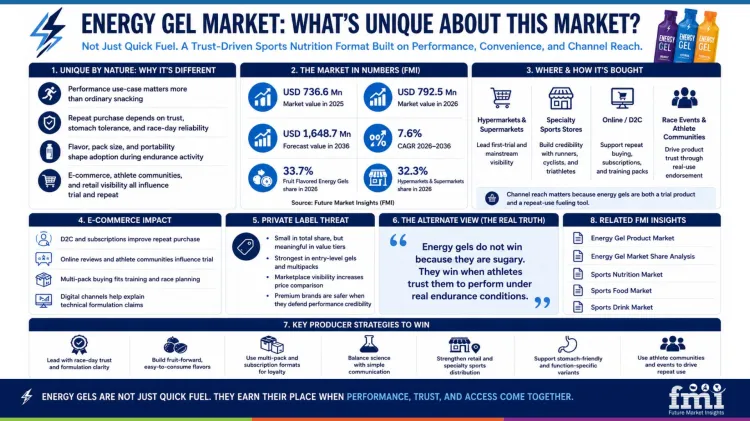
Private label is still small in energy gels, but it should not be ignored. FMI’s Energy Gel Market Share Analysis identifies private labels at 5% share. That may appear modest, but private label does not need to dominate the market to pressure branded margins. It only needs to become credible in value packs, supermarket shelves, marketplace listings, and basic endurance use cases.
The Energy Gel Product Market shows that hypermarkets and supermarkets lead sales channels with 32.3% share. This matters because retailers already control a key purchase environment. If supermarkets and mass retailers decide to expand private-label sports nutrition, they can use shelf placement, pricing, multipack formats, and promotions to attract casual athletes and price-sensitive shoppers.
Private labeling becomes more effective when the products appear simple to imitate. The best examples include basic fruit-flavored gels. According to FMI, fruit flavored energy gels remain the dominant products, accounting for 33.7% in 2026. Fruit flavors are common, universally recognized, and easy to communicate about to the consumer. A customer buying ‘a running gel’ or ‘a cycling gel’ will consider the cost per unit than its branding because the purchase occasion is training and not a race.
The danger that comes from private labels is also very high when it comes to multipacks. According to the share analysis by FMI, multi-serve packs make up for 60 percent share among the highest-selling pack sizes. Multipacks lend themselves well to pricing comparison. When customers purchase several tubes of gel, they become sensitive to how much they pay per serving.
Nevertheless, not all segments of the market are equally vulnerable to the effects of private label production. Brands that have a solid performance rationale will always be better equipped to defend themselves from imitations than premium and niche endurance brands. In fact, there is little competition for an ultra-endurance, high carbohydrate, timely caffeine, easy to digest, balanced electrolytes or elite racing gel.
The Sports Nutrition Market supports this broader point because performance nutrition depends on trust. Athletes are careful about products used during exercise. A private-label product may win trial through price, but repeat purchase depends on whether it performs without digestive issues, stickiness, poor flavor, or unreliable texture.
Online shopping raises the stakes further. For a consumer choosing between branded gels, store brands, and native-value brands on an online market place, price, flavor selection, pack sizes, customer ratings, and ingredients can all be reviewed easily. Provided that there are decent customer ratings, the decision to try it out becomes easy. This is even more likely for casual joggers, hikers, gym goers, and amateur cyclists.
The Sports Food Market also matters because energy gels compete within a broader active nutrition basket. Private labels can bundle gels with bars, drinks, chews, protein products, and hydration mixes. Retailers that already sell sports nutrition under private labels can extend into gels as part of a wider value proposition.
It is also possible for private labeling to mimic superficial trends as well. Vegan, caffeine-free, gluten-free, fruit-based, and simple-labeling are easy to mimic compared to performance. The risk of being mimicked arises when a brand depends on its clean-labeling strategy alone. Product substantiation is needed if the brand wants to sustain its price. Examples include faster absorption, better tolerance to exertion, flavor, and packaging.
The Sports Drink Market is relevant because retailers have already learned how to compete in performance beverages through price tiers and shelf control. A similar playbook can apply to gels: branded performance at the top, credible private label in the value tier, and multipack promotions to drive volume.
Premium brands should not respond only with discounting. Price cuts can weaken brand equity and train consumers to wait for promotions. A stronger response is to make differentiation visible. Brands should clearly communicate carbohydrate source, use occasion, caffeine level, electrolyte content, race distance fit, stomach-friendly design, and athlete testing. They should also build loyalty through D2C subscriptions, training plans, race partnerships, and community endorsements.
The private label’s current share may not be substantial, but the impact may be greater in particular settings. The customer who visits the supermarket or browses on an online marketplace may focus more on ease and affordability. However, when buying at a specialty sporting goods store or race day, the consumer will look for performance and trust.
The myth that should not be believed is that private label products have no chance in the sports nutrition market since athletes require branded products. However, while serious athletes would stick to the specialized brands, some casual athletes would prefer lower-cost options if those were believable enough.
Bottom line: Private label will not replace leading energy gel brands, but it can pressure entry-level gels, multipacks, and supermarket formats. Branded players must defend performance credibility and athlete trust while avoiding the trap of competing on price alone.

