


- Freeze dried fruits are moving from specialty wellness shelves into routine retail snack and pantry-buying occasions.
- Private label becomes more relevant because retail is the leading demand channel and grocery exposure drives routine household trial.
- Berry-based products lead fruit type demand because they work well in snack packs, cereals, bakery toppings, breakfast bowls, and family assortments.
- Fruit pieces lead by form because shoppers can see real fruit identity, texture, and usability more easily than with powders.
- Conventional products dominate nature share because mainstream households still prioritize accessible pricing and regular replenishment over premium-only positioning.
- The biggest misconception is that freeze dried fruits are protected from private label because they are premium. Retailers can mainstream the format once sourcing, texture, and pack consistency are stable.
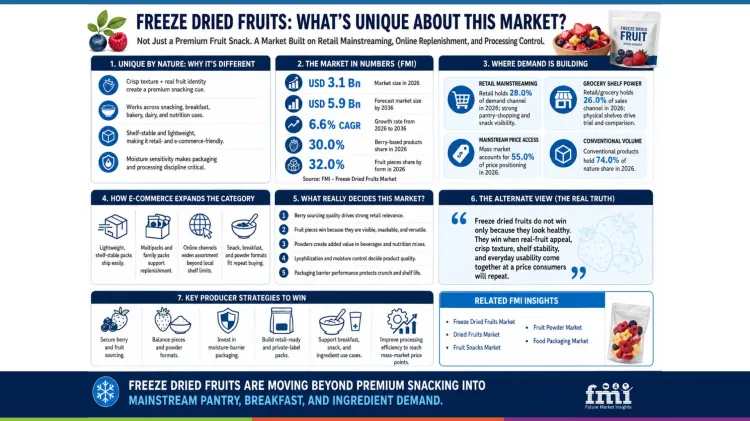
The freeze dried fruits can be considered as a high-end snack option, but now the market scenario is changing into a retail story. This is due to the fact that freeze dried fruits have solved many issues simultaneously like being real fruits, having good shelf life, weighing less, not making much of a mess, breakfast snacking, and children's snacks.
FMI’s Freeze Dried Fruits Market preview shows why retail matters. The market is estimated at USD 3.1 Bn in 2026 and forecast to reach USD 5.9 Bn by 2036, with retail anticipated to hold 28.0% of demand-channel share in 2026. FMI also notes that retail/grocery is expected to account for 26.0% of the sales-channel segment in 2026. These numbers make private label a logical competitive pressure.
Retailers like to have items which can fit into their regular baskets. This is where freeze-dried fruits become relevant as they can easily fit into the aisles meant for snacks, breakfast, kids’ lunch box items, baking, organic food sections, and multipacks for clubs. When retailers are convinced about repeat purchasing and shelf life, private labels become easy.
Berry-based products are expected to account for 30.0% of fruit type share in 2026, according to FMI. The significance lies in the merchandising aspect of berries. Strawberries, blueberries, raspberries, and even berries combined send messages of color, flavor, and nutrition. They are also versatile in direct consumption and use in breakfast cereals, desserts, and toppings. The retailer can create a variety of products based on just one fruit category.
The Dried Fruits Market is useful for positioning freeze dried fruits within the broader dried fruit landscape. However, freeze dried fruits behave differently from traditional dried fruit. They are lighter, crispier, and more visually close to fresh fruit. This creates a premium cue, but it also creates a retail challenge: shoppers compare price, pack size, taste, and crunch against other snacks.
The percentage share of fruit pieces in terms of form is estimated at 32.0% in 2026. It justifies the potential of private label as pieces are simple to comprehend and simple to consume. They can be consumed on their own, put into cereals, combined with granola, added to trail mix, used in baking and put into yogurt and other dessert products. Unlike powders, fruit pieces provide clear proof of fruit presence.
The Fruit Snacks Market is relevant because freeze dried fruits compete not only with dried fruits, but also with fruit chips, gummies, bars, pouches, and better-for-you snack formats. Retailers can use private label to position freeze dried fruits as a cleaner alternative to sugar-heavy fruit snacks while still keeping a convenient snack format.
Conventional products are likely to hold 74.0% share by nature in 2026. This is an important private-label signal. Organic lines are relevant in premium assortments, but mainstream volume still depends on accessible pricing. Retailers are strong at building good-better-best architectures: conventional value packs, organic premium packs, family-size packs, and kids’ lunchbox packs. This gives private label a direct route into volume.
Also, mass market products will make up 55.0% of price positioning by 2026. This supports the idea that frozen fruits are not premium or specialty products only. The segment is gradually being influenced by the regular purchasing behavior of households which favors private labels.
The Healthy Snacks Market provides broader context because shoppers increasingly want snacks that feel simpler, lighter, and more natural. Freeze dried fruits can benefit from this shift, but premium brands cannot rely on “real fruit” as their only defense. Once retailer brands offer credible fruit pieces with acceptable taste and texture, national and specialty brands must differentiate more clearly.
The private label risk will be greatest in simple SKUs like: strawberry pieces, berry mixes, apple slices, banana pieces, mango pieces, kids' snacking packs, cereal toppings, and family packs. Private labels have an easy time comparing, procuring, and pricing these types of goods. The premium brands should be safe from private label competition where they offer better sourcing, exotic fruit blends, organics, functional blends, or ingredients for bakeries and nutritionals.
The Organic Snacks Market is also useful because organic freeze dried fruit can protect premium positioning in some channels. However, organic certification alone may not be enough if retailer brands match the claim at lower price points. Premium brands need stronger reasons to justify price: better fruit selection, more intense flavor, better crunch, no added sugar, better packaging, or clear origin storytelling.
There is another reason why packaging will be used by the retailers to compete. The resealable pouch, lunch box packs, club packs, mixed fruit boxes, and breakfast toppings packs can make freeze dried fruits more functional. Packaging design that is well done can make retailer brands more convenient than premium brands.
The misconception to avoid is that freeze dried fruits are too premium or technical for private label. The processing is technical, but the finished product is easy for consumers to understand. That makes it attractive for retailers.
Bottom line: Private label will not eliminate premium freeze dried fruit brands, but it can mainstream the category quickly through retail visibility, value packs, berry-based SKUs, and routine household snack occasions. Brands must defend quality, sourcing, texture, and format differentiation.
FMI Related Links
- Freeze Dried Fruits Market: Primary link for market size, retail share, fruit type share, form share, and price positioning
- Dried Fruits Market: Use when contrasting freeze dried fruits with traditional dried fruit formats
- Fruit Snacks Market: Use when discussing snack aisle competition and retail mainstreaming
- Healthy Snacks Market: Use when discussing better-for-you snacking demand
- Organic Snacks Market: Use when discussing premium organic positioning and claim defense
- Fruit Powder Market: Use when discussing powder formats and ingredient-side demand

