


- Private label and challenger brands are increasing pressure in the sports drink market because buyers are comparing price, sugar content, electrolyte strength, flavor, and convenience more directly.
- Big brands still hold strong advantages in retail access, cooler placement, athlete trust, product visibility, and flavor familiarity, but these advantages are weaker when shoppers see cheaper low-sugar electrolyte alternatives beside them.
- The strongest private-label threat sits in mainstream RTD sports drinks, electrolyte waters, multipacks, grocery-store hydration products, and basic low-sugar formulas where differentiation is easier to copy.
- Big brands can defend share by improving low-sugar portfolios, cleaner formulations, functional electrolyte claims, packaging clarity, online replenishment, and targeted hydration use cases.
- The biggest risk is assuming brand loyalty alone will protect the category. In sports drinks, shelf space is now being contested by private label, clean-label startups, electrolyte powders, tablets, coconut water, and functional hydration brands.
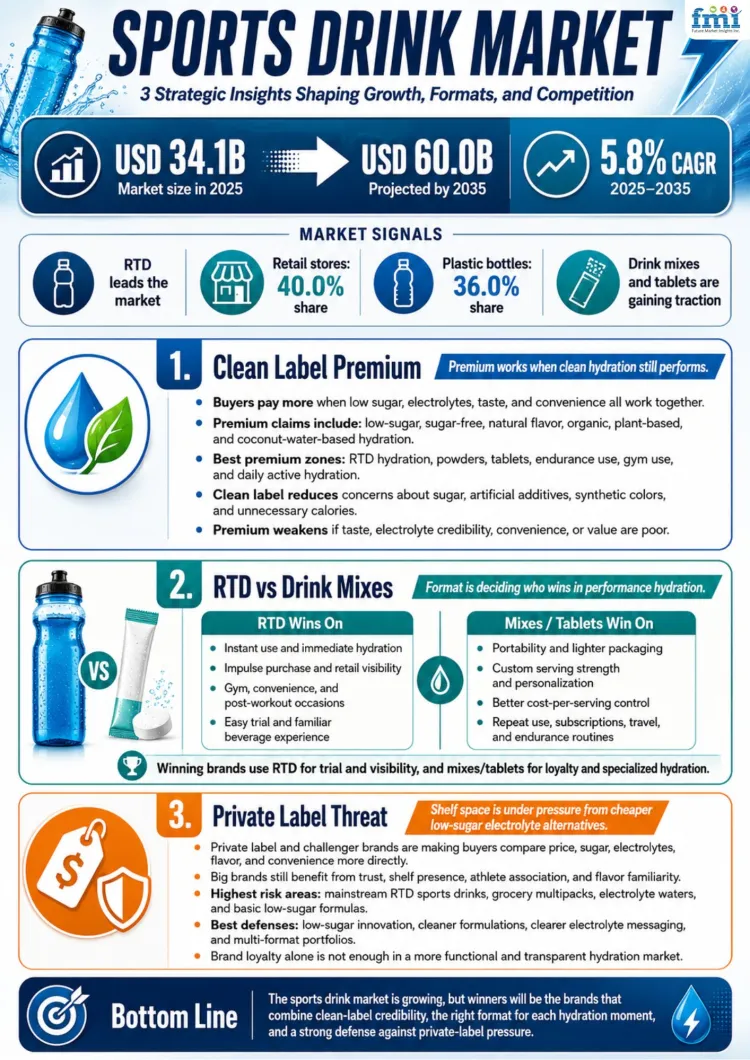
Private label is becoming a more serious threat in the sports drink market because the category is expanding beyond professional athletes and moving into everyday hydration. When a sports drink is bought only for athletic performance, consumers may lean heavily on established brands with long histories in sports science. But when the same product is bought for daily hydration, gym recovery, hot-weather use, travel, or casual wellness, buyers become more willing to compare price, ingredients, sugar content, flavor, and format. Future Market Insights values the global sports drink market at USD 34.1 billion in 2025 and projects it to reach USD 60.0 billion by 2035 at a 5.8% CAGR, which makes the category attractive not only for global beverage companies but also for retailers and new hydration challengers.
The private-label threat is strongest where the product promise is easiest to copy. A basic electrolyte drink, a low-sugar hydration bottle, a flavored isotonic beverage, or a multipack for family sports occasions can be replicated more easily than a highly specialized performance formula. Retailers already control shelf placement, promotions, multipack pricing, and store-brand trust. If they can offer a lower-priced sports drink with acceptable taste, recognizable electrolytes, and a low-sugar claim, they can pressure branded products in high-volume retail channels. FMI specifically identifies competition from new brands and private-label sports drinks offered by leading retailers as a market risk, adding that established brands must keep innovating through unique blends, functional ingredients, and eco-friendly packaging to protect loyalty and positioning.
Big brands still have major advantages. Gatorade, Powerade, BodyArmor, Lucozade, Propel, Vitaminwater, Nuun, LMNT, Hydrant, Electrolit, and other established or fast-growing names have stronger recognition than most retailer-owned sports drink products. FMI describes the global sports drink market as consolidated, with PepsiCo leading through Gatorade and Propel, Coca-Cola strengthening its position through Powerade and BodyArmor, and Suntory holding relevance through Lucozade. These brands benefit from consumer familiarity, athlete association, flavor systems, retail distribution, and product-line depth.
However, the advantage of big brands is no longer only about being famous. Sports drink buyers are becoming more analytical. FMI notes that sports drink demand is moving beyond athlete-focused use and entering daily hydration routines, where consumers compare sugar content, electrolyte strength, and functional ingredients before purchase. That shift makes the category more vulnerable to private label because a shopper may decide that a lower-priced store brand is “good enough” if it offers electrolytes, low sugar, familiar flavors, and convenient packaging.
The low-sugar shift is especially important. Older sports drink formulas were often defended by performance, taste, and brand loyalty. Newer buyers are more concerned about sugar, artificial additives, and unnecessary calories. FMI identifies low-sugar variants as a driver widening appeal among health-focused consumers and notes that sugar-free, organic, and plant-based sports drinks are part of wider product innovation. This creates an opening for private-label products because low-sugar claims are easier to communicate on shelf than complex sports science claims.
Private label also benefits when sports drinks become routine household purchases. A parent buying drinks for youth sports, a gym user buying weekly hydration, or a family buying multipacks may be more price-sensitive than an endurance athlete buying a specialized product. Once sports drinks move into routine grocery baskets, private label gains more room to compete. This is why mainstream RTD bottles, plastic-bottle multipacks, and grocery-store electrolyte beverages are more exposed than niche performance powders or advanced hydration formulas. FMI projects plastic bottles to lead sports drink packaging with a 36.0% share in 2025 and retail stores to dominate distribution with a 40.0% share, showing how important traditional shelf and store access remain to the category.
The threat is not only from retailer-owned sports drinks. Challenger brands are also attacking the same weakness in the market. New hydration brands are using cleaner labels, high-electrolyte formulas, sugar-free positioning, powders, tablets, functional ingredients, and direct-to-consumer models to compete against legacy sports drink brands. The Associated Press reported in 2026 that Gatorade is repositioning to appeal beyond athletes, while PepsiCo said around 150 new brands had entered the sports and hydration space in recent years. The same report noted that many consumers buying sports drinks are not athletes but are seeking functional ingredients such as electrolytes for hydration and carbohydrates for energy.
This creates a double squeeze for big brands. Private label pressures price at the shelf. Challenger brands pressure relevance through cleaner formulations, sharper claims, and specialized hydration occasions. A big brand may be cheaper than a premium startup but more expensive than private label. It may be more trusted than a new brand but seem less modern if the label looks too sugary, artificial, or mass-market. This middle position is risky because buyers can trade down for value or trade up for perceived performance and clean-label benefits.
Electrolyte drinks are making this pressure stronger because they blur the line between sports drinks and everyday hydration. FMI estimates the electrolyte drinks market at USD 40.4 billion in 2025 and projects it to reach USD 69.7 billion by 2035 at a 5.6% CAGR. In that market, ready-to-drink products are projected to hold a leading 54.0% revenue share in 2025, driven by convenience, immediate hydration, and portability. This matters because electrolyte drinks compete directly with sports drinks for the same cooler space, gym occasion, travel occasion, and daily hydration consumer.
For big brands, the response cannot be only price promotion. Discounts may defend volume for a short period, but they can weaken premium positioning if used too often. The better defense is clearer differentiation. A branded sports drink needs to prove why it is better than a cheaper store-brand alternative. That proof may come from electrolyte balance, taste consistency, athlete-tested formulas, lower-sugar options, better packaging, clearer usage occasions, trusted performance science, or wider product availability. FMI states that leading brands compete through flavor, functionality, and channel depth, which are exactly the levers needed to defend against private label.
Packaging clarity is becoming more important in this fight. A shopper may only take a few seconds to compare a branded sports drink and a private-label alternative. If both products say “electrolytes” and “low sugar,” the stronger brand must communicate what makes it different immediately. This could include sodium and potassium levels, no artificial colors, functional ingredients, endurance positioning, recovery positioning, or faster hydration claims. The AP reported that Gatorade is updating packaging to highlight how its different drinks and powders work and the research behind them, which shows how important claim clarity has become in a crowded hydration market.
Big brands also need to defend the format ladder. RTD sports drinks protect visibility and impulse purchases, but drink mixes, tablets, powders, and stick packs support repeat use and specialization. FMI notes that ready-to-drink sports drinks dominate most of the market because they offer instant replenishment, while drink mixes are growing because they allow consumers to adjust concentration and serving size. A brand that stays only in RTD bottles may lose informed hydration consumers to powder and tablet challengers, while a brand that ignores RTD may lose mainstream visibility.
Private label is more dangerous in simple RTD formats than in specialized hydration systems. Retailers can copy basic flavors, bottle sizes, multipacks, and low-sugar cues. It is harder to copy a strong multi-format hydration platform with RTD bottles, zero-sugar lines, powders, tablets, high-sodium endurance formulas, clean-label variants, and targeted recovery products. This is why branded players need to build a portfolio architecture, not only a product line. The brand should own different hydration moments: sports performance, gym recovery, daily hydration, heat exposure, endurance training, youth sports, travel, and wellness.
Price-tier management will also become critical. If a big brand sells only premium products, private label can undercut it. If it sells only mass-market products, premium challengers can out-position it. The strongest brands will likely need a good-better-best structure: value multipacks for family and team use, core RTD sports drinks for mainstream hydration, zero-sugar or low-sugar products for health-focused consumers, and premium powders or functional hydration products for specialized users. This structure helps brands defend against both cheaper private label and sharper startups.
Retail relationships remain a major defense, but retailers are also competitors. A retailer may give shelf space to national brands because they draw traffic and trust, but the same retailer may promote its own lower-priced hydration product beside them. Big brands must therefore prove category growth, not just product sales. They need to show retailers that branded sports drinks bring shoppers into the aisle, support higher basket value, create repeat purchases, and encourage trade-up. Otherwise, private label can gain space by offering better margins and lower prices.
The biggest risk for big brands is complacency. Sports drinks still have strong legacy names, but the category is changing quickly. FMI’s risk assessment highlights changing consumer preferences, health concerns over artificial additives and sugar, competition from healthier alternatives such as electrolyte-infused water and coconut water, and pressure from private-label sports drinks. These risks are connected. Consumers are more open to alternatives because they are rethinking what hydration should look like.
Private label will not replace big sports drink brands across the whole market. Performance credibility, sports heritage, retail power, and flavor loyalty still matter. But private label can weaken branded pricing power in everyday hydration, grocery multipacks, and basic electrolyte drinks. Challenger brands can weaken relevance in clean-label, high-electrolyte, sugar-free, and specialized formats. Together, they force big brands to defend both value and meaning.
The winning sports drink brands will not depend only on logo strength. They will defend shelf space with cleaner formulations, stronger electrolyte stories, low-sugar innovation, clear packaging, multi-format portfolios, and sharper use-case positioning. In the sports drink market, private label is not just a cheaper product threat. It is a warning that the category is becoming more transparent, more functional, and more competitive. Big brands must prove why they deserve the higher price every time the shopper reaches for hydration.

