


- Format is becoming one of the biggest competitive filters in the sports drink market, with ready-to-drink products winning on immediate hydration and drink mixes winning on portability, customization, and cost-per-serving control.
- RTD sports drinks remain stronger in impulse, retail, gym, convenience-store, and post-workout occasions because buyers want instant use without preparation.
- Drink mixes, tablets, and powders are gaining traction among endurance athletes, gym users, travelers, and daily hydration consumers who want flexible serving strength and lighter packaging.
- The strongest format opportunity sits in brands that use both models: RTD for visibility and instant trial, and mixes/tablets for repeat use, subscription, and specialized hydration needs.
- The biggest risk is assuming one format will win the entire market. In sports drinks, RTD and drink mixes are solving different hydration occasions.
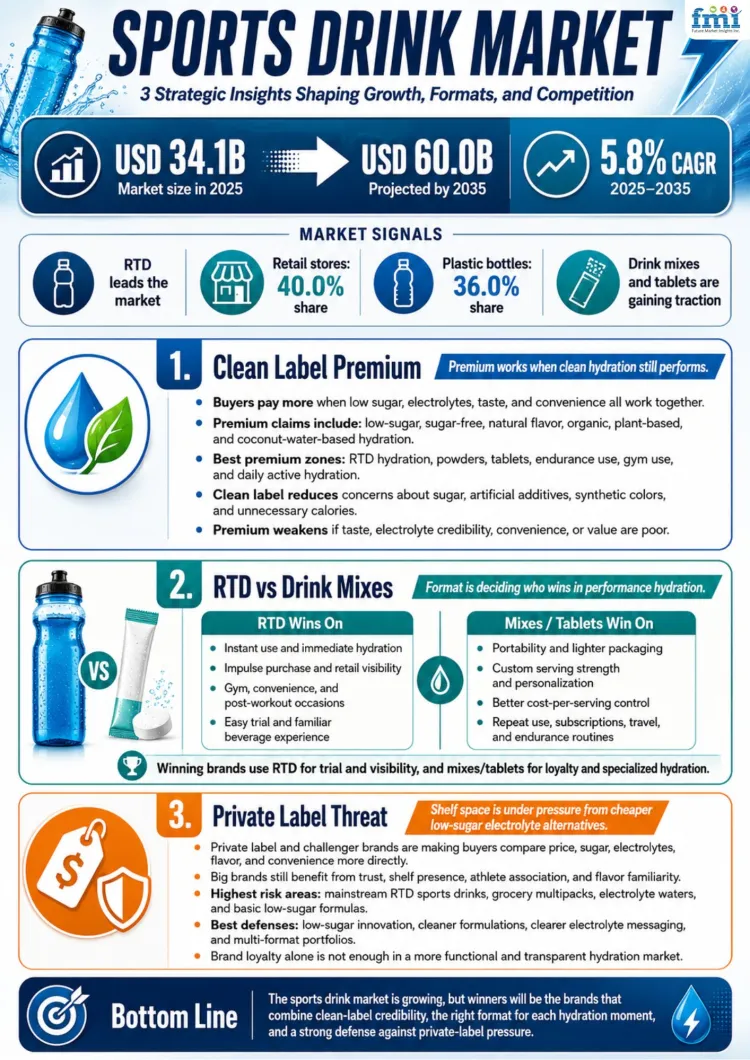
Format is becoming a major competitive battleground in the sports drink market. The category is no longer decided only by flavor, athlete endorsement, sugar level, or electrolyte claims. It is increasingly decided by when, where, and how the buyer wants to hydrate. A consumer leaving the gym may want a cold ready-to-drink bottle. A runner preparing for a long session may prefer a powder or tablet that can be mixed into a bottle at a chosen strength. A traveler may carry stick packs. A team coach may buy bulk RTD packs. A daily wellness consumer may subscribe to tablets or powders for routine hydration. This is why the sports drink market is becoming a format-led market, not just a beverage-led market.
Future Market Insights values the global sports drink market at USD 34.1 billion in 2025 and projects it to reach USD 60.0 billion by 2035, growing at a 5.8% CAGR. FMI also segments the market by form into ready-to-drink, drink mixes, and tablets, which shows that product format is already central to how the category is being evaluated. Ready-to-drink formats lead because they offer immediate use, while drink mixes are gaining traction among users who need customized hydration.
Ready-to-drink sports drinks win because they are built around convenience. The buyer does not need a shaker, scoop, bottle, water source, or preparation time. The product is already mixed, chilled in many retail settings, and available at the point of thirst. This makes RTD the strongest format for impulse consumption, convenience stores, gym coolers, supermarkets, sports venues, retail stores, and post-workout recovery. FMI notes that plastic bottles are likely to lead sports drink packaging with a 36.0% share in 2025, while retail stores are projected to account for 40.0% of distribution channel share. This supports the continued strength of grab-and-go sports drink formats.
The RTD format is especially powerful because sports drink consumption is often urgent. A consumer may feel dehydrated during a workout, after a match, while commuting, during hot weather, or after outdoor labor. In these situations, the product that is easiest to buy and consume often wins. RTD sports drinks also benefit from strong shelf visibility. Bottles and multipacks create brand presence in stores, while color, packaging, and flavor names make the product easier to recognize. For large brands, this matters because RTD distribution allows them to defend cooler space, supermarket shelves, vending machines, and convenience-store doors.
RTD also supports trial better than powders or tablets. A buyer can try one bottle without committing to a tub, pouch, or box of tablets. This is important for flavor-driven categories because taste remains one of the strongest repeat-purchase factors. If a sports drink tastes good and delivers visible refreshment, the buyer may return to the same brand. This is why RTD remains the natural entry point for mass-market sports drink consumers. It is simple, familiar, and easy to understand.
However, RTD is not the only growth story. Drink mixes, powders, tablets, and stick packs are becoming more important because hydration needs are becoming more personalized. Not every consumer wants the same sweetness, sodium level, calorie count, or serving size. Some users want a strong electrolyte dose for heavy sweating. Others want a lighter daily hydration product. Some want sugar-free formulas. Others want carbohydrates for endurance sports. Drink mixes allow brands to serve these different needs more precisely than one standard bottle.
FMI’s hydration supplement market data supports this shift. The hydration supplement market was valued at USD 38.7 billion in 2025 and is projected to reach USD 89.4 billion by 2036, with electrolyte tablets or powders expected to hold 36.2% product share in 2026. FMI also notes that tablets and powders offer portability and flexible serving strength, while sports nutrition is expected to lead the application segment with 41.5% share in 2026.
Drink mixes are attractive because they change the economics of hydration. A powder or tablet can be lighter to ship, easier to store, and more suitable for multi-serve use. For consumers, this can make the product feel more affordable over time, especially if they hydrate regularly. For brands, powders and tablets can support online sales, subscription models, bulk packs, club-store packs, and repeat-purchase routines. This is different from RTD, where the brand must often compete for shelf space, cooler placement, packaging cost, and logistics efficiency.
Customization is the biggest advantage of drink mixes. A cyclist may use a stronger concentration during a long ride. A gym user may use a lighter serving after training. A traveler may use a tablet during a flight. A worker exposed to heat may use multiple servings through the day. This flexibility gives powders and tablets a stronger role in planned hydration occasions. FMI notes that powder formats help athletes adjust serving strength based on climate and exertion level, while reliable taste and simple usage instructions improve repeat orders.
This does not mean drink mixes will replace RTD sports drinks. The two formats solve different problems. RTD solves the problem of immediate hydration. Drink mixes solve the problem of planned hydration. RTD is stronger when the consumer wants convenience now. Mixes and tablets are stronger when the consumer wants control, portability, and repeated use. The winning brands will understand this difference instead of treating formats as interchangeable.
Electrolyte drinks show the same pattern. FMI estimates the electrolyte drinks market at USD 40.4 billion in 2025 and projects it to reach USD 69.7 billion by 2035 at a 5.6% CAGR. Within that market, ready-to-drink products are projected to dominate with a 54.0% revenue share in 2025, driven by convenience, immediate hydration, and portability. At the same time, the market also includes tablets and powder as key product types, showing that hydration demand is expanding across multiple formats.
For sports drink brands, this creates a portfolio challenge. A brand that only sells RTD bottles may win mass visibility but miss repeat-use consumers who want powders or tablets. A brand that only sells powders may build loyalty among informed users but struggle to win impulse buyers. A brand that only sells tablets may be portable and clean, but it may miss consumers who want flavor, refreshment, and a cold beverage experience. The strongest format strategy is likely to combine RTD for trial and visibility with drink mixes or tablets for routine use.
This format split also changes channel strategy. RTD sports drinks perform well in supermarkets, convenience stores, gyms, sports retail, vending, and foodservice because they are designed for immediate consumption. Drink mixes and tablets perform well in online retail, specialty sports stores, pharmacies, supplement shops, and subscription channels because buyers often compare labels, serving counts, electrolyte levels, and price per serving before purchase. FMI lists sports drink sales channels across modern trade, convenience stores, specialty stores, pharmacy stores, sports retail stores, grocery stores, online retail, and other channels, which reflects the category’s multi-channel structure.
The competitive impact is significant. Large beverage companies have an advantage in RTD because they already control distribution, retail relationships, cooler placement, and brand awareness. This helps players such as Gatorade, Powerade, BodyArmor, Lucozade, Propel, and Vitaminwater defend high-traffic consumption occasions. FMI identifies PepsiCo, Coca-Cola, Suntory, Nuun Hydration, LMNT, Hydrant, HOIST, Electrolit, and other brands as key players in the sports drink market.
Smaller brands may have a stronger opening in powders, tablets, and specialized hydration formats. They can target heavy sweaters, runners, cyclists, keto consumers, low-sugar buyers, clean-label shoppers, youth sports parents, travelers, and daily wellness users without immediately needing national cooler distribution. This is why brands such as Nuun and LMNT are relevant in the format conversation. FMI describes Nuun Hydration as a brand specializing in clean, plant-based, tablet-form electrolyte hydration, while LMNT is positioned around high-electrolyte, zero-sugar hydration.
Format also affects claims. In RTD sports drinks, the claim must be simple because the purchase is often fast. The consumer sees the bottle, flavor, sugar claim, electrolyte message, and brand name. In drink mixes, the buyer often studies the product more carefully. They may compare sodium, potassium, magnesium, calories, sweeteners, serving count, and use occasion. This means RTD packaging must communicate quickly, while drink mix packaging must educate and persuade.
Pricing also changes by format. RTD sports drinks are usually compared bottle-to-bottle. Consumers look at size, brand, flavor, promotion, and convenience. Drink mixes are compared more by cost per serving, strength per serving, number of sticks or tablets, and subscription value. A premium RTD product must justify why one bottle costs more. A premium powder must justify why each serving performs better, tastes better, or fits a more specific need.
The role of sustainability and logistics may also increase the importance of drink mixes. RTD products carry water, which adds weight and distribution cost. Powders and tablets reduce shipping weight and can be packed in smaller formats. This does not remove the importance of RTD, but it gives mixes and tablets an efficiency advantage in e-commerce, travel, and routine replenishment. FMI also notes that powders protect pack economics through lighter shipping and multi-serve packaging.
For athletes and performance users, format choice is often linked to training intensity. Casual users may buy an RTD drink after a gym session. Endurance users may prefer powders because they can control carbohydrate and electrolyte intake. Heat-exposed workers may want stick packs that can be used through the day. Team sports may still favor bulk RTD bottles because they are easier to distribute. This means the format decision is not only about product design; it is about use-case design.
The biggest risk for sports drink brands is assuming that one format will dominate every occasion. RTD has the advantage in immediate hydration, taste experience, and retail visibility. Drink mixes and tablets have the advantage in portability, customization, repeat use, and serving economics. Both formats will keep growing, but they will not grow for the same reason. RTD will grow with convenience-led hydration. Mixes and tablets will grow with planned, personalized, and routine hydration.
Sports drink brands that understand format behavior will be better positioned than brands that only chase ingredient claims. A low-sugar RTD drink may win the gym cooler. A high-electrolyte powder may win endurance athletes. A tablet may win travel hydration. A multipack bottle may win family sports occasions. A stick pack may win workplace or outdoor use. The winning company will not ask whether RTD or drink mixes are better. It will ask which format owns which hydration moment.
In the sports drink market, format is becoming strategy. RTD creates reach, visibility, and instant consumption. Drink mixes create control, loyalty, and repeat-use economics. Tablets add portability and routine convenience. The brands that connect the right format to the right consumer occasion will gain stronger relevance as sports drinks move beyond athlete-only hydration into daily active nutrition.

