


- The Hyaluronic Acid Products Market is projected to reach USD 16.82 billion by 2036 from USD 9.94 billion in 2026, at a CAGR of 5.4% during the forecast period.
- The increasing demand for osteoarthritis treatment, ophthalmology and aesthetic medicine is elevating the significance of resilient and diversified supply chains.
- Producers are trying multi-supplier procurement strategies to reduce operational disruptions and improve business continuity.
- The importance of continuous product availability across institutional healthcare channels is highlighted by Future Market Insights, which states that hospital pharmacies will account for 50.3% of the market in 2026.
- The continued growth of the market is driving companies to enhance sourcing agility while ensuring regulatory compliance and product quality.
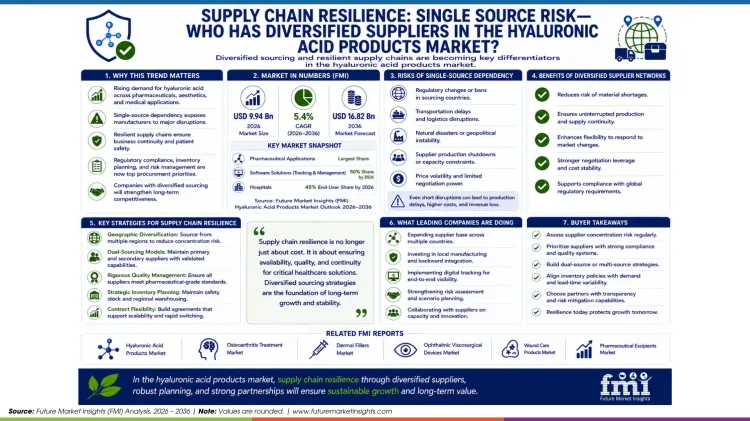
Hyaluronic Acid Products Market: Supply chain resilience is a critical strategic priority for manufacturers seeking to balance growth with operational stability. According to Future Market Insights, the market is expected to reach USD 9.94 billion by 2026 and USD 16.82 billion by the year 2036, registering a CAGR of 5.4% over the forecast period.
As healthcare providers increasingly adopt hyaluronic acid-based products for osteoarthritis management, ophthalmic treatments, and medical aesthetics, the availability of reliable products is vital to maintaining patient care and commercial performance. Disruptions in manufacturing, logistics or procurement of raw materials can affect the supply of products downstream.
Traditionally, many organizations optimized procurement around a small number of qualified suppliers to facilitate operations and benefit from economies of scale. But recent supply chain disruptions have caused manufacturers to reconsider that strategy, and to create sourcing strategies to reduce reliance on a single supplier or production site.
Diversified procurement can create resilience, allowing companies to continue operations when unexpected disruptions arise. Supporting long-term operational flexibility, qualifying multiple manufacturing partners or keeping alternative sourcing options may help to mitigate exposure to delays.
The market’s distribution structure makes this need even stronger. “Hospitals will hold the largest share of the market with a 50.3% share by 2026, thus making hospitals the largest distribution channel for hyaluronic acid products,” says Future Market Insights. For institutional buyers it is about steady supply, regular quality, and reliable delivery times to maintain treatment for patients.
Product segmentation is also a factor in procurement priorities. Single cycle injection products are projected to hold 54.7% of the market in 2026, indicating that manufacturers in this leading segment need to maintain stable production processes and robust quality systems across the supply chain.
Regional market growth patterns also influence sourcing decisions. According to Future Market Insights, China is expected to be one of the fastest growing markets through 2036, growing at a CAGR of 7.9%. As global production and consumption increase, companies might increasingly resort to geographically dispersed supplier networks to enhance security of supply.
Supply chain resilience is more than procurement. Good planning also includes inventory management, logistics coordination, regulatory documentation, quality assurance, and contingency planning that enable manufacturers to respond quickly to changing market conditions.
The misconception is that multiple qualified suppliers only add to procurement costs. Diversified sourcing, in practice, can help to reduce long-term operational risk by increasing continuity, reducing disruption, and improving overall supply reliability in a growing healthcare market.
Bottom Line
The Hyaluronic Acid Products Market is estimated to reach USD 16.82 billion by 2036 from USD 9.94 billion in 2026 and Supply chain resilience is emerging as a strategic differentiator. Companies with diversified sourcing, improved procurement flexibility and dependable distribution capabilities will be best suited to support sustained market growth and evolving customer expectations.
Related FMI Reports
- Hyaluronic Acid Products Market
- Dermal Fillers Market
- Osteoarthritis Therapeutics Market
- Ophthalmic Drugs Market
- Injectable Drug Delivery Market
- Medical Aesthetics Market
- Pharmaceutical Supply Chain Market
- Biopharmaceutical Manufacturing Market
- Regenerative Medicine Market
- Orthobiologics Market

