


- USA and EU regulations rarely prescribe a specific leak testing machine, but they strengthen demand for equipment that improves containment, validation, records, and repeatability.
- In the USA, refinery LDAR programs and refrigerant-management rules create sustained incentives for leak identification, repair, and documentation.
- In the EU, F-gas obligations increase attention on leak checks, maintenance, recovery, and prevention across refrigeration and air-conditioning equipment.
- Medical-device and pharmaceutical production add another compliance-led layer because manufacturers need validated processes and evidence of product integrity.
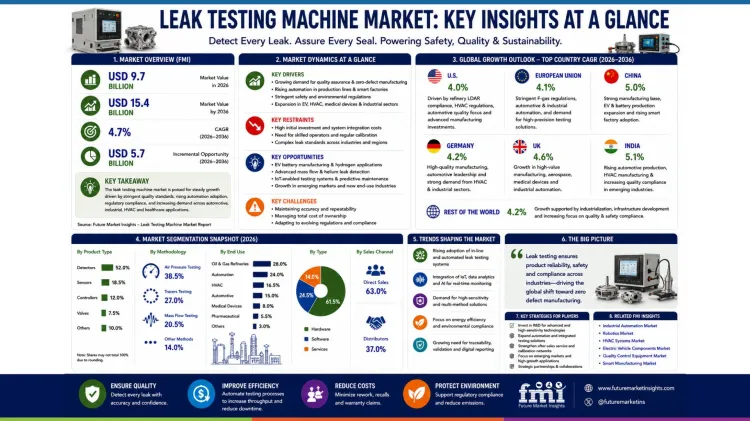
- FMI projects the USA leak testing machine market to grow at 4.0% CAGR and Germany at 4.2%, with the UK at 4.6%.
- The regulatory effect is strongest when rules increase the cost of a failed seal, poor record, or escaped defect, making automated testing part of risk management rather than only factory inspection.
Leak testing equipment is often purchased because a component needs to pass quality control. Regulations alter the purchasing equation by making failure more expensive. A leak can become an emissions issue, a refrigerant-management issue, a refinery compliance issue, a sterility concern, a warranty issue, or an audit finding. When that happens, manufacturers are more likely to invest in repeatable testing, calibration, traceability, and documented validation.
The United States and European Union are important because both regions hold regulatory frameworks that make leakage prevention and controlled testing commercially meaningful. The regulations do not usually say that a manufacturer must buy a pressure-decay instrument, helium detector, or automated test cell. They establish obligations around containment, repair, process control, safety, and documentation. Suppliers of leak testing equipment benefit when customers need stronger proof that sealed systems are fit for release.
FMI forecasts the USA leak testing machine market to grow at 4.0% CAGR through 2036, Germany at 4.2%, and the UK at 4.6%. The report connects USA demand with Gulf Coast refinery checks and frequent validation, Germany with manufacturing quality requirements, and the UK with high-value manufacturing, automotive restructuring, aerospace components, and service reliability. These growth rates sit below ASEAN, India, and China, and the USA and EU remain strategically important because compliance-led procurement can support higher-value systems and recurring calibration work.
USA Compliance Turns Leak Detection into a Continuous Operating Requirement
The USA has two major regulatory pathways relevant to the leak testing machine market, namely refinery and chemical-sector LDAR requirements, and refrigerant management under Section 608 of the Clean Air Act.
EPA describes leak detection and repair as a work practice designed to identify leaking equipment so emissions can be reduced through repair. Its LDAR best-practices guidance is directed toward petroleum refineries, chemical manufacturing facilities, and compliance inspectors. The guidance focuses on improving the effectiveness of programs that monitor valves, pumps, connectors, compressors, pressure-relief devices, and other process equipment.
This field-level LDAR activity is not identical to factory leak testing. A refinery may use portable instruments, optical technologies, monitoring programs, maintenance teams, and inspection contractors. The connection to leak testing machines comes through the broader compliance culture. Refinery operators and equipment suppliers need reliable evidence that valves, tanks, heat exchangers, pressure systems, and components are sealed before installation, after maintenance, or during planned shutdowns.
FMI identifies oil and gas refineries as the largest leak testing machine end-use segment, accounting for 28.0% of demand in 2026. It links this demand to valves, tanks, pressure vessels, heat exchangers, and high-risk process areas. The report also notes that high-sensitivity systems are used in refinery maintenance programs and planned shutdown cycles.
This creates two types of demand. One is equipment used directly in plant maintenance and validation. The other is factory-based testing of components supplied into refinery and process applications. A valve maker, heat exchanger manufacturer, skid builder, or pressure-system supplier may need to prove integrity before shipping equipment to a regulated customer. The closer the component sits to emissions risk or process safety, the stronger the requirement for documented testing.
The EPA refrigerant-management framework has a similar indirect effect. Section 608 establishes a national recycling and emissions-reduction program and prohibits intentional venting of ozone-depleting refrigerants and substitutes such as hydrofluorocarbons during maintenance, servicing, repair, or disposal of refrigeration and air-conditioning equipment. EPA requires corrective action when certain appliances with at least 50 pounds of refrigerant exceed applicable leak trigger rates.
For HVAC and refrigeration manufacturers, this raises the commercial importance of factory release quality. A leak created during manufacturing may not appear immediately in the field, and it can create service calls, refrigerant losses, efficiency issues, customer complaints, and compliance exposure. Manufacturers therefore have an incentive to use fast dry pressure testing, tracer-gas testing, or integrated end-of-line validation to reduce the chance of defective systems entering the market.
FMI highlights HVAC refrigerant rules as a demand driver because charged systems require stronger factory release records. It also projects air-pressure testing to hold 38.5% of methodology demand in 2026, reflecting the suitability of dry testing for automotive and HVAC production lines.
The USA demand profile therefore combines refinery safety, process equipment validation, HVAC containment, automotive and battery production, and advanced manufacturing. The stronger opportunities are likely to sit with suppliers that can offer calibrated equipment, robust fixtures, service coverage, and traceable data rather than basic instruments alone.
EU Regulation Elevates Documentation and Refrigerant Containment
The EU F-gas framework places strong emphasis on leakage prevention. The European Commission states that operators must respect leak-check requirements for applicable equipment containing F-gases, while the broader policy framework includes measures such as regular leak checks, proper maintenance, recovery, and tighter controls around fluorinated greenhouse-gas emissions.
The EU framework is mainly directed at equipment operators, importers, service providers, and manufacturers placing products on the market. It does not mandate a specific factory leak-testing technology in every application. It does raise the importance of keeping refrigeration, air-conditioning, and heat-pump systems sealed throughout their lifecycle. That creates a stronger commercial logic for manufacturers to validate systems before shipment and to retain records that support quality assurance.
The European Commission defines leak checks as inspections to detect leaks from equipment containing F-gases and states that identified leaks must be repaired without undue delay. This reinforces the link between product design, manufacturing quality, service practice, and lifecycle containment.
The effect on leak testing equipment is particularly relevant in commercial refrigeration, industrial refrigeration, air-conditioning systems, heat pumps, cold-chain equipment, and HVAC component manufacturing. A factory that can show consistent end-of-line leak testing can reduce the risk of expensive field repairs and support customer confidence in refrigeration system integrity.
Germany 4.2% CAGR in the FMI forecast reflects its position as a manufacturing-intensive market with automotive, industrial equipment, HVAC, chemical, and engineering demand. The UK 4.6% CAGR is linked to automotive, aerospace, high-value manufacturing, and quality-focused production clusters. These are not simply volume markets. They are environments where customers may ask for stronger application engineering, calibration support, documentation, and production-line integration.
The EU regulatory environment also affects machine suppliers themselves. Equipment manufacturers selling automated test stations into Europe need to consider machine safety, conformity assessment, documentation, guarding, electrical design, software controls, and integration responsibility. A leak tester installed as part of a robotic cell becomes part of a wider automation system. The ability to support compliance documentation can influence supplier choice, particularly for large automotive, HVAC, electronics, and industrial customers.
Medical and Pharmaceutical Validation Add a Third Compliance Layer
Leak testing demand is not shaped only by environmental regulation. Medical device and pharmaceutical production make integrity validation relevant because a failed seal can affect sterility, contamination control, fluid delivery, or package performance.
FDA guidance on container and closure system integrity testing states that manufacturers of devices purporting to be sterile must validate processes, including sterilization, and that sterility is treated as a stability characteristic for products labelled as sterile. The guidance addresses the circumstances in which integrity testing can support stability protocols.
For leak-testing machine suppliers, this creates a different market requirement. HVAC and refinery customers may prioritize speed, ruggedness, and emissions prevention. Medical-device customers may prioritize test-method validation, calibration, repeatability, audit trails, and change control. The same pressure-decay technology can be used in both markets, and the commercial proposition is different.
The FDA warning letter issued to Unomedical Device S.A. de C.V. in 2026 shows the significance of this distinction. The agency cited complaints relating to leaking infusion sets and referred to the manufacturer requirement that a water leak tester consistently and accurately differentiate possible test states. This type of example demonstrates why medical-device manufacturers cannot treat leak testing as a simple pass-fail activity without validating the method.
The USA and EU medical-device frameworks differ in form, and both favour documented process control and evidence-based quality systems. This creates an opening for suppliers with validation services, controlled software, data management, and high-repeatability fixtures.
The Regulatory Effect Is Strongest in Three Conditions
Compliance has the largest market effect when a leak creates one of three outcomes.
- An emissions or environmental consequence is the first. Refineries, chemical plants, HVAC equipment, refrigeration systems, and industrial process installations fit this category.
- A safety or asset-integrity consequence is the second. Battery cooling circuits, fuel systems, pressure vessels, valves, tanks, and process equipment fall into this group.
- A product-integrity consequence is the third. Medical fluid pathways, sterile packaging, diagnostic devices, and sealed drug-delivery products are examples.
The more severe the consequence, the more valuable traceable testing becomes. A simple standalone leak tester can be sufficient for basic component checks. A regulated or high-risk environment may require calibrated sensors, controlled fixtures, automated handling, serialized records, user access controls, and formal validation documentation.
This is why the FMI market report sees leak testing machines evolving beyond basic inspection tools into integrated quality-control systems. It also explains why hardware still represents 61.5% of type revenue, while software and services gain importance after installation through calibration and production data capture.
The regulatory impact should not be overstated. Laws do not automatically create a new machine sale for every regulated asset. Many plants use service providers, manual procedures, portable instruments, or existing equipment. The demand effect emerges when operators need more frequent checks, more reliable records, tighter leak thresholds, or better control of high-volume production.
The most defensible supplier strategy is therefore compliance-enabled rather than compliance-dependent. Suppliers should connect their systems to the customer actual operational need, whether that is faster release testing, lower refrigerant escape risk, better refinery maintenance records, validated medical-device integrity, or improved traceability in battery and automotive manufacturing.
USA and EU regulations are reshaping the market by raising the cost of weak containment and poor documentation. The opportunity is not limited to enforcing rules. It is helping manufacturers and operators demonstrate that sealed systems were tested properly, released with evidence, and supported throughout their operating life.

