


Key Takeaways
- Video streaming is now a default habit: about 85% of UK adults use video-on-demand services monthly, and roughly four in five US households have at least one streaming subscription.
- Branding in streaming is less about a logo and more about the promise a service makes about your time: breadth and novelty (Netflix), safe family universes (Disney+), value inside a broader bundle (Prime Video), or infinite creator content (YouTube).
- Successful brands sit in clear archetypes: library plus algorithm (Netflix), IP universe (Disney, Max), bundle anchor (Amazon, Apple), or creator platform (YouTube), each with its own rules for pricing, UI, and tone of voice.
- The strongest signals of brand positioning are now pricing tiers, ad choices, and curation rather than one-off hit shows. Ad supported plans, telecom bundles and cross service offers are teaching users what is "premium", what is "utility", and what is "background noise".
- Over the next decade, the brand winners are likely to be those that can turn content abundance into a low friction, trusted routine for specific segments, while reducing churn in a world where multi homing across several apps is normal.
What does a video streaming brand actually stand for now?
Ten years ago, "having an app with shows" was a differentiator. Today video-on-demand services reach around 85% of adults in mature markets, and global subscriptions are estimated around 1.8 billion.
In this environment, a streaming brand is essentially a promise around three things:
- how much effort it takes to find something watchable,
- how safe or risky the viewing environment feels for different age groups, and
- how far the subscription fits into a wider digital life of payments, shopping, gaming or social media.
Brand perception is shaped as much by the home screen, the "because you watched" rail and the reliability of offline downloads as by big campaign posters. Studies of subscription behaviour show that ease of use, perceived value and habit are central to why users keep or cancel services, not only the presence of specific titles.
Netflix and the library plus algorithm brand
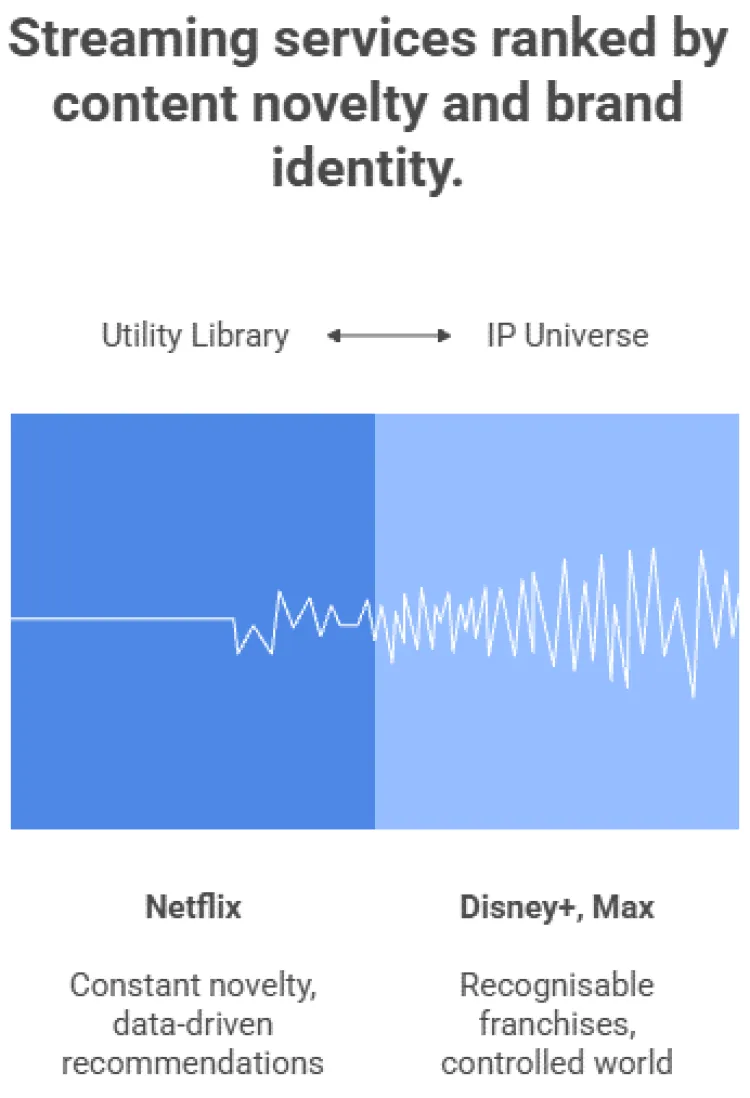
Netflix sits closest to what might be called the "utility library" archetype. It promises constant novelty within a single, relatively simple interface. Branding choices support that position: a global catalogue with local flavours, heavily data driven recommendations and consistent UI across devices.
Some branding signals:
- Global consistency: whether in India, Brazil or Germany, the app feels familiar, which reinforces a sense of reliability.
- Identity through originals: the red "N" before a title has become a shorthand for "this will be discussed online", which is a reputational loop as much as a content tag.
- Algorithm as brand: studies on content valuation in digital film platforms show that perceived value comes from how well the catalogue is surfaced and bundled, not only from the raw number of titles.
With more than 300 million subscribers reported by early 2025, the Netflix brand is now tied to the idea of default entertainment. The risk, from a branding standpoint, is that "default" can drift towards "generic" if curation and quality slips while prices rise. That is why recent moves into ad tiers, games and creator partnerships are carefully framed as added value rather than a change of identity.
Disney, Max and the IP universe brand
Disney+, Max and similar services lean on recognisable franchises and character universes. The brand here is less about the interface and more about the feeling of entering a controlled world.
For Disney this means:
- deep libraries of family friendly IP that parents already recognise,
- cross promotion across film, series, theme parks and merchandise, and
- a catalogue architecture that rewards "universe" browsing rather than one off sampling.
For Max and other premium services, the promise tilts toward quality drama, cinematic production values and association with a specific editorial voice. Their branding often emphasises "home of" language and award winning shows to anchor a reputation for seriousness. In both cases, brand equity sits heavily in IP. The streaming app is the latest distribution layer for assets built over decades. The challenge is that franchises can fatigue and mistakes in high profile series can damage perceptions faster than before, because feedback loops on social platforms are immediate.
Prime Video, Apple TV+ and the bundle brand
Prime Video and Apple TV+ occupy a different space. Here, streaming is framed as part of a broader ecosystem, not the main product.
For Amazon:
- Prime Video is bundled with faster shipping, music, reading and other benefits.
- The brand message is "membership value", where shows, sports rights and local originals are proof points that you are getting enough for your annual fee.
For Apple:
- Apple TV+ carries fewer titles but positions itself around high end production and curation, aligned with Apple’s wider "quality hardware and services" narrative.
- The decision not to rush into ad supported tiers has been explained publicly as a deliberate choice to maintain a certain experience, which is a branding call as much as a revenue decision.
These bundle based brands care slightly less about being the only streaming app a household uses. They focus instead on being a reason to stay inside a larger membership where the real lifetime value comes from commerce, devices or cloud services.
YouTube and the creator platform brand
YouTube is technically a video sharing platform rather than a classic SVOD service, yet from the audience’s perspective it competes for the same hours. Ofcom data shows YouTube is now the second most watched TV style service in the UK, ahead of some traditional broadcasters, especially among younger viewers.
Its brand is based on:
- creator driven variety, from short clips to long form essays,
- an algorithm that learns quickly from sparse signals, and
- the feeling that there is always another recommended video waiting.
Where Netflix sells a curated subscription, YouTube sells an endless feed funded largely by advertising, with a premium tier layered on top. For advertisers and many creators, that scale and the data behind it are the brand’s core assets. For regulators, the same features raise questions about audience protection and content prominence, which in turn shape how the brand is perceived in policy debates.
Pricing, ads and bundles as brand signals
Branding in streaming is now communicated as much through pricing mechanics as through trailers. Several patterns stand out:
- Ad supported tiers: many services have introduced cheaper plans with advertising. Survey work in European markets shows a significant share of users now prefer ad supported options so they can afford multiple platforms. That shifts the meaning of "premium" to ad free viewing, not merely to the catalogue.
- Multi platform households: research indicates that households commonly hold subscriptions to more than one service, particularly in the US and Europe. This undermines the old idea that one brand can be the exclusive gateway to entertainment and increases the importance of a clear positioning.
- Telecom and hardware bundles: in many countries, video streaming is integrated into broadband, mobile or pay TV bundles. From a branding standpoint, that means the user sometimes experiences the streaming service through the telecom’s onboarding, billing and promotions, not directly. Clarity about who "owns" the customer relationship becomes part of the brand strategy.
For users, these moves send simple signals. A higher priced, ad free tier presented alongside cheaper plans says "we are the premium experience". A service included within a wider membership signals value and ubiquity more than distinctiveness.
Geography, culture and the local face of global brands
Streaming brands are global, but what they mean in practice is local. Case studies of Netflix’s adaptation efforts in markets such as India show how pricing, language menus, payment methods and local originals all reshape the brand.
Regulators have also started to push for local content quotas and clearer prominence of public service content in online environments. Ofcom’s recent work highlights generational splits, where younger viewers treat YouTube and SVOD apps as default, while older audiences still lean toward broadcaster services.
For brand strategy this means that:
- the same logo carries different associations depending on how much local language content sits on the home screen,
- price points must reflect local income, data costs and device penetration, and
- partnerships with telecoms, device makers and local producers influence whether the service feels "foreign" or embedded in local culture.
Risks and failure modes for streaming brands
Most services do not fail because "people stopped liking video". They fail in more specific ways:
- Content oversupply without clear curation makes a service feel like a chaotic warehouse rather than a trusted guide.
- Frequent price rises without obvious value improvements weaken brand trust.
- Inconsistent stance on ads and data privacy can alienate both viewers and regulators.
- Confusing brand architecture, such as overlapping sub brands or sudden rebrands, can erase accumulated equity.
In a market where multi homing is routine, small mistakes compound into churn. The brand that survives is often the one that is easiest to keep rather than the one that shouts loudest at launch.
How FMI can help
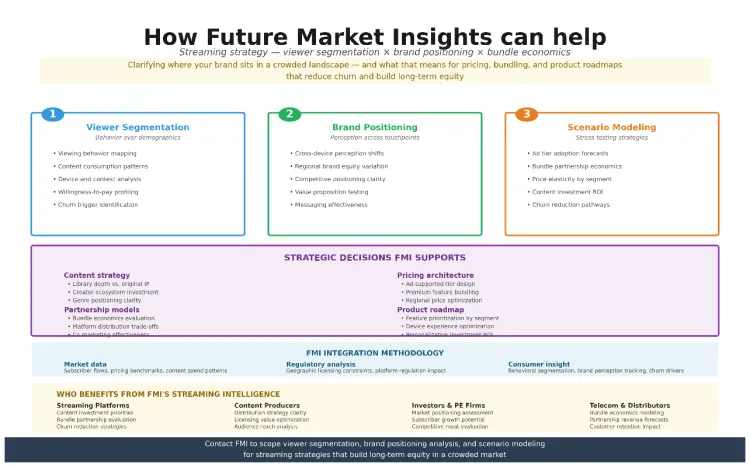
Future Market Insights can help streaming and media clients clarify where their brand sits in this crowded landscape and what that implies for pricing, bundling and product roadmaps. That includes segmenting viewers by behaviour rather than demographics alone, mapping how brand perception shifts across devices and regions, and stress testing scenarios for ad tier adoption or bundle partnerships. By combining market data, regulatory analysis and consumer insight, FMI can support decisions on whether to double down on library, IP, bundles or creator ecosystems and how to communicate those choices in a way that reduces churn and builds long term equity.
Sources
- Ofcom, Media Nations 2025 and related media habits reports.
- Exploding Topics, "Video Streaming Services Stats (2025)".
- Forbes, "Top Streaming Statistics in 2025" and related streaming coverage.
- Business of Apps, "Video Streaming App Market" and "Netflix Revenue and Usage Statistics (2025)".
- Global Media Journal, "Streaming wars: navigating the competitive landscape".
- Academic and industry work on streaming consumer behaviour and content valuation.
- Ofcom and FT reporting on YouTube and SVOD services in UK viewing.

