


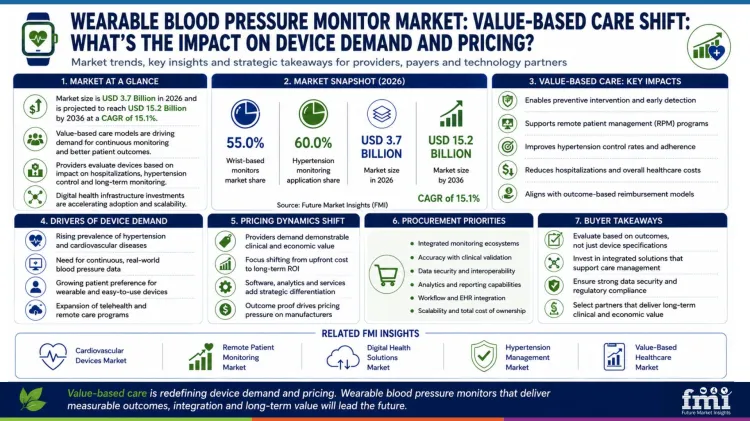
- The wearable blood pressure monitor market size is USD 3.7 Billion in 2026 and it is expected to reach USD 15.2 Billion by 2036 at a CAGR of 15.1% during the forecast period. Wrist-based monitor is anticipated to hold 55.0% of the total market demand. Hypertension monitoring accounts for 60.0% of the total application share.
- Value-based care models are driving demand for continuous monitoring technologies that enable preventive intervention, remote patient management and outcome-based reimbursement programs.
- As a result, healthcare providers are not only looking at the cost of acquiring the devices but also the potential of the wearable blood pressure monitors to reduce hospitalizations, increase hypertension control rates, and allow for long-term monitoring of patients.
- Procurement decisions are moving toward integrated monitoring ecosystems that combine hardware, analytics, connectivity and clinician workflow integration, offering new competitive advantages to vendors.
- Pricing dynamics are changing as providers are demanding demonstrable clinical outcomes, pressuring manufacturers to demonstrate economic value as well as accuracy in monitoring.
- With hospitals, ambulatory care providers and remote care programs looking for scalable solutions to manage chronic disease, investments in digital health infrastructure are driving adoption.
Introduction
The delivery of value-based healthcare is fundamentally transforming the way medical devices are evaluated, purchased, and used throughout healthcare systems. In this context, wearable blood pressure monitors are emerging as strategic tools for continuous patient monitoring, preventive care programs, and population health management goals.
The global wearable blood pressure monitor market is projected to reach USD 3.7 billion by 2026 and USD 15.2 billion by 2036, at a CAGR of 15.1% between 2026 and 2036. Traditional episodic blood pressure measurement is increasingly supplemented by methods for continuous monitoring, providing richer clinical insights and enabling proactive intervention strategies.
As reimbursement models shift towards rewarding outcomes over volume of service, wearable monitoring technologies are becoming critical components of long-term cardiovascular management programs.
Market Context
Hypertension is a major driving force behind the global burden of cardiovascular disease and places immense pressure on health systems to improve monitoring, compliance and treatment effectiveness. In turn, providers are deploying technologies that allow for continuous data collection outside of traditional clinical settings.
Wearable blood pressure monitors align well with these goals, as they not only take monitoring out of the physician’s office, but also provide real-time insights into patient health trends. The growing use of them reflects broader healthcare priorities to reduce preventable complications, increase patient engagement, and reduce expensive episodes of acute care.
These trends are mirrored in the market structure itself. The wrist-based monitors contribute the largest share of 55.0% in the segment owing to ease of use, patient acceptance, and long-term usability. By application demand, Hypertension monitoring is the largest demand, with 60.0% share. It shows that chronic disease management plays an important role in the market growth.
Continued adoption is driven by the convergence of digital health initiatives, reimbursement structures for remote monitoring, and value-based care models.
Value-Based Care and Device Demand
Value-based care emphasizes patient outcomes, quality of care and reducing overall costs across the continuum of care. Such models increasingly reward providers for preventing complications up front rather than after the fact.
Wearable Blood Pressure Monitors directly support this goal, enabling earlier detection of blood pressure’s changes and timely therapeutic adjustments. Continuous monitoring creates longitudinal datasets which provide more complete pictures of patient health than periodic office measurements.
Healthcare organizations involved in accountable care arrangements and population health programs are increasingly recognizing the value of remote monitoring technologies to reduce emergency department utilization and avoidable hospitalizations. Therefore, the demand for devices is starting to be associated with not only diagnostic needs but with broader care management goals.
This change is expanding the addressable market beyond traditional cardiology departments. Wearable monitoring technologies are increasingly being purchased by primary care networks, integrated delivery systems, chronic disease management programs, and telehealth providers.
With the evolution of value-based care models, demand growth is more and more driven by clinical utility and economic impact, rather than by device performance specifications alone.
Pricing Dynamics Under Outcome-Based Healthcare
Pricing expectations are changing with the shift to value-based care, too.
Historically, acquisitions were driven by upfront costs and hardware specifications. Today’s healthcare providers are looking at wearable blood pressure monitoring solutions from a broader economic perspective that considers patient outcomes, workflow efficiency and long-term cost savings.
This shift is pressurising prices for hardware-focused manufacturers. Providers are looking for more and more solutions that can prove their measurable contributions to improved hypertension control, improved patient adherence and reduced healthcare utilization.
Thus, software-enabled monitoring platforms are gaining strategic importance. Vendors that can bundle devices with analytics, reporting tools, remote monitoring dashboards and clinical decision support systems are often better positioned to justify premium pricing.
So, we are seeing the market slowly shifting from buying devices to buying solutions where reimbursement alignment and outcome generation impact pricing power.
Manufacturers who can't clearly articulate economic value will have an increasingly tough time in premium market segments where tech innovation alone might not be enough.
Segment Insights
Demand is led by wrist-based monitors with 55.0% share and reflects the growing importance of usability in value-based care settings. Long-term monitoring devices must obtain a high degree of patient compliance in order to provide clinically useful data. Comfortable and user friendly designs also help to increase engagement rates which support the goal.
The application demand is majorly in the field of hypertension monitoring, which accounts for 60.0% of the market. This focus reflects the strategic relevance of wearable devices for chronic disease management programs to reduce cardiovascular risks through continuous observation and early intervention.
The strategic importance of wearable monitoring technologies is likely to increase as healthcare systems emphasize more on preventive care, and as these technologies expand into broader cardiovascular risk management programs.
End-User Insights
Hospitals continue to be prominent adopters of wearable monitoring technologies, but value-based care models are expanding the need spanning across a variety of care settings.
Integrated health care networks are turning to wearable monitors more and more in remote patient monitoring programs to manage chronic disease populations outside traditional clinical settings. Ambulatory care providers are also using wearable monitoring to improve follow-up care and increase treatment adherence.
Another area of major growth is in home based care programs. Real-time monitoring capability aligns well with the healthcare system’s need to reduce inpatient utilization with clinical oversight.
Wearables for blood pressure monitoring have gone from a diagnostic tool only for providers. They are being integrated into larger care-coordination infrastructures that support long-term goals for patient management.
Procurement and Buyer Behaviour
Procurement strategies are being driven by value-based care priorities.
When healthcare purchasers evaluate wearable monitoring solutions, interoperability, data integration, and fit with clinical workflow are emerging as more important considerations. It is less attractive to use stand-alone monitoring devices than to use platforms that can be integrated into electronic health records and remote monitoring ecosystems.
Procurement teams are increasingly involving clinical leadership, population health managers and digital health specialists in purchasing decisions. This multidisciplinary approach is indicative of the growing strategic significance of monitoring technologies within health-care delivery models.
Long-term relationships with suppliers are more common, as providers want reliable technology partners to help with software upgrades, analytics improvements, cybersecurity needs and regulatory compliance requirements.
That means procurement criteria are no longer just about device accuracy, durability but also ecosystem capabilities and long term vendor support.
Competitive Implications
The competitive environment is no longer defined by hardware differentiation, but by ecosystem development.
Manufacturers that integrate wearable monitoring devices with advanced analytics, artificial intelligence capabilities, remote monitoring platforms and clinical workflow integration are achieving more competitive positions.
Vendors are looking to improve connectivity and build end-to-end monitoring solutions, and technology partnerships are gaining traction. The ability to take physiological data and turn it into insights that clinicians can act on is increasingly becoming the competitive differentiator.
This is also fuelling investment in cloud-based platforms, predictive analytics, and patient engagement apps that do more than just track blood pressure to provide value.
For device-centric companies that continue to be device-centric, they may experience increasing margin pressures as procurement decisions become more outcome centric.
Strategic Implications
The move to value-based care is speeding up the shift of wearable blood pressure monitors from standalone medical devices to essential healthcare infrastructure assets.
Healthcare providers are looking for technologies that support population health goals, improve clinical outcomes and reduce long-term treatment costs. This shift provides enormous opportunities for manufacturers who are able to align product development with changing reimbursement and care delivery models.
The ability to demonstrate measurable clinical and economic benefits is more likely to determine future market leadership than technological innovation alone. As healthcare systems increasingly focus on outcomes-based performance, manufacturers that embed monitoring devices into wider digital health ecosystems will be better positioned to capture value.
Bottom Line
Value-based care is accelerating the adoption of wearable blood pressure monitors by connecting device use to measurable clinical and economic outcomes. The demand is increasingly driven by the ability to improve patient outcomes while lowering overall care costs, as healthcare providers focus on preventive care, chronic disease management and remote patient monitoring. Manufacturers will win by offering integrated monitoring ecosystems, which align with reimbursement goals, clinical workflows and long-term population health strategies, instead of competing based on hardware specifications.
Related FMI Reports
- Blood Pressure Monitor Market
- Wearable Band Market
- Wearable Sensor Market

