


Key Takeaways
- China controls 70-80% of global lithium-ion cell capacity with vertically integrated LFP manufacturing ecosystems
- India emerges as fastest-growing hub through PLI incentives and explosive electric scooter adoption
- Japan maintains premium technology leadership in NMC chemistry and advanced battery safety standards
- Vietnam leverages favorable trade agreements and low costs as regional assembly hub for ASEAN markets
- Indonesia bets on dominant nickel resources to attract downstream battery manufacturing localization
Why Does Two-Wheeler Battery Manufacturing Matter Globally?
Two-wheeler battery manufacturing has emerged as a critical battleground in the global energy transition, encompassing both lithium-ion packs for electric scooters and motorcycles alongside traditional lead-acid batteries for internal combustion engine vehicles. The sector's significance extends beyond environmental considerations. Manufacturing location directly influences cost competitiveness, supply chain resilience, and strategic autonomy for nations pursuing electrification goals. Electric two-wheelers, including e-scooters, e-motorcycles, and mopeds, represent the fastest-growing segment of battery-powered transportation, particularly in Asia where two-wheelers dominate urban mobility.
Simultaneously, conventional motorcycles still require millions of VRLA and lead-acid batteries annually. The geographic concentration of battery production determines which original equipment manufacturers can secure cost-effective supply, which nations control critical supply chains, and where future innovation hubs will emerge. As governments worldwide implement emission regulations and electrification mandates, understanding the manufacturing landscape becomes essential for policymakers, investors, and industry stakeholders navigating this transformative market.
Why Is Two-Wheeler Battery Manufacturing Geographically Concentrated?
Two-wheeler battery manufacturing exhibits pronounced geographic concentration driven by multiple reinforcing factors. Access to critical minerals, particularly lithium, nickel, cobalt, and lead, provides fundamental advantages, though processing capacity matters more than raw material location. Cell-manufacturing capability, requiring substantial capital investment and technical expertise, creates high barriers to entry that favor established industrial economies. Domestic two-wheeler market size generates demand-side scale economies; countries with large scooter and motorcycle markets naturally develop local battery ecosystems.
Policy incentives, including production-linked subsidies, import duties, and localization mandates, artificially concentrate manufacturing in jurisdictions offering favorable terms. Export infrastructure and free trade agreements determine which countries can serve global markets efficiently. Finally, skilled labor pools and component ecosystems, encompassing battery management systems, thermal management, and enclosures, create agglomeration effects that reinforce existing manufacturing centers. These factors explain why five countries have emerged as dominant players, each leveraging distinct competitive advantages while facing unique constraints in the rapidly evolving two-wheeler battery supply chain landscape.
How Does China Dominate Two-Wheeler Battery Manufacturing?
China commands overwhelming dominance in two-wheeler battery manufacturing, controlling approximately 70-80% of global lithium-ion cell production capacity according to industry assessments. Companies like CATL, BYD, EVE Energy, and Lishen supply cells to both domestic electric scooter manufacturers and international export markets. China's lithium-ion battery ecosystem benefits from vertical integration spanning cathode materials, separators, electrolytes, and pack assembly. The country has particularly strong capabilities in lithium iron phosphate chemistry, which offers cost advantages and safety benefits suited to two-wheeler applications where weight tolerance is higher than passenger vehicles.
Beyond lithium-ion, China remains a major lead-acid battery exporter, serving conventional motorcycle markets across Asia, Africa, and Latin America. Key strategic advantages include government support through manufacturing subsidies, access to processed lithium and nickel, and economies of scale from supplying the world's largest electric two-wheeler market, exceeding 30 million annual units. However, geopolitical tensions and Western supply chain diversification efforts represent emerging challenges to China's export-oriented model, though domestic demand alone sustains massive production capacity.
Why Is India the Fastest-Growing Two-Wheeler Battery Hub?
India has emerged as the fastest-growing two-wheeler battery manufacturing hub, driven primarily by pack assembly rather than cell production. The government's Production-Linked Incentive scheme for Advanced Chemistry Cell manufacturing, announced with substantial financial commitments, aims to develop domestic cell capacity reaching multiple gigawatt-hours annually. Companies like Ola Electric have announced plans for integrated battery manufacturing, while Ather Energy and traditional automotive suppliers are expanding pack assembly operations. India's electric scooter market has grown exponentially, with companies like Ola Electric, Ather, TVS, and Bajaj driving adoption through affordable pricing and expanding charging infrastructure.
The country retains significant lead-acid battery manufacturing capacity serving its massive conventional two-wheeler market, the world's largest at over 15 million annual motorcycle and scooter sales. Strategic advantages include low labor costs, growing domestic demand, and policy protection through import duties on batteries and cells. However, India remains heavily dependent on imported lithium-ion cells from China, South Korea, and Japan, with limited upstream access to critical minerals. The PLI scheme's success in attracting cell manufacturing investment will determine whether India evolves from pack assembly to integrated battery production capabilities.
What Makes Japan a Premium Two-Wheeler Battery Technology Leader?
Japan occupies a premium position in two-wheeler battery manufacturing, emphasizing advanced technology, rigorous safety standards, and high-performance applications rather than volume leadership. Panasonic, through its collaboration with Tesla and independent operations, produces cylindrical lithium-ion cells used in premium electric motorcycles and performance applications. GS Yuasa, another major player, supplies batteries for both electric two-wheelers and conventional motorcycles, with particular strength in lead-acid technology for internal combustion engine applications across Asia. Japanese manufacturers focus on nickel-manganese-cobalt chemistry for applications requiring higher energy density, though at premium price points compared to Chinese LFP alternatives.
Japan's strategic advantages include decades of battery research expertise, stringent quality control processes, and strong intellectual property portfolios. However, high manufacturing costs, limited domestic two-wheeler electrification compared to China and India, and relatively small production volumes constrain export competitiveness. Japanese companies increasingly license technology and establish joint ventures in lower-cost jurisdictions rather than expanding domestic manufacturing. The country's role centers on innovation leadership and premium segments rather than mass-market battery supply for the two-wheeler sector.
How Has Vietnam Emerged as a Regional Two-Wheeler Battery Assembly Hub?
Vietnam has rapidly developed as a strategic two-wheeler battery assembly hub, particularly for export-oriented production serving Southeast Asian markets. The country benefits from favorable free trade agreements, relatively low labor costs compared to China, and proximity to key ASEAN markets. VinFast, Vietnam's automotive champion, has established battery pack assembly operations supporting its electric scooter and motorcycle initiatives, though relying on imported cells. Multiple contract manufacturers have established operations assembling battery packs for regional electric two-wheeler brands, leveraging Vietnam's established electronics manufacturing ecosystem. The country's lead-acid battery production serves both domestic conventional motorcycle demand and regional export markets.
Strategic advantages include supply chain diversification benefits for companies seeking alternatives to Chinese manufacturing, supportive government policies including tax incentives for electric vehicle production, and integration into regional supply chains. However, Vietnam lacks domestic cell manufacturing capacity and upstream mineral access, positioning it primarily as an assembly hub rather than integrated manufacturer. Technology maturity remains limited, with most operations focused on pack integration using imported cells rather than advanced battery development. Export competitiveness depends heavily on maintaining favorable trade relationships and cost advantages relative to other regional alternatives.
Can Indonesia's Nickel Resources Transform It Into a Battery Manufacturing Powerhouse?
Indonesia represents an emerging two-wheeler battery manufacturing player with significant long-term potential based on its dominant position in nickel production, a critical input for lithium-ion batteries. The government has implemented aggressive policies including nickel export restrictions designed to force downstream processing and battery manufacturing localization. Several joint ventures between Indonesian conglomerates and Chinese, South Korean, and Japanese battery makers have been announced, targeting both automotive and two-wheeler applications.
Indonesia's electric two-wheeler market remains nascent compared to India or China, but government incentives including subsidies and localization requirements aim to accelerate adoption. The country retains substantial lead-acid battery manufacturing serving its large conventional motorcycle market, one of Asia's largest. Strategic advantages include abundant nickel resources, potential for integrated supply chains from mining through cell production, large domestic market providing demand-side scale, and government commitment through investment incentives and local content requirements.
However, Indonesia faces significant challenges including limited cell manufacturing expertise, nascent technology maturity, infrastructure constraints, and competition from established manufacturers. Current two-wheeler battery production remains modest, focused primarily on conventional lead-acid batteries with lithium-ion capacity in early development stages following announced investments.
How Do the Top Five Countries Compare in Two-Wheeler Battery Manufacturing?
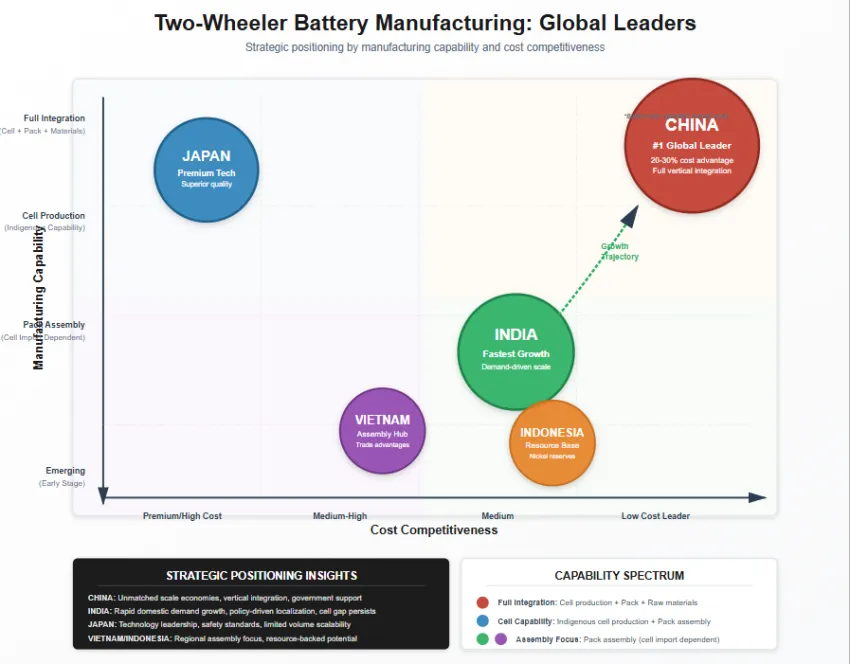
Comparing the five leaders reveals distinct competitive positions and strategic trajectories. China maintains unassailable cost leadership through scale economies, vertical integration, and government support, controlling both cell manufacturing and pack assembly across all battery chemistries. Manufacturing costs remain 20-30% below other markets according to industry assessments, driven by automation, supply chain depth, and processing capacity for critical minerals.
India's rapid growth centers on pack assembly and market size rather than cell production, with cost competitiveness in labor-intensive processes but dependence on imported cells. Japan occupies premium segments with superior technology and safety standards but cannot compete on manufacturing cost or volume production. Vietnam and Indonesia represent emerging players, Vietnam as an assembly hub leveraging trade benefits, Indonesia betting on nickel resources to attract integrated manufacturing. Cell versus pack capability separates leaders: China and Japan possess indigenous cell production, while India, Vietnam, and Indonesia remain predominantly assembly-focused.
Policy strength varies substantially, with China and India offering comprehensive incentive structures, Japan emphasizing research support, and Vietnam and Indonesia providing targeted investment benefits. China's number-one position rests on unmatched scale, cost structure, and vertical integration. India rises fastest through domestic demand growth and policy-driven localization, though technology gaps persist. Japan, Vietnam, and Indonesia occupy specialized niches, premium technology, regional assembly, and resource-backed future potential respectively.
How FMI Can Help
Sources
- Company investor presentations and annual reports from Ola Electric, Ather Energy, CATL, BYD, Panasonic, GS Yuasa, and VinFast accessed through official corporate websites and securities filings
- Government policy documents including India's PLI scheme notifications from Ministry of Heavy Industries, Indonesia's nickel export policies, and China MIIT electric vehicle battery production statistics
- Industry association reports from Society of Indian Automobile Manufacturers (SIAM), China Automotive Battery Innovation Alliance, and Japan Battery Association
- Trade analysis utilizing UN Comtrade database for battery import/export flows and customs data
- Financial and business reporting from Reuters, Nikkei Asia, Financial Times, and specialized electric vehicle trade publications

