


Key Takeaways
- Regulatory scrutiny accelerates substitution away from synthetic antioxidants
- Natural antioxidants introduce formulation and stability trade offs
- Botanical sourcing creates variability in quality and pricing
- Extraction yield and standardisation determine commercial viability
- Application performance matters more than antioxidant potency claims
Why Does Regulatory Pressure Favour Natural Antioxidants Over Synthetic Options?
The regulatory environment surrounding synthetic antioxidants has grown increasingly restrictive, creating a clear pathway for natural alternatives despite their higher costs. Synthetic antioxidants such as butylated hydroxyanisole (BHA), butylated hydroxytoluene (BHT), and tertiary butylhydroquinone (TBHQ) face mounting scrutiny from food safety authorities globally. In October 2023, the European Commission published Regulation 2023/2108, establishing lowered limits for synthetic additives including nitrites and nitrates as part of the Beating Cancer Plan, signaling a broader regulatory shift toward natural preservation systems.
The United States Food and Drug Administration requires premarket authorization for all food additives under the Federal Food, Drug, and Cosmetic Act, whether natural or synthetic. However, the regulatory burden differs substantially in practice. While synthetic antioxidants require extensive toxicological data and face ongoing reassessment, natural alternatives like rosemary extract, tocopherols, and ascorbic acid often qualify for Generally Recognized as Safe (GRAS) status through historical use or self-affirmation pathways. State-level restrictions in the United States on BHA and BHT have further accelerated reformulation timelines, pushing manufacturers toward natural alternatives regardless of cost premiums.
Consumer perception risk compounds regulatory pressure. Food manufacturers face reputational exposure when controversial synthetic preservatives appear on ingredient labels, even when legally compliant. Clean label positioning has transitioned from marketing advantage to baseline expectation in developed regions. European food processors report that retail buyers increasingly mandate natural antioxidant systems as listing requirements, effectively creating commercial mandates that exceed regulatory minimums. This dynamic forces manufacturers to absorb higher ingredient costs rather than risk delisting or consumer backlash.
How Do Performance And Stability Constraints Limit Natural Antioxidant Substitution?
Natural antioxidants deliver inconsistent performance across application environments, creating formulation barriers that synthetic alternatives rarely encounter. Oxidation control efficacy varies substantially based on substrate composition, processing conditions, and storage parameters. Rosemary extract demonstrates strong antioxidant activity in bulk oils but shows reduced efficacy in oil-in-water emulsions due to partitioning effects and pH sensitivity. Carnosic acid and carnosol, the primary active compounds in rosemary, exhibit optimal activity at acidic pH levels but lose effectiveness in neutral or alkaline systems commonly found in dairy and bakery applications.
Heat stability presents another critical constraint. While rosemary extract maintains antioxidant activity up to 200 degrees Celsius, making it suitable for frying applications, other natural antioxidants degrade rapidly under thermal stress. Tocopherols function effectively as primary antioxidants in ambient storage but can act as pro-oxidants at elevated temperatures or in the presence of transition metals. This dual behavior requires careful evaluation of processing parameters and may necessitate synergistic antioxidant blends combining tocopherols with metal chelators like citric acid or rosemary polyphenols.
Solubility and dispersion characteristics differ markedly between natural and synthetic options. Fat-soluble antioxidants like tocopherols and rosemary diterpenes require specialized delivery systems for aqueous applications, adding formulation complexity and cost. Water-soluble options like rosmarinic acid face the opposite challenge in lipid systems. Emulsion-based foods require careful selection and often demand multiple antioxidant types to protect both aqueous and lipid phases. Interaction with other food components further complicates formulation. Natural antioxidants can bind to proteins, reducing their availability and effectiveness. They may also interact with minerals, creating chelation effects that alter both antioxidant performance and nutritional bioavailability.
How Does Raw Material Sourcing Affect Natural Antioxidant Cost And Consistency?
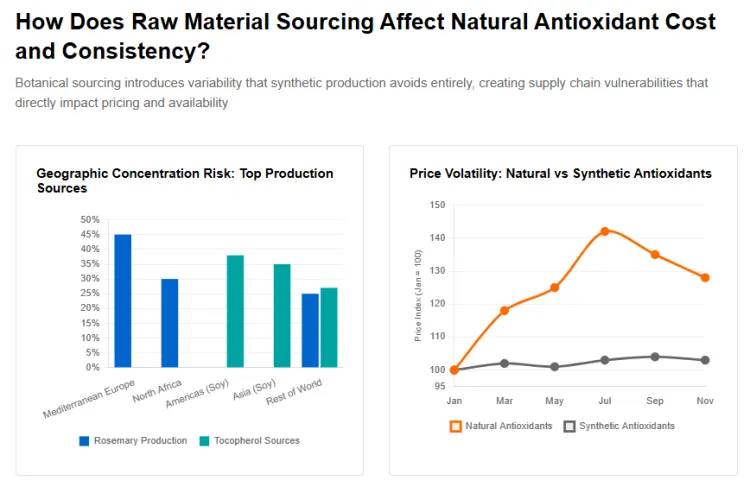
Botanical sourcing introduces variability that synthetic production avoids entirely. Geographic concentration of cultivation creates supply chain vulnerabilities that directly impact pricing and availability. Rosemary production concentrates in Mediterranean Europe and North Africa, while tocopherol sources depend heavily on soybean oil processing in the Americas and Asia. Climate disruptions in key growing regions cause immediate supply shocks. The 2024 ginger production decline in Peru demonstrated how weather-related harvest failures cascade through global botanical supply chains, affecting multiple antioxidant applications simultaneously.
Seasonality compounds sourcing challenges. Unlike synthetic antioxidants manufactured year-round from petrochemical feedstocks, botanical harvests follow agricultural cycles. Peak harvest periods deliver maximum active compound concentrations, but processors must secure annual supply during narrow procurement windows. Off-season purchasing requires premium pricing or acceptance of lower-potency material. This seasonality creates working capital demands and inventory risks absent from synthetic antioxidant procurement.
Botanical variability affects standardised active content even from consistent sources. Growing conditions, harvest timing, and plant genetics all influence the concentration of target compounds like carnosic acid, carnosol, or specific tocopherol homologues. A single rosemary field can produce extracts ranging from 15 to 25 percent total active diterpenes depending on harvest date and processing method. This natural variation requires extensive quality testing and often necessitates blending multiple harvest lots to achieve specification targets. Organic and sustainably sourced certifications add another layer of supply constraint and cost, as certified acreage remains limited relative to conventional production.
Why Do Extraction Technology And Standardisation Define Competitive Advantage?
Extraction methodology determines both the yield of target compounds and the purity of the final antioxidant ingredient. Conventional solvent extraction using ethanol or acetone remains the dominant commercial approach for rosemary and many botanical antioxidants, offering reasonable yields at moderate cost. However, residual solvent concerns and environmental regulations drive interest in alternative technologies. Supercritical carbon dioxide extraction delivers higher-purity extracts with no solvent residues but requires substantial capital investment and operates at higher unit costs. This technology finds application in premium natural antioxidants where clean label positioning justifies price premiums.
Ultrasound-assisted and microwave-assisted extraction represent emerging technologies that can increase yield and reduce processing time compared to conventional methods. Research demonstrates that ultrasound extraction of rosemary waste from essential oil distillation recovers significantly more rosmarinic acid and carnosic acid than traditional approaches, potentially improving the economics of botanical utilization. However, scaling these technologies from laboratory to commercial production presents engineering challenges that limit current adoption.
Standardisation processes separate commodity botanical extracts from commercially viable antioxidant ingredients. Raw botanical extracts contain complex mixtures of active and inactive compounds. Commercial applications demand consistent performance, which requires standardization to defined levels of key actives. Rosemary extracts are standardised to total carnosic acid and carnosol content, typically ranging from 10 to 33 percent depending on application requirements. This standardisation involves concentration steps, potentially including precipitation, chromatography, or dilution with carriers to achieve target specifications.
Tocopherol standardisation follows a different model, focusing on the ratio of alpha, beta, gamma, and delta homologues. Mixed tocopherols extracted from soybean oil deodorizer distillate contain varying ratios of these homologues, each with different antioxidant versus vitamin activity. Processors separate and blend these fractions to create standardised products optimized for either antioxidant function (high delta and gamma content) or vitamin E fortification (high alpha content). This fractionation capability creates differentiation and value in what would otherwise be commodity ingredients.
How Do Application Specific Requirements Segment The Natural Antioxidant Landscape?
Food oils represent the largest application segment for natural antioxidants, where oxidative stability directly determines shelf life and sensory quality. Mixed tocopherols dominate this space due to superior performance in preventing lipid oxidation during storage and their clean label appeal. Delta and gamma tocopherol isomers demonstrate higher antioxidant activity than alpha tocopherol in bulk oil systems, making mixed tocopherol concentrates the preferred choice. Rosemary extract functions synergistically with tocopherols in oil applications, providing additional oxidative protection through its metal chelation properties and different mechanism of action.
Beverage applications present distinct challenges requiring water-soluble or water-dispersible antioxidant systems. Ascorbic acid remains the dominant natural antioxidant in beverages, but formulators increasingly incorporate botanical extracts like green tea polyphenols or rosemary derivatives for additional functionality and marketing appeal. Emulsion stability and pH sensitivity become critical parameters in these applications, as antioxidant effectiveness varies dramatically across the pH range typical of different beverage categories.
Dietary supplements and nutraceuticals prioritize antioxidant potency and bioavailability over preservation function. This segment consumes high-purity tocopherols, concentrated polyphenol extracts, and carotenoids like lycopene and astaxanthin. Standardisation requirements are more stringent, often specifying minimum levels of individual active compounds rather than total antioxidant classes. Encapsulation technologies protect these sensitive actives from degradation and improve bioavailability, adding significant formulation complexity and cost.
Cosmetics and personal care formulations demand antioxidants that function in emulsion systems while providing skin benefits beyond preservation. Tocopherol acetate, a stabilized form of vitamin E, dominates cosmetic applications due to its stability and proven skin penetration. Botanical extracts including rosemary, green tea, and various fruit extracts serve dual roles as antioxidants and marketing-friendly label ingredients. The transition toward clean beauty standards in Europe and North America has accelerated natural antioxidant adoption in this segment despite performance tradeoffs compared to synthetic alternatives like BHT.
Animal nutrition represents an emerging application segment where natural antioxidants protect feed stability while potentially delivering health benefits to livestock. This segment accepts less refined antioxidant forms than human food or supplements, creating opportunities for lower-cost botanical extracts and processing byproducts. However, efficacy requirements remain stringent due to the high polyunsaturated fat content of many animal feeds and the extended storage periods common in agricultural supply chains.
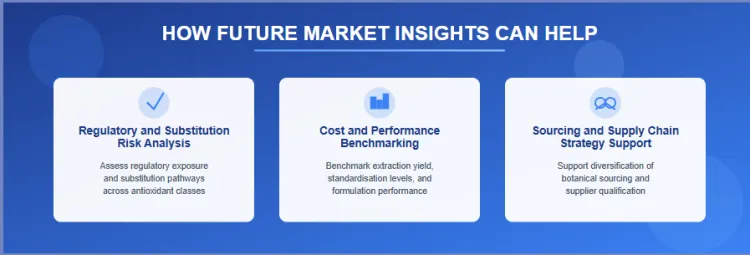
How Future Market Insights Can Help
Bibliography
- Petcu, C.D., Mihai, O.D., Tăpăloagă, D., Gheorghe-Irimia, R.-A., Pogurschi, E.N., Militaru, M., Borda, C., and Ghimpețeanu, O.-M. (2023). Effects of Plant-Based Antioxidants in Animal Diets and Meat Products: A Review. Foods, 12(17), 3176.
- European Commission (2023). Commission Regulation (EU) 2023/2108, Setting New Lowered Limits for Nitrite and Nitrate Food Additives. Published October 6, 2023.
- Irakli, M., Skendi, A., Bouloumpasi, E., Christaki, S., Biliaderis, C.G., and Chatzopoulou, P. (2023). Sustainable Recovery of Phenolic Compounds from Distilled Rosemary By-Product Using Green Extraction Methods: Optimization, Comparison, and Antioxidant Activity. Molecules, 28(18), 6669.

