


Key Takeaways
- Win in the commercial seaweed farming differs between scale and cost efficiency
- China dominates global output through large scale nearshore farming systems
- Southeast Asia supplies low cost biomass for carrageenan and agar chains
- Species choice determines farming method and downstream value
- Processing proximity shapes realised farmgate pricing
Why does China dominate global commercial seaweed farming output?
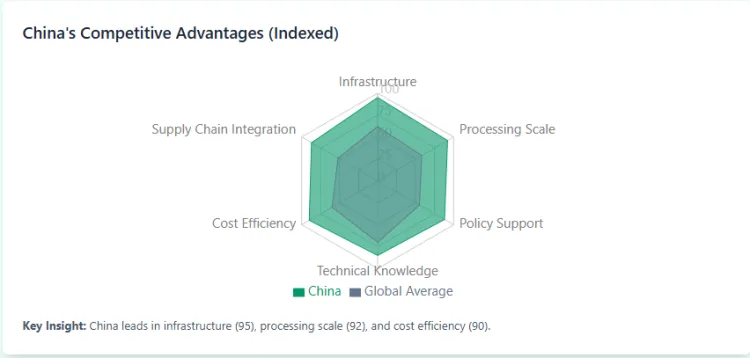
China produces approximately 60 percent of global farmed seaweed by weight, a dominance built on decades of coastal cultivation infrastructure and policy support. Kelp species, particularly Saccharina japonica, and nori cultivation form the core of Chinese production. These brown and red seaweeds serve both direct consumption channels and industrial processing for alginates and food ingredients.
Coastal farming systems in China benefit from established infrastructure and technical knowledge accumulated over generations. Nearshore rope culture systems, anchored to the seabed in shallow waters, enable dense cultivation across extensive coastal areas. Infrastructure investment includes hatcheries for seedling production, offshore anchoring systems, harvesting vessels, and drying facilities positioned near farming zones. This integrated production network supports consistent large scale output.
Government policy actively supports seaweed farming as a coastal economic development tool. Programs provide technical assistance, access to credit, and infrastructure development for coastal communities. Seaweed farming complements fisheries management goals by offering alternative livelihoods and reducing pressure on wild capture fisheries. Rural coastal employment remains a policy priority, and seaweed cultivation provides income with relatively low skill barriers.
Kelp cultivation demonstrates particular efficiency in Chinese systems. Saccharina japonica grows rapidly in cold temperate waters, achieving harvest biomass within 6 to 8 months. Rope culture methods enable high density planting, and mechanised harvesting systems improve labour productivity. China has optimized seedling production, grow out timing, and harvest logistics to maximize annual yield per coastal area.
Nori farming, primarily Pyropia species, targets premium direct consumption channels. Dried nori sheets command substantially higher prices than kelp biomass, creating economic rationale for labour intensive cultivation and processing. Japanese and Korean nori farming techniques have been adopted and scaled in Chinese operations, though product quality and pricing vary with processing standards.
Production scale creates cost advantages in processing and logistics. Large volumes support dedicated drying facilities, milling operations, and extraction plants operating at efficiency scales unavailable to smaller producing regions. Vertical integration between farming, processing, and industrial buyers stabilizes income and reduces transaction costs across the supply chain.
Why do Southeast Asian countries lead in cost efficient seaweed biomass supply?
Southeast Asian nations, particularly Indonesia and the Philippines, dominate production of red seaweeds used for carrageenan extraction. Eucheuma and Kappaphycus species thrive in warm tropical waters and grow well in simple offshore cultivation systems. These countries supply the majority of global carrageenan feedstock, a hydrocolloid used in food processing, pharmaceuticals, and industrial applications.
Labour costs in Southeast Asia remain substantially lower than in China, Japan, or developed economies. Seaweed farming requires significant manual effort for line preparation, seedling attachment, maintenance, and harvest. Lower labour costs enable profitable farming even when biomass prices remain modest. This cost structure positions Southeast Asian producers as preferred suppliers for price sensitive industrial buyers.
Coastal conditions favor year round cultivation. Warm water temperatures and consistent sunlight enable continuous growth cycles without seasonal limitations. Farmers in temperate regions face restricted growing seasons, while tropical producers harvest multiple times annually. This biological advantage increases annual yield per unit of infrastructure investment.
Simple farming systems reduce capital requirements. Basic rope or net structures attached to wooden or bamboo stakes enable seaweed cultivation with minimal investment. Unlike kelp farming requiring offshore anchoring and mechanized harvest, tropical red seaweed farming remains accessible to smallholder farmers with limited capital. This allows rapid capacity expansion when prices incentivize production.
Eucheuma and Kappaphycus species demonstrate tolerance of variable conditions and resistance to common diseases. Hardiness reduces mortality risk and enables farming in areas where more sensitive species would fail. This reliability makes red seaweed farming a dependable livelihood option for coastal communities with few alternative income sources.
However, farmgate pricing remains low relative to labour input. Processing companies dominate supply chains and capture most value from refined carrageenan products. Farmers receive commodity biomass prices with limited ability to negotiate given fragmented production and concentrated buyer power. Cost efficiency at farm level does not translate to farmer prosperity, but it does sustain global competitiveness.
How does species selection define national seaweed farming models?
Brown seaweeds, including kelp and other Laminariales, dominate temperate water farming. These species produce alginates, used as thickeners and stabilizers in food and industrial applications. Brown seaweed farming requires cold water and often involves more capital intensive systems for offshore cultivation. China and South Korea lead brown seaweed production, targeting both food and alginate extraction channels.
Red seaweeds, particularly carrageenophytes and agarophytes, concentrate in tropical and subtropical farming. Eucheuma and Kappaphycus species supply carrageenan extraction, while Gracilaria provides feedstock for agar production. Red seaweed farming generally involves lower capital intensity but remains labour intensive. Southeast Asia dominates red seaweed supply due to suitable biology and labour economics.
Green seaweeds, primarily Ulva species, remain minor in commercial farming despite potential applications. Sea lettuce farming exists at small scale for food, animal feed, and bioremediation applications. Limited processing infrastructure and lower demand constrain expansion. Green seaweed farming may grow if feed applications develop or if policy supports nutrient remediation in coastal waters.
Growth rates determine economic viability. Fast growing species like Saccharina japonica achieve harvest weight in months, enabling rapid capital turnover. Slower growing species require longer cultivation periods, increasing risk from storms, disease, or environmental variability. Biological productivity per unit area and time directly influences farm economics.
Processing requirements shape species choice. Alginates require specific brown seaweed chemistry, and carrageenan extraction depends on particular red seaweed polysaccharides. Farmers select species based on available processing infrastructure and buyer demand. Regions lacking local processing focus on species where dried biomass can be economically transported to distant extraction facilities.
Why does processing integration determine commercial viability in seaweed farming?
Fresh seaweed contains 80 to 90 percent water, making transport economically unfeasible without drying. Proximity to drying facilities critically influences farm profitability. Farmers near processing infrastructure receive better prices and face lower logistical burdens. Those in remote locations must invest in on farm drying or accept lower prices from intermediaries.
Integrated supply chains improve farmer income stability. Contracts with processors provide price certainty and guaranteed offtake, reducing income volatility. Processors gain supply security and quality control, while farmers access credit and technical support. Vertical integration between farming and processing characterizes successful seaweed industries in China and several Southeast Asian operations.
Processing capacity constrains farm expansion. New farming investment requires corresponding processing infrastructure, or expanded output floods regional buyers and depresses prices. Infrastructure development often lags behind potential farming capacity, creating supply chain bottlenecks. Regions with established processing attract more farming investment, while areas lacking infrastructure struggle to commercialize despite suitable coastal conditions.
Quality specifications from processors drive farming practices. Carrageenan yield depends on species strain, cultivation timing, and post harvest handling. Processors enforce quality standards through price differentiation, incentivizing farmers to optimize cultivation and drying methods. Lack of processing sophistication in some regions means farmers receive undifferentiated commodity pricing regardless of biomass quality.
Value addition opportunities depend on processing access. Dried seaweed biomass commands modest prices, while refined hydrocolloids sell at multiples of raw material cost. Processing companies capture most margin in the value chain. Farmer cooperatives or community processing initiatives attempt to capture more value, but capital requirements and technical complexity limit success. Integration determines who profits from seaweed cultivation.
How do policy frameworks and environmental limits shape future seaweed farming expansion?
Coastal space allocation increasingly constrains seaweed farming expansion. Competition from shipping lanes, fishing grounds, conservation zones, tourism, and offshore energy development limits available cultivation areas. Zoning frameworks determine whether seaweed farming can access suitable locations. Countries with supportive marine spatial planning enable expansion, while those without clear frameworks face regulatory uncertainty.
Licensing systems control farm establishment and growth. Some jurisdictions issue permits freely, encouraging rapid expansion. Others impose environmental assessments, limiting licenses to areas with demonstrated carrying capacity. Licensing policy directly influences national production trajectories. Indonesia and Philippines have relatively open access, while countries with stricter coastal management impose tighter controls.
Biosecurity concerns shape regulatory approaches. Disease outbreaks in seaweed cultivation can devastate regional production. Authorities increasingly monitor cultivated species for pathogens and enforce controls on seedling movement. Stricter biosecurity may slow expansion but protects long term industry viability. Historical disease events in Southeast Asian red seaweed farming demonstrate vulnerability of monoculture systems.
Environmental monitoring requirements vary widely. Some regions mandate water quality testing, biodiversity assessments, and cultivation density limits. Others impose minimal oversight. As seaweed farming intensifies, concerns about local nutrient depletion, genetic contamination of wild populations, and habitat modification may drive regulatory tightening. Proactive environmental management protects industry reputation and secures social license.
Offshore farming represents potential expansion pathway. Moving cultivation into deeper, more exposed waters could relieve coastal space pressure and access stronger currents improving growth. However, offshore systems require substantial capital investment in robust infrastructure, specialized vessels, and engineering capability. Offshore farming remains experimental at scale, and whether it can achieve economic viability comparable to nearshore systems is uncertain. Policy support for offshore demonstration projects may accelerate technical development.
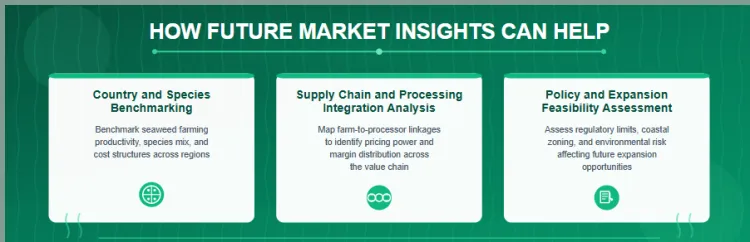
How Future Market Insights Can Help
Sources
- Cottier-Cook, E.J., Nagabhatla, N., and Badis, Y. A Multidisciplinary Assessment of Seaweed Aquaculture for Global Blue Economy Development. Journal of the World Aquaculture Society, Vol. 54, No. 6, pp. 1215-1241, 2023.
- Food and Agriculture Organization. Global Seaweed Production Statistics 2023: Species, Volume and Value Analysis. Rome: FAO Fisheries and Aquaculture Division, 2024.

