


Key Takeaways
- Fish Processing Technology is defined by yield and automation, not volume
- Norway processing systems focus on salmon specific precision and consistency
- High labor cost accelerates robotics and machine vision adoption
- Cold chain control directly determines export pricing and shelf life
- Byproduct recovery materially improves processing economics
Why does Norway set the global benchmark in Fish Processing Technology?
Norwegian salmon aquaculture produces approximately 1.4 million tonnes annually, representing 55 percent of global Atlantic salmon supply. This concentrated production creates scale advantages for processing technology development. Fish arrive at processing facilities with uniform size distribution, consistent fat content and predictable quality characteristics that manual processing in wild catch operations cannot match. Equipment manufacturers develop automation solutions optimised for salmon morphology, knowing Norwegian processors provide reference installations with high volume throughput justifying capital investment.
Labor economics fundamentally shape technology adoption patterns. Norwegian processing wage rates exceed $30 per hour including benefits, creating immediate payback for automation investments that reduce headcount. A manual filleting line requiring 40 workers at $250,000 annual labor cost per position represents $10 million in recurring expenditure. Automated systems costing $5 million to $8 million deliver payback within two to three years through labor reduction alone, before accounting for yield improvements and quality consistency. This labor cost pressure drives continuous equipment innovation absent in regions where manual processing remains economically viable.
Close integration between salmon farmers, processors and equipment manufacturers accelerates technology development. Marel, Baader and Arenco maintain engineering centres in Norway, testing equipment modifications directly with processing customers. Salmon farmers provide feedback on handling requirements to minimise stress and quality loss between harvest and processing. This collaborative ecosystem enables rapid iteration and deployment of new technologies, creating first mover advantages that equipment manufacturers then commercialise globally. Norwegian processors effectively subsidise development costs through early adoption, establishing technical leadership that compounds over successive equipment generations.
How does automation and machine vision improve yield in modern fish processing plants?
Filleting robots equipped with machine vision scan each fish to map skeleton geometry, adjusting blade trajectories to follow bone structure precisely. X ray imaging locates pin bones enabling targeted removal without excessive flesh loss. Traditional manual filleting achieves 58 to 62 percent fillet yield from whole salmon, with variation depending on worker skill and fatigue. Automated filleting systems deliver 64 to 67 percent consistent yield by optimising every cut based on individual fish anatomy rather than standardised techniques. For a processing plant handling 100,000 tonnes annually, a 3 percentage point yield improvement generates 3,000 additional tonnes of saleable product worth $30 million to $40 million at current salmon prices.
Trimming optimisation uses vision systems to identify and remove damaged tissue, bloodlines and off colour areas while preserving maximum saleable flesh. Algorithms calculate optimal trim patterns minimising waste while meeting quality specifications for fresh retail, foodservice or further processing channels. Manual trimming relies on operator judgment, creating inconsistency between shifts and individual workers. Automated trimming delivers uniform results, reducing over trimming that discards sellable product and under trimming that requires downstream rework or downgrades product value.
Grading systems analyse colour, fat content, texture and size to route fillets to optimal value channels. Superior grade fillets command premium pricing for fresh retail distribution while lower grades enter frozen, smoked or canned products at reduced values. Precise grading maximises revenue per kilogram processed by matching product quality to market requirements. Norwegian processors report 8 to 12 percent revenue improvements through advanced grading compared to manual visual assessment, reflecting both better product market matching and reduced misclassification errors that send premium product into lower value channels.
Why is cold chain technology central to value creation in fish processing?
Temperature control from slaughter through processing determines microbial growth rates and enzymatic activity affecting shelf life. Norwegian salmon processors maintain fish between 0 and 2 degrees Celsius throughout primary processing, using plate chillers, ice slurry systems and refrigerated air to extract heat rapidly. This temperature discipline extends fresh salmon shelf life to 14 to 16 days post harvest compared to 7 to 10 days for product experiencing temperature abuse. Extended shelf life enables air freight to distant export destinations including Asia and North America, capturing premium pricing over shorter shelf life competing products.
Precision freezing technology preserves cellular structure and minimises drip loss during thawing. Blast freezers, plate freezers and cryogenic systems freeze salmon fillets to negative 18 degrees Celsius within 2 to 4 hours, creating small ice crystals that limit cell membrane damage. Slow freezing or temperature fluctuations during storage form large ice crystals that rupture cells, releasing moisture and reducing fillet weight and texture quality upon thawing. Norwegian processors invest $2 million to $5 million in advanced freezing systems to protect product value for frozen export channels, accepting higher capital cost to maintain pricing premiums over lower quality frozen imports.
Continuous temperature monitoring through RFID sensors and data loggers provides traceability and quality assurance documentation required by export regulations. European Union and Japanese import requirements mandate verified temperature history from processing through retail distribution. Automated monitoring systems record and transmit temperature data continuously, alerting managers to deviations requiring corrective action. This documentation supports premium pricing by assuring buyers of cold chain integrity, differentiating Norwegian product from origins lacking comprehensive temperature verification. Compliance infrastructure costs add $500,000 to $1 million per facility but enable access to highest value export channels worth $2 to $4 per kilogram price premiums.
How does byproduct processing technology change overall plant economics?
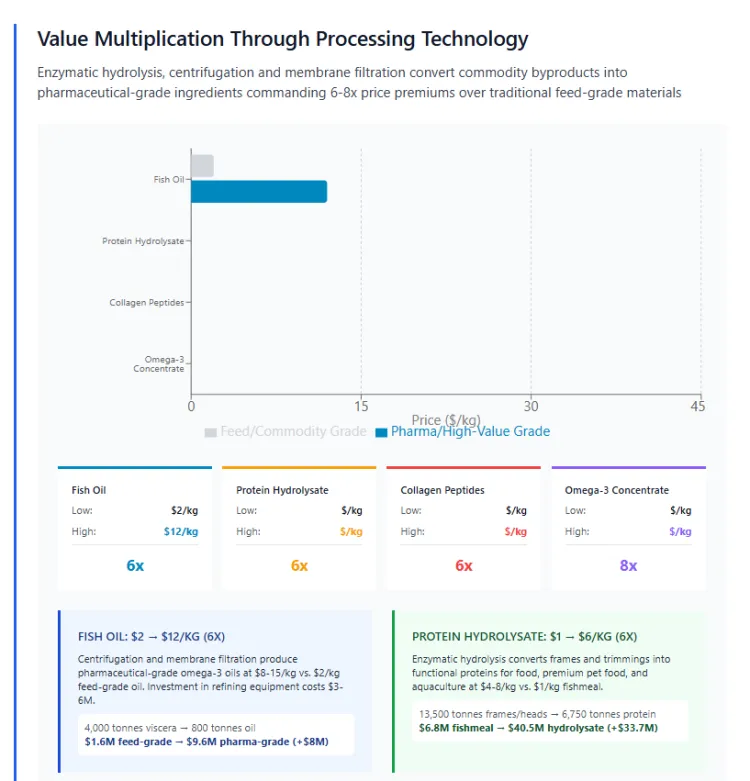
Salmon heads, frames, viscera and skins represent 35 to 40 percent of whole fish weight, historically discarded or sold as low value animal feed. Modern Norwegian processing facilities integrate enzymatic hydrolysis systems that convert byproducts into fish oil, protein hydrolysates and collagen peptides for nutraceutical and cosmetic applications. A processing plant handling 50,000 tonnes of salmon generates 18,000 to 20,000 tonnes of byproducts. Converting these materials into high value ingredients generates $15 million to $25 million additional revenue compared to disposal or commodity feed sales.
Fish oil extraction uses centrifugation and membrane filtration to produce pharmaceutical grade omega 3 oils commanding $8 to $15 per kilogram compared to $2 per kilogram for feed grade oil. Investment in refining equipment costs $3 million to $6 million but transforms waste into profit centre within 2 to 3 years. Norwegian processors license technology to equipment manufacturers who then commercialise systems globally, creating intellectual property revenue streams beyond direct processing margins. This technology development model depends on initial high value byproduct volumes justifying development investment that manual processing operations cannot support economically.
Protein recovery systems hydrolyse frames and trimmings into functional proteins for food applications, pet food premiumisation and aquaculture feed. These hydrolysates sell for $4 to $8 per kilogram compared to $1 per kilogram for fishmeal. Enzyme technology development, process optimisation and market development require sustained investment that Norwegian processors fund through salmon processing margins. Smaller processors in other regions lack scale to justify dedicated byproduct processing infrastructure, limiting their ability to capture these additional value streams and perpetuating reliance on lower margin commodity processing models.
Why do other high volume processing countries lag in technology depth?
Asian processing centres in China, Thailand and Vietnam handle larger absolute volumes across diverse species but face fundamentally different economics. Labor costs of $3 to $8 per hour make manual processing economically optimal for many applications. A processing line requiring 50 workers costs $150,000 to $400,000 annually in labor, substantially below automated equipment capital expenditure of $5 million to $10 million. Without Norway labor cost pressure, automation payback extends beyond 10 years for many processing steps, failing investment return thresholds.
Species diversity complicates automation justification in multi species processing facilities. A plant handling tuna, shrimp, tilapia and mixed whitefish requires flexible processing capability that manual labor provides naturally. Automated systems optimised for specific species morphology cannot economically adapt to variable raw material. Norwegian processors benefit from salmon monoculture enabling species specific automation without compromising facility utilisation. Asian processors face technology adoption barriers from species mix that Norwegian salmon focus avoids entirely.
Export quality requirements vary by destination, with some channels accepting lower processing standards at discounted pricing. Norwegian processors target premium fresh and frozen retail channels in European Union, United States and Japan requiring highest quality and traceability standards. Asian processors serve broader channel mix including lower value institutional and industrial segments accepting manual processing quality. Without uniform quality requirements driving all production toward premium specifications, automation investment cannot justify across full product portfolio, limiting adoption to highest value processing lines serving premium export destinations.
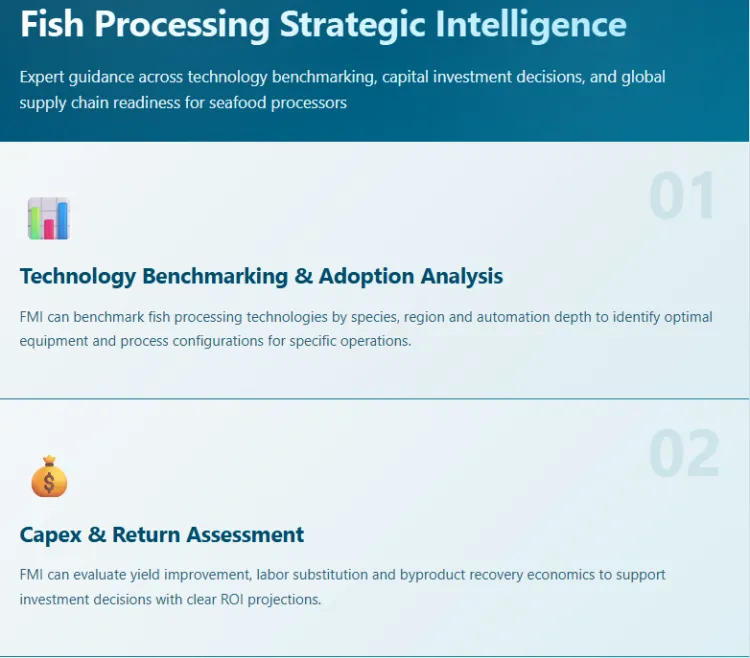
How Future Market Insights Can Help
Sources
- Marel hf. (2024). Salmon processing solutions: Automated filleting, grading and portioning systems technical documentation. Marel hf.
- Nofima AS. (2024). Byproduct valorisation in salmon processing: Technologies for fish oil, protein hydrolysates and bioactive compounds. Nofima Norwegian Institute of Food, Fisheries and Aquaculture Research.
- Food and Agriculture Organization. (2024). The state of world fisheries and aquaculculture 2024. FAO.

