


Key Takeaways
- Smart mining focuses on measurable output per tonne rather than digital novelty
- Autonomous equipment reduces safety risk and labour intensity
- Real time data improves ore recovery and asset utilisation
- Connectivity and interoperability determine deployment success
- Capital discipline favours scalable and modular digital systems
How does smart mining improve productivity across extraction, hauling and processing stages?
Autonomous drilling systems increase drill pattern precision and operating hours compared to manual operations. Surface drill rigs equipped with automated positioning and depth control achieve 20 to 30 percent higher utilisation by operating during shift changes, meal breaks and periods when manual operation would cease due to dust or visibility constraints. Blast hole positioning accuracy improves by 15 to 25 percent, optimising explosive placement and reducing ore dilution during blasting. Underground development drilling benefits similarly, with remote operated jumbos delivering consistent advance rates while removing operators from active headings.
Autonomous haulage systems represent the largest productivity gain in surface mining operations. Fleets of driverless trucks operating 24 hours per day achieve 15 to 20 percent higher payload utilisation and 10 to 15 percent lower fuel consumption compared to crewed fleets. Elimination of shift handovers, fatigue related speed variations and inconsistent loading practices creates measurable throughput improvement. Rio Tinto reports approximately 15 percent lower operating costs per tonne moved using autonomous haul trucks across Pilbara iron ore operations. These gains compound at scale, with 100 truck autonomous fleets delivering tens of millions of dollars in annual savings.
Predictive maintenance systems reduce unplanned downtime through sensor monitoring and analytics. Vibration analysis, thermal imaging and lubricant condition monitoring detect bearing failures, hydraulic leaks and component wear before catastrophic failure occurs. Maintenance teams receive advance notice enabling planned repairs during scheduled shutdowns rather than emergency response. Caterpillar and Komatsu report 20 to 35 percent reductions in unplanned maintenance events for mining equipment operating with connected monitoring systems. This availability improvement translates directly to higher annual production from installed asset base without capital expenditure.
Why is worker safety a primary driver of smart mining investment?
Remote operations eliminate personnel from high risk environments. Underground operations expose workers to ground instability, ventilation challenges and mobile equipment interaction risks. Remote operated loaders, muckers and transport vehicles keep operators in surface control rooms hundreds of metres from active mining faces. Surface operations similarly benefit, with autonomous trucks removing drivers from fatigue intensive roles and reducing light vehicle interaction hazards. BHP reports 30 to 40 percent reductions in safety incident exposure hours through automation deployment across Australian iron ore and coal operations.
Collision avoidance systems prevent equipment interactions that historically caused severe injuries and fatalities. Proximity detection warns operators when personnel or vehicles enter equipment blind spots. Automatic braking intervenes when sensors detect imminent collision risk. These systems become mandatory in many jurisdictions, with adoption driven by regulatory compliance as much as voluntary safety improvement. South African, Australian and North American mining regulations increasingly require proximity detection and collision avoidance capability on mobile equipment operating in underground and surface environments.
Environmental monitoring and real time hazard detection improve response to atmospheric and geotechnical risks. Continuous gas monitoring in underground operations triggers ventilation adjustments or evacuation protocols when methane, carbon monoxide or oxygen depletion reach threshold levels. Slope stability radar and ground penetrating sensing provide early warning of wall failures in open pit operations. These systems reduce exposure to catastrophic events that manual monitoring cannot detect reliably. Vale implemented real time geotechnical monitoring following Brumadinho tailings dam failure, illustrating how safety drivers accelerate digital adoption following major incidents.
How do data platforms and analytics change ore recovery and operational decision making?
Sensor integration across drilling, blasting, excavation and processing creates unified data flows enabling optimisation across production stages. Grade control sensors on excavators provide real time ore body delineation, directing material to appropriate processing streams or waste dumps. This immediate feedback reduces ore loss and dilution compared to delayed assay results from laboratory analysis. Newmont reports 2 to 4 percent improvements in gold recovery through sensor based grade control at several operations, translating to millions of dollars annually at current metal prices.
Digital twin models combine geological data, equipment telemetry and process parameters to simulate operational scenarios before implementation. Mine planners test extraction sequences, equipment assignments and processing configurations virtually, identifying optimal approaches without physical trial and error. Anglo American uses digital twin technology to optimise underground scheduling and ventilation design, reducing energy consumption and improving development productivity. These models continuously update with actual performance data, maintaining accuracy as mining progresses through changing geological conditions.
Predictive analytics enable proactive decision making rather than reactive management. Machine learning algorithms analyse historical equipment performance, ore characteristics and processing conditions to forecast throughput constraints, quality variations and maintenance requirements. Operators receive advance notice of emerging issues, adjusting plans before problems impact production. Freeport McMoRan applies analytics driven scheduling at copper concentrators, improving mill availability and metal recovery through optimised feed blending and reagent dosing based on predicted ore behaviour.
Why do connectivity and interoperability determine smart mining success?
Private wireless networks provide reliable communications in underground and remote surface operations where commercial cellular coverage is absent. LTE and 5G networks deployed by mining companies support autonomous equipment control, video streaming for remote operations and real time sensor data transmission. Infrastructure investment for private networks ranges from $10 million to $50 million depending on mine size and geography. This capital requirement represents a threshold barrier, with connectivity often determining whether advanced automation can deploy regardless of equipment capability.
Edge computing reduces latency for time critical automation functions. Autonomous haulage requires millisecond response times that cloud processing cannot deliver reliably over satellite or long distance fibre connections. Local processing infrastructure at mine sites handles real time control while aggregating data to central systems for analytics and long term storage. This hybrid architecture balances processing requirements with bandwidth constraints, particularly for remote operations in Australia, Canada and South America where terrestrial connectivity remains limited.
Equipment interoperability challenges arise when mines operate mixed fleets from multiple vendors. Caterpillar, Komatsu, Hitachi and Liebherr equipment use proprietary control systems and communication protocols. Integrating autonomous and conventional equipment from different manufacturers requires middleware platforms and custom interfaces. Standardisation efforts through organisations like the Global Mining Guidelines Group progress slowly, leaving operators to manage integration complexity. This interoperability friction slows deployment and increases implementation cost, favouring single vendor approaches despite desire for competitive equipment sourcing.
How do cost structure and capital discipline shape smart mining deployment strategies?
Staged automation allows mines to implement systems incrementally rather than requiring full site transformation. Initial investments focus on highest value applications such as haul truck automation or primary crusher optimisation. Subsequent phases add complementary systems as operational experience validates performance and return on investment. This phased approach reduces capital risk and allows workforce adaptation while building technical capability progressively. Fortescue Metals Group deployed autonomous haulage across multiple sites over five years, expanding from pilot programs to full fleet conversion as confidence and cost justification strengthened.
Return on capital expectations vary by commodity price environment and company financial position. Base metal producers facing margin pressure prioritise cost reduction applications with rapid payback periods of two to four years. Precious metal operations with stronger margins tolerate longer payback for safety and geological systems delivering incremental production rather than direct cost savings. These return thresholds determine technology selection, with proven autonomous haulage systems preferred over emerging artificial intelligence applications with less certain value delivery.
Retrofit deployment versus greenfield integration reflects installed base economics. Existing mines evaluate smart systems based on remaining mine life and compatibility with current infrastructure. Sites with 10 plus year reserves justify substantial automation investment. Shorter life operations focus on lower capital retrofit solutions or defer digital spending. Greenfield projects integrate automation from design phase, optimising pit layouts, communication networks and maintenance facilities for autonomous equipment. This creates performance advantages over retrofit installations constrained by legacy infrastructure decisions made before automation became viable.
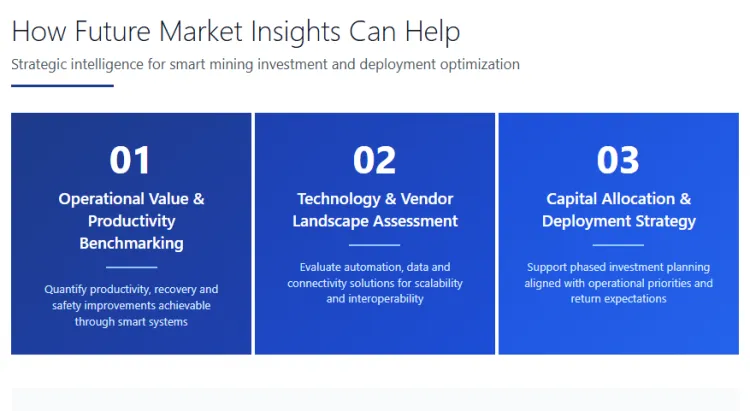
How Future Market Insights Can Help
Sources
- Rio Tinto plc. (2024). Mine of the Future: Autonomous haulage and operations centre performance review. Rio Tinto plc.
- BHP Group Limited. (2023). Integrated remote operations centres: Safety and productivity outcomes from automation deployment. BHP Group Limited.
- Caterpillar Inc. (2024). Cat MineStar system: Autonomous haulage, fleet management and analytics documentation. Caterpillar Inc.

